


The right starting weight for a drop set is 70 to 80 percent of your one-rep max (1RM) — heavy enough to reach muscle failure within 8 to 12 reps, but not so heavy that your form breaks down before you get there. If you don’t know your 1RM, a simpler rule works just as well: pick a weight you can lift with good form for 10 reps, but couldn’t do an 11th.
Getting this wrong is more common than people think. Too heavy and you burn out after three reps, leaving nothing for the drops. Too light and the drops become easy sets. You’re not pushing past muscle failure, you’re just lifting weights.
A drop set only works the way it’s supposed to when the technique is executed correctly, and that starts with picking the right load.
- What Does the Right Starting Weight for a Drop Set Actually Mean?
- How Do You Find Your Starting Weight If You Don't Know Your 1RM?
- Starting Weight by Goal — Quick Reference
- How Does Your Starting Weight Affect How Much to Drop Between Sets?
- What Mistakes Tell You Your Starting Weight Is Wrong?
- Does the Right Starting Weight Change for Different Exercises?
- How Does Your Drop Set Starting Weight Connect to Progressive Overload?
- Frequently Asked Questions
What Does the Right Starting Weight for a Drop Set Actually Mean?
It means picking a load that gets you to genuine muscle failure — not quitting because it’s hard, but because your muscle physically cannot complete another rep with proper form. That’s your target. For most exercises, that lands between 70 and 80 percent of your one-rep max.
At that range, you’ll hit failure somewhere between 8 and 12 reps, which is the sweet spot for hypertrophy — the muscle growth response that drop sets are primarily used to trigger.
The 70-80% range isn’t arbitrary. Research published in the Journal of Strength and Conditioning Research consistently shows that loads in this range produce the greatest stimulus for muscle fiber recruitment and metabolic stress, both of which drive growth.
This drop set weight percentage also determines which muscle fibers you’re targeting — loads above 70% of 1RM recruit fast-twitch muscle fibers, the ones most responsible for size and strength gains. Go above 85% and the neurological demand becomes too high to sustain across multiple drops.
Drop below 65% and you’re primarily training slow-twitch endurance fibers, not the ones that drive hypertrophy.
How Do You Find Your Starting Weight If You Don’t Know Your 1RM?
Use the 10-rep test. Load a weight you can lift 10 times with clean form. If you finish all 10 and feel like you had 3 or 4 more reps left, go heavier. If the last two reps were grinding and shaky but your form held, that’s your starting weight.
Failure means your muscle gave out, not your technique. If your back rounds on a row or your elbows flare on a curl before you hit failure, the weight is too heavy. Reduce it and retest.
More experienced lifters use reps in reserve (RIR) instead: pick a weight that leaves you with 0 to 1 reps in reserve. Zero RIR means the next rep would fail with clean form. Both methods land in the same place — use whichever gives you a clearer read.
For machines, adjust the pin and retest quickly. For dumbbells, start one increment below your normal working weight. That buffer gives you enough headroom to reach true failure on the first set without burning out before the drops begin.
Starting Weight by Goal — Quick Reference
Your starting weight also depends on what you’re actually training for. Drop sets aren’t one-size-fits-all:
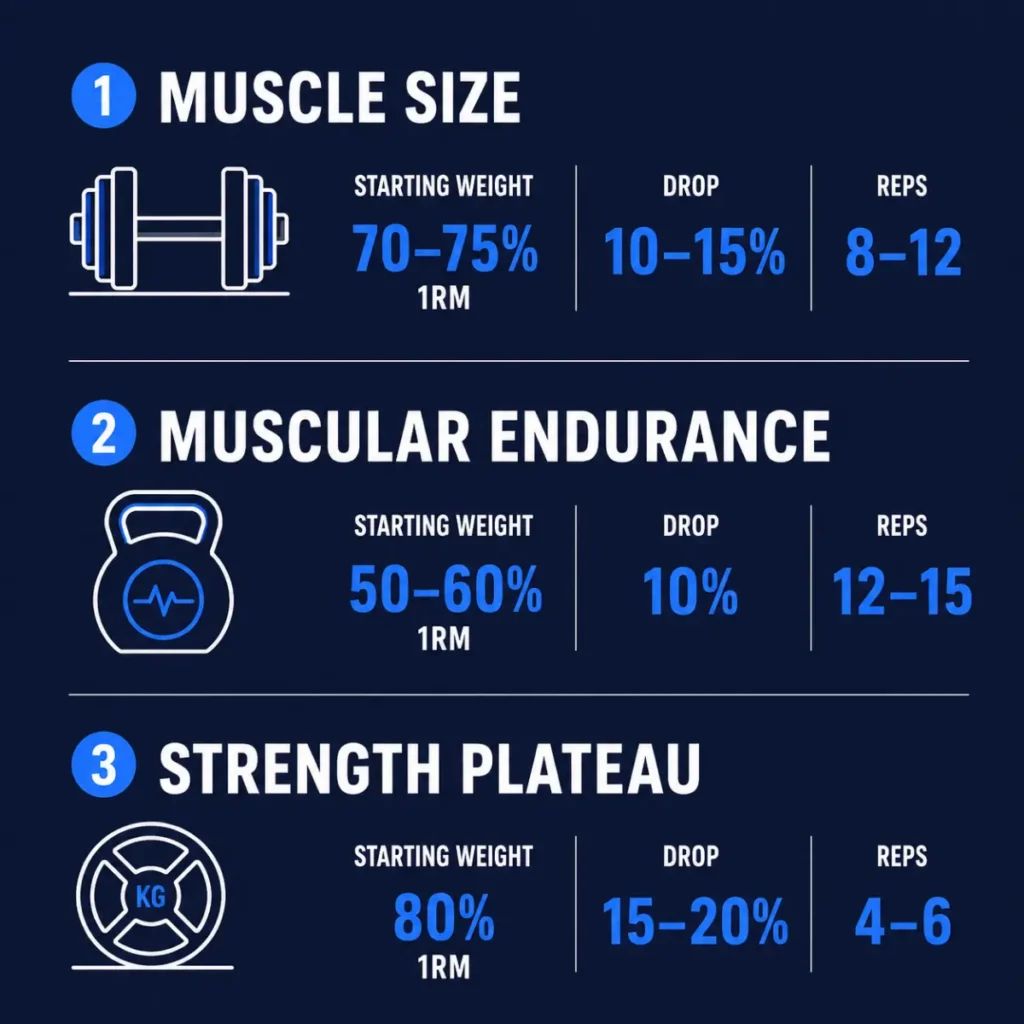
| Your Goal | Starting Weight | Drop Amount | Reps Per Drop |
| Muscle size (hypertrophy) | 70-75% of 1RM | 10-15% each drop | 8-12 reps |
| Muscular endurance | 50-60% of 1RM | 10% each drop | 12-15 reps |
| Strength plateau busting | 80% of 1RM | 15-20% each drop | 4-6 reps |
If you’re new to tracking percentages, understanding how your rep ranges connect to training goals helps you pick the right load from the start, without guessing.
How Does Your Starting Weight Affect How Much to Drop Between Sets?
Drop 10 to 15 percent of the weight between each set. If you start at 50 pounds, your next drop is 42 to 45 pounds, then 36 to 40 pounds. That range keeps each set challenging without killing your rep count.
Dropping too much, say 30 to 40 percent, turns your later sets into warm-up territory. You’re no longer pushing past failure; you’re just doing extra light reps that don’t add meaningful stimulus.
The goal is to reach failure again within a similar rep range on each drop. If your first set gets you 10 reps and your next drop gets you 3, you over-dropped. If the next set gets you 15 comfortable reps, you under-dropped. Each drop should feel hard. You should reach failure, or close to it, on every set.
For exercises like dumbbell curls or lateral raises where increments jump by 5 pounds, you may need to drop two increments to get a meaningful reduction. For cable machines, single-plate drops (usually 5 to 10 pounds) tend to be more precise and controllable, which is one reason isolation exercises on machines are better suited to drop sets than free-weight compound movements.
What Mistakes Tell You Your Starting Weight Is Wrong?
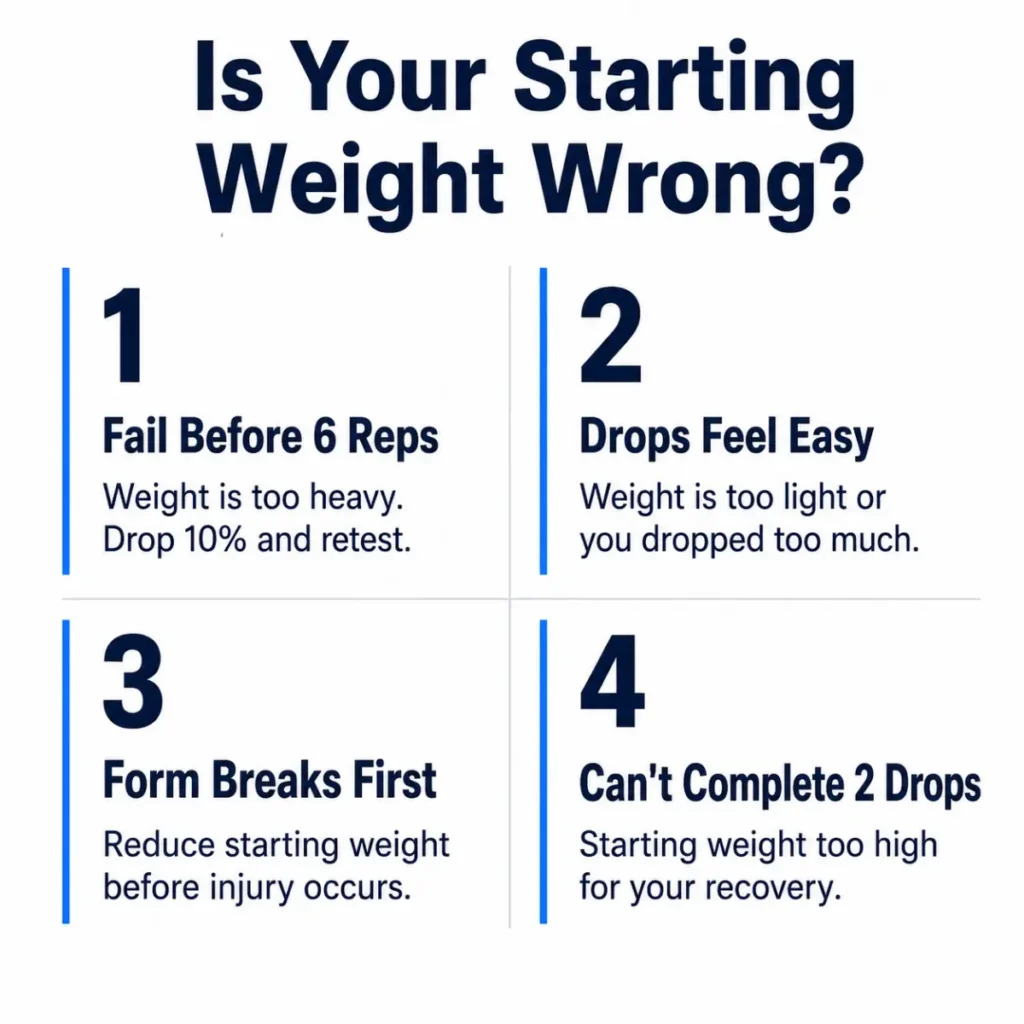
You fail too early on the first set
If you reach failure before 6 reps, the weight is too heavy for a drop set. You’ve burned out your muscle too quickly to get meaningful volume from the drops. Reduce your starting weight by 10 percent and retest.
Your drops feel easy
If the second or third set feels like a warm-up, you didn’t start heavy enough, or you dropped too much weight between sets. A correctly chosen starting weight should make every drop feel challenging by the time you reach failure.
Your form breaks before your muscle does
Form failure before muscle failure means the weight is too heavy. This is especially common on compound movements, which is why drop sets work best on isolation exercises where one muscle group is the clear limiting factor. If you’re finding form breakdown is consistent, consider switching to a machine variation of the same movement.
You can’t complete two full drops
A proper drop set has two to three drops after the initial set, a guideline supported by the National Academy of Sports Medicine (NASM), which notes that performing more than three drops shows no demonstrated additional benefit.
If you’re too fatigued to continue past one drop, your starting weight was too high relative to your current recovery capacity. How you manage total weekly volume per muscle group directly affects how much you have left for drop sets at the end of a session.
Does the Right Starting Weight Change for Different Exercises?
Yes, significantly. The 70-80% of 1RM guideline applies most cleanly to single-joint isolation exercises: bicep curls, tricep pushdowns, lateral raises, leg extensions. For these, the target muscle is clearly the limiting factor and you can push it to genuine failure safely.
For compound movements like bench press, barbell row, or squat, drop sets are harder to execute safely and are generally not recommended as a regular technique. When you reach failure on a heavy compound lift, your stabilizers and secondary muscles are also fatigued.
Dropping the weight and continuing raises your injury risk significantly, especially without a spotter. If you want to apply the drop set principle to compound movements, machine versions, like a chest press machine or a cable row, give you the same muscle stimulus with far better control.
Drop sets also pair well with pyramid set structures when you’re building toward peak intensity in a session — the descending weight pattern shares similar logic, though pyramid sets include full rest between sets and drop sets do not.
How Does Your Drop Set Starting Weight Connect to Progressive Overload?
Your drop set starting weight should increase over time, the same way your regular working weights do. If you started drop sets on dumbbell curls at 30 pounds and now you can consistently hit failure at 12 reps with clean form, move up to 35 pounds.
The principle is the same as standard training: your muscle adapts, and you need to increase the demand to keep stimulating growth.
This is where many lifters stall. They find a drop set protocol that feels hard, stick with it for months, and wonder why they’ve stopped making progress. The starting weight in a drop set isn’t fixed. It should follow the same progressive overload logic that governs all effective resistance training — gradual, trackable increases that force continued adaptation.
Track your drop set starting weights the same way you track your working sets. Write down the weight, reps per drop, and how close to failure each set felt. When a given starting weight becomes manageable across two to three sessions, it’s time to move up.
Frequently Asked Questions
What is the right starting weight for a drop set?
Start at 70 to 80 percent of your one-rep max, which typically allows 8 to 12 reps before muscle failure. If you don’t know your 1RM, use a weight you can lift for 10 reps with clean form but couldn’t do an 11th.
How much weight should you drop between drop sets?
Drop 10 to 15 percent of the weight between each set. This keeps the load challenging enough to reach failure again within a similar rep range, without making the later sets feel like a warm-up.
Can you do drop sets with compound exercises like squat or bench press?
It’s not recommended. When you reach failure on heavy compound lifts, stabilizers and secondary muscles are also fatigued, which raises injury risk significantly during drops. Machine versions of compound movements are a safer alternative.
How do you know if your drop set starting weight is too heavy?
If you reach muscle failure before 6 reps on your first set, or if your form breaks down before your muscle gives out, the weight is too heavy. Reduce by 10 percent and retest before your next session.
Pick your starting weight using the 10-rep test, keep drops between 10 and 15 percent, and track what you’re lifting the same way you would any working set. Once a starting weight stops feeling like a challenge across two or three sessions, move up.
That’s the whole system. Your next step is choosing the right exercise to run a drop set on — isolation movements on machines give you the most control and the cleanest path to failure, which is exactly where you want to be.
