

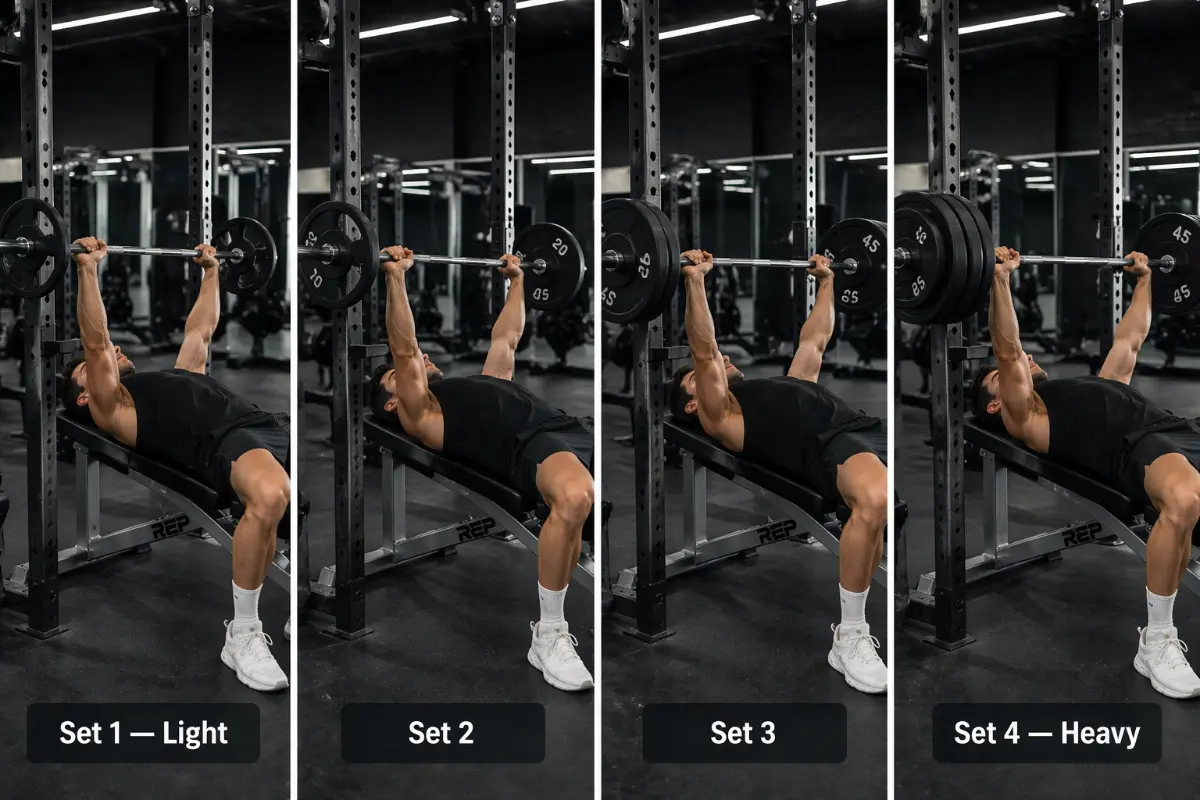
Pyramid sets are a resistance training method where you change the weight and reps from one set to the next — either going heavier with fewer reps, lighter with more reps, or both within the same exercise. The name comes from the shape the loading pattern forms when graphed: a pyramid.
The technique has been around since the 1940s, rooted in the DeLorme protocol — a progressive resistance system developed by Dr. Thomas DeLorme to rehabilitate injured soldiers after World War II. His original structure — 3 sets of 10 reps at 50%, 75%, and 100% of a 10-rep max — is the ancestor of every pyramid variation used in gyms today.
What makes pyramid training different from straight sets (where weight and reps stay constant) is that it forces your muscles to work across multiple rep ranges and intensities in a single exercise. One session covers strength, hypertrophy, and endurance territory instead of camping in one zone.
- Why pyramid sets work — the physiology
- The 5 types of pyramid sets
- Which pyramid type should you use?
- How to load your pyramid — 1RM percentage guide
- Pyramid sets examples — exercise by exercise
- Pyramid sets vs straight sets — what the research says
- Benefits of pyramid training
- When NOT to use pyramid sets
- Common mistakes
- Sample pyramid workout — upper body
- Frequently asked questions
Why pyramid sets work — the physiology
Three things happen inside your muscles during a pyramid that don’t happen with straight sets.
Mechanical tension increases as the load rises each set. Heavier weight places greater stress on muscle fibers, causing micro-tears at the cellular level. The body repairs those tears by rebuilding the tissue thicker and stronger — the process behind muscle hypertrophy.
Metabolic stress builds during the higher-rep sets. The deep burn from lactate and metabolic byproducts signals the body to increase muscle protein synthesis. This is why the lighter sets in a pyramid aren’t wasted — they serve a growth function that heavy sets alone don’t fully trigger.
Neuromuscular activation ramps up progressively through the ascending sets. Lighter loads wake up the communication pathway between your brain and your muscles — recruiting more motor units with each set. By the time the heaviest load arrives, more fast-twitch fibers are already online, making the peak set both safer and more productive. A 2021 peer-reviewed analysis of pyramidal loading published in Sports (MDPI) confirmed that structural variation in loading is necessary to prevent stagnation in trained individuals.
The relationship between your central nervous system and different rep ranges goes deeper than most training guides cover. If you want to understand why low reps build strength differently than high reps at the neural level, read how your CNS responds to different rep ranges.
The 5 types of pyramid sets
Not all pyramids are built the same. Each type creates a different training stimulus, and the right choice depends on your goal.
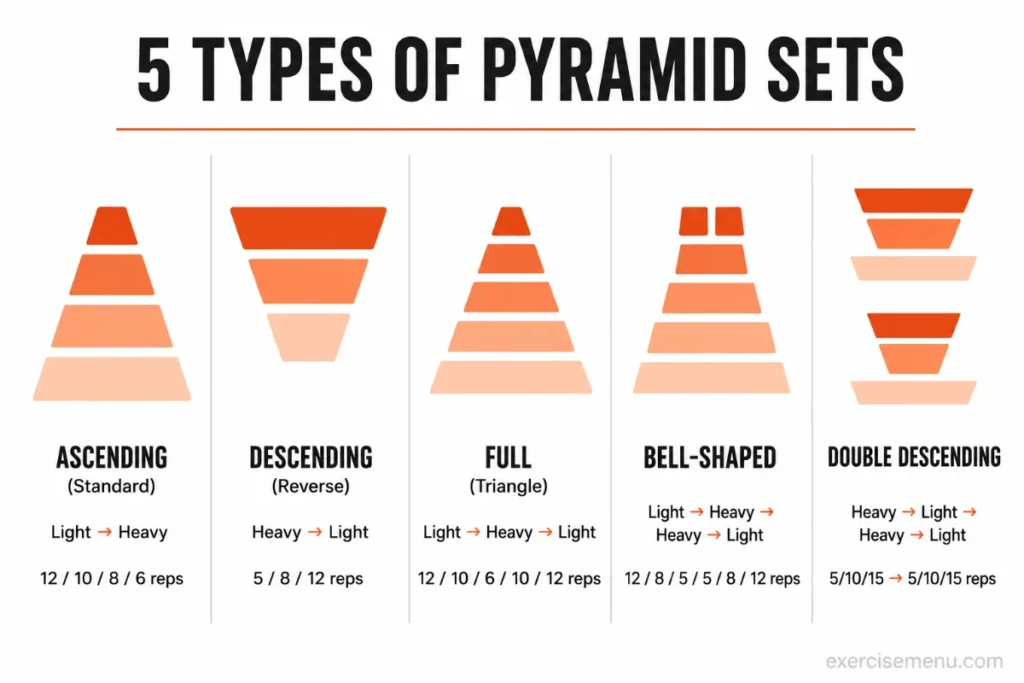
1. Ascending (standard) pyramid
You start light with higher reps and increase the weight while decreasing reps each set. The classic structure most people think of when they hear “pyramid training.”
| Set | Weight (% of 1RM) | Reps |
|---|---|---|
| 1 | 50% | 12 |
| 2 | 65% | 10 |
| 3 | 75% | 8 |
| 4 | 85% | 6 |
Best for: Hypertrophy, beginners, and anyone who wants a built-in warm-up before heavier work. The lighter opening sets prepare your joints, lubricate your connective tissue, and prime your central nervous system before the load gets serious.
Rest periods: 2–3 minutes between sets.
2. Descending (reverse) pyramid
You flip the structure — heaviest weight first, lightest last. This means your most demanding set happens when your muscles and nervous system are freshest.
| Set | Weight (% of 1RM) | Reps |
|---|---|---|
| 1 | 90% | 4–6 |
| 2 | 80% | 8 |
| 3 | 70% | 10–12 |
Best for: Strength. If your primary goal is moving the heaviest weight possible, the reverse pyramid delivers — you hit peak output before fatigue accumulates. Research published in the Journal of Sports Science and Medicine (Drinkwater et al.) found that training with maximal intensity early in a session enhances overall performance and total training volume over time. Motor unit recruitment and neural drive are highest in the first working set — which is exactly where a reverse pyramid places the heaviest demand.
Rest periods: 3–5 minutes between sets (heavier loads demand longer recovery).
Critical note: Reverse pyramids require thorough warm-up sets before your first working set. Jumping straight to 90% of your max without ramping up is asking for injury. Two to three warm-up sets at 50–70% prepare the pathway.
3. Full (triangle) pyramid
The full pyramid combines ascending and descending in one continuous sequence — you work up to your heaviest set, then strip weight back down.
| Set | Weight (% of 1RM) | Reps |
|---|---|---|
| 1 | 50% | 12 |
| 2 | 65% | 10 |
| 3 | 80% | 6 |
| 4 | 65% | 10 |
| 5 | 50% | 12 |
Best for: Total training volume and fat loss. The full triangle nearly doubles the volume of a standard ascending or descending pyramid. For advanced lifters, the descending portion becomes an opportunity to push AMRAP sets — as many reps as possible — with lighter weight after the nervous system has been primed by the heavy peak set.
Rest periods: 2–4 minutes. Shorter on the way down as the load decreases.
4. Bell-shaped pyramid
Similar to the full pyramid but with a longer peak phase. Instead of hitting one heavy set at the top and immediately descending, you hold the heavy weight for two consecutive sets before coming back down.
| Set | Weight (% of 1RM) | Reps |
|---|---|---|
| 1 | 70% | 12 |
| 2 | 80% | 8 |
| 3 | 90% | 5 |
| 4 | 90% | 5 |
| 5 | 80% | 8 |
| 6 | 70% | 12 |
Best for: Lifters who want both strength exposure and volume. The double heavy set at the top provides more time under maximal load than a standard triangle, while the descending sets accumulate hypertrophy volume.
5. Double descending pyramid
Two full descending cycles performed back-to-back within one exercise.
| Set | Weight (% of 1RM) | Reps |
|---|---|---|
| 1 | 90% | 5 |
| 2 | 80% | 10 |
| 3 | 70% | 15 |
| 4 | 90% | 5 |
| 5 | 80% | 10 |
| 6 | 70% | 15 |
Best for: Advanced lifters chasing both strength and muscular endurance in one session. The second cycle forces you to produce near-maximal effort under accumulated fatigue — a different stimulus than the fresh first cycle.
Which pyramid type should you use?
This is where most articles stop — they list the types and leave you to figure out which one fits. Here’s the breakdown by goal:
| Your goal | Best type | Why |
|---|---|---|
| Strength (1–5 rep max) | Reverse pyramid | Heaviest load when freshest — max neural drive |
| Muscle growth (hypertrophy) | Ascending or full pyramid | Multiple rep ranges, higher volume, built-in warm-up |
| Fat loss | Full pyramid | Highest total volume per session, elevated heart rate throughout |
| Muscular endurance | Ascending with high-rep base | Start at 15+ reps, build toward moderate weight |
| Beginner | Ascending only | Natural warm-up, lightest weight first, form stays clean |
| Short on time (30 min) | Reverse (3–4 sets) | Fewer total sets, heaviest work done early |
How to load your pyramid — 1RM percentage guide
One of the most common programming errors with pyramid training is starting too heavy. If Set 1 is already a grind, there’s no room to build — the structure collapses before it delivers.
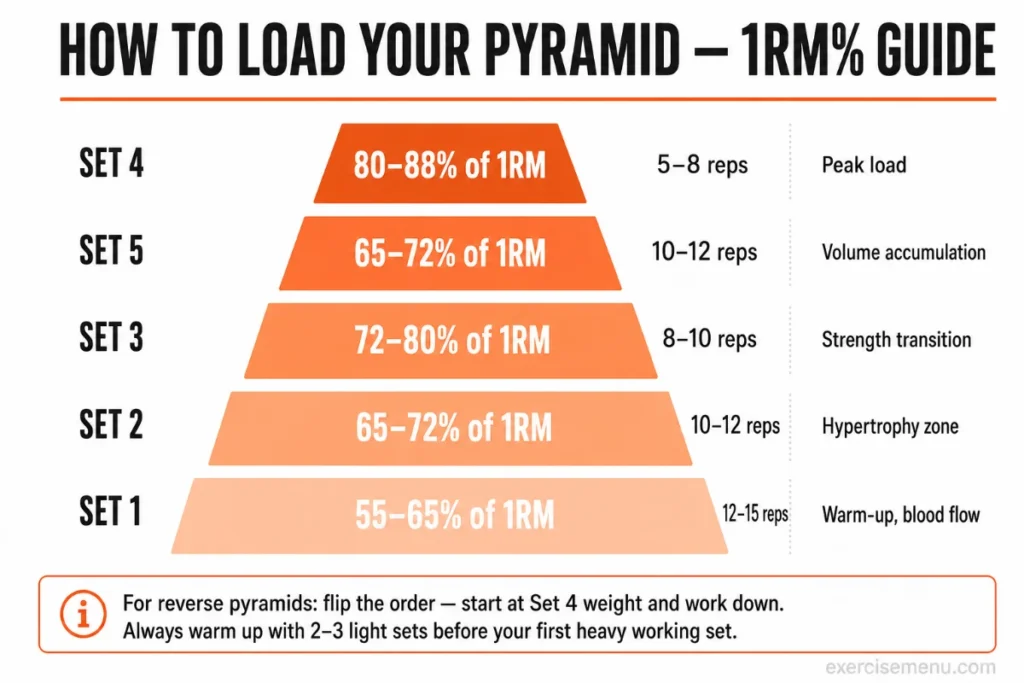
Use these percentage benchmarks based on your one-rep max as a starting framework:
| Set | % of 1RM | Target reps | Purpose |
|---|---|---|---|
| Set 1 (light) | 55–65% | 12–15 | Warm-up, blood flow, joint preparation |
| Set 2 | 65–72% | 10–12 | Hypertrophy zone, moderate tension |
| Set 3 | 72–80% | 8–10 | Transition to strength stimulus |
| Set 4 (peak) | 80–88% | 5–8 | Near-maximal load, peak motor unit recruitment |
| Set 5 (descend) | 65–72% | 10–12 | Volume accumulation, metabolic stress |
For reverse pyramids, flip the table — Set 1 starts at 85–90% and each subsequent set drops by roughly 8–10%. The key is that your heaviest set never exceeds a weight you can control with clean technique for the prescribed reps.
If you haven’t tested your 1RM recently, a general rule works: your 10-rep max is roughly 75% of your true 1RM. Start there and adjust based on how the sets feel.
Pyramid sets examples — exercise by exercise
Bench press (ascending pyramid)
| Set | Weight | Reps |
|---|---|---|
| 1 | 60 kg | 12 |
| 2 | 70 kg | 10 |
| 3 | 80 kg | 8 |
| 4 | 90 kg | 6 |
Squat (reverse pyramid)
Warm-up: 2–3 sets at 50–70% first.
| Set | Weight | Reps |
|---|---|---|
| 1 | 120 kg | 5 |
| 2 | 110 kg | 8 |
| 3 | 95 kg | 10 |
Deadlift (full triangle)
| Set | Weight | Reps |
|---|---|---|
| 1 | 80 kg | 10 |
| 2 | 100 kg | 8 |
| 3 | 120 kg | 5 |
| 4 | 100 kg | 8 |
| 5 | 80 kg | AMRAP |
Bodyweight push-ups (ascending pyramid — no equipment needed)
| Set | Variation | Reps |
|---|---|---|
| 1 | Knee push-ups | 15 |
| 2 | Standard push-ups | 12 |
| 3 | Decline push-ups | 8 |
| 4 | Deficit push-ups | 5 |
Pyramid training works with any equipment — barbells, dumbbells, cables, kettlebells, machines, or bodyweight. Compound movements like squats, bench press, deadlifts, overhead press, and rows are the most practical for calculating load changes. Isolation exercises like bicep curls, lateral raises, and tricep pushdowns work too but require smaller weight jumps.
Pyramid sets vs straight sets — what the research says
Straight sets use the same weight and reps across every set — 3×10, 4×12, 5×5. Pyramid sets change the load set to set. The question most people ask: which one builds more muscle?
The honest answer from the research: they produce similar hypertrophy outcomes. Multiple reviews — including analysis referenced by the Brookbush Institute — conclude that pyramid set strategies are “unlikely to improve outcomes more than conventional set strategies.”
That doesn’t mean pyramids are useless. It means the muscle growth difference is negligible. The practical differences are real:
Pyramids offer: Built-in warm-up, exposure to multiple rep ranges in one exercise, mental variety that fights training boredom, and the ability to train both strength and hypertrophy zones in a single session.
Straight sets offer: Simpler tracking, easier progressive overload application (same weight across sets makes week-to-week comparison clearer), and more consistent stimulus per set.
Neither is superior. Pick based on what keeps you consistent and what matches your training phase. If you’re still deciding which technique fits your current phase, the advanced set techniques guide breaks down all four side by side.
How pyramid sets differ from drop sets: Drop sets reduce weight immediately after hitting failure — no rest between weight changes. Pyramid sets use full rest between each loading change. Drop sets push deep muscular fatigue through continuous effort.
Pyramid sets preserve technique and neural quality by allowing recovery between loads. Different tools for different purposes.
Benefits of pyramid training
Graduated warm-up. Ascending pyramids take your joints, tendons, and nervous system through progressively heavier loads — reducing cold-start injury risk without needing separate warm-up exercises.
Exposure to multiple training zones. One exercise covers strength (low rep), hypertrophy (moderate rep), and endurance (high rep) ranges instead of limiting you to one.
Fatigue management. Reverse pyramids put the heaviest demand first when you’re freshest. Your technique stays cleaner on the sets that matter most.
Mental engagement. Changing the weight every set keeps you focused. Straight sets can become autopilot — pyramid sets demand attention to loading, rep targets, and rest.
Training variety. If you’ve been running the same rep and set structure for months and progress has stalled, pyramid training introduces a new stimulus without changing your exercises.
When NOT to use pyramid sets
Pyramid training isn’t always the right call.
Pure strength peaking. If you’re preparing for a 1RM test or powerlifting meet, you need heavy singles, doubles, and triples — not variable loading across wide rep ranges.
Beginners still learning form. Changing the weight every set adds complexity that can compromise technique. Master the movement pattern with straight sets first. Once form is locked in under a consistent load, introduce pyramids.
High-frequency programs. Pyramid sessions are demanding — the total volume per exercise is higher than straight sets. If your program trains the same muscle group 3–4 times per week, pyramid loading at every session will exceed your recovery capacity.
Common mistakes
Skipping warm-up sets on reverse pyramids. Your first working set is your heaviest. Walking in cold and loading 90% of your max is reckless. Two to three ramp-up sets at 50–70% protect your joints and prime your motor units.
Using pyramid training on every exercise in a session. Pyramid one or two main compound lifts per session. Accessories and isolation work are better served by straight sets — the constant plate-changing on smaller exercises wastes time without meaningful benefit.
Resting too little on the heavy sets. The top of a pyramid demands full recovery between sets — 3–5 minutes for loads above 85%. Cutting rest short to save time defeats the purpose of the heavy work.
Not tracking the numbers. Pyramid training involves more variables than straight sets — different weights, different reps, different rest. Without a training log, you’re guessing session to session instead of progressing.
Sample pyramid workout — upper body
| Exercise | Pyramid type | Sets × Reps | Rest |
|---|---|---|---|
| Bench press | Ascending | 12/10/8/6 | 2–3 min |
| Barbell row | Reverse | 6/8/10 | 3–4 min |
| Overhead press | Ascending | 12/10/8 | 2–3 min |
| Dumbbell curl | Straight sets | 3×10 | 90 sec |
| Tricep pushdown | Straight sets | 3×12 | 60 sec |
Notice the structure: pyramid the main compound lifts where the loading variation matters. Keep accessories on straight sets where simplicity and pump matter.
Frequently asked questions
Are pyramid sets good for hypertrophy?
Yes — particularly ascending and full pyramids. They accumulate high volume across multiple rep ranges, and the moderate-to-heavy sets generate the mechanical tension that drives muscle growth. Research shows hypertrophy outcomes are similar to straight sets, but pyramids add warm-up integration and training variety.
What are pyramid sets called?
Pyramid sets are also referred to as “crescent training” in academic research, “triangle sets” when describing the full up-and-down pattern, and “variable-set training” in some programming contexts. Reverse pyramids are sometimes called “descending sets.”
How many sets should a pyramid workout have?
Three to five sets per exercise for ascending and reverse pyramids. Five to seven for full triangles and bell-shaped pyramids. Total working sets across a session should stay within your recoverable volume — typically 10–20 sets per muscle group per week.
Can beginners do pyramid sets?
Beginners should start with ascending pyramids only — the lighter first sets serve as a natural warm-up and allow form practice before heavier loads arrive. Avoid reverse pyramids until you’ve built 6–12 months of training experience and can confidently handle heavy loads with clean technique.
Are pyramid sets better than straight sets?
Neither is objectively better for muscle growth — research shows similar outcomes. Pyramids offer variety, built-in warm-up, and multi-zone training. Straight sets offer simpler tracking and more consistent progressive overload. Use both across different training phases.
How often should I do pyramid training?
Two to three pyramid sessions per week is enough. Allow at least 48 hours between sessions that target the same muscle groups. Pyramid training generates higher per-exercise volume than straight sets, so recovery demands are greater.
