

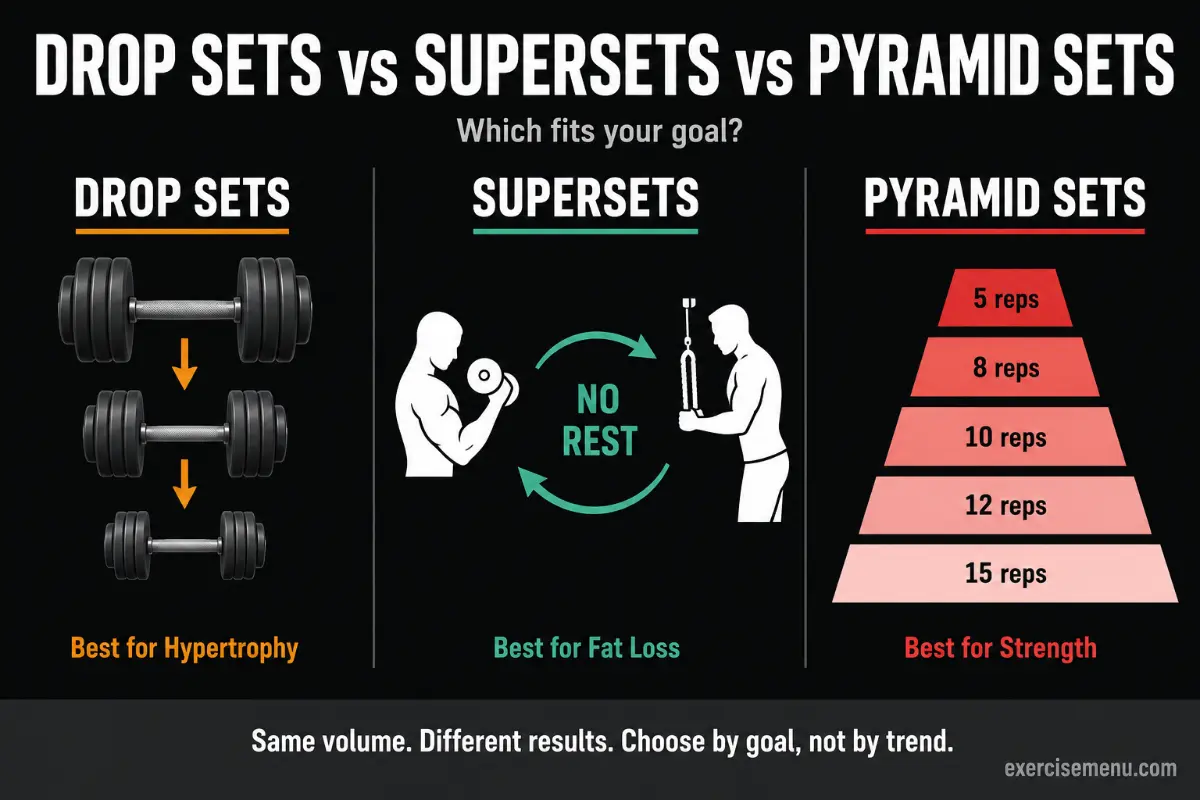
Quick Answer: Drop sets build muscle in less time. Supersets burn the most calories and cut session length. Pyramid sets build strength and suit beginners. When total weekly volume is equal, all three produce similar muscle growth to straight sets. The difference is which goal and schedule each one fits.
Key Takeaways
- Drop sets, supersets, and pyramid sets produce similar muscle growth when total volume is equal. The difference is how each fits your goal and schedule.
- Drop sets are the most time-efficient path to hypertrophy. The advantage is volume in less time, not a greater muscle-building signal.
- Supersets are the strongest choice for fat loss and workout efficiency. They elevate heart rate, shorten session time, and maintain training volume.
- Reverse pyramid training outperforms ascending pyramids for strength because maximum load lands when muscles are fresh.
- Beginners should start with straight sets or ascending pyramid sets. Drop sets belong in intermediate and advanced programs.
Drop sets, supersets, and pyramid sets each serve a different purpose. Picking the wrong one for your goal does not mean zero results, but it does mean leaving progress on the table. The comparison below shows where each technique fits, and which one matches what you are training for.
Side-by-Side Comparison
| Drop Sets | Supersets | Pyramid Sets | |
|---|---|---|---|
| Best for | Hypertrophy, time efficiency | Fat loss, workout efficiency | Strength, beginners |
| Training level | Intermediate to advanced | Beginner to advanced | Beginner to advanced |
| Time per session | Shortest | Short | Moderate |
| Metabolic stress | Highest | High (antagonist) | Low to moderate |
| Strength transfer | Low | Low to moderate | Moderate to high (RPT) |
| Recovery demand | High | Moderate | Low to moderate |
| Failure required | Yes | No | Only final set (ascending) |
| Fat loss effect | Moderate | Best | Moderate |
What Are Drop Sets?
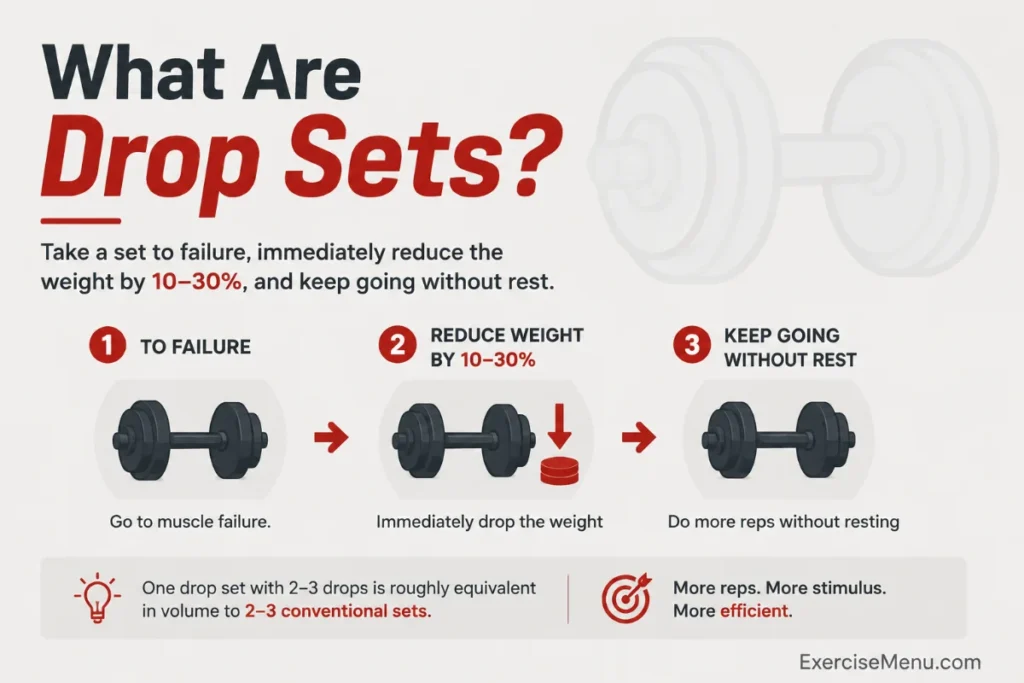
A drop set takes a set to muscle failure, then immediately reduces the load by 10-30% and continues for more reps without rest. For a complete breakdown of how drop sets work, when to use them, and which exercises suit them best, the what is a drop set guide covers everything. Below is how they compare to supersets and pyramid sets.
What Are Supersets?
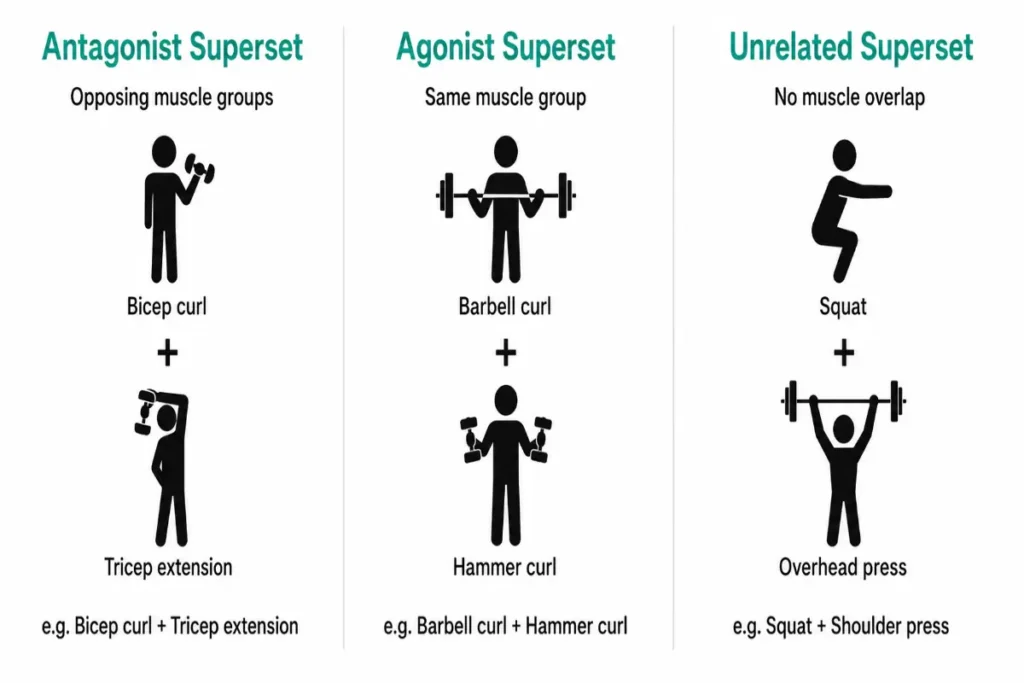
A superset pairs two exercises back-to-back with little to no rest between them. Three types exist:
Antagonist supersets pair opposing muscles: bench press followed by rows. One muscle rests while the other works. Load quality stays high. This is the most researched and most efficient type.
Agonist supersets pair exercises for the same muscle: barbell curl followed by hammer curl. Metabolic fatigue is high, but the pre-fatigued muscle cannot sustain the same load on the second exercise.
Unrelated supersets pair exercises with no overlap: squats with shoulder press. No fatigue transfer. The benefit is purely time.
For fat loss, supersets are the strongest option. Short rest keeps heart rate elevated, driving EPOC (excess post-exercise oxygen consumption). Calorie burn stays elevated during and after the session. Switching from traditional sets to antagonist pairings like bench/row or squat/Romanian deadlift typically drops session length by 20 to 25 minutes while average heart rate increases.
What are pyramid sets?
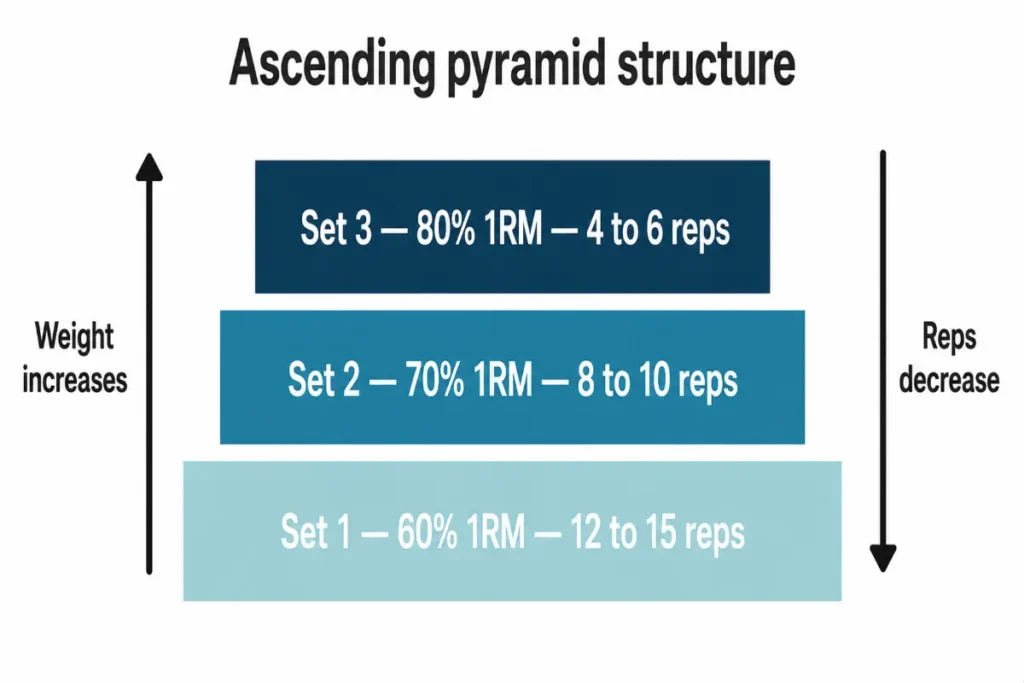
Pyramid sets change both the load and rep count across consecutive sets. Two main variants:
Ascending pyramid: start light and high reps, increase weight and decrease reps each set.
| Set | Load | Reps |
|---|---|---|
| 1 | 60% 1RM | 12–15 |
| 2 | 70% 1RM | 8–10 |
| 3 | 80% 1RM | 4–6 |
Early sets act as a warm-up, making ascending pyramids well-suited to beginners. The trade-off is that muscles are partially fatigued by the heaviest set.
Reverse pyramid training (RPT): heaviest set first, then reduce weight and increase reps. Multiple training studies comparing ascending and reverse pyramid protocols show that reverse pyramids produce better strength outcomes because peak load lands on the first working set, before fatigue accumulates.
A 2023 review of 15 studies in the Journal of Bodywork and Movement Therapies confirmed that both pyramid variants produce similar overall results to traditional training, with the reverse format offering a structural advantage for strength-focused goals.
How Do These Techniques Compare to Straight Sets?
Straight sets are the baseline that every advanced technique is built on top of. Three sets of 10 at the same weight with 2 to 3 minutes rest between sets. Before comparing advanced methods to each other, you need to know whether switching from straight sets produces better results at all.
A 2026 meta-analysis in Sports Medicine Open, analyzing 12 studies with 274 participants, confirmed that drop set training and traditional straight set training produce comparable hypertrophy and strength outcomes. Drop sets did generate higher ratings of perceived exertion and blood lactate levels, meaning they feel harder and create more metabolic stress per set. But the additional discomfort did not translate into additional muscle growth.
| Factor | Straight Sets | Drop Sets | Supersets | Pyramid Sets |
|---|---|---|---|---|
| Hypertrophy | Equivalent | Equivalent (less time) | Equivalent | Equivalent |
| Strength | Best | Weakest | Moderate | Strong (RPT) |
| Time per session | Longest | Shortest | Short | Moderate |
| Progressive overload tracking | Easiest | Hardest | Moderate | Easy |
| Fatigue per set | Lowest | Highest | Moderate | Low to moderate |
| Best placement | Entire session | Final set, isolation work | Accessory pairings | Compound lifts |
Straight sets remain the best primary structure for most training programs because they are the easiest to track, progress, and recover from. You log a weight and rep count. Next session, you aim to beat it. That simplicity is what makes progressive overload work over months and years.
Drop sets, supersets, and pyramid sets are tools you layer on top of straight sets when a specific problem needs solving. Time is limited? Add supersets. Need more volume for a lagging muscle without extending the session? Add a drop set on the last exercise. Want to hit both strength and hypertrophy rep ranges in one exercise? Use a pyramid. None of these replace straight sets. They supplement them.
Which Technique Matches Your Goal?
For Muscle Growth (Hypertrophy)
Drop sets and antagonist supersets are both effective. The choice depends on training frequency and weekly fatigue management. Training four or more days? Add drop sets to the final set of isolation work like curls, lateral raises, or leg extensions, and keep compound movements in traditional or superset format. Training three days a week? Antagonist supersets hit two muscle groups in the time one would normally take.
For Fat Loss
Supersets. Build sessions around antagonist pairings (push/pull, quad/hamstring, bicep/tricep) and keep rest to 60 to 90 seconds between pairs. Combine with a controlled calorie deficit and training volume stays high enough to preserve muscle while the deficit does the work. For the specific rep and set ranges that pair with this approach, see the reps and sets for fat loss guide.
For Strength
Reverse pyramid training. Peak load comes before fatigue accumulates, and back-down sets add volume at a lower percentage. For pure strength goals, drop sets are a poor primary structure: accumulated fatigue and elevated RPE compromise technique on the lifts that matter most.
For Time-Limited Workouts
Antagonist supersets cut session length by 30 to 40% without reducing total volume. Forty-five minutes for upper body? Pair every push movement with a pull.
Can You Combine These Techniques?
Yes. For most intermediate and advanced lifters, using all three across a session is the most practical structure: reverse pyramid training on compound lifts (squat, deadlift, bench press), antagonist supersets for accessory work (rows paired with flyes, curls paired with triceps), and a single drop set on one isolation exercise to finish.
Avoid applying drop sets and supersets to the same muscle group in the same session. Cumulative fatigue degrades form without meaningfully increasing the growth stimulus. Commit for a full training block of at least four weeks before judging results. Switching methods weekly produces novelty, not adaptation.
If you are still deciding which technique suits your current training phase, the advanced set techniques guide breaks down each one by goal.
Frequently asked questions
Do drop sets build strength or just size?
Mostly size. The high-rep, high-fatigue nature of drop sets does not replicate the low-rep, high-load conditions that drive maximal strength. For strength, reverse pyramid training is the better primary structure.
Which technique burns the most calories?
Supersets, by a clear margin. Short rest periods keep heart rate elevated throughout the session, and EPOC continues post-workout. Drop sets create more metabolic stress than pyramid sets, but neither produces the same cardiovascular demand as a structured superset session.
Are supersets better for muscle growth or fat loss?
Both, depending on structure. Antagonist supersets preserve mechanical tension and volume for growth. Compressed rest elevates calorie burn for fat loss. For growth specifically, pairings that don’t pre-fatigue the target muscle (back and chest, for example) outperform same-muscle combinations.
Can beginners use drop sets?
Not yet. Consistent technique under fatigue takes time to build. Spend 6-12 months with straight sets or ascending pyramids first, then introduce drop sets on lower-risk isolation exercises like curls or lateral raises.
Should I replace all my straight sets with advanced techniques?
No. The bulk of your program should use straight sets with controlled progressive overload. Advanced techniques apply to 1 to 2 exercises per session, usually the last exercise for a muscle group on the final set. They supplement your training. They do not replace it.
How often should I use drop sets or supersets in a training block?
Run one technique on a given exercise for 4 to 6 weeks, then switch to another or return to straight sets for 2 to 3 weeks. Permanent high-intensity training without variation leads to accumulated fatigue and diminishing returns. Cycling between straight sets and advanced techniques across training blocks keeps stimulus effective without overreaching.
If you have an existing injury or medical condition, consult your doctor before adding high-intensity techniques like drop sets to your program.
