

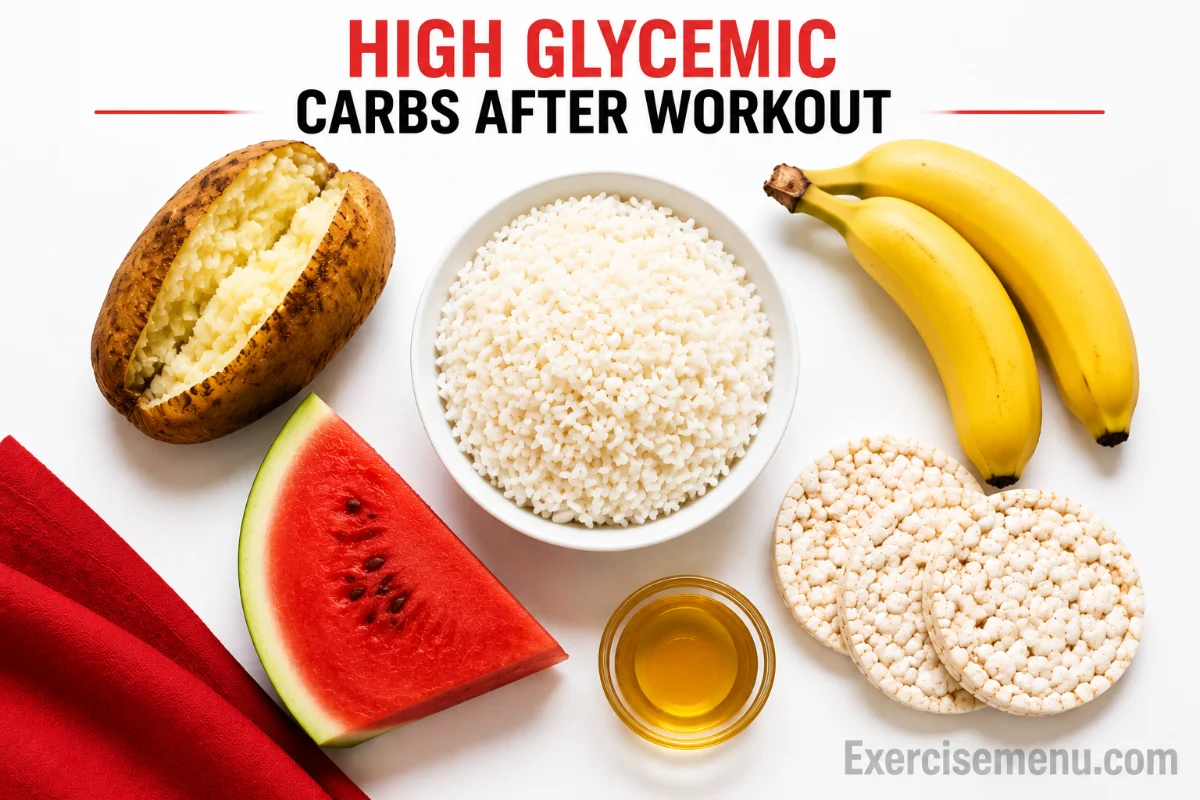
Quick Answer: Only if you are training again within 8 hours or completing endurance work over 60 minutes. In those scenarios, high glycemic carbs restore muscle glycogen faster than low GI options — a benefit confirmed by research in the Journal of Applied Physiology. For once-a-day training with 24+ hours between sessions, total carbohydrate intake matters more than glycemic index.
The advice to eat “fast carbs” after a workout has circulated in gym culture for decades — white rice, white bread, even candy based on the idea that spiking insulin speeds recovery. The science behind it is real, but the application is narrower than the advice suggests.
Whether high glycemic carbs actually help depends on three variables: how long you trained, how hard you trained, and when you are training next.
- What Does Glycemic Index Mean for Post-Workout Recovery?
- When Do High Glycemic Carbs Actually Matter After a Workout?
- What Are the Best High Glycemic Foods to Eat After a Workout?
- Does Eating High GI Carbs After a Workout Cause Fat Gain?
- High GI vs Low GI After a Workout: How Do You Choose?
- Frequently Asked Questions
- Your Next Step
What Does Glycemic Index Mean for Post-Workout Recovery?
Glycemic index ranks carbohydrate foods on a scale of 0–100 based on how quickly they raise blood glucose. Foods scoring above 70 are classified as high GI they enter the bloodstream fast and trigger a strong insulin response. Below 55 is low GI; 56–69 is moderate.
After exercise, this insulin response serves a specific purpose. A 2013 review in Physiological Reviews found that exercise activates GLUT4 transporters in skeletal muscle — proteins that pull glucose directly into muscle cells.
This GLUT4 activation remains elevated for up to 48 hours post-exercise, which means your muscles are primed to absorb glucose at a rate they cannot match at rest. High GI carbs capitalize on this window by flooding the bloodstream with glucose while the transporters are most active.
This is why the same bowl of white rice behaves differently after a workout than it does sitting on your couch. At rest, a sharp insulin spike drives glucose toward fat storage. After training, that glucose is redirected toward depleted muscle glycogen instead.
When Do High Glycemic Carbs Actually Matter After a Workout?
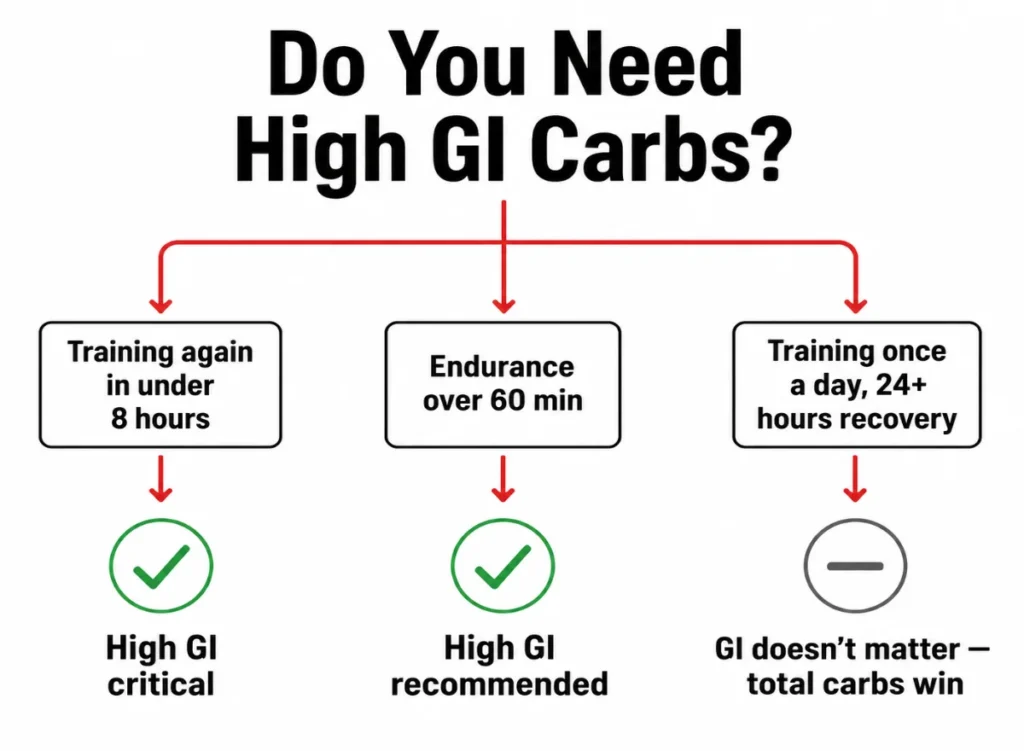
The answer depends on your training schedule. Two-a-day athletes, endurance runners, and competitors need high GI carbs within 30 minutes of finishing. Everyone else has 24 hours for glycogen to normalize — and at that timescale, GI makes no measurable difference.
The GI Decision Matrix
- Training again in under 8 hours (two-a-days, morning + evening sessions) → High GI carbs within 30 minutes are critical. You do not have time to wait for slow-digesting carbs to convert to glycogen.
- Endurance session exceeding 60 minutes (long runs, cycling, swimming) → High GI recommended. Glycogen depletion is severe after prolonged cardio, and rapid replenishment reduces fatigue in subsequent sessions.
- Competition or event the next day → High GI carbs at every meal post-training. Glycogen supercompensation requires aggressive carb loading, and high GI foods achieve this faster.
- Training once a day with 24+ hours recovery → GI does not matter. Eat any carbohydrate source you prefer — white rice, brown rice, oats, sweet potatoes. Total grams consumed across the day determine glycogen levels by the next session.
- Short resistance session under 45 minutes → GI is irrelevant. Glycogen depletion from a 30-minute arm workout is minimal. A normal meal within 2 hours is sufficient.
A 1993 study by Burke, Collier, and Hargreaves confirmed this distinction. Participants who consumed high GI carbs after prolonged cycling stored significantly more muscle glycogen over 24 hours than those who ate low GI carbs with the same total carbohydrate content. But subsequent research showed that when recovery time extends beyond 24 hours, this gap disappears total carbs catch up regardless of source.
What Are the Best High Glycemic Foods to Eat After a Workout?
These 10 high GI foods are ranked by glycemic index score, with the serving size needed to deliver 50g of carbohydrates — the amount the International Society of Sports Nutrition recommends per post-workout meal for glycogen restoration.
| Food | GI Score | Serving for 50g Carbs | Pairs With |
|---|---|---|---|
| Baked russet potato | 85 | 1 large potato (300g) | Grilled chicken, cottage cheese |
| Rice cakes | 82 | 6 cakes | Peanut butter, turkey slices |
| Cornflakes | 81 | 60g (~2 cups) | Milk, banana |
| Watermelon | 76 | 650g (~4 cups diced) | Greek yogurt, protein shake |
| White bread | 75 | 4 slices | Eggs, tuna, turkey |
| White rice (cooked) | 73 | 1.5 cups (180g dry) | Salmon, chicken breast, lean beef |
| Sweet potato (baked) | 63 | 1 large (250g) | Salmon, tempeh, ground turkey |
| Ripe banana | 62 | 2 large bananas | Peanut butter, oats |
| Honey | 61 | 3.5 tablespoons | Greek yogurt, toast |
| Pineapple | 59 | 380g (~2.5 cups chunks) | Cottage cheese, chicken |
Pair every high GI carb source with 30–40g of protein. The carbohydrate handles glycogen; the protein handles muscle repair. Eating them together also blunts the GI spike slightly, which prevents the blood sugar crash that pure carb meals can trigger 60–90 minutes later.
One detail most guides miss: the GI of a food drops when eaten as part of a mixed meal. White rice alone scores 73, but white rice eaten with chicken and vegetables scores closer to 55–60 because protein, fat, and fiber slow gastric emptying.
If rapid glycogen replenishment is your goal during a two-a-day or after a 90-minute run — eat the high GI carb source first or on its own, then follow with protein 15–20 minutes later.
Does Eating High GI Carbs After a Workout Cause Fat Gain?
No. Post-exercise insulin sensitivity redirects glucose toward muscle glycogen, not fat storage. The same insulin spike that would promote fat storage at rest has the opposite function after training.
Here is the mechanism: during exercise, your muscles deplete their stored glycogen and activate GLUT4 transporters that remain on the cell surface for hours afterward. When you eat high GI carbs in this window, insulin shuttles glucose directly into these depleted muscle cells. The glucose is converted to glycogen not triglycerides because the muscle demand takes priority over fat tissue.
This does not mean you can eat unlimited high GI carbs without consequence. The protective window scales with session intensity. A 20-minute walk depletes minimal glycogen and offers minimal GLUT4 activation. A 75-minute strength training session depletes significant glycogen across multiple muscle groups and keeps GLUT4 elevated for 24–48 hours. Match your carb intake to what you actually depleted.
High GI vs Low GI After a Workout: How Do You Choose?
Choose high GI when speed of glycogen restoration determines your next performance. Choose low GI when you have time and want sustained energy without a blood sugar dip.
| Factor | High GI Wins | Low GI Wins |
|---|---|---|
| Next session in <8 hours | ✓ Faster glycogen synthesis | |
| Next session in 24+ hours | ✓ Same glycogen, steadier energy | |
| Fat loss is the goal | ✓ Greater satiety, less overeating risk | |
| Endurance over 60 min | ✓ Severe glycogen depletion | |
| Short resistance training | ✓ Minimal glycogen depletion | |
| Appetite is low | ✓ Easier to eat (less volume) | |
| Evening session before sleep | ✓ Avoids energy spike before bed |
One factor most guides overlook: cooking and cooling changes the GI of starchy foods. When you cook white rice or potatoes and then refrigerate them, a portion of the starch converts to resistant starch — a form that resists digestion and behaves like fiber.
Reheated leftover rice has a measurably lower GI than freshly cooked rice. If you meal prep and reheat your carbs, you are already eating a lower GI version of the same food without realizing it.
For most people training once a day, the practical answer is simple: eat whichever carb source you enjoy and will eat consistently. White rice, brown rice, sweet potatoes, oats, pasta over 24 hours, they all restore glycogen equally when total carb intake is matched.
Reserve the deliberate high GI strategy for double sessions, competition days, or prolonged endurance work where speed of recovery directly affects your next output.
Frequently Asked Questions
Is it OK to eat sugar or candy after a workout?
Technically, yes — sugar restores glycogen. But candy provides zero protein, no micronutrients, and no fiber. A baked potato with chicken delivers the same glycogen benefit plus 35g of protein, potassium, and vitamin B6. Real food serves recovery better than pure sugar in every measurable way.
How many grams of high GI carbs should I eat after training?
0.5–0.7g per kilogram of body weight within the first 30 minutes, then repeat every 2 hours for 4–6 hours if training again the same day. For a 75kg person, that is 38–53g per feeding. If you are training once a day, a single post-workout meal with 50–70g of carbs from any source is sufficient.
Does blending or juicing fruit raise its glycemic index?
Yes. Blending breaks down fiber structures that normally slow digestion, which increases the rate of glucose absorption. A whole banana has a GI of 51; a blended banana in a smoothie scores closer to 62. If rapid glycogen restoration is your goal, this works in your favor. If steady blood sugar is the priority, eat the fruit whole.
Are high GI carbs bad for people with insulin resistance or type 2 diabetes?
Exercise improves insulin sensitivity temporarily, which makes post-workout the safest window for higher GI carbs even in insulin-resistant individuals. However, portions should be smaller (30–40g carbs), and pairing with protein is especially important to moderate the glucose spike. Consult a physician or dietitian for individualized guidance.
Do high GI carbs help build muscle or just restore glycogen?
Primarily glycogen. Muscle growth is driven by protein intake and progressive training stimulus. High GI carbs support muscle building indirectly — by restoring glycogen, they ensure your next session has full fuel, which allows higher training volume over time. But eating high GI carbs without adequate protein does nothing for muscle protein synthesis.
Your Next Step
If you train once a day, stop stressing about glycemic index — eat the carbs you enjoy alongside 30–40g of protein and recover fully before your next session. If you train twice a day, compete, or run endurance sessions over 60 minutes, prioritize the high GI foods from the table above within 30 minutes of finishing.
For complete meals with exact macros organized by training intensity, see our guide on post-workout meal ideas. For the full science behind post-workout nutrition — protein, carbs, timing, and hydration — start with our guide on what to eat after a workout.
Want a Nutrition Plan Built Around Your Training?
Generic meal plans don’t account for your training schedule, health history, or goals. Rimsha Shahid — Registered Dietitian, Certified Diabetes Specialist (USA), and Certified Pediatric Nutritionist — builds personalised nutrition plans that work alongside your programme, not against it.
Free initial consultation — no commitment required.

Rimsha Shahid is a Registered Dietitian (DDNS, MS HND), Certified Diabetes Specialist (USA), and Certified Pediatric Nutritionist with five years of clinical experience across hospital nutrition departments and private practice. At Exercise Menu, she writes and reviews all nutrition content — applying the same clinical standard she uses with her own clients. Every plan she builds starts with your actual health picture, not a generic template.