

Quick Answer: Do 2-4 exercises for large muscle groups (chest, back, legs) and 1-2 for smaller muscles (biceps, triceps, calves) per workout. Across the week, aim for 10-20 hard sets per muscle. The exercise count distributes that volume — your muscles don’t count exercises, they respond to total work done close to failure.
The number of exercises per muscle group matters — but not the way most people think. Adding a fifth or sixth exercise for chest doesn’t automatically mean more growth. Your muscles respond to total weekly volume (hard sets taken close to failure), not how many different movements you use to get there.
Exercises distribute that volume across angles and movement patterns. Too few and you miss parts of the muscle. Too many and the extra work turns into fatigue without stimulus. For a full breakdown of how reps and sets work together, the pillar guide covers the foundations.
This guide breaks down the right exercise count by individual muscle group, experience level, and training split with a selection framework so you know not just how many, but which ones to pick. — Sadia Baloch, FISAF-certified fitness coach, 7+ years, 257+ clients.
- How Many Exercises Do You Need Per Muscle Group?
- How to Choose Exercises for Large Muscles
- How to Choose Exercises for Small Muscles
- How Experience Level Changes Your Exercise Count
- Does Your Goal Change the Exercise Count?
- How Your Training Split Affects Exercise Count
- How to Know If You're Doing Too Many Exercises
- How Many Exercises Per Muscle Group FAQ
How Many Exercises Do You Need Per Muscle Group?
For most people, 2-4 exercises per large muscle group and 1-2 per small muscle group per workout session hits the effective range. This distributes your weekly volume (10-20 hard sets) across enough movement patterns to cover different muscle fibers without crossing into junk volume territory.
| Muscle Group | Size | Exercises Per Session | Weekly Sets Target | Sets Per Exercise |
|---|---|---|---|---|
| Chest | Large | 2-3 | 10-16 | 3-4 |
| Back | Large | 3-4 | 12-18 | 3-4 |
| Quads | Large | 2-3 | 10-16 | 3-4 |
| Hamstrings | Large | 2 | 8-12 | 3-4 |
| Glutes | Large | 2-3 | 8-14 | 3-4 |
| Shoulders | Medium | 2-3 | 10-16 | 3 |
| Biceps | Small | 1-2 | 6-10 | 2-3 |
| Triceps | Small | 1-2 | 6-10 | 2-3 |
| Calves | Small | 1-2 | 6-10 | 3-4 |
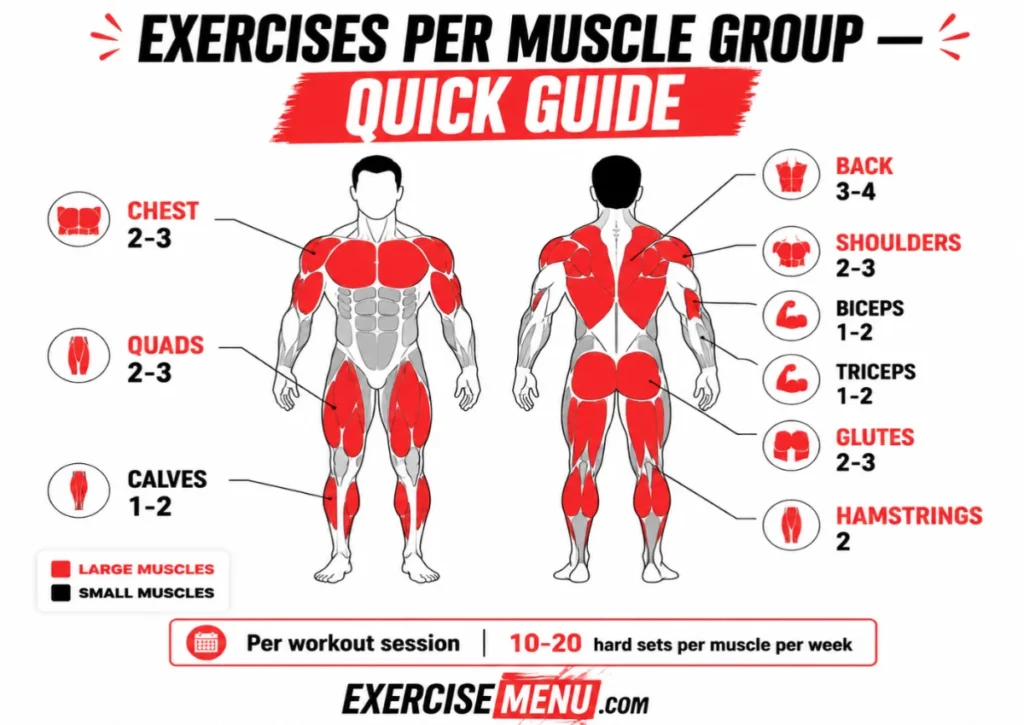
Back gets the highest exercise count because it contains multiple muscles pulling in different directions — lats, rhomboids, traps, rear delts. Biceps and triceps get the lowest because they already fire during compound pulling and pressing movements.
These numbers are per session. Across your full training week, you’ll use 4-8 different exercises per muscle group depending on how many times per week you train that muscle. If you’ve already set your weekly set targets per muscle group, the exercise count is how you split those sets across different movements.
How to Choose Exercises for Large Muscles
The right number of exercises means nothing if the exercises themselves don’t cover the muscle properly. Each large muscle group has multiple fiber regions, heads, or biomechanical functions — and one movement can’t reach all of them. Distributing exercises across different angles also spreads joint stress, reducing overuse injury risk from repeating the same movement pattern indefinitely.
For each muscle, pick one compound as your primary lift, then add exercises covering angles or functions the primary misses.
Chest (2-3 Exercises)
The chest has three fiber regions — upper (clavicular), mid (sternal), and lower (costal). A flat bench press alone hits the mid and lower regions well but underloads the upper fibers.
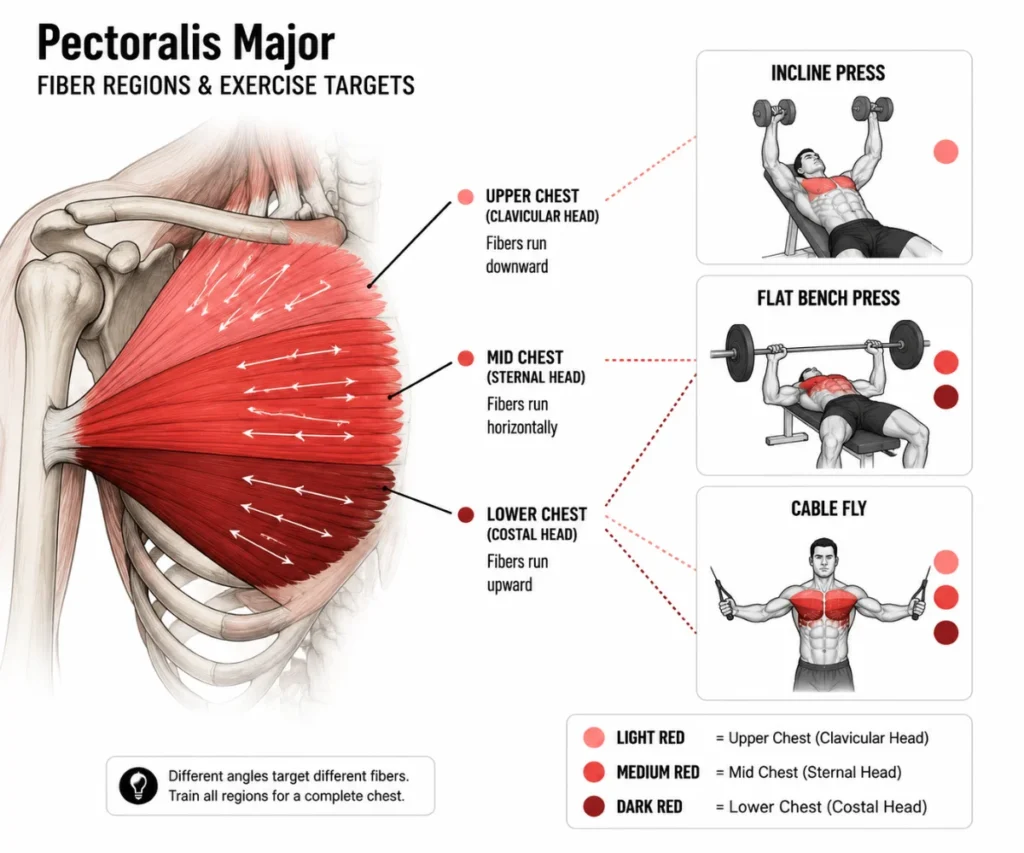
- Horizontal press (bench press, dumbbell press) — primary mass builder
- Incline press (incline dumbbell, incline barbell at 30-45°) — targets upper chest fibers that flat pressing misses
- Fly or stretch movement (cable fly, pec deck) — full range of motion, emphasizes the squeeze at peak contraction
A 2014 study by Fonseca et al. in the Journal of Strength and Conditioning Research found that subjects using varied exercises experienced growth in all four heads of the quadriceps, while the same-exercise group saw no growth in two of the four heads. The same principle applies to chest — different angles stimulate different fiber regions.
Back (3-4 Exercises)
Back is the most complex muscle group in the body. Lats, rhomboids, traps, rear delts, and erectors all pull in different directions. No single exercise reaches all of them.
- Vertical pull (pull-ups, lat pulldown) — lat width, vertical fiber engagement
- Horizontal row (barbell row, cable row) — mid-back thickness, rhomboid and trap involvement
- Unilateral row (dumbbell row, single-arm cable row) — addresses left-right imbalances, rotational stability
- Optional rear delt/upper trap (face pulls, reverse fly) — if your rowing doesn’t adequately hit posterior deltoids
Three exercises is the minimum for back. Four is often necessary because no two pulling angles cover the same fibers.
Quads (2-3 Exercises)
Quads have four heads. Squats activate all four, but the rectus femoris and vastus medialis often receive less stimulus than the vastus lateralis and intermedius.
- Squat pattern (back squat, front squat, goblet squat) — primary compound, covers most of the quad
- Single-leg or machine variation (leg press, lunges, Bulgarian split squat) — addresses imbalances, reduces spinal load
- Optional knee extension (leg extension) — isolates rectus femoris, which squats tend to underload
Two exercises covers most people. A third becomes useful at the intermediate level when quad development becomes uneven.
Hamstrings (2 Exercises)
Hamstrings perform two distinct functions: hip extension and knee flexion. Training only one function leaves half the muscle fibers understimulated.
- Hip extension (Romanian deadlift, stiff-leg deadlift) — targets hamstrings through the hinge pattern
- Knee flexion (seated or lying leg curl) — isolates the knee-bending function that deadlifts don’t cover
Exactly two exercises, one per function. This is one of the few muscle groups where the number isn’t a range — it’s a prescription.
How to Choose Exercises for Small Muscles
Small muscles need fewer exercises for two reasons. First, they have simpler fiber arrangements and fewer biomechanical functions. Second, they receive significant indirect work from compound movements — biceps fire during every row and pulldown, triceps fire during every press.
The assumption that small muscles inherently need less volume than large muscles isn’t as clean-cut as it sounds. The Baz-Valle et al. (2022) systematic review in the Journal of Human Kinetics found that quadriceps and biceps responded similarly to moderate and high volume, while triceps — a small muscle — actually responded better to higher volume. The “small muscles need less” rule holds practically because of indirect work, not because small fibers are fundamentally different.
Shoulders (2-3 Exercises)
Front delts get heavy indirect work from bench pressing and overhead pressing. Lateral and rear delts don’t — they need direct attention.
- Overhead press (barbell or dumbbell) — front and lateral delts under load
- Lateral raise (dumbbell or cable) — lateral delt isolation, the muscle responsible for shoulder width
- Rear delt work (reverse fly, face pull) — if not adequately covered on your back/pull day
If your back training includes face pulls or wide-grip rows, you may only need 2 shoulder exercises. If it doesn’t, add a third for rear delts.
Biceps (1-2 Exercises)
Biceps have two heads (short and long) but a simple function: elbow flexion. They work hard during every pulling movement you do for back.
- Curling variation (barbell curl, dumbbell curl) — primary direct work
- Optional angle change (incline curl for long head, preacher curl for short head) — addresses the head that your primary curl underloads
Most people need 1 direct biceps exercise. A second becomes useful when biceps lag behind despite consistent back training.
Triceps (1-2 Exercises)
Triceps have three heads, but pressing movements already cover the lateral and medial heads. The long head — which crosses the shoulder joint — needs overhead extension work to be fully stretched and loaded.
- Extension (cable pushdowns, overhead dumbbell extension) — direct tricep work
- Optional compound (close-grip bench press, dips) — adds load if pushdowns alone aren’t progressing
If you’re already doing heavy bench pressing and overhead pressing, 1 direct tricep exercise is often enough.
Calves (1-2 Exercises)
The calf contains two muscles that respond to different knee positions. Gastrocnemius activates most with a straight knee. Soleus activates most with a bent knee.
- Standing calf raise (straight knee) — gastrocnemius emphasis
- Seated calf raise (bent knee) — soleus emphasis
Both positions cover both muscles — the split is about emphasis, not exclusion. One exercise can work, but two ensures complete coverage.
How Experience Level Changes Your Exercise Count
Beginners (0-12 months): 1-2 exercises per muscle group per workout. Your muscles respond to any new stimulus at this stage — you don’t need variety, you need consistency and technique. A full-body routine with squats, bench press, rows, and overhead press covers nearly every muscle group with just 4 movements.
Intermediate (1-3 years): 2-3 per large muscle, 1-2 per small. Your body has adapted to basic compound patterns. Adding isolation movements after your primary lifts starts paying off because you can now target fiber regions that compounds alone aren’t fully reaching.
Advanced (3+ years): 3-4 per large muscle, 2 per small. Growth comes in smaller increments at this stage. You need varied angles and periodically rotated exercises to keep stimulating fibers that have already adapted to your core lifts. But more exercises doesn’t mean more total sets — keep weekly volume within 10-20 hard sets per muscle. Adding exercises without managing volume leads to diminishing returns.
A systematic review by Baz-Valle et al. (2022) in the Journal of Human Kinetics confirmed that 12-20 weekly sets per muscle group produces optimal hypertrophy, with diminishing returns beyond 20. A larger meta-regression by Pelland et al. (2024) — covering 67 studies and 2,058 participants — reinforced this: muscle size and strength increase with volume, but both follow a curve of diminishing returns. More exercises only help if they add productive sets within that range.
Does Your Goal Change the Exercise Count?
Strength: Fewer exercises, more sets per exercise. Strength is skill-specific — you get stronger at movements you practice repeatedly under heavy load. Stick to 1-2 heavy compound exercises per muscle (squat, bench, deadlift, overhead press) and build volume through additional sets, not additional movements. A strong squatter doesn’t need 4 quad exercises — they need more sets of squats.
Hypertrophy (muscle growth): More exercises, varied angles. Muscle growth responds to mechanical tension across different fiber regions. This is where 2-4 exercises per large muscle earns its value — different angles ensure proportional development. Distribute 10-20 weekly sets across those exercises rather than loading everything onto one movement.
Endurance: Fewer exercises, higher reps. Muscular endurance improves through sustained effort, not movement variety. 1-2 exercises per muscle at 15-20+ reps per set builds the capillary density and mitochondrial capacity that endurance requires. Volume comes from reps per set, not from exercise count.
How Your Training Split Affects Exercise Count
Your split determines how many sessions each muscle gets per week. More sessions = fewer exercises per session. Fewer sessions = more exercises per session. The weekly volume stays the same.
| Split | Days/Week | Exercises Per Muscle Per Session | Why |
|---|---|---|---|
| Full Body | 3 | 1-2 | Each muscle hit 3x/week — low per-session volume needed |
| Upper/Lower | 4 | 2-3 | Each muscle hit 2x/week — moderate variety per session |
| Push/Pull/Legs | 3-6 | 3-4 | Each muscle 1-2x/week — higher per-session count to hit weekly volume |
| Body Part Split | 4-5 | 4-5 | Each muscle 1x/week — all weekly volume packed into one session |
A full-body trainee doing 2 chest exercises per session across 3 sessions uses 6 chest exercises per week. A body part split trainee doing 5 chest exercises hits the same muscle once. Both approaches work if weekly volume is equated — the split is a scheduling preference, not a growth variable. For a deeper comparison: how to structure a workout and the push-pull-legs breakdown.
How to Know If You’re Doing Too Many Exercises
Performance drops across sets. If your third exercise for a muscle feels drastically weaker than your first — not just slightly harder — your earlier work already created sufficient stimulus. The extra movement is producing fatigue, not growth.
Technique breaks down. When form deteriorates on your fourth or fifth exercise, you’re training through patterns that increase injury risk without proportional muscle benefit.
Sessions consistently exceed 75 minutes. Cortisol rises, focus drops, and set quality declines past the 60-75 minute mark for most people. If your workouts run long, you likely have more exercises than you need.
Recovery takes longer than 72 hours. Still sore from Monday’s session on Thursday? The total volume was too high — either too many sets, too many exercises, or both.
Progress stalls despite training hard. The instinct when growth stops is to add more exercises. But stalled progress more often points to recovery, nutrition, or sleep — not insufficient exercise variety. For a deeper breakdown of when extra volume stops helping: what is junk volume.
How Many Exercises Per Muscle Group FAQ
Is 2 exercises per muscle group enough to build muscle?
For small muscles — yes, especially with indirect compound work already contributing. For large muscles, 2 exercises can work if frequency is high. Two exercises at 4 sets each, done twice per week, gives you 16 weekly sets. That’s well within the hypertrophy range. The weekly total matters more than the per-session exercise count.
Should I do the same exercises every workout or rotate them?
Stick with the same core exercises for 6-10 weeks, focusing on adding weight or reps. Consistency lets you track progress and build strength on specific patterns. Rotate exercises when progress stalls on a particular movement — not every session. Constant switching prevents you from getting stronger at anything because you never practice the same lift long enough.
Should I count compound lifts as “exercises” for the smaller muscles they hit?
Yes. A barbell row counts as a back exercise AND provides stimulus to your biceps. When planning your biceps volume, factor in the pulling work you’ve already done. If you did 4 sets of rows and 4 sets of pulldowns, your biceps already received 8 sets of indirect work. Adding 2-3 direct curl sets on top of that is usually enough — you don’t need 4 more exercises for biceps as if those rows didn’t happen.
What if I only have time for one exercise per muscle group?
Pick a compound that covers the most fibers. For chest, a dumbbell bench press (wider ROM than barbell). For back, a cable row or pull-up. For quads, a squat variation. For hamstrings, a Romanian deadlift. One exercise per muscle can maintain and even build muscle if you push those sets hard enough — but you’ll want to rotate which exercise you use every 6-8 weeks to prevent specific fiber regions from being neglected long-term.
Should I change my exercise count when cutting or bulking?
During a bulk, energy and recovery capacity are higher — you can handle more exercises (3-4 per large muscle) and push volume toward the upper end of 15-20 weekly sets. During a cut, energy drops and recovery slows. Reduce to 2-3 exercises per large muscle and prioritize maintaining intensity on your primary compounds rather than adding variety. The goal during a cut is preserving muscle, not building new stimulus through extra exercises.
Conclusion
Your exercise count per muscle group is a distribution decision, not a growth lever. Pick 2-4 exercises for large muscles and 1-2 for small ones, cover different angles and functions within each muscle, and keep your total weekly sets between 10-20. For the complete foundation on how reps, sets, and volume work together, see our guide on reps and sets.
