

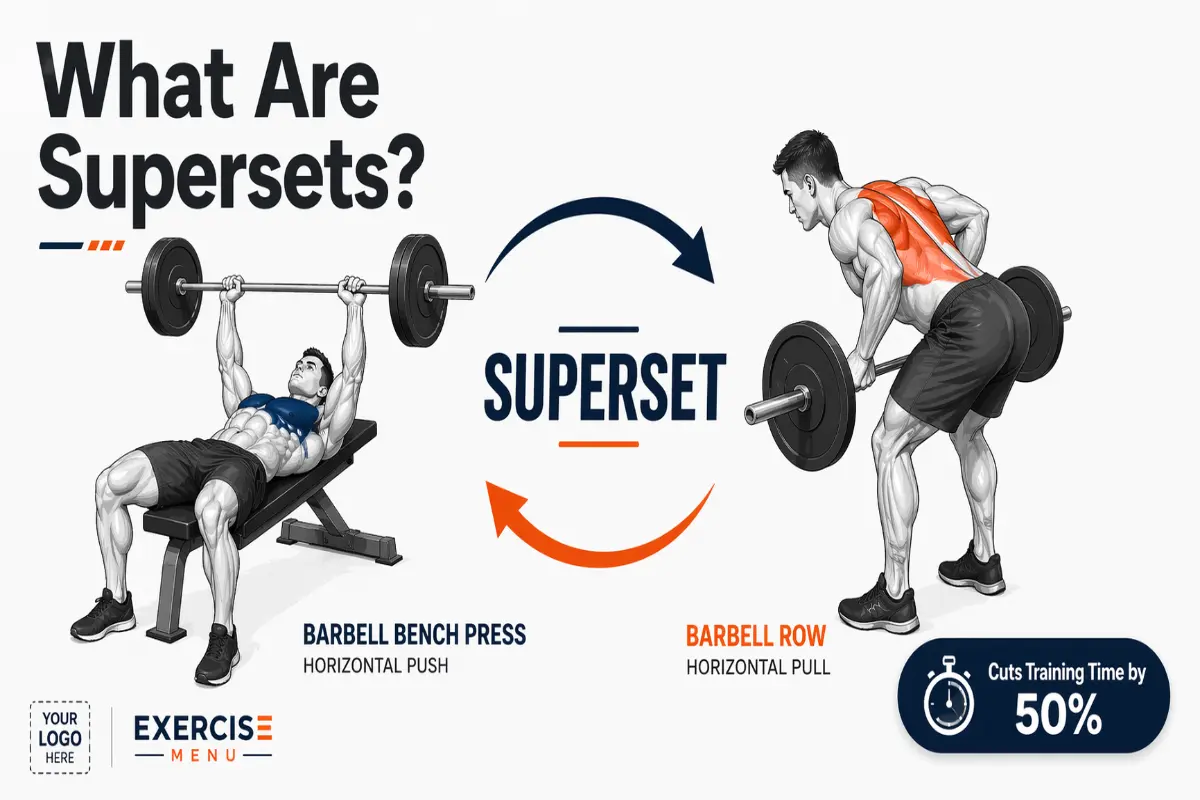
Quick Answer: A superset is when you perform two exercises back-to-back with minimal rest between them. Total sets and reps stay identical what changes is time. Because rest for Exercise A happens while you’re doing Exercise B, session duration drops by up to 50% without removing a single rep. Which exercises you pair, and where in your session you place them, determines whether supersets help or hurt your results.
Walk into any gym on a weeknight and count how many people are actually lifting versus sitting between sets. Rest periods that should last 90 seconds routinely stretch to four minutes. Supersets fix this the pairing logic and session placement are what determine whether they actually work.
The method takes 30 seconds to learn. Programming it correctly takes more thought than most lifters give it.
- What Is a Superset in Weight Training?
- What Are the 3 Types of Supersets?
- What Are the Benefits of Supersets?
- What Are the Disadvantages of Supersets?
- Are Supersets Good for Building Muscle?
- Where Should Supersets Go in Your Session?
- How Do Supersets Improve Workout Efficiency?
- How Often Can You Use Supersets?
- Who Should and Shouldn't Use Supersets?
- What Are the Biggest Superset Mistakes?
- How to Program Supersets Into Your Training Week?
- Frequently asked questions
What Is a Superset in Weight Training?
A superset pairs two exercises performed consecutively with little or no rest between them. You complete one set of Exercise A, move directly into one set of Exercise B, then take your rest. That rest period covers both exercises — which is why total session time drops without any reduction in volume.
Before adding supersets, you need a clear picture of how reps and sets work in your program. Supersets don’t change your rep targets they change how those reps are distributed across time.
What Are the 3 Types of Supersets?
1. Push-pull supersets
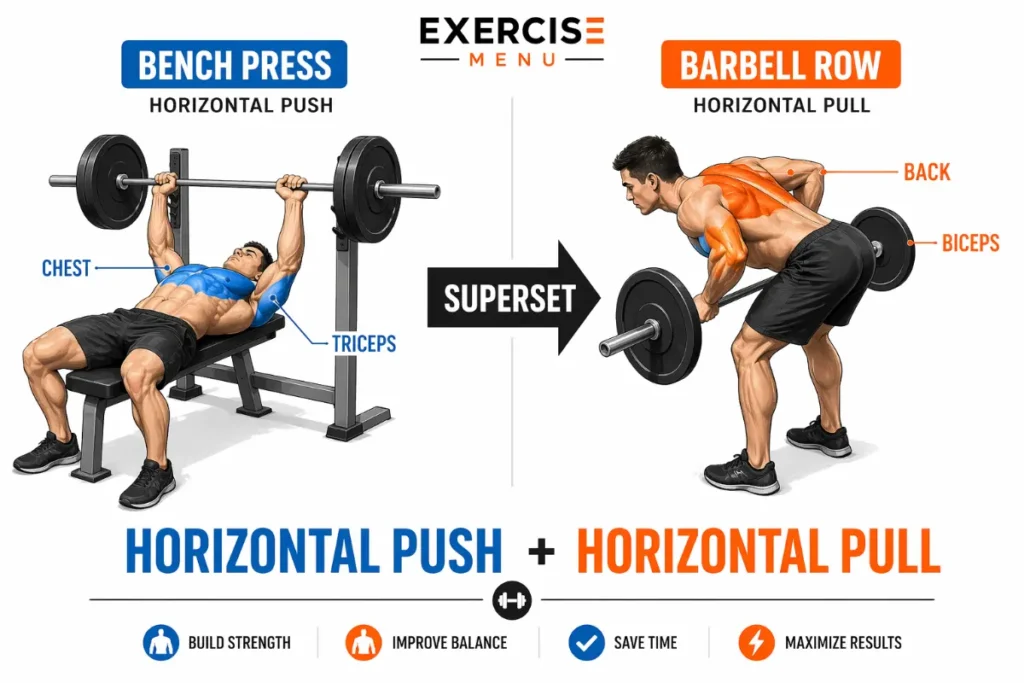
You pair a pushing movement bench press, overhead press, tricep extension with a pulling movement row, pull-up, bicep curl. Because these muscle groups are antagonists, one recovers while the other works. Neither enters its sets compromised.
Match the movement plane, not just the direction:
- Horizontal push (bench press) + Horizontal pull (barbell row) ✅
- Vertical push (overhead press) + Vertical pull (lat pulldown) ✅
- Horizontal push + Vertical pull ⚠️ — suboptimal
Mismatching planes puts the scapula through opposing positional demands before it’s had time to reset over weeks, that shows up in uneven shoulder development and upper back tightness.
A 2025 systematic review by Zhang et al. in Sports Medicine, covering 19 studies and 313 participants, confirmed that push-pull supersets maintain similar training volume while substantially reducing session time.
Example pairs:
- Bench press → Barbell row
- Overhead press → Lat pulldown
- Incline dumbbell press → Seated cable row
2. Upper-lower supersets
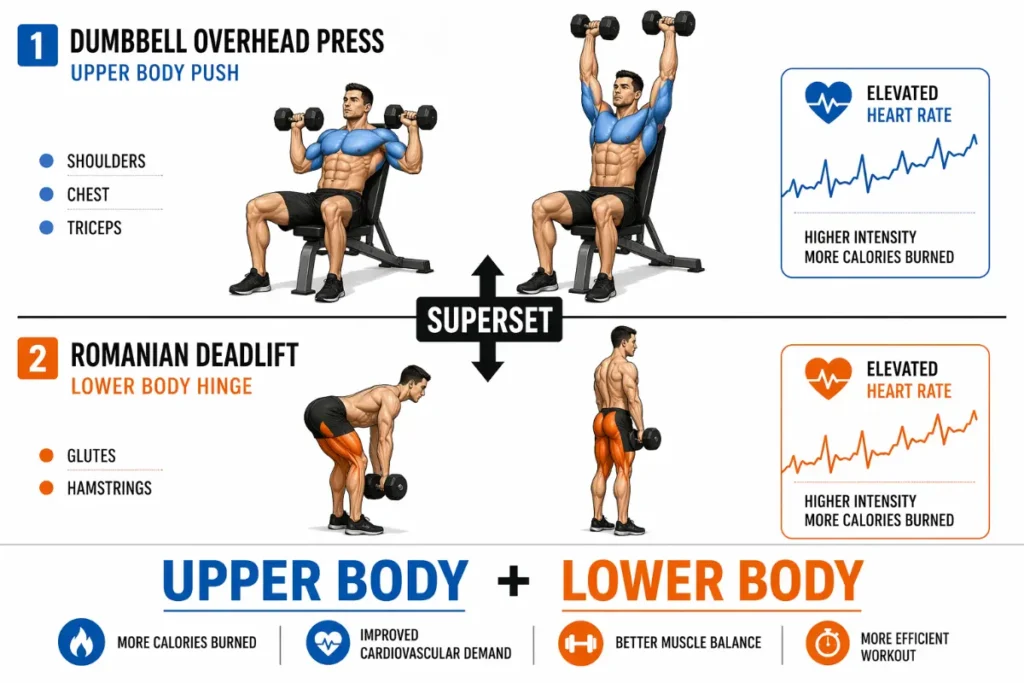
You pair an upper body exercise with a lower body exercise. The muscle groups don’t overlap, so neither is compromised and your heart has to pump blood continuously between upper and lower body, keeping heart rate elevated throughout the session.
This is the basis of Peripheral Heart Action (PHA) training. For anyone training for body composition, upper-lower supersets build muscle and improve conditioning simultaneously without a separate cardio session.
Example pairs:
- Dumbbell chest press → Romanian deadlift
- Seated cable row → Leg press
- Overhead press → Walking lunge
3. Isolation-compound supersets
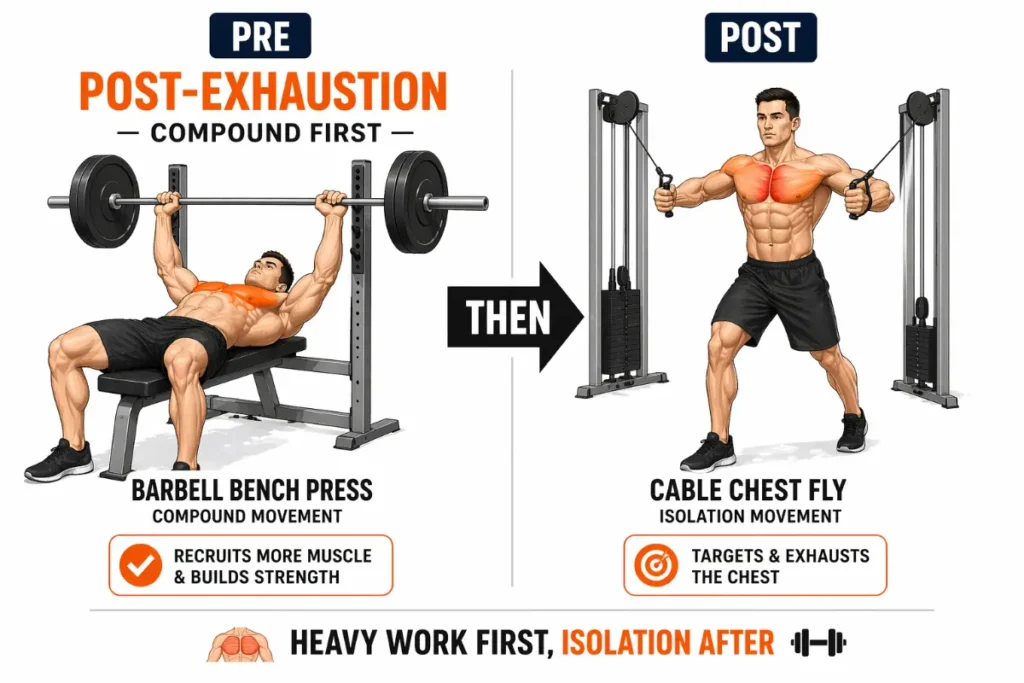
This format pairs exercises that target the same muscle group in a deliberate sequence.
Post-exhaustion (compound first): Bench press → Cable fly. Heavy work done fresh, isolation adds metabolic stress to an already-fatigued muscle. More reliable for hypertrophy compound quality is preserved.
Pre-exhaustion (isolation first): Cable fly → Bench press. Pre-fatigued chest theoretically shifts more demand to the shoulders and triceps during the compound. The research is mixed on whether the recruitment shift actually occurs it’s a legitimate technique but not one to build a program around.
This format belongs in dedicated body-part splits. Not in full-body sessions where the same muscle group needs to perform again later.
What About Tri-Sets and Giant Sets?
Once you move past two exercises back-to-back, the naming changes. A tri-set chains three exercises with no rest between them. A giant set chains four or more. The structure is the same as a superset — move from one exercise to the next without stopping — but the metabolic demand and recovery cost increase with each exercise you add.
A chest-focused giant set might look like this: flat dumbbell press × 10, cable crossover × 12, machine chest press × 10, then push-ups to failure. No rest until all four exercises are done. Rest 2–3 minutes, then repeat for 2–3 total rounds. That’s usually enough — giant sets drain more energy per round than most people expect, and adding rounds beyond three rarely adds stimulus without digging into next-session recovery.
Giant sets work best during hypertrophy blocks or when your training time is cut short and you need to hit one muscle group hard and fast. They don’t suit strength work because the accumulated fatigue forces weight down too far — by exercise three or four, the load you can handle is light enough that mechanical tension drops below what drives strength adaptation.
For most lifters, supersets cover the time-efficiency need. Tri-sets and giant sets are a step up in intensity that earns its place only when supersets alone stop producing results on a lagging body part.
What Are the Benefits of Supersets?
You save time without losing volume. The Zhang et al. meta-analysis confirmed supersets cut training time by up to 50% while keeping sets, reps, and load identical.
Metabolic stress increases. Supersets produce higher blood lactate concentrations than traditional sets — a direct marker of metabolic stress that contributes to muscle growth. You’re not doing the same work faster. You’re creating a stronger stimulus per unit of time.
Conditioning improves without extra cardio. Compressed rest keeps heart rate elevated throughout. Upper-lower and push-pull supersets, in particular, generate enough cardiovascular demand to meaningfully improve aerobic capacity without stepping on a treadmill.
EPOC increases. The elevated training intensity creates an oxygen deficit that your body repays for hours after the session. More calories burned at rest, after you’ve already left the gym.
What Are the Disadvantages of Supersets?
Supersets are not a universal upgrade to traditional training — there are specific conditions where they work against you.
Maximal strength suffers. A 2024 randomized controlled trial by Iversen et al. in the Journal of Strength and Conditioning Research found that traditional set groups gained significantly more strength than superset groups over 10 weeks on the same exercises. For 1RM improvements, full recovery between sets produces better results. Compressed rest limits force output and force output is what drives maximal strength adaptation.
Recovery demand is higher. Supersets generate more severe muscle damage and higher perceived exertion than traditional sets at matched volume. The session feels manageable the 48–72 hours after tell a different story. If you run superset-heavy sessions back-to-back on the same muscle group, recovery won’t keep pace.
Form breaks down under fatigue. Back-to-back sets with compressed rest accelerate fatigue faster than the load alone would suggest. By round three or four, bar path drifts, range of motion shortens, and the movement you’re repping out bears little resemblance to what you did on round one.
Beginners need more time to adapt. Learning correct movement patterns under accumulating fatigue is harder than learning them under controlled rest. Reinforce poor mechanics early and you spend months correcting what should have been right from week one.
Are Supersets Good for Building Muscle?
Yes provided the format and pairing are right.
The metabolic demand supersets create is genuinely useful for hypertrophy. The metabolic demand supersets create drives blood lactate up and keeps muscles under sustained tension — both of which contribute to the growth stimulus. Push-pull and upper-lower formats are the most reliable because neither muscle group enters its working sets already fatigued.
| Variable | Target for Hypertrophy |
|---|---|
| Rep range | 8–12 per exercise |
| Rest between pairs | 60–90 seconds |
| Sets per exercise pair | 3–5 |
| Load selection | 10–15% lighter than your straight-set weight |
That last point matters more than most people expect. Drop 10–15% off what you’d normally use for a straight set on round one. By round three, with compressed rest and back-to-back loading, that reduction is what keeps your mechanics and rep quality intact. Build it back over 3–4 sessions as your body adapts to the density.
Where Should Supersets Go in Your Session?
Supersets belong in the middle and end of your session. Not at the start.
Do your primary lifts first as straight sets with full recovery. Squats, deadlifts, bench press, overhead press these movements require maximal neuromuscular output. The fatigue from compressed rest and back-to-back loading degrades force production on every heavy set that follows. If you superset your primary lifts, you’re not just making those sets harder you’re systematically reducing what your main movements can produce.
Once the heavy work is done, superset your assistance exercises. Lower load, lower technical demand, lower consequence if form degrades slightly.
Someone who starts supersetting from exercise one, then wonders why their main lift feels flat by session four this is why. Primary lifts first, straight sets. Everything after, superset.
How Do Supersets Improve Workout Efficiency?
The efficiency gain is mechanical. Your rest for Exercise A happens while you’re performing Exercise B. Neither exercise loses volume. Neither exercise loses load. The time between sets is simply repurposed.
A session with 4 exercises, 4 sets each, 90 seconds rest after each set traditionally takes approximately 60–70 minutes. The same session programmed as two superset pairs takes 35–40 minutes. The difference isn’t from rushing. It’s from eliminating passive rest.
That efficiency gain applies fully only when exercises are correctly paired if the same primary muscle group is doing both exercises, neither gets recovery and you’ve traded time for quality you don’t get back.
How Often Can You Use Supersets?
Greater metabolic stress means greater recovery demand between sessions. The Zhang et al. (2025) meta-analysis confirmed supersets produce significantly higher blood lactate than traditional sets — lactate is a direct marker of how much the body has to clear before the next session is productive.
Practically: 48–72 hours before training the same muscle groups again when you’ve run a superset-heavy session. Your warm-up performance in the next session tells you more about readiness than soreness does if your first working sets feel measurably heavier than they should at familiar weights, you haven’t recovered.
When transitioning to superset-heavy programming, drop frequency by one session in the first 3–4 weeks. Once recovery adapts, add it back. Jumping straight to the same weekly frequency as traditional training is one of the more reliable ways to stall progress.
Who Should and Shouldn’t Use Supersets?
Supersets suit:
- Intermediate to advanced lifters with limited training time you have the movement foundation to maintain form under fatigue
- Anyone training for hypertrophy or body composition the metabolic demand directly supports both goals
- Athletes maintaining conditioning alongside strength work compressed rest keeps cardiovascular fitness up without adding separate cardio sessions
- Adults over 50 training for general fitness the aerobic demand from upper-lower pairs provides cardiovascular benefit that resistance training alone doesn’t generate
Use with caution or avoid:
- Complete beginners still learning movement patterns fatigue accelerates form breakdown before mechanics are established; 8–12 weeks of traditional sets first
- Anyone in a strength peaking or competition prep phase maximal force output requires full recovery between sets, which supersets don’t allow
- Anyone recovering from injury where controlled, full-rest loading is prescribed
- Anyone whose primary goal is a 1RM improvement the Iversen et al. (2024) trial confirmed traditional sets produce meaningfully greater strength gains
What Are the Biggest Superset Mistakes?
Pairing exercises that share a primary muscle group. Romanian deadlifts paired with leg curls, bench press paired with skull crushers both exercises load the same tissue. Neither gets recovery, fatigue accumulates on the same muscle, and the pairing defeats its own purpose.
Going too heavy on round one. You’ll feel fine. By round three, bar path is drifting and the movement you’re counting as a rep barely qualifies. Start lighter than your straight-set weight and earn it back over sessions.
Skipping the warm-up. Supersets keep working intensity higher throughout the session. Joints and stabilizers need more preparation going in, not less. Dynamic mobility work for the relevant joints plus at least one activation set per muscle group before loading.
How to Program Supersets Into Your Training Week?
Superset everything and you’ll either exhaust yourself or compromise your primary lifts. The better approach is selective identify the pairs in your current program that make logical sense, superset those, and leave primary lifts as traditional sets.
A practical framework for a four-day program:
Days 1 and 3 — upper body:
- Primary lifts (bench press, row, overhead press, pull-up) straight sets, full recovery
- Assistance work push-pull supersets matched by plane (cable fly + face pull, lateral raise + rear delt fly)
Days 2 and 4 — lower body:
- Primary lifts (squat, deadlift, hip hinge variation) straight sets
- Assistance work upper-lower supersets (leg curl + dumbbell curl, leg extension + tricep pushdown)
Start with 2–3 superset pairs per session. Over 4–6 weeks, add a fourth pair, reduce rest by 10–15 seconds, or increase load based on what your training goal requires that block.
For how supersets compare directly to drop sets and pyramid sets in terms of muscle growth and time efficiency, that comparison is covered in drop sets vs supersets vs pyramid sets.
Frequently asked questions
Does a superset reduce training volume or just time?
Time drops volume doesn’t. If your program calls for 4 sets of bench press and 4 sets of rows, you complete exactly that. The rest for each exercise happens during the other’s working set.
What are the disadvantages of supersets?
Maximal strength development suffers compared to traditional sets with full recovery. Recovery demand between sessions is higher. Form breakdown accelerates under compressed rest. Beginners risk reinforcing poor mechanics before they’ve established correct ones.
Can beginners do supersets?
With caution. Learn correct movement patterns under controlled rest first typically 8–12 weeks of traditional sets. Then introduce push-pull pairs with lighter loads than you think you need.
Are supersets better than circuits for fat loss?
They serve different purposes. Supersets maintain heavier loads and target specific muscle groups while raising metabolic demand. Circuits chain four or more exercises and prioritize cardiovascular output. For fat loss with muscle retention, supersets are typically the stronger choice.
Why can’t you superset squats and deadlifts?
Both load the same muscles — quads, glutes, hamstrings — so neither recovers while the other works. But there’s a second problem most people miss: both are heavy spinal loading exercises. Back-to-back sets of squats and deadlifts compress the spine under heavy load without any decompression break, which increases lower back injury risk beyond what muscle fatigue alone would suggest. Pair either one with an upper-body exercise instead
