

Key Takeaways
- Dumbbell training can fully develop every head of the deltoid and every biceps muscle — the limiting factor is technique and programming, not equipment.
- The standing dumbbell press outperforms the seated version because it keeps the scapulae free to rotate, which is a prerequisite for safe overhead loading.
- Most lifters neglect the rear delt and brachialis entirely. Both absences have direct consequences for posture, strength ceiling, and arm development.
- Form breaks down before strength does — getting the load right from day one saves months of wasted effort.
- Progressive overload with dumbbells is a 10 lb total-load jump per increment — not 5 lb. Understanding this changes how you program weight increases.
- Introduction
- Section 1: Before you pick up a dumbbell — equipment and starting weight
- Section 2: Understanding the muscles — what you're actually training
- Section 3: Warm-up — 5 minutes that make every session safer
- Section 4: Exercise technique — form, cues, and what goes wrong
- Section 5: Goal-based programming — how to train based on what you actually want
- Section 6: Common mistakes and how to fix them
- Section 7: Training with shoulder injuries — what to keep, what to skip
- FAQs
- Wrap-up
Introduction
If you want to learn how to perform curls and delt training with dumbbells and build stronger, fuller shoulders with thicker arms, this is the complete system — not a list of exercises. It covers anatomy, exercise technique, goal-based programming, injury modifications, and direct answers to the questions that actually matter.
Whether you train at home or in a gym, every principle here applies. All you need is a pair of adjustable dumbbells.
After 7+ years of coaching clients through dumbbell-only shoulder and arm programs, I’ve seen the same gaps appear repeatedly: pressing without any rear delt work, curling with too much body swing, and jumping weight before form deserves the increase. This guide addresses all of it, with the research behind every recommendation.
Section 1: Before you pick up a dumbbell — equipment and starting weight
This section takes two minutes to read and saves you weeks of doing the wrong thing with the wrong weight.
Equipment you need: One pair of adjustable dumbbells. No bench, no cables, no machines required. A quality set covering 5–50 lb handles every exercise in this guide.
How to choose your starting weight
Most beginners go too heavy on their first session and don’t realize it until form collapses. Use this framework before your first rep:
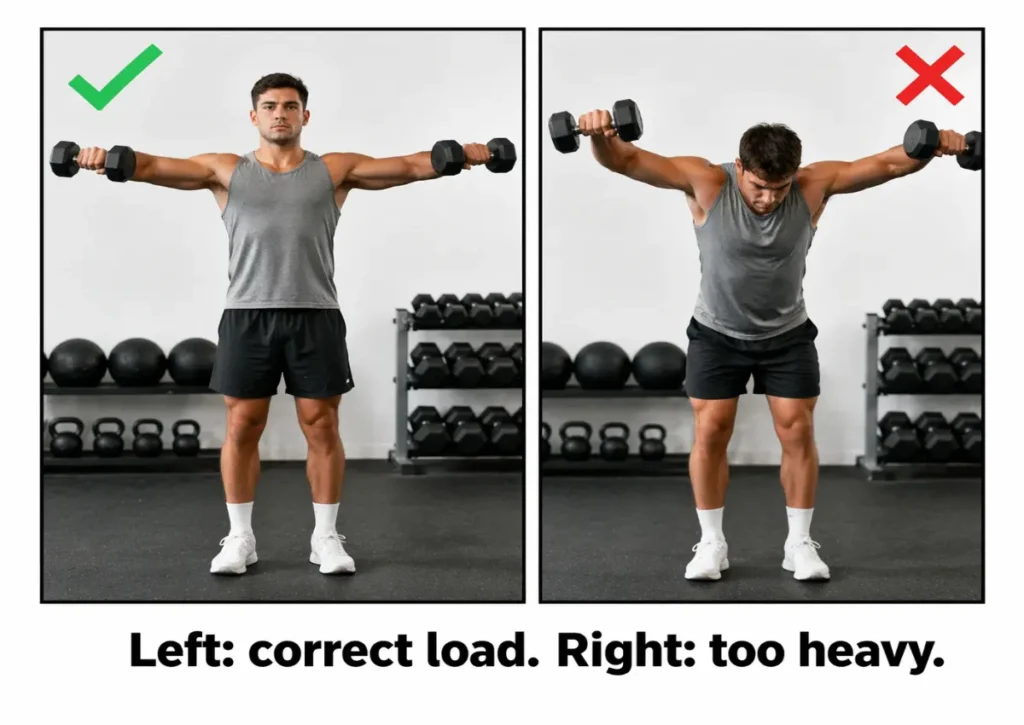
- Lateral raises: Pick a weight you can lift for 12 clean reps with zero body swing. For most beginners, that’s 8–15 lb — lighter than expected.
- Overhead pressing: Use a weight that allows 10 clean reps without leaning back on the last two.
- Curls: Your upper arms must stay pinned to your sides through every rep. The moment your elbows drift forward or your torso swings, you’ve exceeded your working weight.
If any of those cues break down, drop 5 lb and start again.
What the research says about dumbbells vs barbells
A 2013 study by Saeterbakken and Fimland in the Journal of Strength and Conditioning Research confirmed that dumbbell pressing produces comparable deltoid activation to barbell pressing — with one added advantage. Each shoulder moves through its own natural arc independently, which reduces compensation patterns and places more demand on the rotator cuff and stabilizing muscles. Long-term, that makes your shoulders more resilient, not just stronger.
Section 2: Understanding the muscles — what you’re actually training
You don’t need a degree in anatomy. You need to know which muscle does what so you can stop accidentally skipping one of them — which most lifters do every single session.
The three deltoid heads — and why skipping one creates problems
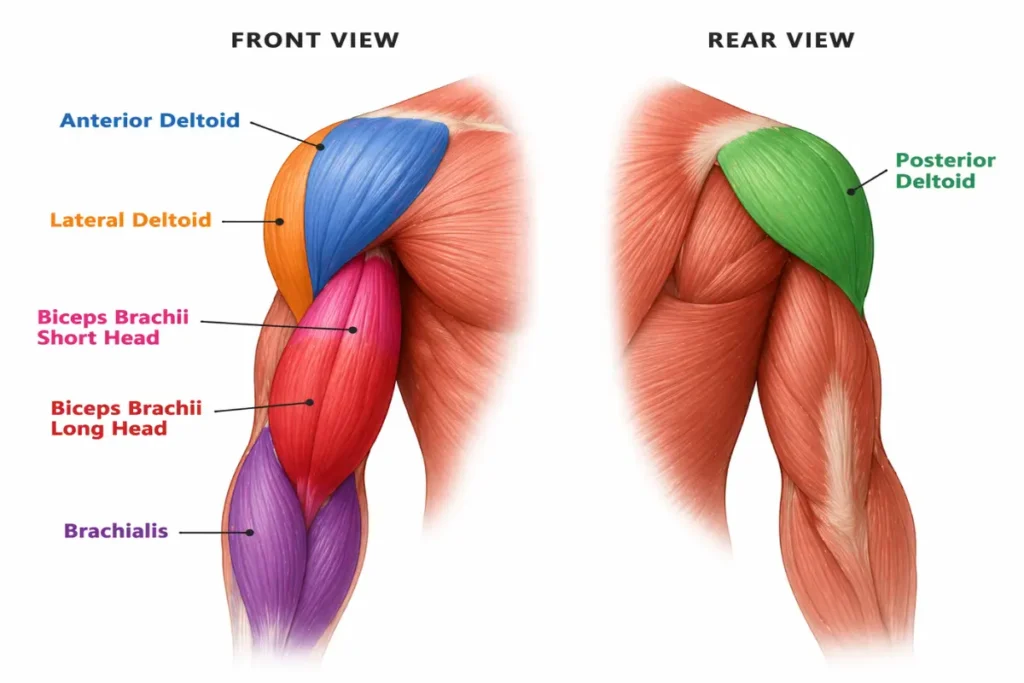
The anterior deltoid is the front head. It handles forward arm flexion and assists in virtually every pressing movement. If you press regularly for both chest and shoulders, your anterior deltoid is almost certainly the most-trained head you have. Dedicated front raise work is rarely necessary.
The lateral deltoid is the middle head and the primary driver of shoulder width. It abducts the arm out to the side. Pressing movements don’t load it adequately — lateral raises in their various forms are the only reliable way to develop it directly.
The posterior deltoid is the rear head. It extends the arm and assists with external rotation. This is the most neglected head in most programs because it’s not visible in a mirror. Neglecting it creates a real imbalance: posture problems, elevated impingement risk, and a ceiling on your pressing strength.
A complete shoulder session requires dedicated work for all three heads. One pressing movement and a few sets of lateral raises is not a complete shoulder workout. If you want to understand how training volume affects each head differently, see our guide on sets per muscle group for hypertrophy.
The biceps and what actually makes arms look bigger
The biceps brachii has a long head and a short head. The long head runs along the outer arm and creates the peak you see when flexing. The short head sits on the inner side and adds width. Both perform elbow flexion — but actively rotating the palm upward during the curl (supination) specifically loads the long head more.
Underneath both heads sits the brachialis — a separate elbow flexor that, when developed, physically pushes the biceps upward. This makes the arm look thicker from every angle, not just the front. Hammer curls and neutral-grip variations target it more directly than standard supinating curls.
A third muscle worth knowing: the brachioradialis, which runs along the outer forearm. Hammer curls and reverse curls engage it more than standard curls do. Developing it adds forearm thickness and supports grip strength.
In my experience, arm development stalls most often when someone has been doing the same curl variation for months. The brachialis is almost always the missing stimulus. I switch clients to hammer curls for 3–4 weeks and the arm thickness change is visible within a cycle.
The scapular plane and scapular-humeral rhythm — two concepts that protect your shoulders
The scapular plane is the natural resting angle of the shoulder blade — roughly 30 degrees forward from the body’s frontal plane. When you press with your elbows in this plane (slightly in front of the torso, not flared directly out), the shoulder joint works at its best mechanical advantage. Impingement risk drops and force output increases.
Scapular-humeral rhythm is the coordinated movement between the shoulder blade and upper arm during elevation — for every 2 degrees the arm rises, the scapula rotates 1 degree upward. When you sit against a bench to press overhead, the bench blocks the scapula from rotating freely. That disrupted rhythm is what produces the pinching and chronic soreness many seated pressers develop over time.
The NSCA identifies free scapular movement as a prerequisite for safe overhead loading. This is the biomechanical case for standing presses over seated ones — and it matters every single session.
Section 3: Warm-up — 5 minutes that make every session safer
The goal is threefold: raise tissue temperature, activate the rotator cuff, and prepare the scapular stabilizers before any load goes overhead.
Rotator cuff activation before loading
The rotator cuff — supraspinatus, infraspinatus, teres minor, and subscapularis — stabilizes the humeral head in the socket. When it’s cold before heavy loading, larger muscles compensate and the joint absorbs force it’s not designed to handle.
Two drills that reliably activate it before training:
- Light dumbbell external rotations: Elbow bent at 90 degrees, pinned to your side. Rotate your forearm outward slowly for 15 reps per side. Use 2–5 lb.
- Prone Y-T-W raises: Face down on the floor or bench. With bodyweight or 2–3 lb, raise your arms into a Y shape, then a T, then a W (elbows bent, pulled back). 8 reps in each position.
Scapular wall slides
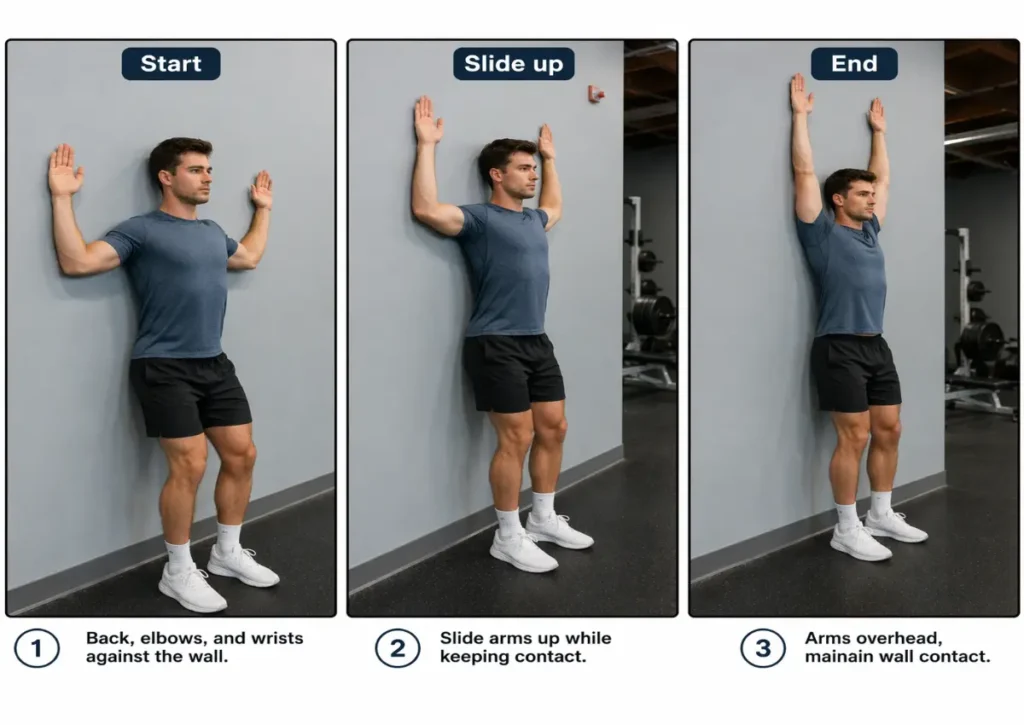
Stand with your back flat against a wall, arms at 90 degrees, elbows and wrists touching the surface. Slide both arms overhead while keeping all four contact points on the wall. This trains the serratus anterior — the muscle along your ribcage that controls scapular upward rotation — and the lower traps. Both are critical for safe pressing.
Add 10 scapular push-ups (no elbow bend, just protract and retract the shoulder blades) to reinforce scapular control before loading.
The full 5-minute sequence — run this before every session
| Order | Drill | Duration/Reps |
|---|---|---|
| 1 | Arm circles | 30 sec forward, 30 sec backward |
| 2 | Cross-body shoulder stretch | 20 sec each arm |
| 3 | Scapular wall slides | 2 sets × 10 |
| 4 | Light dumbbell external rotations | 2 sets × 15 each side |
| 5 | Prone Y-T-W raises | 2 rounds × 8 each position |
| 6 | Warm-up set at 50% of working load | 15 reps |
Under 5 minutes. No exceptions.
Section 4: Exercise technique — form, cues, and what goes wrong
This is the section most guides put last. It’s here first because correct form is what determines whether the programming in the next section actually produces results.
Each exercise below includes the technique, the one cue that matters most, and the most common error.
Shoulder exercises
Standing dumbbell press
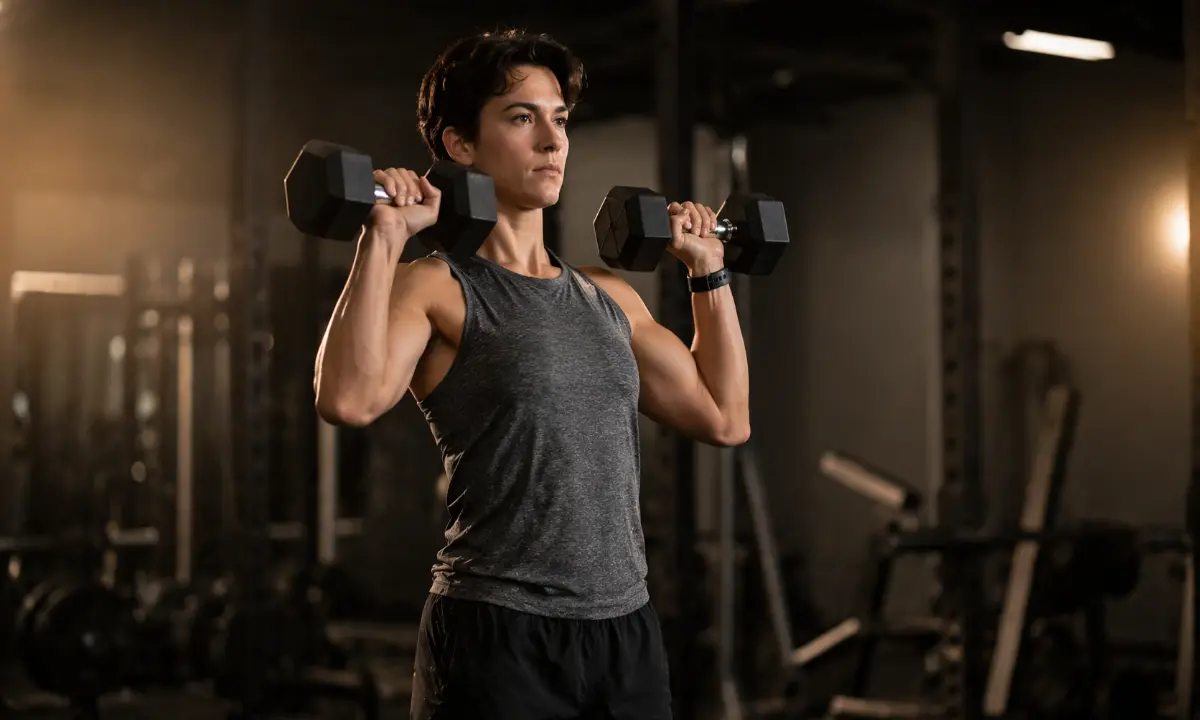
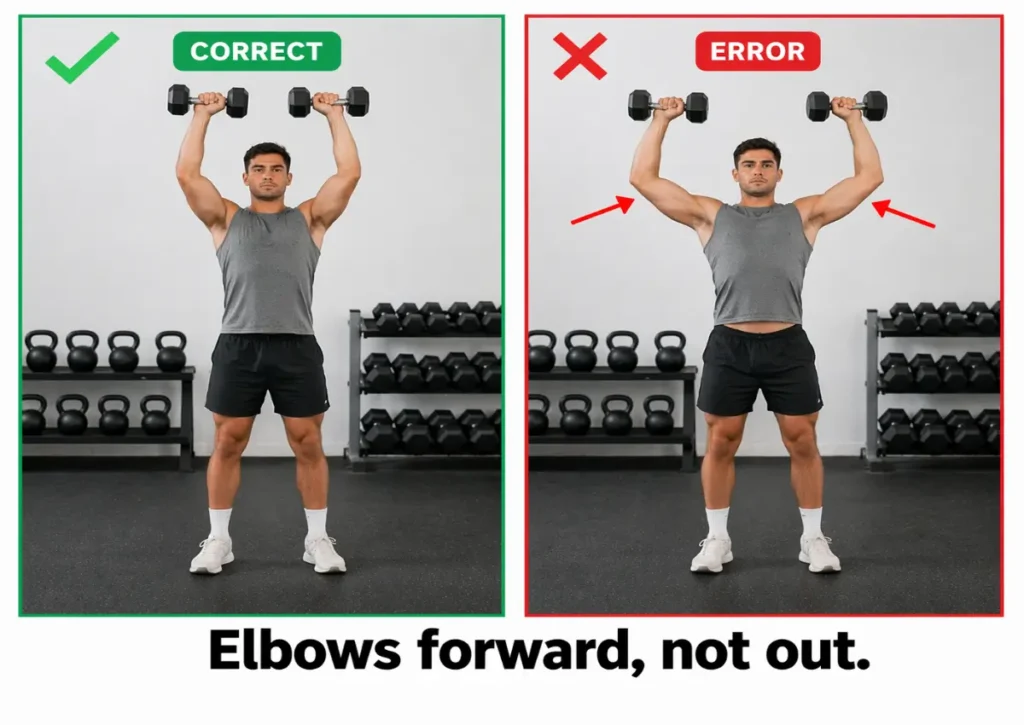
Stand with feet shoulder-width apart, dumbbells at shoulder height, palms facing each other or forward. Pull your ribs down and brace your core before the first rep. Press both dumbbells simultaneously overhead — let the elbows find a natural position slightly in front of your torso, not flared out to the sides. Lower under control.
The cue that matters most: If your lower back arches on the press, the weight is too heavy.
Most common error: Pressing with elbows flared wide — this takes the shoulder out of the scapular plane and increases impingement risk on every rep.
Arnold press
Start with dumbbells at chest height, palms facing you — as if finishing a curl. As you press overhead, rotate the dumbbells so palms face forward at full extension. Lower in reverse.
The cue that matters most: Keep the rotation fluid throughout the press — don’t stage it in two separate movements.
Most common error: Using the same load as your standard press. The rotation reduces the safe working weight by 10–15%. Drop the load accordingly.
Lateral raise
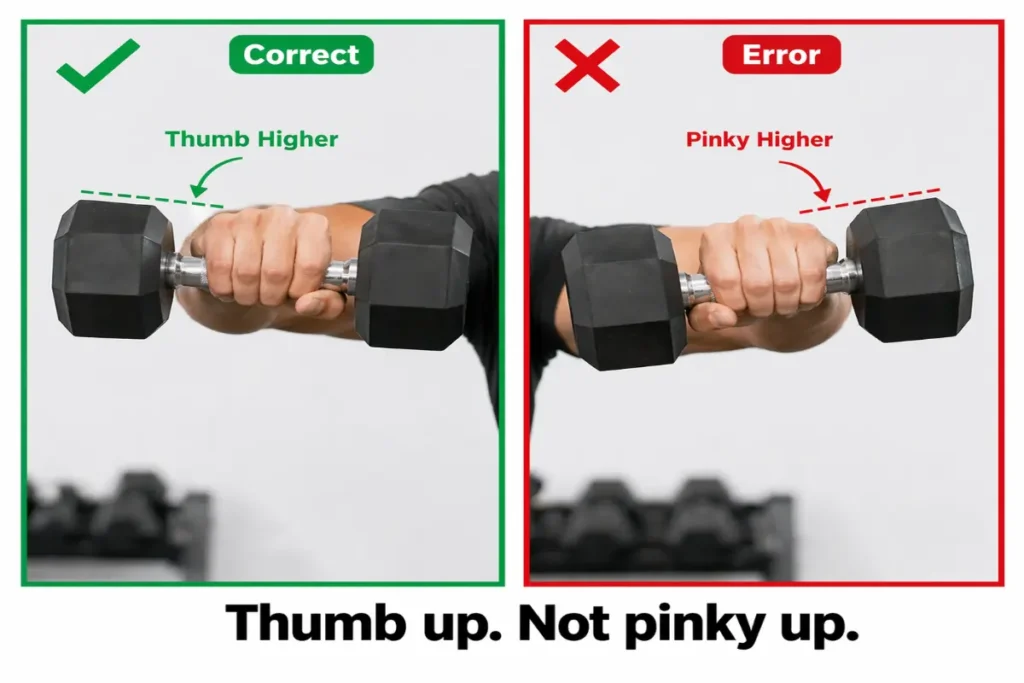
Hold dumbbells at your sides. Raise both arms out to the side until parallel with the floor — no higher. Keep your thumb at least as high as your pinky at the top of the movement. Internally rotating the shoulder so the pinky leads narrows the subacromial space and increases impingement risk on every rep.
Pause briefly at the top and lower over 2–3 seconds.
Most common error: Going too heavy and using body momentum to swing the weight up. The lateral deltoid is a small muscle — it responds to controlled, high-rep work, not heavy loads with momentum.
Dumbbell push press
Bend your knees slightly, then push your hips back — load the glutes, not the quads. Then drive everything forward and upward simultaneously: hips extending, legs straightening, arms pressing. One fluid motion.
The cue that matters most: The drive should feel like it starts from your rear end and travels up through your core into the press. If you feel it only in your legs, you’re squatting — not hinging.
Most common error: Only bending the knees. A knee bend loads the quads. The hip hinge loads the glutes, which produce far more drive.
Rear delt fly (bent-over)
Hinge forward at the hips until your torso is roughly parallel to the floor. Hold dumbbells hanging straight down, palms facing each other. Raise both arms out to the sides until parallel with the floor, leading with your elbows. Squeeze the rear delts at the top. Lower slowly.
The cue that matters most: Lead with your elbows, not your hands. If your hands lead, the movement turns into a lateral raise — and the rear delt loses its primary role.
Most common error: Not hinging far enough forward. The more vertical your torso, the less the rear delt is loaded.
The Urlacher rear delt movement
Stand with dumbbells at your sides, palms facing in. Simultaneously open your chest, retract your shoulder blades, externally rotate both arms, and drive them back and wide to hip height. Palms face upward at the end position. Hold one second at the back. Return slowly.
The cue that matters most: The external rotation must happen at the same time as the backward drive — not after it. Without it, this becomes a partial rear delt row and the posterior chain benefit drops significantly.
Best for: Lifters who want to train rear delts, rotator cuff, rhomboids, and upper traps in one coordinated movement. For strict isolated rear delt activation, use the bent-over rear delt fly instead.
Prone floor press (face pull substitute)
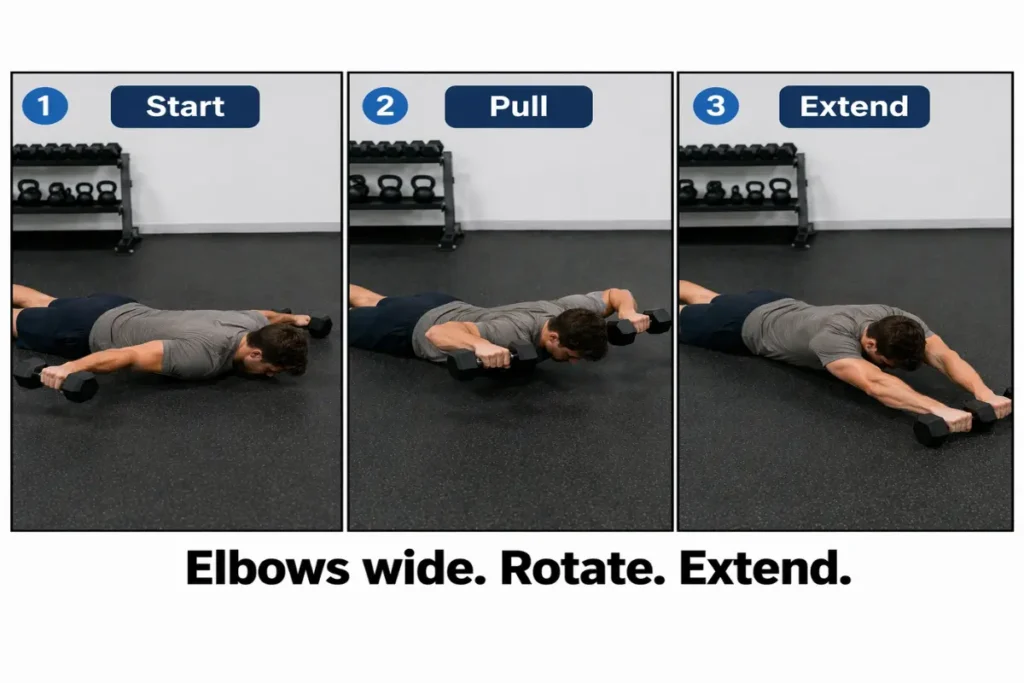
Lie face down on the floor, hold very light dumbbells (2–5 lb). Pull both dumbbells toward your face with elbows wide, externally rotate at the top, extend overhead, then lower slowly back to the start.
The cue that matters most: Use very light weight. This is a corrective drill, not a strength exercise. If you feel it in the upper traps instead of the mid-back and rear delts, the weight is too heavy.
Use this: 2–3 times per week at the end of your session, as a direct replacement for cable face pulls.
Biceps curl exercises
Dumbbell curl (standard)
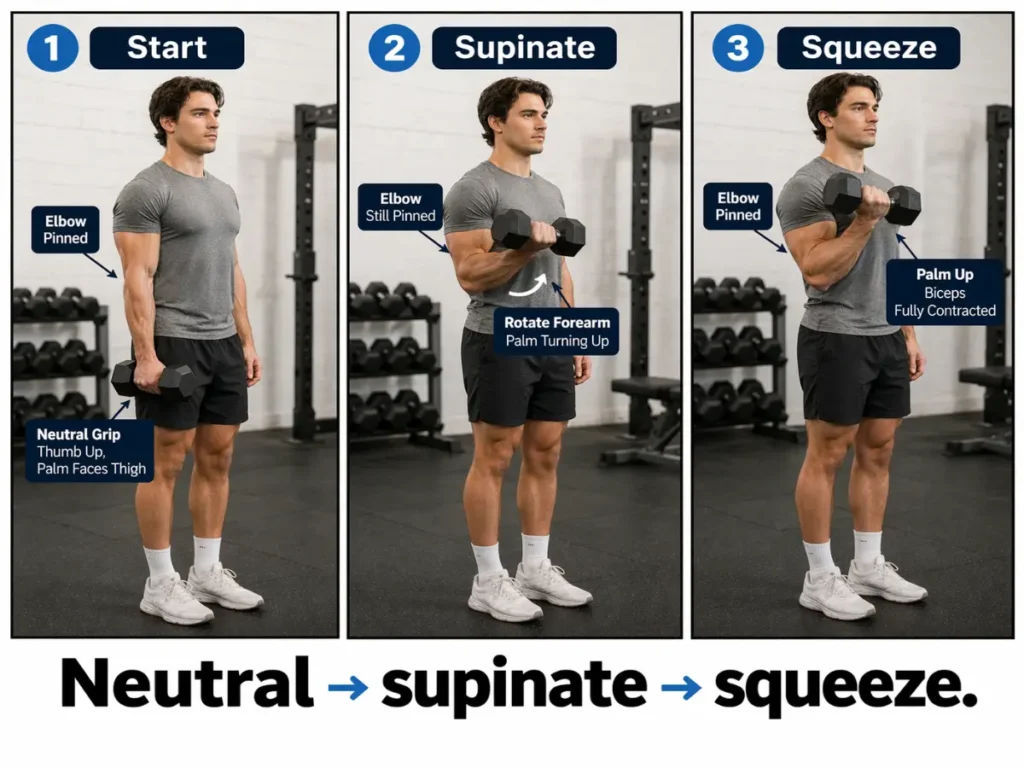
Pin your elbows to your sides and keep them there throughout. Start with a neutral grip (thumb up). As you pass the halfway point of the curl, rotate your forearm until the palm faces fully upward. Squeeze at the top for 1–2 seconds. Lower slowly over 2–3 seconds to full extension without locking the elbow.
The cue that matters most: The supination (rotation) must happen on the way up — not at the top as an afterthought. That rotation is what loads the long head of the biceps.
Most common error: Torso swinging on the concentric phase. When your torso swings to help complete a rep, your spinal erectors are doing the work — not your biceps. Most lifters who think they curl 35s are genuinely curling 25s with a 10 lb body swing supplement. Drop the weight. Still torso, every rep.
Hammer curl
Neutral grip throughout — thumb up, palm facing in for the entire movement. No supination. Raise until the dumbbell reaches shoulder height. Lower slowly.
Best for: Brachialis and brachioradialis development. When arm thickness (not peak) is the goal. 3–4 sets of 10–12 reps.
Incline dumbbell curl
Set a bench to 45 degrees. Sit back so your arms hang slightly behind your torso at the bottom — this stretches the long head of the biceps before the curl even begins. Curl from this stretched position to full contraction at the top.
Why it’s effective: A 2021 study by Kassiano et al. confirmed that training through a longer range of motion — particularly loading the stretched position — produces greater hypertrophy than partial-range work. The incline curl achieves this automatically by positioning the arm behind the body at the bottom.
Best for: Building biceps peak. Add 2–3 sets when peak development is a specific goal.
Zottman curl
Supinate (palm up) on the concentric phase — same as a standard curl. At the top, pronate (rotate palm down) before lowering. Lower with a reverse grip. Supinate again at the bottom before the next rep.
Best for: Loading the biceps on the way up and the brachioradialis on the way down — both elbow flexors in one movement. Efficient when training time is short.
Concentration curl
Seated. Rest the back of your upper arm against your inner thigh. Curl one dumbbell at a time with full control. No torso movement possible.
Best for: Building or restoring mind-muscle connection to the biceps. Use this when you can’t feel the biceps working during standard curls — it teaches the contraction pattern better than any other variation.
Section 5: Goal-based programming — how to train based on what you actually want
Now that you know how to execute every exercise correctly, this section tells you how to combine them — based on your goal.
Now that you know how to execute every exercise correctly, this section tells you how to combine them — based on your goal. If you’re new to the concept of reps and sets altogether, read our guide on what are reps and sets before going further — it’ll make every table below immediately clear.
The rep range and rest reference
| Goal | Reps | Sets | Rest |
|---|---|---|---|
| Strength | 6–8 | 3–4 | 2–3 min |
| Power | 7–8 (explosive) | 3–4 | 2–3 min |
| Hypertrophy | 8–12 | 3–4 | 60–90 sec |
| Endurance/corrective | 12–15 | 2–3 | 30–60 sec |
Training for strength
For shoulder strength, the standing dumbbell press is your anchor movement — 6–8 reps, 3–4 sets, 2–3 minutes rest. Apply the dumbbell weight jump rule before you add load:
| Equipment | Increase per side | Total load increase |
|---|---|---|
| Barbell (+2.5 lb plate each side) | +2.5 lb | +5 lb |
| Dumbbells (25s → 30s) | +5 lb per hand | +10 lb |
That’s a bigger jump than most people account for. Add reps at your current weight before moving up. Hit 10 clean reps, then increase load at your next session and work back from 6.
For curl strength — same principle. Work in the 6–8 rep range. Full range of motion on every rep: complete extension at the bottom, full contraction at the top.
Training for power
Power requires leg involvement. The dumbbell push press is the primary tool — 7–8 explosive reps per set, 2–3 minutes rest. Stop the set the moment drive speed drops.
For a complete ground-to-overhead movement, the dumbbell power clean-over covers the entire kinetic chain: clean one dumbbell from the floor to one shoulder, press it overhead, lower it cross-body to the opposite shoulder. 3–4 rounds of this alone makes a demanding full-body session when time is short.
For curl power: fast concentric, 2–3 second eccentric. Use a weight that allows 6–8 fast reps with zero body swing or elbow flare.
Training for hypertrophy
Building muscle requires mechanical tension alongside metabolic stress. According to Dr. Brad Schoenfeld’s research, metabolic stress functions primarily as an amplifier of mechanical tension — and continuous effort under load without rest is what keeps that stimulus elevated. That’s the mechanism behind the two methods below.
Method 1 — Cheat lateral raise into strict lateral raise: Pick a dumbbell heavier than your strict lateral raise weight. Use a small body swing to get it to shoulder height — cheat only on the way up. Lower slowly over 3–4 seconds. Once exhausted, immediately pick up a lighter dumbbell and continue with strict lateral raises to failure. No rest between the two weights.
Method 2 — Mechanical drop set (4 exercises, no rest between):
- Fixed Arm Front Raise — elbow locked at 90 degrees, raise straight up. To failure.
- High Pull — hands lead, elbows trail, external rotation at the shoulder. Not an upright row. To failure.
- Figure 8 — hold one dumbbell with both hands extended, trace a figure-8 pattern. To failure.
- Dumbbell Press Out — hold at chest, press straight out and return. To final failure.
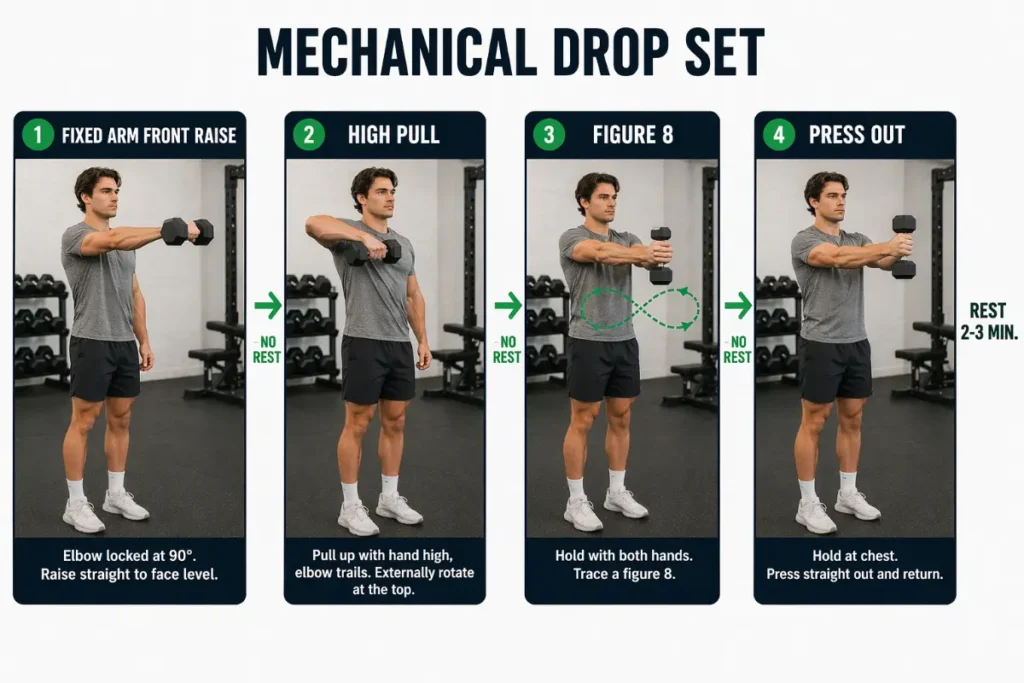
Full rest (2–3 min) after completing all 4. No rest within the sequence.
The set doesn’t begin until it burns. At that point, you push through it — not away from it.
For biceps hypertrophy: Start with the standard supinating curl (8–12 reps). Add 2–3 sets of incline curls for peak development. Rotate in hammer curls for brachialis thickness. Run the Arnold press on hypertrophy days for anterior and medial delt development.
Complete weekly programs
Beginner — 2 days per week (Monday and Thursday):
| Exercise | Sets | Reps |
|---|---|---|
| Standing dumbbell press | 3 | 10–12 |
| Dumbbell lateral raise | 3 | 12–15 |
| Rear delt fly (bent-over) | 3 | 12–15 |
| Dumbbell curl | 2–3 | 10–12 |
| Prone floor press | 2 | 15 |
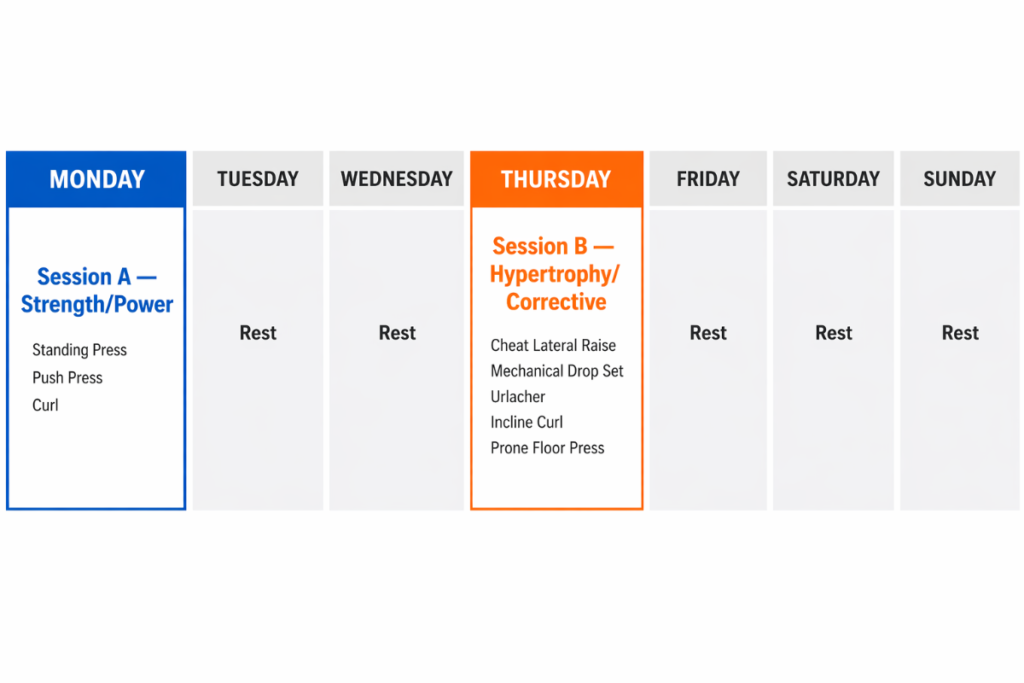
Intermediate — Session A (Monday, strength/power focus):
| Exercise | Sets | Reps | Tempo |
|---|---|---|---|
| Standing dumbbell press | 4 | 6–8 | Controlled |
| Dumbbell push press | 3 | 7–8 | Explosive |
| Dumbbell curl | 3 | 6–8 | Controlled |
Intermediate — Session B (Thursday, hypertrophy/corrective focus):
| Exercise | Sets | Reps |
|---|---|---|
| Cheat lateral raise → strict lateral raise | 3 rounds | To failure |
| Mechanical drop set (Front Raise → High Pull → Figure 8 → Press Out) | 2–3 rounds | To failure per movement |
| Urlacher | 3 | 12–15 |
| Incline dumbbell curl | 3 | 10–12 |
| Prone floor press | 2 | 15 |
How to keep progressing when you’ve maxed your dumbbell set
Four tools when you’ve hit your maximum available load:
- Slow the eccentric — lower over 4–5 seconds instead of 2. Same load, more time under tension.
- Add a peak contraction hold — hold the top position for 2–3 seconds on each rep.
- Reduce rest periods — cut 15–20 seconds per rest period to increase density.
- Add reps — push from 8 to 12 reps before calling the weight maxed out.
The NSCA’s Essentials of Strength Training and Conditioning recognizes time under tension and density manipulation as valid progressive overload variables — not workarounds.
Superset pairings for time efficiency
Shoulders and biceps don’t compete for the same blood flow or neural drive. They superset cleanly:
- Standing dumbbell press → dumbbell curl
- Lateral raise → hammer curl
- Rear delt fly → incline dumbbell curl
Superset format cuts total session time by 20–30% without reducing volume or quality. Our guide on training frequency per muscle group explains how to fit these sessions into a full weekly split.
Section 6: Common mistakes and how to fix them
Swinging on curls
When your torso swings to complete a rep, your spinal erectors are doing the work — not your biceps. The body keeps routing work away from the biceps because the swing is more efficient. Drop the weight until every rep is completed with a completely still torso.
Elbow drift in pressing
Elbows drifting directly out to the sides during overhead pressing puts the shoulder at its most vulnerable angle for impingement. Let the elbows sit slightly in front of the body throughout the press. This is a motor pattern problem — drop the weight and rebuild the pattern before adding load.
Pinky-leading on lateral raises
Internally rotating the shoulder during a lateral raise narrows the subacromial space. Thumb must be at least as high as the pinky at the top of every rep. If you feel pinching between 70–120 degrees of elevation, this is likely the cause — fix the grip first before any other intervention.
Stopping short on the lowering phase
The bottom half of a lateral raise and the bottom third of a curl are where the muscle is fully stretched under load. The Kassiano et al. (2021) study confirmed that loading the stretched position produces greater hypertrophy than partial-range work. Slowing the lowering phase is the single simplest improvement you can make with no equipment change.
Section 7: Training with shoulder injuries — what to keep, what to skip
A shoulder injury doesn’t mean stopping training. It means training within your pain-free range and choosing exercises that don’t aggravate the specific structure involved.
If you’re managing an acute tear, dislocation, or post-surgical rehab, work with a qualified physical therapist first. The American Physical Therapy Association’s Find a PT tool can help you locate a sports specialist.
Rotator cuff injury
| Keep — typically pain-free | Skip until resolved |
|---|---|
| Lateral raises limited to 70–80° | Overhead pressing above shoulder height |
| Prone floor press | Upright rows |
| Urlacher with very light weight | Any pattern that reproduces the pain |
| Dumbbell curls |
AC joint pain during pressing
- Keep elbows slightly in front of the body — not flared wide
- Stop the press 10–15 degrees before full lockout if that’s where pain appears
- Switch to a neutral grip to reduce AC joint compression
Biceps tendon irritation
Safest options: hammer curl (neutral grip reduces tension on the long head tendon) and seated dumbbell curl (limits the stretched position at the bottom). Avoid incline curls and concentration curls initially. Progress back to standard supinating curls over 4–6 weeks, starting at 50% load.
Training modifications for 40+ and 50+ lifters
Connective tissue adaptation lags behind muscle tissue after 40. Tendons and joints need more warm-up time and more recovery between sessions.
- Extend warm-up to 8–10 minutes
- Train shoulders 1x per week if recovery feels incomplete between sessions
- Work in the 10–15 rep range with moderate load — Burd et al. (2012) demonstrated comparable hypertrophy to heavy low-rep training with significantly less joint stress
- Make prone floor press and the Urlacher permanent fixtures every session
- Deload every 4–6 weeks — reduce volume by 40% while maintaining intensity
These aren’t concessions. They’re the approach that keeps you training consistently at 55 instead of managing injuries.
FAQs
What is the best dumbbell exercise for shoulder strength?
The standing dumbbell press. It replicates the overhead press, allows proper scapular rotation, and builds bilateral shoulder strength. Stand feet shoulder-width apart, press from shoulder height to full extension overhead, lower under control. Don’t substitute the seated version — the bench blocks scapular rotation, which is a prerequisite for safe overhead loading.
Why shouldn’t you do the dumbbell overhead press seated?
Sitting against a bench pins your shoulder blades and disrupts scapular-humeral rhythm. Every degree of arm elevation above 90 degrees requires scapular upward rotation — block it and you press into impingement risk on every rep. The NSCA identifies free scapular movement as a prerequisite for safe overhead loading. Stand up.
What is the difference between front raises and lateral raises?
Lateral raises target the lateral deltoid — the head responsible for shoulder width. Front raises target the anterior deltoid. Most lifters with a regular pressing routine don’t need front raise work because the anterior deltoid is already heavily stimulated by pressing. Lateral raises can’t be replaced by pressing — they’re the higher priority movement for most people.
How do you build shoulder width with dumbbells?
Shoulder width comes from the lateral deltoid. Lateral raises — strict and loaded through full range of motion — are the primary tool. The cheat-into-strict combo and the mechanical drop set are the two most effective hypertrophy methods for the lateral head. Press work alone will not produce shoulder width.
What muscles do dumbbell lateral raises work?
The primary target is the lateral deltoid. The supraspinatus (rotator cuff) assists throughout the range. The traps are involved at higher elevation angles — which is why the movement should stop at parallel. Past that point, trap contribution increases and lateral delt work decreases.
How heavy should I go on dumbbell lateral raises?
Lighter than you think. For most beginners, 8–15 lb is the right starting range. The test: can you complete 12 clean reps with no body swing and a 2-second lowering phase? That’s your working weight. If momentum is involved, the load is too high.
Is it better to do curls standing or seated?
Standing curls allow more natural elbow movement and make it harder to cheat without noticing. Seated curls reduce body swing but can still be cheated by shifting the torso. For pure isolation, the concentration curl (elbow braced against inner thigh) is the strictest option. For strength and hypertrophy, standing curls are the standard.
What is the best dumbbell exercise for shoulder power?
The dumbbell push press. Hip hinge and leg drive generate explosive force that the arms finish overhead. The key is the hip hinge — not a knee bend. Hinging loads the glutes; squatting loads the quads. Glutes produce far more drive.
What dumbbell exercises build the most shoulder hypertrophy?
The cheat lateral raise into strict lateral raise for eccentric overload, and the mechanical drop set — Fixed Arm Front Raise → High Pull → Figure 8 → Press Out — for metabolic stress. Use both in the same session. No rest between movements within the drop set.
What is a mechanical drop set for shoulders?
Four exercises performed without rest, moving to a mechanically easier variation after reaching failure at each one. Load stays the same; the exercise changes. Rest only after all four are complete. The mechanism is metabolic stress accumulation — unbroken effort keeps lactate elevated, which amplifies the hypertrophic stimulus.
What corrective dumbbell exercise replaces face pulls?
The prone floor press. Lie face down, hold light dumbbells, pull toward your face with elbows wide, externally rotate, extend overhead, lower under control. Targets mid-scapular muscles, rotator cuff, and lower traps. Include 2–3 times per week at the end of your session.
What is the best dumbbell exercise for rear delts?
The Urlacher movement for most lifters — rear delts trained alongside the rotator cuff and rhomboids in a coordinated arc. The rear delt fly is better for strict posterior delt isolation. Choose based on your goal.
Is two shoulder exercises enough per workout?
No. Two exercises cover at most two of the three deltoid heads. Use a minimum of 3–4: one press, one lateral raise, one rear delt movement, and one corrective exercise. Missing one head every session is a structural imbalance that compounds over months.
How long until you see visible shoulder results from dumbbell training?
Most beginners notice visible changes within 8–12 weeks of consistent training at 1–2x per week. Significant mass development takes 6–12 months. The lateral deltoid responds relatively quickly; the rear delt takes longer because it’s harder to activate without correct technique.
Can I build shoulders and arms with dumbbells only?
Yes. Every major deltoid head, the biceps brachii, brachialis, and brachioradialis can be fully developed with nothing but dumbbells. The limiting factor is not equipment — it’s technique, progressive overload, and consistency.
Should I train shoulders and biceps on the same day?
It’s an efficient pairing. Pressing doesn’t significantly fatigue the biceps, and curling doesn’t significantly fatigue the deltoids. It fits naturally on a push/pull day structure and allows full effort on both muscle groups.
What is the number one shoulder exercise for home gym users?
The standing dumbbell press. It requires only dumbbells and a few feet of space, covers the primary compound movement pattern for shoulder strength, and can be progressively loaded for months and years without any additional equipment.
Wrap-up
Use the Exercise Menu Rep Range Recommender to match your goal — strength, power, hypertrophy, or endurance — to the exact rep range, set count, and rest period for your next session. If you’re building out a full upper body plan, our guide on progressive overload for beginners covers how to apply these principles across every lift.
This guide is for educational purposes. If you experience pain during any exercise described here, stop and consult a qualified physical therapist before continuing.
