
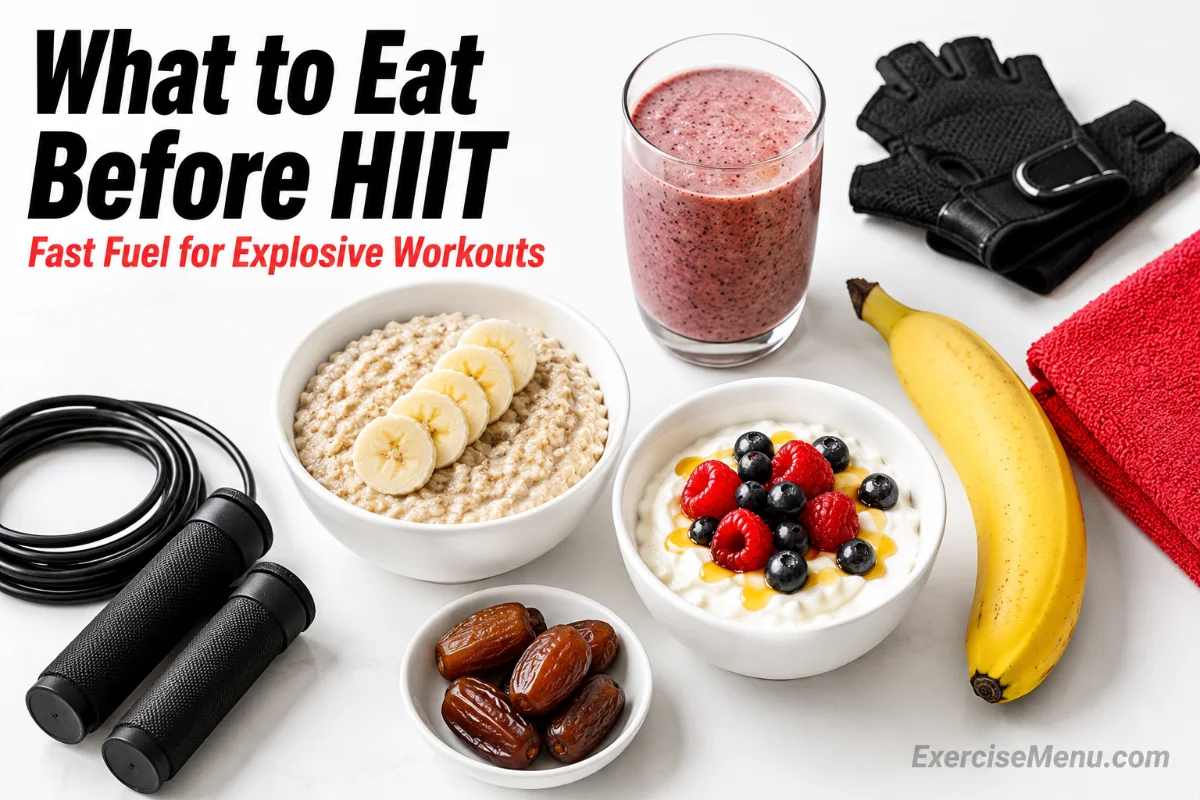
Eat a carb-focused meal or snack before HIIT — higher in carbs and lower in fat than you’d eat before strength training. Two hours out, go for oatmeal with banana and a small protein source. Thirty minutes out, a banana or a few dates is enough. Keep fat minimal — explosive movements and undigested fat don’t mix.
HIIT burns through your carb stores faster than almost any other training style. The explosive intervals sprints, burpees, box jumps rely on stored glycogen as fuel, and your body can’t convert fat fast enough to keep up with that intensity.
What you eat before a HIIT session determines whether you power through every round or fade halfway in. Our full guide on what to eat before a workout covers the framework for all training styles. This article narrows to HIIT specifically, where the rules shift: more carbs, less fat, lighter meals, and tighter timing.
If you’ve been eating the same pre-workout meal for both lifting days and HIIT classes, this breakdown shows you where to adjust and why.
Why HIIT Needs Different Fuel Than Strength Training?
HIIT relies on your anaerobic energy system short, explosive bursts that burn through stored glycogen much faster per minute than steady lifting or moderate cardio. A typical HIIT session depletes a meaningful portion of your muscle glycogen how much depends on session length, rest intervals, and how much glycogen you started with. Shorter sessions (15–20 minutes) use less; longer sessions (40+ minutes) with minimal rest can significantly reduce glycogen stores, particularly in fast-twitch muscle fibres.
A strength session of the same length uses significantly less because rest periods between sets allow partial recovery.
A review by Vigh-Larsen et al. (2021) in Sports Medicine confirms that high-intensity exercise depletes glycogen at substantially higher rates than moderate-intensity work, with fast-twitch muscle fibers — the ones HIIT depends on most — depleting first.
What this means for your plate: HIIT meals should be higher in carbs per calorie, lower in protein, and much lower in fat than what you’d eat before a strength session. Fat slows gastric emptying — and undigested food during burpees creates nausea, not performance.
HIIT also raises cortisol (the stress hormone) more sharply than moderate exercise. A study published in the Journal of the American College of Nutrition (2013) found that consuming protein before training reduced the cortisol response to exercise, supporting better recovery afterward. You don’t need a lot — 10–20g is enough for HIIT, compared to 30–40g before heavy lifting.
| Factor | Before HIIT | Before Strength Training |
|---|---|---|
| Carbs | Higher priority (30–60g) | Moderate (40–80g) |
| Protein | Lower (10–20g) | Higher (20–40g) |
| Fat | Minimal (<5g) | Moderate OK with 2hr+ window |
| Calories | 100–400 | 300–600 |
| Meal complexity | Simple, fast-digesting | Full meals tolerated |
| GI risk | Higher (explosive movements) | Lower (controlled movements) |
If you also lift on separate days, see our guide on pre-workout meal for muscle gain for heavier meal templates.
What to Eat 2–3 Hours Before HIIT?
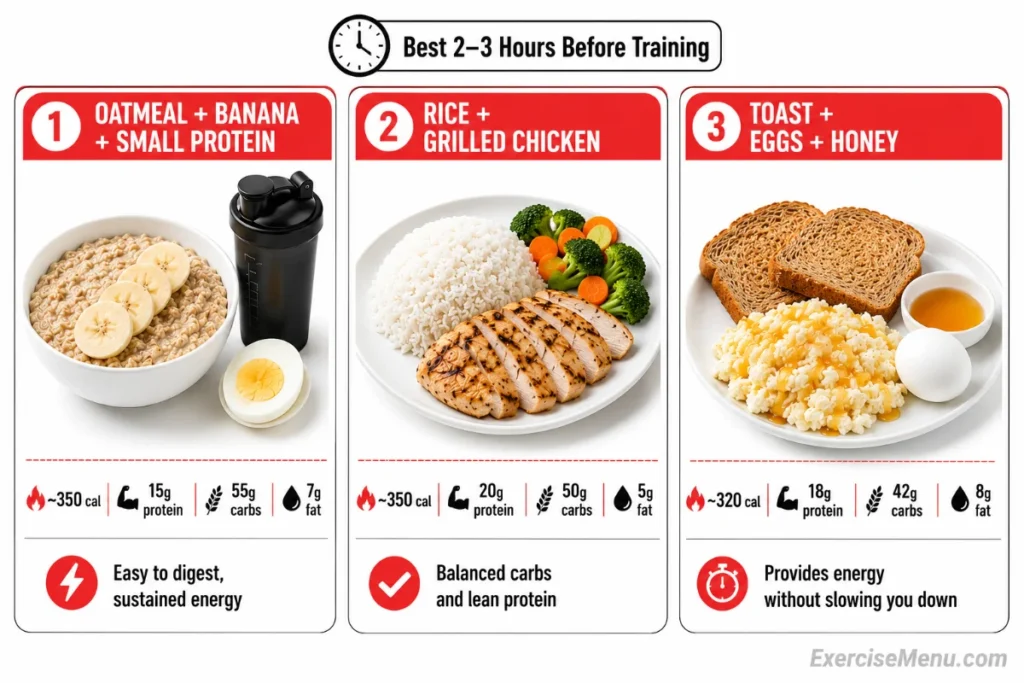
With 2–3 hours of lead time, you can eat a proper meal and digest it fully before your first interval. Carbs should make up most of the plate, with a moderate protein source and minimal fat.
A study by Ramonas et al. (2023) examined carbohydrate availability during high-intensity exercise in a deliberately glycogen-depleted state. In a crossover design, the same eight trained male cyclists completed both carbohydrate and placebo conditions after a glycogen-depletion protocol. They consumed a 6% carbohydrate drink before and during exercise, and time to exhaustion was longer in the carbohydrate condition.
This was a small laboratory study involving glycogen-depleted cyclists, so its results should not be applied directly to every HIIT class or gym user. It shows that carbohydrate availability can become more important when glycogen is already low—for example, after prolonged fasting or an earlier demanding training session. It does not prove that everyone needs additional carbohydrates before a typical short HIIT workout.
Meal 1 — Oatmeal + Banana + Small Protein Source ½ cup rolled oats, 1 banana (sliced), 1 boiled egg or ½ scoop whey in water. ~350 cal | 15g protein | 55g carbs | 7g fat. Oats release energy steadily over 2+ hours. Banana adds potassium and fast-acting sugars for the opening intervals.
Meal 2 — Rice + Grilled Chicken (Small Portion) ¾ cup white rice, 80g grilled chicken, steamed vegetables. ~350 cal | 20g protein | 50g carbs | 5g fat. White rice digests faster than brown — better for HIIT where you want glucose available sooner. Chicken portion is deliberately smaller than a muscle gain meal. HIIT doesn’t need 30g+ protein before the session.
Meal 3 — Toast + Eggs + Honey 2 slices whole grain toast, 1 whole egg + 1 egg white (scrambled), honey drizzle. ~320 cal | 18g protein | 42g carbs | 8g fat. Toast and honey handle carbs. Eggs provide protein without the volume or heaviness of a larger meat portion.
What to Eat 1 Hour Before HIIT?
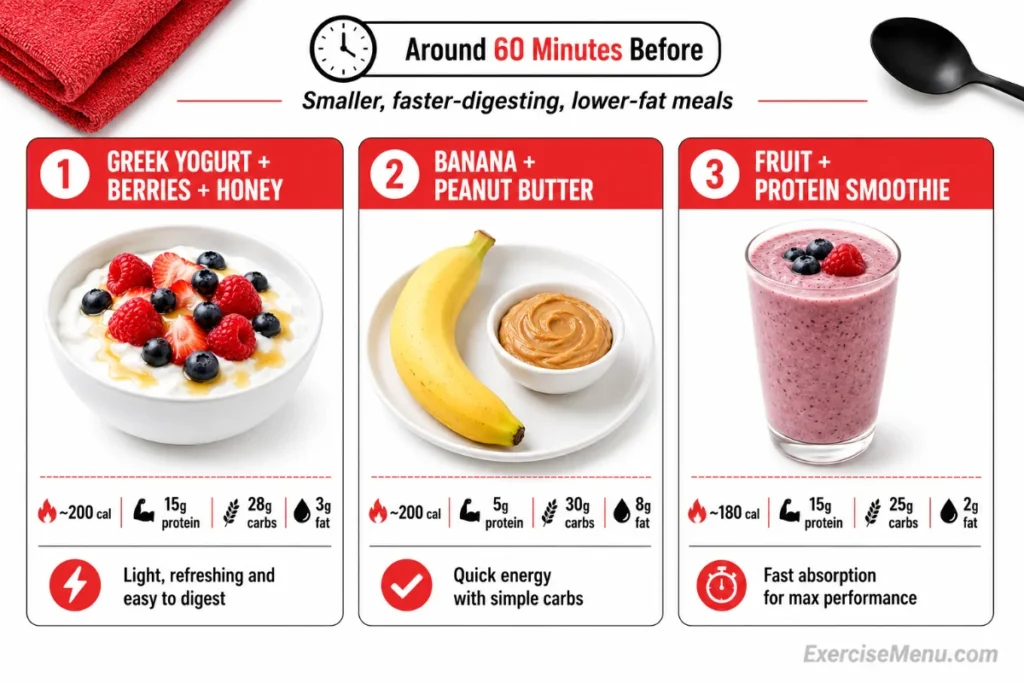
One hour out, your meal needs to shrink — fewer calories, faster-digesting carbs, and almost no fat. The goal is enough energy to fuel the session without anything sitting heavy when the pace picks up.
Option 1 — Greek Yogurt + Berries + Honey ¾ cup Greek yogurt, ½ cup mixed berries, drizzle of honey. ~200 cal | 15g protein | 28g carbs | 3g fat. Yogurt provides both fast-absorbing whey and slower casein protein. Berries and honey cover carbs without excess fiber. For more detail on yogurt as a pre-workout food: Greek yogurt pre-workout.
Option 2 — Banana + Peanut Butter 1 banana, 1 tbsp peanut butter. ~200 cal | 5g protein | 30g carbs | 8g fat. Banana is one of the fastest-digesting whole-food carb sources available. Peanut butter adds just enough substance to keep you full through the session.
Option 3 — Smoothie (Fruit + Small Protein) ½ banana, ½ cup berries, ½ scoop whey, water — blended. ~180 cal | 15g protein | 25g carbs | 2g fat. Liquid form digests faster than solid food. Useful when you’re cutting it close and don’t want anything heavy bouncing during high-impact movements.
What to Eat 30 Minutes Before HIIT?
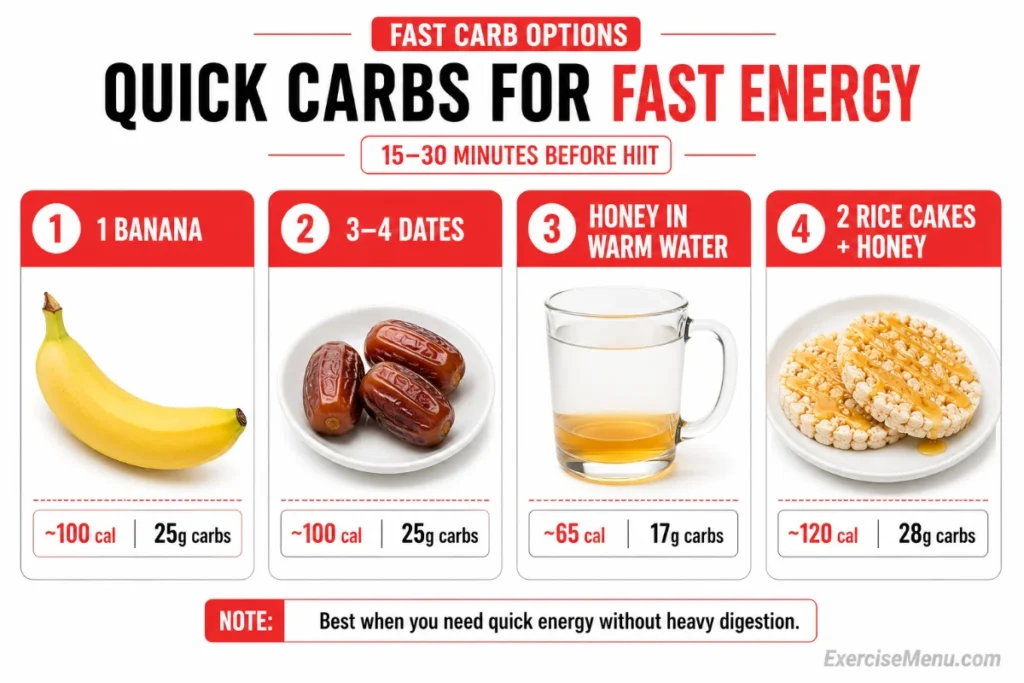
This close, solid food can backfire. Your stomach doesn’t have time to process a full snack. Go for fast-acting carbs only — just enough to top off blood glucose.
- 1 banana — ~100 cal | 25g carbs. Fastest whole-food option.
- 3–4 dates — ~100 cal | 25g carbs. Dense, fast-acting natural sugar.
- 1 tbsp honey in warm water — ~65 cal | 17g carbs. Liquid, near-zero digestion time.
- 2 rice cakes + honey drizzle — ~120 cal | 28g carbs. Light, fast-digesting.
If you ate a full meal 2–3 hours ago, you may not need anything in this window. This snack is for people who haven’t eaten in 3+ hours or who train first thing in the morning.
What to Eat Before a Morning HIIT Class?
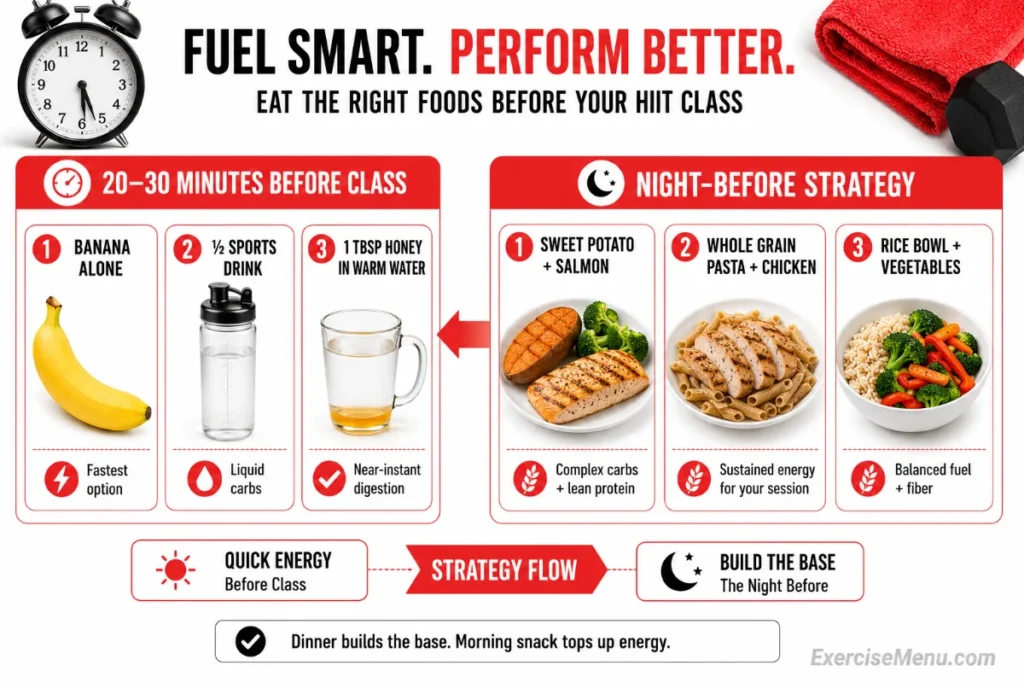
Training at 5–6am creates a specific fueling problem. You’ve fasted 7–9 hours overnight. Glycogen is partially depleted. Appetite at that hour is low. And eating a full meal at 4:30am isn’t a realistic option.
The fix is two-part — something small in the morning, and a smarter dinner the night before.
Morning options (20–30 minutes before):
- Banana alone (~100 cal) — fastest option, zero prep
- ½ sports drink (~50–75 cal) — liquid carbs when solid food at 5am causes nausea
- 1 tbsp honey in warm water (~65 cal) — near-instant digestion
Night-before strategy: Eat a complex carb dinner with moderate protein and healthy fat at 7–8pm. Sweet potato with salmon, whole grain pasta with chicken, or a rice bowl with vegetables. Fat at dinner is fine here — it slows overnight digestion, which means fuel is still partially available by 6am. The evening meal sets the foundation. The morning snack tops it off.
If solid food at 5am makes you nauseous, start with just water and a spoonful of honey for the first week. Build up to a banana. Even 50 liquid calories outperform training completely fasted when the session demands max-effort intervals.
Should You Do HIIT on an Empty Stomach?
Research comparing fasted and fed HIIT over multi-week periods shows no meaningful difference in fat loss between the two approaches. However, fed training consistently produces higher power output, longer time-to-exhaustion, and better interval performance. For fat loss, fasted HIIT won’t hurt your results. For performance, eat something first.
The fat-loss appeal of fasted HIIT is that your body oxidizes more fat during the session itself. But this doesn’t translate to greater long-term fat loss because total daily calorie balance — not what fuel you burn during a 30-minute window — determines body composition over weeks and months.
The performance cost is more concrete. Without carbs, your intensity drops. Lower intensity means fewer calories burned during the session and less EPOC (the afterburn effect that continues post-workout). You end up burning less overall by trying to burn more fat per minute.
If your only option is fasted or not at all, train fasted. A lower-quality session still beats skipping entirely. But if you have 10 minutes for a banana, that banana pays for itself in output.
One note for low-carb trainers: fast-twitch muscle fibers — the ones HIIT depends on — cannot use ketones for fuel. They require glycogen. A keto or very low-carb diet and high-intensity interval training are a poor match for performance, regardless of what you eat pre-session.
FAQs
Can I eat the same pre-workout meal for both HIIT and lifting days?
You can, but you’ll be over-fueling for HIIT or under-fueling for lifting. A 500-calorie chicken and rice meal that works before squats is too heavy for burpees. A banana that works before a HIIT class doesn’t provide enough protein for a strength session. If you train both in the same week, adjust your pre-workout meal to match the session type rather than defaulting to the same meal every day.
Does caffeine help before HIIT?
Research shows caffeine can improve power output by roughly 4% and reduce perceived effort during high-intensity intervals. If you tolerate it, 100–200mg (about one cup of coffee) taken 30–45 minutes before your session can help. Don’t rely on caffeine as a replacement for food — it sharpens focus but doesn’t provide fuel for your muscles. And if you train in the evening, caffeine’s 6-hour half-life may interfere with sleep, which undermines recovery more than the session benefited from the boost.
Can I just drink a protein shake before HIIT?
A shake alone misses the point. HIIT runs on carbs, not protein. A scoop of whey in water gives you 25g protein and almost zero carbs — that’s fuel for muscle repair, not fuel for intervals. Blend in a banana and some oats to turn it into a usable pre-HIIT option. Or eat the protein after the session and have carbs before.
Is a protein bar a good pre-HIIT snack?
Most protein bars contain 8–15g fat and 5–10g fiber — both slow digestion. That combination works against you before explosive movements. If you prefer bars, choose one that’s carb-dominant with under 5g fat and under 3g fiber. Otherwise, a banana outperforms most bars as a pre-HIIT option — faster digestion, cheaper, and no ingredient list to decode.
Should I eat differently before a 20-minute HIIT session vs a 45-minute one?
Yes. A 20-minute session uses less total glycogen, so a smaller snack — banana, a few dates — covers it, especially if you’ve eaten a meal within the last 3 hours. A 45-minute session depletes significantly more glycogen and benefits from a proper carb + protein meal 1–2 hours beforehand. Match the fuel to the session length.
Want a Nutrition Plan Built Around Your Training?
Generic meal plans don’t account for your training schedule, health history, or goals. Rimsha Shahid — Registered Dietitian, Certified Diabetes Specialist (USA), and Certified Pediatric Nutritionist — builds personalised nutrition plans that work alongside your programme, not against it.
Free initial consultation — no commitment required.
