


Quick Answer: The average bench press for a trained man is roughly 212 to 220 lbs (96 to 100 kg) for a single rep. For a trained woman, it’s 104 to 112 lbs (47 to 51 kg). Both numbers represent intermediate-level lifters who train consistently. Your bodyweight, training experience, and age shift those numbers significantly in either direction.
“How much should I be able to bench?” depends on who you are. The number shifts with your bodyweight, how long you’ve trained, your sex, and your age. A 135 lb bench press is below average for a 200 lb man with two years of training but perfectly strong for a 130 lb woman six months in.
The tables below are organized so you can find the benchmark that matches your situation.
- Average Bench Press for Men by Experience Level
- Average Bench Press for Women by Experience Level
- How Bench Press Strength Changes with Age?
- Is 135, 185, 225, or 315 a Good Bench Press?
- How to Test Your Bench Press Accurately?
- Where These Numbers Come From (and What They Don't Tell You)
- What to Do If Your Bench Press Is Below Average?
- Frequently Asked Questions
- Your Next Step
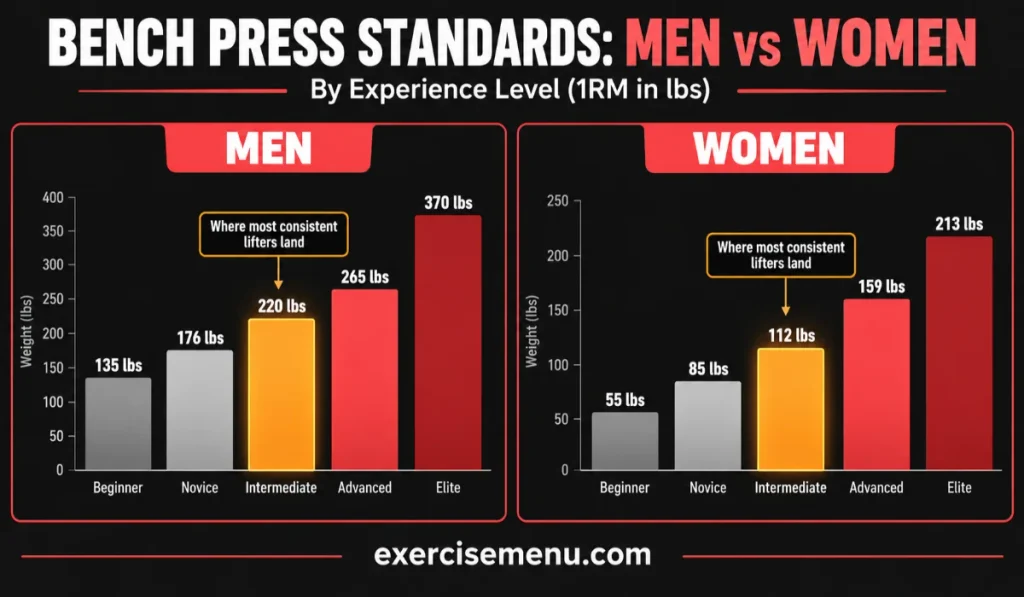
Average Bench Press for Men by Experience Level
| Experience Level | Training Time | Bench Press (lbs) | Bench Press (kg) | Bodyweight Ratio |
|---|---|---|---|---|
| Beginner | 0-6 months | 119-135 | 54-61 | 0.65× BW |
| Novice | 6-12 months | 176 | 80 | 0.90× BW |
| Intermediate | 1-2 years | 215-220 | 98-100 | 1.0-1.15× BW |
| Advanced | 3-5 years | 265 | 120 | 1.40× BW |
| Elite | 5+ years | 370 | 168 | 1.75× BW |
Data from Strength Level (48.7 million logged lifts) and StrengthLog (24,408 users). Bodyweight ratios calculated using the average American male weight of 199.8 lbs per the CDC.
“Intermediate” is where most consistent gym-goers land after one to two years. If you bench roughly your bodyweight for a single rep, you’re in that range.
Average Bench Press for Men by Bodyweight
| Bodyweight (lbs) | Beginner | Novice | Intermediate | Advanced | Elite |
|---|---|---|---|---|---|
| 132 | 83 | 113 | 148 | 193 | 268 |
| 148 | 95 | 128 | 167 | 216 | 298 |
| 165 | 106 | 142 | 185 | 237 | 325 |
| 181 | 116 | 155 | 201 | 257 | 349 |
| 198 | 125 | 167 | 216 | 275 | 370 |
| 220 | 135 | 180 | 232 | 294 | 393 |
| 242 | 143 | 191 | 246 | 311 | 414 |
Numbers in lbs. Based on Strength Level and StrengthLog aggregated data.
Average Bench Press for Women by Experience Level
| Experience Level | Training Time | Bench Press (lbs) | Bench Press (kg) | Bodyweight Ratio |
|---|---|---|---|---|
| Beginner | 0-6 months | 43-55 | 20-25 | 0.30× BW |
| Novice | 6-12 months | 72-85 | 33-39 | 0.50× BW |
| Intermediate | 1-2 years | 104-120 | 47-54 | 0.70-0.75× BW |
| Advanced | 3-5 years | 128-159 | 58-72 | 0.90-1.10× BW |
| Elite | 5+ years | 198-213 | 90-97 | 1.25-1.45× BW |
Bodyweight ratios calculated using the average American female weight of 170.8 lbs per the CDC.
Women’s bench press numbers climb more slowly in the first year partly because upper body pressing strength has a wider starting range, and partly because the bench press receives less programming priority in many women’s programs. If bench press is trained with the same consistency and progressive loading as in men’s programs, the relative progression rate is similar.
Average Bench Press for Women by Bodyweight
| Bodyweight (lbs) | Beginner | Novice | Intermediate | Advanced | Elite |
|---|---|---|---|---|---|
| 97 | 23 | 44 | 73 | 110 | 152 |
| 114 | 32 | 56 | 88 | 128 | 173 |
| 132 | 40 | 67 | 102 | 145 | 192 |
| 148 | 48 | 77 | 114 | 159 | 209 |
| 165 | 55 | 86 | 126 | 173 | 224 |
| 181 | 59 | 91 | 131 | 179 | 232 |
| 198 | 66 | 99 | 141 | 191 | 245 |
Numbers in lbs. Based on Strength Level data.
How Bench Press Strength Changes with Age?
Strength peaks in the mid-20s to early 30s and declines gradually, with the drop accelerating after 50. Rather than listing absolute numbers for every age bracket (which vary wildly by bodyweight and experience), here’s the pattern as a percentage of your peak performance.
| Age Range | Approximate % of Peak Strength |
|---|---|
| 20-29 | 100% (peak) |
| 30-39 | 95-100% |
| 40-49 | 85-90% |
| 50-59 | 75-80% |
| 60-69 | 65-70% |
| 70+ | 55-60% |
Apply this to your experience-level number from the tables above. If you’re an intermediate-level man at 40, your expected bench is roughly 85 to 90% of the intermediate standard for your bodyweight.
The decline is not inevitable at any given rate. Consistent training significantly slows age-related strength loss. A 55-year-old who trains three times per week retains more strength than these averages suggest because these averages include people who stopped training or reduced their frequency.
What About Teenagers (15 to 19)?
Teen bench press numbers climb rapidly between 15 and 19 as bodyweight, hormonal output, and training experience increase simultaneously. Based on Liftoff and Strength Level data, beginner teens typically bench 65 to 95 lbs, while experienced teen lifters who have trained for a year or more can reach 140 to 185 lbs.
These ranges are wider than adult benchmarks because the variation in physical maturity between a 15-year-old and a 19-year-old is enormous. A 15-year-old weighing 130 lbs and a 19-year-old weighing 180 lbs are in completely different developmental stages. Comparing to the adult bodyweight tables above using their actual bodyweight gives a more useful benchmark than any teen-specific average.
Is 135, 185, 225, or 315 a Good Bench Press?
These are the four milestone numbers almost every lifter measures themselves against. Here’s what each one actually represents.
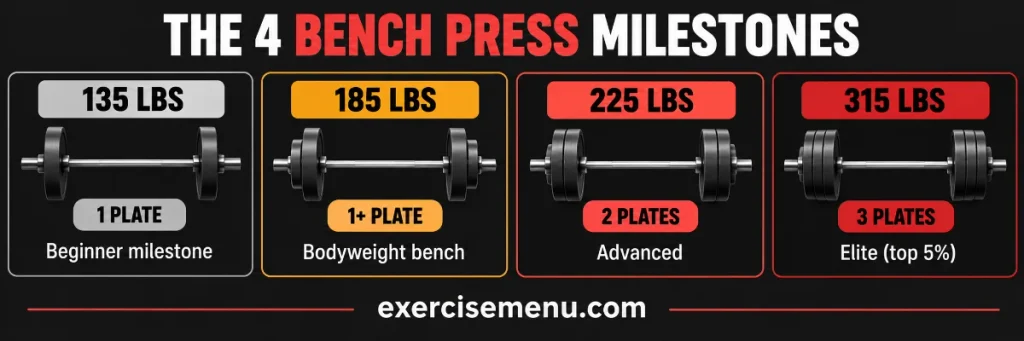
135 lbs (1 plate per side): For an average-weight man (198 lbs), this is beginner to early novice territory. For a woman at 130 to 150 lbs, this is advanced-level strength. Context matters more than the number.
185 lbs: Solid novice to early intermediate for most men. A 180 lb man benching 185 lbs has reached roughly bodyweight, which is a meaningful milestone that typically takes 6 to 12 months of consistent training.
225 lbs (2 plates per side): Advanced for an average-weight man. A 198 lb man benching 225 lbs exceeds the intermediate standard and is stronger than roughly 70 to 80% of trained lifters at that bodyweight. Most recreational lifters who train consistently for two to three years can reach this level.
315 lbs (3 plates per side): Elite territory. A 198 lb man benching 315 lbs is pressing roughly 1.6× bodyweight, which places him in the top 5% of trained lifters. This typically requires three to five years of structured, progressive training with bench press as a priority.
How to Test Your Bench Press Accurately?
The numbers above are all based on a barbell flat bench press performed through a full range of motion (bar touches the chest, arms fully locked out at the top). Testing on a Smith machine, using a partial range of motion, or bouncing the bar off the chest inflates the number and makes comparisons unreliable.
If you’ve never tested a true one rep max, you don’t need to. Estimate your 1RM from a rep max using a set of 3 to 5 reps. It’s safer and produces a close enough number for comparison purposes.
Use a consistent grip width every time you test. Switching between narrow and wide grip changes the result by up to 5%, which is enough to shift your category.
Where These Numbers Come From (and What They Don’t Tell You)
One important caveat that most bench press standard articles skip: the databases behind these numbers (Strength Level, StrengthLog, ExRx) collect data from people who actively track their workouts. That population is already more trained, more consistent, and more motivated than the general public.
A Strength Level “beginner” is someone who has spent several months in the gym. An actual first-day lifter is not represented in the data at all. If you just started training and your bench press is lower than the “beginner” number in the tables above, that does not mean you’re below beginner level. It means you haven’t been in the sample pool long enough.
The numbers in different databases also disagree. StrengthLog puts the average trained male bench at 220 lbs, while Strength Level says 212 lbs. The gap comes from different user bases and different sample sizes. Treat these as ranges, not exact targets.
What to Do If Your Bench Press Is Below Average?
Comparing yourself to the table is the starting point. Here’s how to close the gap.
Check technique first. Poor bar path, unstable shoulders, or flared elbows leak force on every rep. Small setup fixes often add 10 to 20 lbs without any strength increase. Grip width, shoulder blade position, and foot placement all affect the number.
Apply progressive overload consistently. For the bench press, this means adding 1 to 2.5 kg per session as a beginner, or adding one rep per set per week when load increases stall. Progress is slower on bench than on squats or deadlifts because the muscle groups involved are smaller.
Train the bench press at least twice per week. Frequency drives bench press progress more than volume for most intermediate lifters. Two bench sessions per week with different rep ranges (one heavy, one moderate) is the most common effective split.
Be patient with bodyweight ratios. A lighter lifter will reach a higher bodyweight ratio faster. A 148 lb man benching 185 lbs (1.25× BW) is objectively stronger relative to his size than a 220 lb man benching 225 lbs (1.02× BW), even though the absolute number is lower.
Frequently Asked Questions
Is benching your bodyweight good?
For men, yes. It places you at the intermediate tier, stronger than roughly half of people who track their lifts. For women, benching bodyweight is advanced-level strength that puts you ahead of roughly 80% of female lifters. Both take consistent training to reach.
Why is my bench press so weak compared to my squat?
The bench press uses smaller muscle groups (chest, triceps, front delts) than the squat (quads, glutes, hamstrings, back). Most men can squat 1.25 to 1.5 times what they bench. If your ratio is wider than that, your upper body pressing volume or frequency may need attention.
Can I compare my Smith machine bench press to these standards?
Not directly. A Smith machine removes the stabilization demand and fixes the bar path, which typically allows 10 to 15% more weight than a free barbell bench press. If you bench 200 lbs on a Smith machine, your free barbell equivalent is closer to 170 to 180 lbs.
How long does it take to bench 225?
For an average-weight man starting with no prior training, two to three years of consistent, progressive bench press training is a realistic timeline. Lighter lifters may take longer because 225 represents a higher bodyweight ratio for them. Factors like training frequency, programming, nutrition, and sleep quality all accelerate or slow the timeline.
Are bench press standards different for powerlifters?
Yes. Competitive powerlifters specialize in the bench press with optimized technique (wide grip, arch, leg drive, competition pause). Their standards are higher than general gym-goer standards. An intermediate powerlifter typically benches 1.25 to 1.5× bodyweight, compared to 1.0 to 1.15× for an intermediate recreational lifter.
Your Next Step
Find your bodyweight in the table, find your experience level, and note the number. That’s your current benchmark. Then check your 1RM against it. If you’re below the benchmark, the priorities are technique, frequency, and progressive overload. If you’re at or above it, the next tier in the table is your target.

1 Comment
Pingback: How to Calculate Your 1RM (One Rep Max Calculator + Formula)