

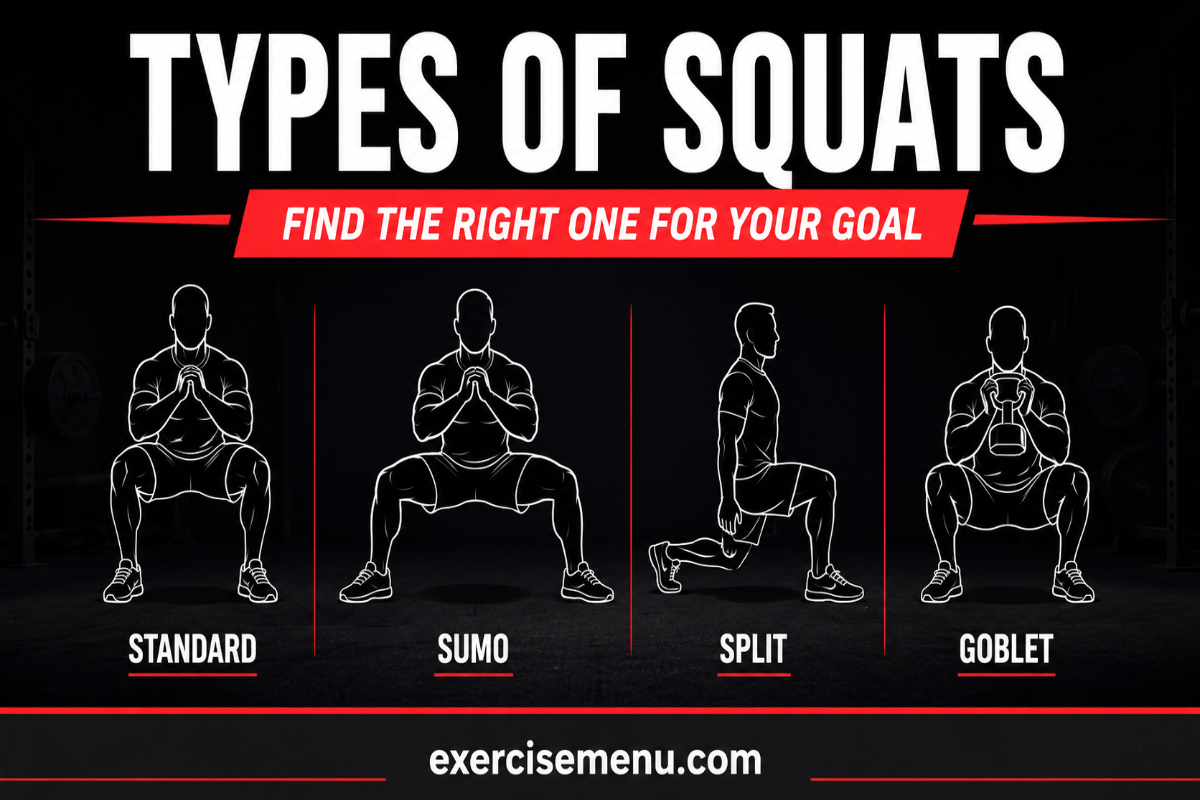
Quick Answer: There are over a dozen squat variations, and each one shifts the emphasis to different muscles depending on your stance, bar position, and equipment. Bodyweight squats build the foundation. Dumbbell and kettlebell squats add load without a rack. Barbell squats allow the heaviest loading. Machine squats reduce balance demands. The right variation depends on your goal, equipment, and experience level.
Squats are not one exercise. They are a family of movements that share the same basic pattern: bend at the hips and knees, lower your body, stand back up. But the stance you take, where the weight sits, and what equipment you use change which muscles do the most work, how much load you can handle, and how much mobility the movement demands.
That distinction matters because the wrong squat variation for your current level or goal either limits your progress or creates problems you could have avoided. A beginner forcing a barbell back squat with limited ankle mobility is not training effectively. Neither is an intermediate lifter doing only bodyweight squats and wondering why their legs have stopped growing.
- Every Squat Variation at a Glance
- Bodyweight Squat Variations
- Dumbbell and Kettlebell Squat Variations
- Barbell Squat Variations
- Machine Squat Variations
- Which Squat Variation Should You Start With?
- How to Pick the Right Squat for Your Goal?
- How Many Squat Variations Should You Use in One Program?
- Frequently Asked Questions
- Your Next Step
Every Squat Variation at a Glance
| Variation | Equipment | Primary Muscles | Difficulty | Best For |
|---|---|---|---|---|
| Air squat | None | Quads, glutes, core | Beginner | Foundation, warm-up, conditioning |
| Sumo squat (bodyweight) | None | Adductors, glutes, quads | Beginner | Inner thigh emphasis, limited ankle mobility |
| Cossack squat | None | Adductors, quads, glutes | Intermediate | Hip mobility, lateral strength |
| Jump squat | None | Quads, glutes, calves | Intermediate | Explosive power, conditioning |
| Pistol squat | None | Quads, glutes per leg | Advanced | Single-leg strength, balance |
| Goblet squat | DB/KB | Quads, core, glutes | Beginner | Learning depth, upright torso |
| Dumbbell sumo squat | DB | Adductors, glutes, quads | Beginner | At-home glute and inner thigh work |
| Bulgarian split squat | DB/BB | Quads, glutes per leg | Intermediate | Fixing imbalances, single-leg strength |
| Back squat (high bar) | Barbell | Quads, glutes, hamstrings | Intermediate | Overall strength, quad emphasis |
| Back squat (low bar) | Barbell | Glutes, hamstrings, quads | Intermediate | Heavy loading, posterior chain |
| Front squat | Barbell | Quads, core, upper back | Intermediate | Quad development, upright torso |
| Overhead squat | Barbell | Full body, shoulders | Advanced | Mobility, Olympic lifting prep |
| Zercher squat | Barbell | Quads, core, upper back | Advanced | Core bracing, real-world strength |
| Box squat | Barbell/BW | Glutes, hamstrings, quads | Beginner-Int | Depth control, force from a dead stop |
| Hack squat | Machine | Quads | Beginner | Quad isolation, low back-friendly |
| Smith machine squat | Machine | Quads or glutes (stance-dependent) | Beginner | Solo training, foot position variety |
| Belt squat | Machine | Quads, glutes, hamstrings | Beginner-Int | Zero spinal load, back-friendly volume |
This table covers the variations most relevant to beginner-to-advanced lifters. Specialty squats like the Anderson squat, safety bar squat, or sissy squat exist for specific training purposes but are beyond the scope of a general overview.
Bodyweight Squat Variations
Air Squat
The air squat is the starting point for every other squat on this list. No equipment, no external load, just the movement pattern. It trains the quads, glutes, hamstrings, and core simultaneously, and it exposes mobility limitations that heavier squats will punish later.
If you cannot perform a full-depth air squat with your heels flat and your chest upright, loaded squats will reinforce the problem instead of building strength. For a full breakdown of form, common mistakes, and when to add weight, see the complete air squat guide.
Sumo Squat (Bodyweight)
Widening your stance past shoulder-width and turning your toes out shifts the emphasis from the quads toward the adductors and glutes. The wider stance also reduces the ankle dorsiflexion demand, making this a more comfortable option for people who struggle with standard squat depth.
The bodyweight sumo squat is the unloaded version. Once form is consistent, loading it with a dumbbell held between the legs is the natural next step. That progression is covered in the dumbbell sumo squat guide.
Cossack Squat
A lateral squat where you shift your weight to one side, squatting deeply on that leg while the other stays straight. The Cossack squat challenges hip mobility, adductor flexibility, and single-leg stability in a plane of motion that forward-facing squats never reach.
Most people can’t reach full depth on the first attempt, and that’s the point. It reveals tightness and imbalances between sides. Start with partial depth and progress over weeks.
Jump Squat
A bodyweight squat with an explosive jump at the top. Jump squats are a plyometric exercise that trains fast-twitch muscle fibers and develops lower-body power that carries over to sprinting, cutting, and vertical jumping. They also work as a conditioning tool because the explosive output drives heart rate up quickly.
Land softly with bent knees and transition straight into the next rep. If your form breaks on landing, you’re either fatigued or jumping too high. Control matters more than height.
Pistol Squat
A single-leg squat to full depth with the other leg extended straight in front of you. No support, no counterbalance. The pistol squat demands quad strength, ankle mobility, and balance all working at once, which is why most people need months of progressive single-leg work before a clean rep is realistic. Box-assisted pistols and goblet-style counterbalance reps are the standard progressions.
The payoff is real: pistol squats expose strength imbalances between legs that bilateral squats hide entirely. They belong in advanced programming, not beginner routines.
Dumbbell and Kettlebell Squat Variations
Goblet Squat
Hold a dumbbell or kettlebell at your chest and squat. The front-loaded weight acts as a counterbalance that naturally pulls your torso upright, which makes hitting proper depth easier than almost any other squat variation. For beginners, the goblet squat is the best teaching tool for squat mechanics because the weight helps you find the right position rather than fighting against it.
Loaded heavier than most people attempt, the goblet squat is a legitimate strength exercise, not just a warm-up drill.
Dumbbell Sumo Squat
The loaded version of the bodyweight sumo squat. Holding a dumbbell vertically between the legs with a wide stance targets the adductors, glutes, and quads. The upright torso position keeps lower-back stress low, making this a strong option for home training or for lifters who want glute and inner-thigh work without a barbell.
The full form guide, muscles worked, and programming are covered in the dumbbell sumo squat article.
Bulgarian Split Squat
Elevate your rear foot on a bench, step the front foot forward, and squat on the front leg. Nearly all of the load falls on the working leg, which exposes strength imbalances that bilateral squats hide. Research by Speirs et al. (2016) published in the Journal of Strength and Conditioning Research found that unilateral squat training produced comparable strength and sprint improvements to bilateral training in athletes, supporting the Bulgarian split squat as a primary lower-body exercise rather than just an accessory. The rear hip flexor is also stretched under load throughout the set, so hip mobility improves alongside strength.
Loading options are flexible. Dumbbells at the sides are easiest to manage, but a barbell across the back or a kettlebell at the chest both work. The leg does the same job regardless of where the weight sits.
Barbell Squat Variations
Back Squat
The barbell back squat is the most commonly programmed squat in strength training for good reason: it allows you to move the heaviest loads across the largest muscle groups in a single movement. Bar position creates two distinct sub-variations. High bar placement on the upper traps keeps the torso more upright and shifts emphasis toward the quads. Low bar placement on the rear delts requires more forward lean and loads the glutes, hamstrings, and posterior chain more heavily. The differences between high bar and low bar squat run deeper than bar position alone.
Neither position is universally better. Your build, goals, and what your body tolerates determine which one makes sense.
Front Squat
The barbell moves from behind the neck to the front of the shoulders, resting across the front delts. That single change forces a more upright torso, shifts the primary demand to the quads and core, and significantly reduces lower-back loading compared to the back squat. The trade-off is that the front rack position requires wrist and shoulder mobility that many lifters need to develop.
For a detailed comparison of when to use a front squat versus a back squat, including the muscle emphasis differences, see the front squat vs back squat guide.
Overhead Squat
Hold a barbell locked out overhead with a wide grip and squat to depth. The overhead squat is less about leg strength and more about total-body stability, shoulder mobility, and thoracic extension. It is a key position in Olympic weightlifting (the bottom of a snatch) and one of the most revealing movement assessments available, since any mobility restriction becomes immediately obvious.
Most people should not load this variation until they can hold a PVC pipe or empty barbell overhead in a full squat position without their chest collapsing or heels lifting.
Zercher Squat
The barbell sits in the crooks of your elbows instead of on your back or shoulders. This unusual loading position forces you to brace hard through the core and upper back to stay upright. Zercher squats are uncomfortable by design, but they develop real-world carrying strength and expose weaknesses in posture and core stability that other squat styles can mask.
Consider using a barbell pad or towel across the bar until you’re accustomed to the position.
Box Squat
Squat back onto a box set at parallel height, pause briefly, then drive up. The pause eliminates the elastic rebound that normally helps you out of the bottom, so your muscles must generate force from a near-dead stop. Box squats also teach you to sit the hips back rather than letting the knees drift forward, which makes them useful for both learning squat mechanics and building explosive strength.
Machine Squat Variations
Hack Squat
The hack squat machine supports your back against a pad while your feet press into a platform. Lower-back involvement drops close to zero, which means you can push to genuine quad fatigue without your spine becoming the limiting factor. Foot placement on the platform changes the emphasis: lower feet increase quad activation, higher feet shift load toward glutes and hamstrings.
Smith Machine Squat
The barbell runs on a fixed track, so balancing it is not a concern. That freed-up stability demand lets you experiment with foot positions in ways a free barbell doesn’t allow. Feet directly under the bar targets quads. Feet walked forward shifts emphasis to the glutes. The fixed path also removes the need for a spotter, making this a practical option for people who train alone.
A 2009 EMG study by Schwanbeck et al. in the Journal of Strength and Conditioning Research found that free-weight squats produced 43% higher average muscle activation across all muscles compared to Smith machine squats. That’s a real difference. But for beginners learning depth and control, or for experienced lifters pushing close to failure without a spotter, the Smith machine earns its place as a training tool rather than a replacement for free-weight squats.
Belt Squat
The belt squat loads your lower body through a belt around the hips instead of a bar on your back. That removes spinal compression entirely, which makes it one of the few squat variations that trains the quads, glutes, and hamstrings hard without loading the spine at all. For lifters managing back discomfort, or for anyone who wants additional leg volume without the systemic fatigue of another barbell squat, the belt squat fills a gap that no other variation covers.
The trade-off is access. Belt squat machines are not available in every gym. If yours has one, it works well as a finisher after your primary squat movement.
Which Squat Variation Should You Start With?
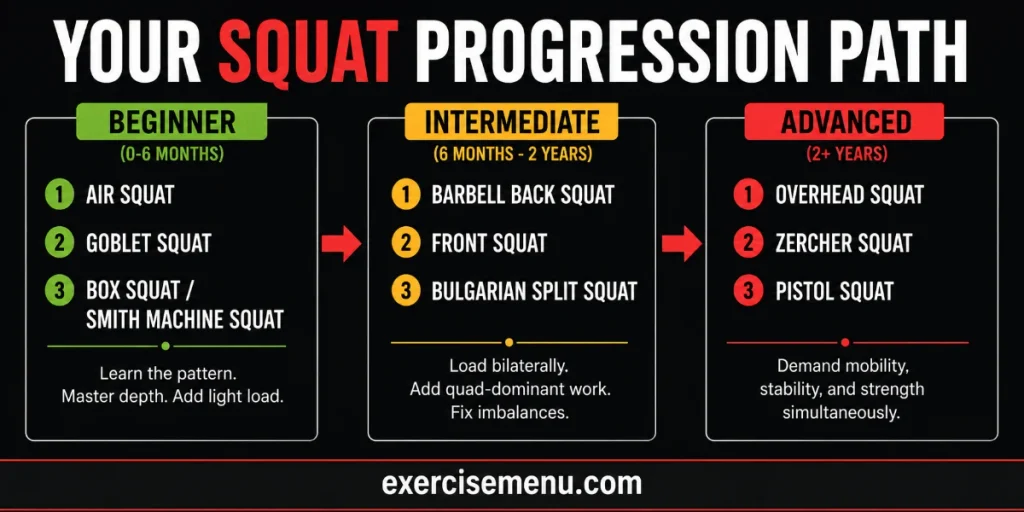
Not every variation is appropriate for every level. Jumping straight to a barbell back squat without mastering the basic movement pattern is how form errors get built in early and reinforced over time.
Beginner (0 to 6 months): Air squat → Goblet squat → Box squat or Smith machine squat. Learn the pattern unloaded, add front-loaded weight to reinforce depth and positioning, then introduce back-loading in a controlled environment.
Intermediate (6 months to 2 years): Barbell back squat → Front squat → Bulgarian split squat. You have the movement foundation. Now load it bilaterally, add a quad-dominant barbell variation, and introduce unilateral work to address imbalances.
Advanced (2+ years): Overhead squat, Zercher squat, Cossack squat, pistol squat. These variations demand mobility, stability, and strength simultaneously. They expose weaknesses that standard squats don’t reveal.
How to Pick the Right Squat for Your Goal?
| Your Goal | Best Variations |
|---|---|
| Build quad size | Front squat, hack squat, heel-elevated goblet squat |
| Build glutes and posterior chain | Sumo squat, Bulgarian split squat, low-bar back squat |
| Fix strength imbalances between legs | Bulgarian split squat, Cossack squat |
| Train at home with no equipment | Air squat, sumo squat, jump squat, Cossack squat |
| Train with dumbbells only | Goblet squat, dumbbell sumo squat, Bulgarian split squat |
| Reduce knee discomfort during squats | Box squat, goblet squat (see: form errors that cause knee stress during squats) |
| Reduce lower-back stress during squats | Belt squat, hack squat, goblet squat |
| Build explosive power | Jump squat, box squat |
| Train alone without a spotter | Smith machine squat, hack squat, goblet squat |
| Improve mobility and movement quality | Overhead squat, Cossack squat, goblet squat hold |
How Many Squat Variations Should You Use in One Program?
Two to three. One primary bilateral squat (back squat or front squat), one unilateral variation (Bulgarian split squat), and one accessory or machine movement (hack squat, goblet squat, or Smith machine squat) covers bilateral strength, single-leg development, and targeted muscle work without redundancy.
Rotate your secondary and accessory variations every four to six weeks to avoid staleness while keeping your primary squat consistent for tracking progress. Adding variety without a reason is not programming, and it often slows progress by preventing adaptation to any single stimulus. This is the core problem with muscle confusion as a training approach.
Frequently Asked Questions
How many types of squats are there?
There is no fixed number. Between stance variations, equipment options, and loading positions, the count easily exceeds 20. But most people only need three to four in their training at any given time. The rest exist for specific training goals or advanced programming.
Which squat is easiest on the knees?
The goblet squat and box squat tend to be the most comfortable for people managing knee sensitivity. The goblet squat’s counterbalance encourages a more natural knee path, and the box squat limits depth to a controlled range while teaching you to sit back into the hips.
Can you build muscle with bodyweight squats only?
For the first few weeks of training, yes. After that, the load is too light to drive adaptation in most people. You can extend their usefulness with tempo manipulation (slow eccentrics), single-leg progressions, and jump squats, but eventually external load is necessary for continued growth.
Is the Smith machine squat a real squat?
Yes. The movement pattern, range of motion, and muscle groups are the same. What changes is the stability demand, which is lower on a fixed track. That makes the Smith machine less effective for developing overall coordination under load, but more effective for isolating specific muscles or training safely alone. Using both in a program gives you the benefits of each.
Should beginners start with barbell squats?
Not unless they already have solid squat mechanics. Most beginners benefit from starting with bodyweight squats, progressing to goblet squats, and only moving to a barbell once they can consistently squat to depth with an upright torso and flat feet. Rushing to the barbell without this foundation builds bad habits that are harder to fix later.
What is the single best squat variation for overall strength?
The barbell back squat, because it allows the heaviest loading across the most muscle mass. But “best” depends on context. A lifter with chronic lower-back issues may get more productive training from a front squat or hack squat. The best squat is the one you can perform well, load progressively, and recover from.
Your Next Step
Pick one squat from each category: one bodyweight or light variation for warm-up, one barbell or heavy variation as your main lift, and one accessory for targeted work. That combination covers the full spectrum without redundancy. If you’re unsure where to start, begin with the air squat and work through the progression path above. Use the comparison table to adjust as your goals change. Check your average squat weight to benchmark where you currently stand.

5 Comments
Pingback: Air Squats: Form, Benefits & When to Add Weight
Pingback: Front Squat vs Back Squat: Muscle Differences Full Guide
Pingback: Knees Hurt When Squatting? 5 Form Errors and How to Fix Each
Pingback: Dumbbell Sumo Squat: Form, Muscles & Benefits
Pingback: How to Warm Up Before a Workout: 3 Phase Guide