

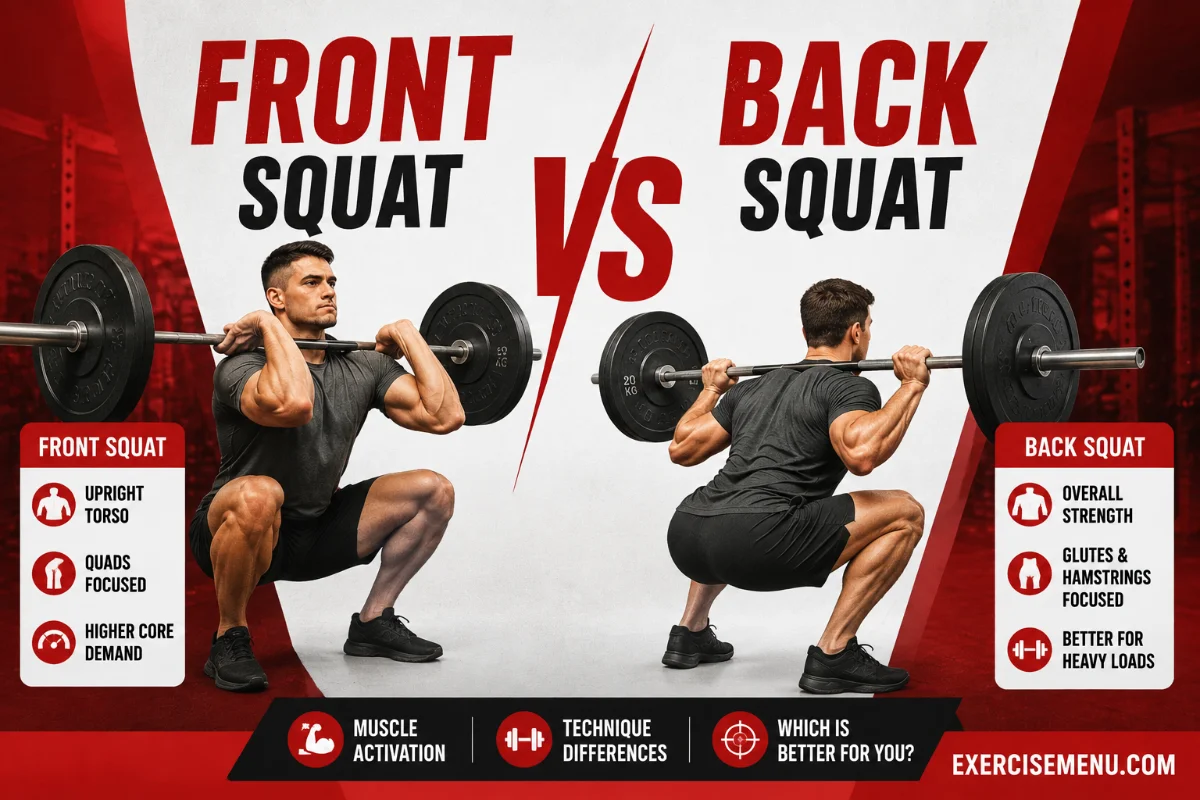
Quick Answer: Both lifts train quadriceps, glutes, adductors, hamstrings and trunk. Front squats keep the torso more upright and bias knee-extensor demand; back squats permit heavier loads and more hip contribution. Neither is universally safer or better for growth.
Front squats and back squats train the same broad lower-body system, but they do not challenge it in exactly the same way. Moving the bar from the upper back to the front of the shoulders changes how you stay balanced, how upright your torso remains, which joints take more of the demand and how much weight you can use. The better choice depends on the outcome you want and the position you can perform consistently.
- Front Squat vs Back Squat at a Glance
- What Changes When the Bar Moves to the Front?
- Which Muscles Do Front and Back Squats Work?
- Which Squat Builds More Muscle?
- Which Squat Builds More Strength?
- Is One Squat Better for the Knees or Lower Back?
- Which Squat Requires More Mobility?
- How to Perform Front and Back Squats Correctly
- Common Form Problems and Practical Fixes
- Which Squat Is Best for Your Goal?
- What If You Cannot Perform Either Barbell Squat?
- How to Programme Both Squats
- Frequently Asked Questions
Front Squat vs Back Squat at a Glance
The front squat usually favours an upright torso and lower absolute load, while the back squat usually permits more weight and greater hip contribution. Those are tendencies, not rules: stance, depth, bar position, limb proportions and training experience can change the comparison.
| Feature | Front squat | Back squat |
| Bar position | Across the front deltoids, close to the collarbones | On an upper-back shelf, not on the neck |
| Typical torso position | More upright | More forward inclination, especially low bar |
| Usable load | Usually lower | Usually higher |
| Relative demand | Often more knee-extensor and upper-back demand | Often more hip contribution and total-load capacity |
| Limiting factor | Front-rack comfort, upper-back position or quadriceps | Bracing, hip and leg strength, or upper-back setup |
| Mobility requirement | Secure front rack needs adequate shoulder, wrist and upper-back positioning | Shoulder comfort and a stable upper-back shelf still required |
| Best sport match | Olympic lifting and clean recovery | Powerlifting and maximal squat strength |
| Muscle growth | Effective when trained hard through a controlled range | Also effective; heavier loading does not automatically mean more growth |
Scope note: Back squat mechanics differ between high-bar and low-bar styles. The high bar vs low bar squat comparison covers those differences in detail. This article uses a conventional high-bar back squat as the main reference. A low-bar position generally allows more forward torso inclination and hip contribution.
What Changes When the Bar Moves to the Front?
Moving the bar forward changes the balance strategy needed to keep the combined lifter-and-bar system over the midfoot. The front squat therefore tends to use a more upright torso, while a back squat can accommodate more forward torso inclination without losing balance.
A 2024 biomechanical review by Straub and Powers in the International Journal of Sports Physical Therapy explains why torso and shin angles must be considered together. A more upright torso generally raises the knee-flexion moment and reduces the hip-flexion moment; more forward trunk inclination tends to shift the balance in the opposite direction.
The comparison also depends on how researchers match the load. At the same absolute weight, the front squat can create a different demand from a back squat. At the same percentage of each lift’s one-repetition maximum, the front squat uses less weight because its 1RM is normally lower. That is why a single laboratory result should not be turned into a universal rule.
How to read the evidence: Joint moments describe mechanical demand, EMG estimates electrical activity during a session, and muscle-thickness studies track longer-term adaptation. None of these measures alone proves that one squat grows more muscle, causes less pain or prevents injury.
Which Muscles Do Front and Back Squats Work?
Both lifts train the quadriceps, gluteus maximus, adductors, hamstrings, spinal erectors and abdominal wall. The meaningful difference is usually the relative contribution and the muscle or position that limits the set, not an entirely different list of muscles.
Quadriceps
Front squats often place a strong demand on the knee extensors because the torso stays upright and the knees can travel farther forward. That can make the quadriceps feel more limiting, but it does not prove that front squats always produce more quadriceps growth.
In a small acute study of 12 trained men, the front squat produced greater vastus medialis EMG while the back squat produced greater semitendinosus EMG under maximal loading (Yavuz et al., 2015, Journal of Sports Sciences). The authors also observed more forward trunk lean in the back squat. These findings describe muscle activity during a testing session; EMG is not a direct measure of long-term hypertrophy.
Glutes, Adductors and Hamstrings
Back squats commonly allow more hip contribution because they can be performed with more torso inclination and a heavier load. Front squats still train the glutes and adductors, particularly as depth and effort rise. The hamstrings contribute to both lifts, but neither squat should automatically replace a hip-hinge or knee-flexion exercise when complete hamstring development is the goal.
Core, Upper Back and Spinal Erectors
Both squats demand hard bracing. The front squat adds a distinctive upper-back challenge because the elbows and thoracic position must keep the bar supported on the shoulders. The back squat’s heavier load can create a large whole-trunk demand. Calling one lift a “core exercise” and the other a “leg exercise” misses how both movements work as integrated barbell lifts.
Which Squat Builds More Muscle?
Neither squat has shown a clear, universal advantage for quadriceps growth. The best hypertrophy choice is the version you can load progressively, perform through a controlled and repeatable range, and recover from without the rack position or another weak link ending the set too early.
The most direct longitudinal comparison currently available followed 24 recreationally trained women for 12 weeks, with 12 participants assigned to each squat. Both groups increased quadriceps muscle thickness to a similar extent. The back-squat group improved 45-degree leg-press 1RM more, but that test does not establish that back squats produce universally greater strength, and the study did not measure glute hypertrophy (Enes et al., 2024, European Journal of Sport Science).
In practice, choose the front squat when its upright position lets your quadriceps work hard without the front rack failing first. Choose the back squat when it gives you a stable setup, a useful range of motion and enough recoverable volume. More plates on the bar do not automatically create more hypertrophy if technique, range or target-muscle effort deteriorates.
Which Squat Builds More Strength?
Strength is specific to the movement you practise. Back squats are the priority for improving a powerlifting back squat, while front squats are more specific to the receiving and recovery positions used in Olympic weightlifting.
For general lower-body strength, both work. The back squat normally permits a higher absolute load, which can make it useful for practising heavy bracing and producing force with substantial total resistance. The front squat can expose weaknesses in quadriceps strength, posture or the front-rack position.
Track each lift against its own baseline instead of expecting a fixed front-to-back ratio. If you use percentages, calculate them from the correct lift rather than applying your back-squat maximum to both. ExerciseMenu’s 1RM calculation guide explains how estimates can support programming without requiring a true maximum attempt.
Is One Squat Better for the Knees or Lower Back?
Neither variation is universally safer. A front squat may reduce particular knee-load measures in a specific test while creating a different trunk demand, but pain and injury risk cannot be predicted from bar position alone. Load, depth, technique, anatomy, training history and current symptoms all matter.
A crossover study of 15 trained participants found greater knee compressive forces and knee-extensor moments in the back squat, while shear forces were small and similar and overall muscle recruitment was comparable (Gullett et al., 2009, Journal of Strength and Conditioning Research). This study measured acute knee biomechanics, not injury rates, and it did not measure lumbar compression.
Lower-back mechanics are equally nuanced. In an 18-person study using the same absolute load across six squat conditions, more anterior load reduced trunk flexion but increased low-back extension moments under the tested conditions (Dai, Goršič et al., 2021, Sports Biomechanics). This analysis included straight-bar and transformer-bar variations, so it should not be treated as a direct injury comparison.
A knee moving beyond the toes is not automatically a technique error. The relevant question is whether the whole repetition remains balanced and controlled, with the foot planted and the knees tracking in a position the lifter can tolerate. If either squat causes sharp, radiating or persistent pain, stop loading through it and seek assessment from a qualified clinician. A coach can help with technique; pain diagnosis requires an appropriate health professional.
Which Squat Requires More Mobility?
The front squat usually has the more demanding rack position, but both lifts have mobility and setup requirements. A secure front rack needs enough shoulder and upper-back positioning to keep the elbows up; a clean grip can also expose wrist or lat restrictions. The back squat avoids the front rack but still requires a comfortable shoulder position and a stable upper-back shelf.
Ankle dorsiflexion, hip motion, stance and limb proportions affect the depth and torso position of both variations. A heeled weightlifting shoe or small heel elevation can help some lifters keep the whole foot supported while allowing more forward knee travel, but it also tends to increase knee-extensor demand. Use it as a technique choice, not as a cure for pain or proof that ankle mobility is defective.
Limited wrist extension does not automatically rule out front squats. If the bar remains secure on the deltoids, a fewer-finger clean grip, strap-assisted rack or cross-arm grip may work. Do not force a painful grip, and do not let the hands become the main support for the bar.
How to Perform Front and Back Squats Correctly
Both lifts should begin in a rack with safety arms or pins set just below the lowest intended bar position. Use collars, clear the area and practise the unrack and rerack with an empty bar before adding meaningful load. Before each repetition, take a breath into the belly and brace the trunk in all directions; hold this brace through the full descent and ascent before exhaling at the top.
Front Squat Key Cues
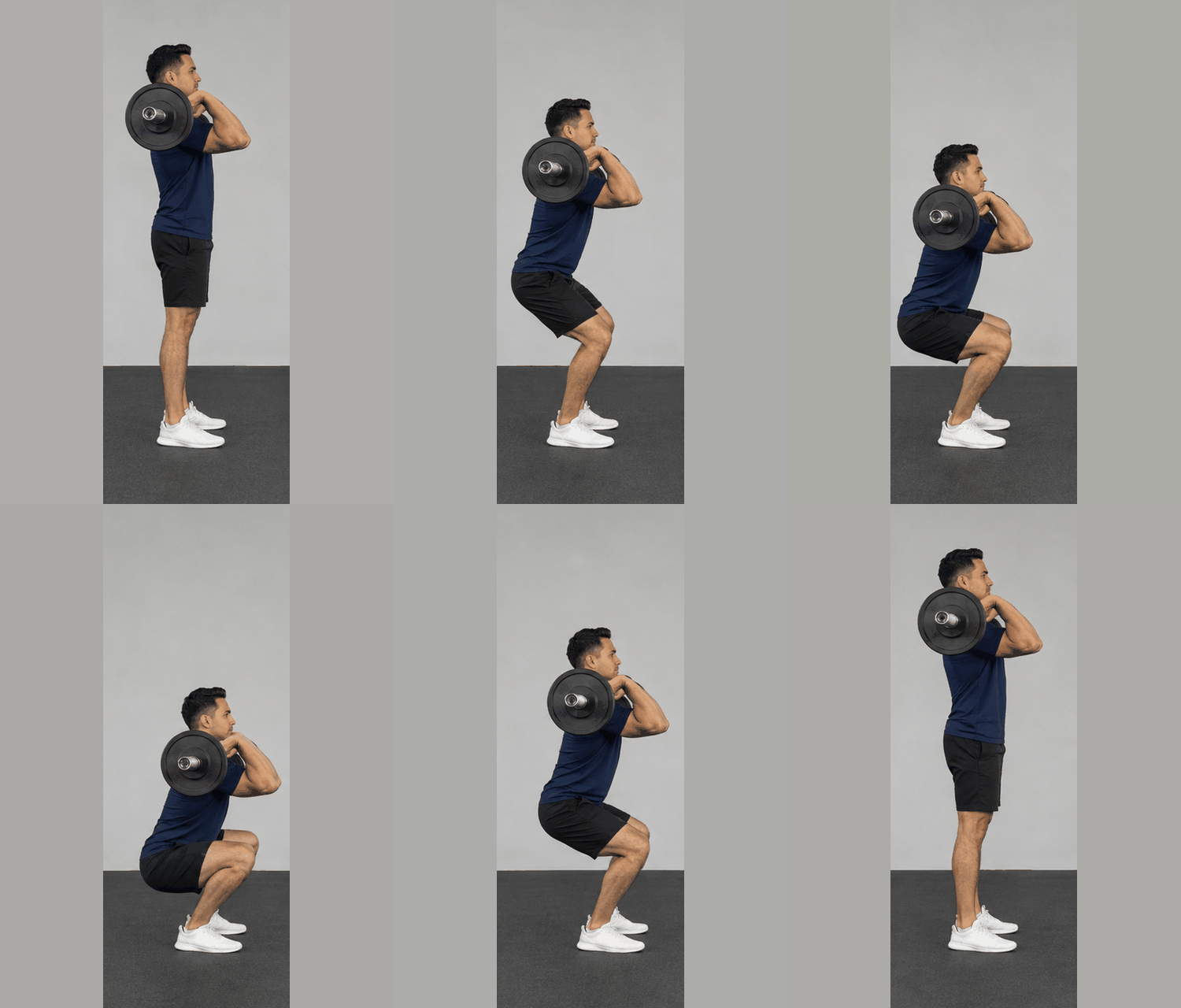
Set the hooks just below shoulder height. Place the bar across the front deltoids near the collarbones. In a clean grip, lift the elbows and let the fingers guide the bar; the wrists should not carry its full weight. A cross-arm grip or lifting straps can work when the front rack is limited.
Brace before unracking. Take one or two deliberate steps back. Set a stance that allows the knees and hips to bend together while the whole foot stays planted. Descend under control, keeping the bar over the midfoot and the elbows lifted. Use the deepest range you can control without losing balance, heel contact or the front rack.
Drive the whole foot into the floor and let the hips and chest rise together. Walk into the rack until the bar contacts the uprights before bending the knees to set it down.
Back Squat Key Cues
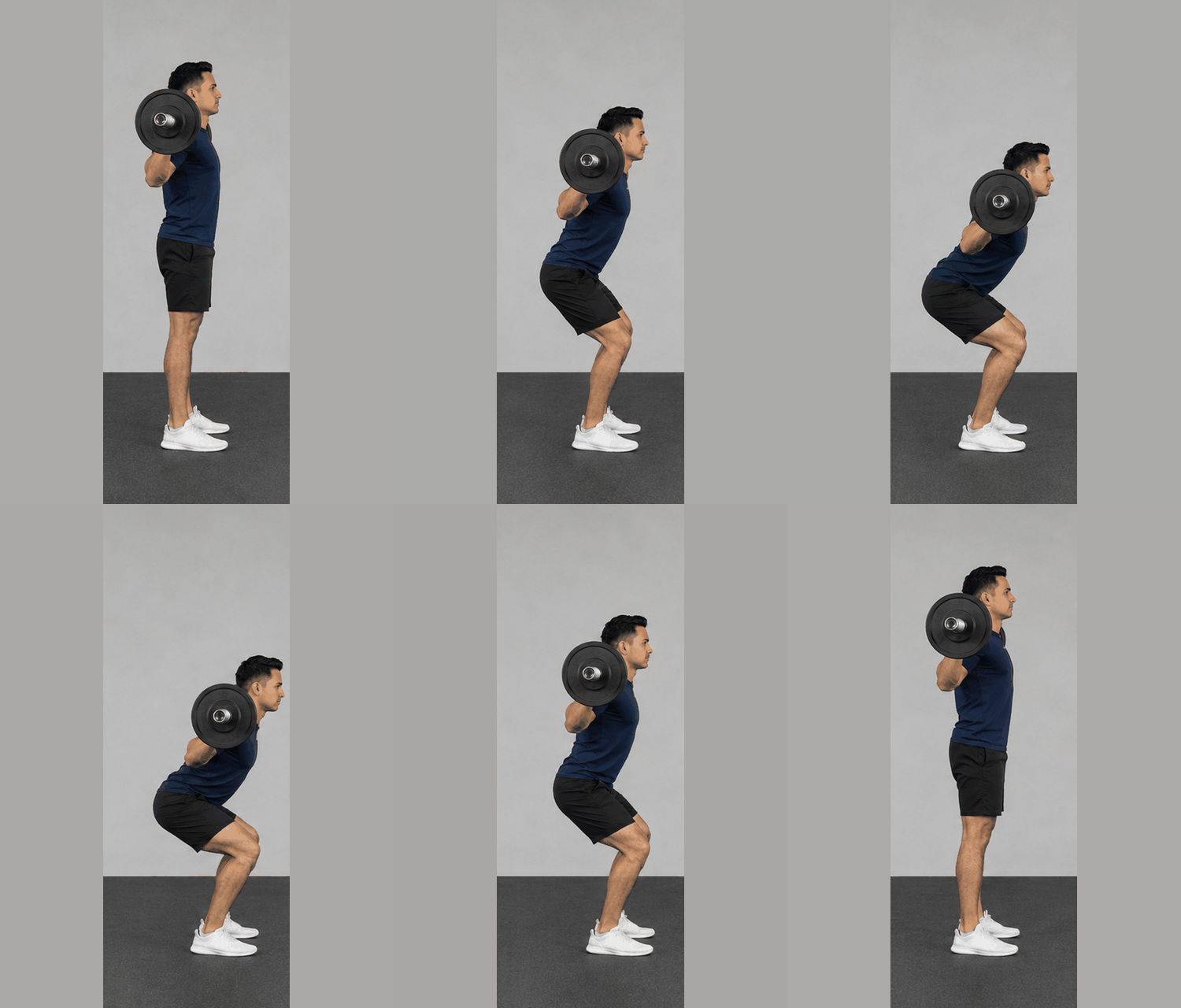
For a high-bar squat, place the bar on the upper trapezius, not directly on the neck. Grip the bar evenly and tighten the upper back so the bar has a secure shelf. Brace, stand the bar up and use a short walkout.
Choose a stance that lets you keep the whole foot down. Bend the knees and hips together, keeping the bar travelling over the midfoot. Descend only as far as you can maintain balance, bracing and control. Stand by pushing through the whole foot; the hips and chest should rise together rather than turning the ascent into a good morning.
Common Form Problems and Practical Fixes
Most technique problems improve when the load is reduced enough to practise the position that is being lost. A cue should solve an observed problem, not be applied to every lifter by default.
| What you see or feel | Likely issue | First adjustment to try |
| Front-squat bar rolls forward | Elbows or upper back lose position; load may be too heavy | Reduce load, lift elbows and keep bar settled on deltoids |
| Wrist discomfort in front rack | Hands supporting the bar or rack position forced | Let shoulders carry bar; try fewer fingers, straps or cross-arm grip |
| Back-squat bar on neck | Bar is above the muscular shelf | Reposition on trapezius and rebuild upper-back tension |
| Heels lift | Balance shifts forward or stance exceeds ankle control | Reduce depth temporarily, adjust stance or use heel elevation |
| Knees collapse inward | Load, fatigue or control exceeds current position | Lower load and track knees with toes through a stable foot |
| Hips rise before chest | Load or torso position cannot be maintained | Reduce load, brace before descent and practise coordinated ascent |
Which Squat Is Best for Your Goal?
Choose the squat that is most specific to your goal, then use the other only if it adds useful training without creating a recovery or technique problem.
| Goal or situation | Prioritise | Why |
| Powerlifting | Back squat | It is the competition lift |
| Olympic weightlifting | Front squat | Directly supports clean recovery; back squats still build general strength |
| Quadriceps hypertrophy | Either | Both grow quadriceps; choose the version that keeps target muscles working through a stable range |
| Maximum squat loading | Back squat | Most lifters can use more absolute weight |
| Upright squat practice | Front squat | The bar position rewards an organised torso and front rack |
| General fitness | Either | Consistency, technique, appropriate effort and recovery matter most |
| New to barbell squats | Easiest stable setup | A goblet squat may come first; progress to the bar position you can rack and control safely |
| Current knee or back symptoms | Individual assessment | Use symptom response and qualified guidance, not a generic label |
What If You Cannot Perform Either Barbell Squat?
If neither barbell squat works for you right now, the lower-body training pattern is still available through other loaded squat variations. Start where you can control the position and increase demand from there.
Goblet squat: Hold a dumbbell or kettlebell at chest height. The front-loaded position teaches an upright torso similar to the front squat, without requiring a rack or barbell mobility. Once you can control a goblet squat through a full range, the transition to a barbell front or back squat becomes simpler.
Landmine squat: Place one end of a barbell in a corner or landmine attachment and hold the other end at chest height. This creates an angled load path that naturally guides an upright squat pattern and is easier on the wrists and shoulders than a front rack.
Both options let you train the quadriceps, glutes and trunk through a progressively loaded squat pattern while building the control and confidence to move to a barbell when ready.
How to Programme Both Squats
Use one squat as the primary lift and the other as a secondary variation when both serve a clear purpose. Avoid treating them as interchangeable numbers: progress the front squat from its own baseline and the back squat from its own baseline. Apply progressive overload by changing one variable at a time so you can tell what is improving.
| Session | Exercise | Example role | Example loading |
| Day 1 | Back squat | Primary strength lift | 3–4 work sets of 4–6 controlled reps |
| Day 2 | Front squat | Secondary technique or quad lift | 2–3 work sets of 6–8 controlled reps |
Build the working weight through sensible warm-up sets, then stop the set when technique no longer matches the intended movement. This guide to rep ranges provides a useful framework for choosing rep ranges.
Progress does not have to mean adding weight every session. Better depth control, a cleaner rack, another repetition at the same effort or an extra work set can all be valid forms of overload. Change one variable at a time.
If using both squats only duplicates fatigue without improving a clear outcome, reduce the overlap. ExerciseMenu’s guide to exercise selection per muscle group can help place the two lifts within the rest of your lower-body volume.
Frequently Asked Questions
Can Front Squats Completely Replace Back Squats?
Yes, if you do not need back-squat specificity and the front squat supports your strength or hypertrophy goals. It will not reproduce the same maximal loading or exact competition skill, so powerlifters should still practise the back squat.
Why Is My Front Squat Much Weaker Than My Back Squat?
The front squat is commonly limited by the rack position, upper-back control, upright torso demand or quadriceps before the hips can express their full strength. A large difference is not automatically a muscle imbalance, and there is no mandatory front-to-back squat ratio.
What Is a Normal Front-to-Back Squat Ratio?
Most trained lifters front squat roughly 70–85% of their back squat. This range varies with body proportions, training history and front-rack skill. It is a loose guideline for spotting technique or mobility issues, not a target you must hit. If your ratio falls outside this range and both lifts feel controlled, it is not a problem to fix.
What Should I Do if Front Squats Hurt My Wrists?
First, make sure the bar rests on the shoulders and the fingers merely guide it. Use fewer fingers, a strap-assisted rack or a cross-arm grip if those options are stable. Stop if the pain is sharp or persists, and have the setup assessed rather than stretching aggressively into a painful position.
Can I Do Front and Back Squats in the Same Workout?
Yes, but doing both is useful only when each has a distinct role. Put the lift that best matches your main goal first, then use the second with less load, fewer sets or a different rep range. If technique or recovery deteriorates, separate them across sessions or keep only one.
Do Front and Back Squats Need the Same Stance and Depth?
No. Your stance and usable depth can differ because the bar position changes balance and because hip anatomy, ankle motion and front-rack control vary between lifters. Keep each version consistent enough to track, but do not force identical foot positions simply to make the lifts look the same.
Fitness Disclaimer: If you have an existing injury or medical condition, check with your doctor before starting a new programme or changing your training. The information in this article is for educational purposes and does not replace individual assessment by a qualified health or fitness professional.
Sources:
1. Straub & Powers 2024 → https://pubmed.ncbi.nlm.nih.gov/38576836/ (What Changes section)
2. Yavuz et al. 2015 → https://pubmed.ncbi.nlm.nih.gov/25630691/ (Quadriceps section)
3. Enes et al. 2024 → https://onlinelibrary.wiley.com/doi/full/10.1002/ejsc.12042 (Hypertrophy section)
4. Gullett et al. 2009 → https://pubmed.ncbi.nlm.nih.gov/19002072/ (Knee/Back section)
5. Dai, Goršič et al. 2021 → https://pubmed.ncbi.nlm.nih.gov/33161870/ (Knee/Back section)

2 Comments
Pingback: Knees Hurt When Squatting? 5 Form Errors and How to Fix Each
Pingback: 17 Types of Squats: Muscles, Difficulty and How to Choose