

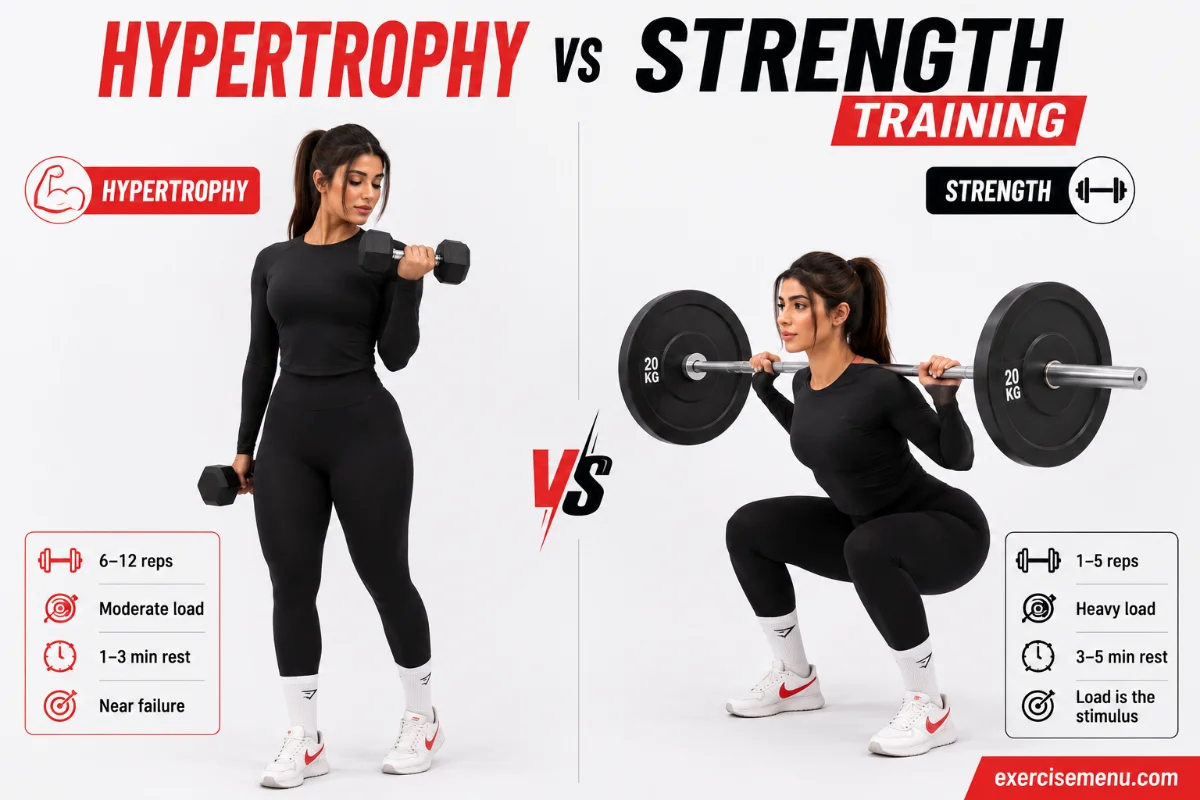
Quick Answer: Hypertrophy training builds muscle size using moderate loads and higher reps (6–12). Strength training builds force output using heavy loads and lower reps (1–5). Both are resistance training, but they drive different adaptations — muscle growth vs neuromuscular power. Most people benefit from combining both.
You train consistently. You push yourself. But your results don’t match your effort — and you’re not sure whether the problem is your program or your expectations.
That gap usually comes down to one thing: your training doesn’t match your actual goal. Training for muscle size and training for strength share the same equipment and many of the same exercises, but they differ in how you use them — how many reps, how heavy, how long you rest, and how hard you push each set.
- What's the Actual Difference Between Hypertrophy and Strength?
- Quick Reference: Hypertrophy vs Strength Training at a Glance
- Why Most People Accidentally Train for Neither
- How Do Reps, Load, and Rest Change the Outcome?
- Does Exercise Selection Matter Differently for Each Goal?
- How Does Progressive Overload Differ Between the Two?
- Can You Train for Both at the Same Time?
- Should Beginners Start With Strength or Hypertrophy?
- When Should You Switch Between Hypertrophy and Strength Phases?
- FAQ
What’s the Actual Difference Between Hypertrophy and Strength?
Hypertrophy is the process of increasing muscle fiber size — a structural change inside the muscle itself. Strength is the ability to produce maximum force against resistance — a performance outcome that depends on muscle size, neural efficiency, and lifting skill combined.
They overlap, but they aren’t the same thing. Hypertrophy contributes to strength because bigger muscles have more contractile tissue to recruit. But strength also depends on how well your central nervous system responds to different rep ranges — how many motor units fire, how fast they fire, and how coordinated the contraction is.
A 2017 meta-analysis by Schoenfeld et al. in the Journal of Strength and Conditioning Research confirmed that heavy loads (above 70% of 1RM) produce greater strength gains than light loads — but both produce similar hypertrophy when effort per set is high enough.
Hypertrophy — Growing Bigger Muscles
Muscle growth happens primarily through myofibrillar hypertrophy — an increase in the number of contractile units (myofibrils) within each muscle fiber. This makes fibers thicker, and thicker fibers make the overall muscle belly visually larger.
The trigger is mechanical tension — challenging a muscle under load until it fatigues. Volume (total sets × reps × load) is the primary driver. More productive work on a muscle produces more growth stimulus.
Strength — Producing More Force
Strength is task-specific. Getting stronger at the barbell squat requires practicing the barbell squat with heavy loads. A leg press won’t transfer the same way because the movement pattern, stabilization demands, and neural coordination differ.
This is the principle of specificity — and it’s the single biggest distinction between the two approaches. Hypertrophy doesn’t care which exercise you use as long as the target muscle reaches fatigue. Strength cares deeply about which exact movement you train.
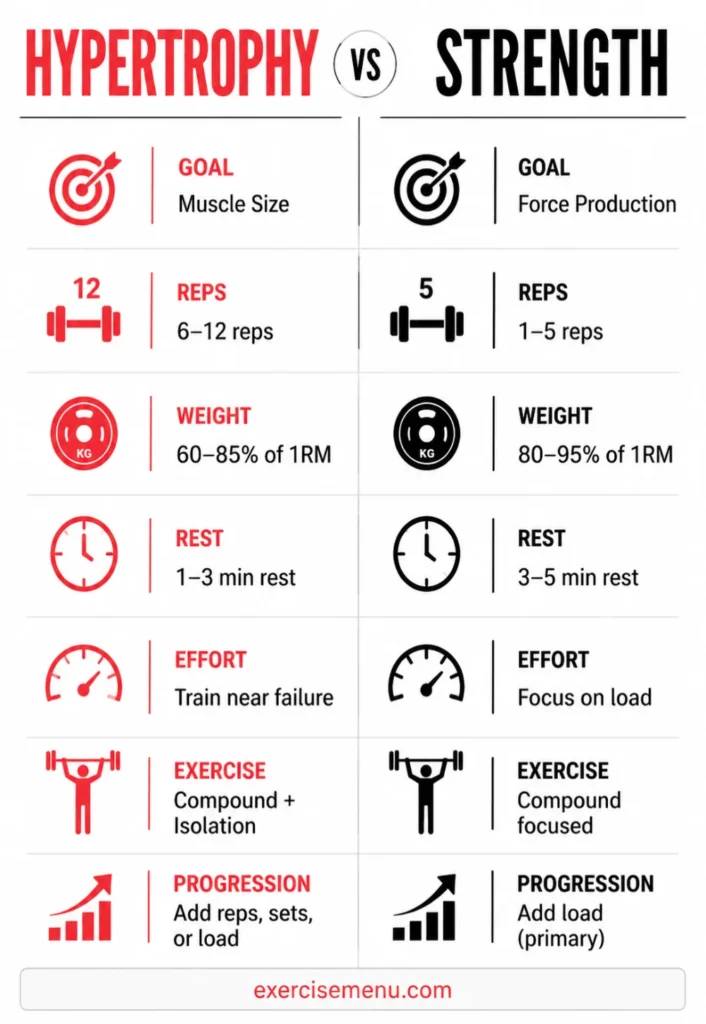
Quick Reference: Hypertrophy vs Strength Training at a Glance
Use this table as a starting point. The sections below explain why each variable differs.
| Variable | Hypertrophy Training | Strength Training |
|---|---|---|
| Primary goal | Muscle size | Force production |
| Rep range | 6–12 (5–30 works if taken near failure) | 1–5 |
| Load (% of 1RM) | 60–85% | 80–95% |
| Rest periods | 1–3 minutes | 3–5 minutes |
| Sets per exercise | 3–5 | 3–6 |
| Proximity to failure | Within 1–2 reps of failure | Focus on load; failure isn’t required |
| Exercise selection | Compound + isolation, flexible | Compound-focused, movement-specific |
| Progression method | More reps, sets, or load | More load (primary) |
| Technique priority | Lengthened range, controlled eccentric | Maximum mechanical efficiency |
| Workout structure | Muscle-group based | Movement-based |
If you’re unsure how to calculate your 1RM to apply these percentages, a simple formula using your best 3–5 rep set gives you a reliable estimate.
Why Most People Accidentally Train for Neither
Here’s the pattern that stalls progress for most intermediate lifters: they load the bar heavy enough that 8–10 reps feel hard, rest 2–3 minutes, stop 3–4 reps short of failure, and repeat.
That approach is too heavy and too low-volume for optimal hypertrophy. The muscle never reaches the fatigue threshold that drives growth. But it’s also too light and too many reps for meaningful strength adaptation — the nervous system never gets exposed to the near-maximal loads it needs to improve force production.
The result is slow, frustrating progress on both fronts.
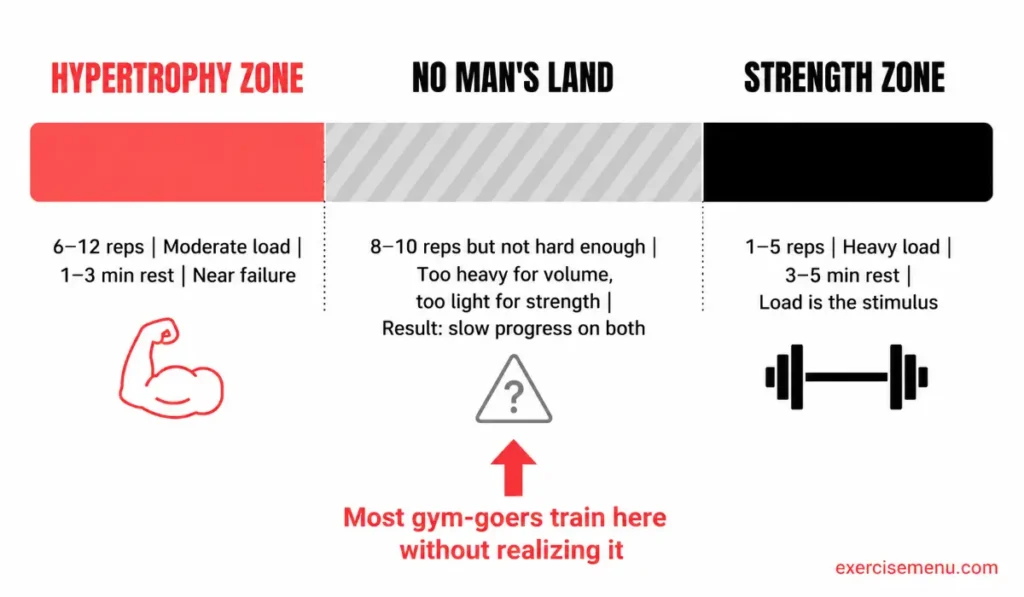
A quick self-check: if your last 2 reps of every set aren’t a genuine struggle, you’re not close enough to failure for hypertrophy. If you can consistently get more than 6 reps, you’re not heavy enough for strength. That middle zone produces what coaches call junk volume — sets that add fatigue without adding stimulus.
Fix it by deciding before each exercise: am I training this for size or for strength? Then set the reps, load, and rest to match.
How Do Reps, Load, and Rest Change the Outcome?
The three variables that differ most between hypertrophy and strength training are rep range, load, and rest periods. Each one shifts the type of adaptation your body prioritizes.
Rep Ranges and Load
Strength develops best with heavy loads in the 1–5 rep range (80–95% of 1RM). The neural system adapts to producing maximum force — recruiting more motor units, firing them faster, and coordinating contraction more efficiently.
Hypertrophy occurs across a much wider range — anywhere from 5 to 30 reps — as long as each set is pushed hard enough to challenge the muscle. A 2022 meta-analysis by Schoenfeld et al. published in Sports Medicine found that muscle growth is similar across rep ranges when total volume and effort are equated. The 6–12 range is most practical because it balances mechanical tension with enough reps to accumulate meaningful volume without excessive joint stress.
For muscle growth specifically, the load matters less than people assume. What matters more is effort per set — covered in the proximity to failure section below.
Rest Periods
Strength training requires 3–5 minutes between sets. Heavy loads demand full recovery of fast-twitch muscle fibers and the ATP-phosphocreatine energy system. Cutting rest short means lifting less weight on subsequent sets — which directly undermines the stimulus.
Hypertrophy training works well with 1–3 minutes of rest. The goal is maintaining enough performance across sets that volume stays productive, while keeping sessions time-efficient. A 2016 study by Schoenfeld et al. found that 3-minute rest periods produced slightly better hypertrophy than 1-minute rest — suggesting that performance preservation matters more than metabolic fatigue.
Proximity to Failure
For hypertrophy, training within 1–2 reps of failure (1–2 RIR) drives better results. Proximity to failure shows a positive relationship with muscle growth: the closer you get to failure, the more motor units you recruit, and the greater the growth signal.
For strength, the relationship is different. When load is equated, proximity to failure shows no clear directional benefit for 1RM strength gains. Strength training is about exposing the nervous system to heavy loads — the load itself is the stimulus, not the degree of fatigue. Pushing to failure on heavy compounds also increases injury risk and neural fatigue without proportional strength benefit.
Does Exercise Selection Matter Differently for Each Goal?
Strength programs are built around a small number of lifts — typically 3–5 core compound movements practiced frequently. A powerlifter might only train squat, bench, and deadlift plus close variations. Adding exercises doesn’t help unless they directly improve performance on the target lift.
Hypertrophy programs use more exercises per muscle group — often 2–4 different movements for a single body part in one session. A chest workout might include barbell bench press, incline dumbbell press, and cable flys. Each exercise stresses the muscle from a different angle, through a different range, which promotes more balanced growth across the full muscle.
Research comparing machines to free weights shows no significant difference in muscle growth. But free weights produce better strength transfer to barbell tests. So a strength-focused lifter needs barbells. A hypertrophy-focused lifter can use whatever equipment fatigues the target muscle effectively — machines, cables, dumbbells, or barbells.
How Does Progressive Overload Differ Between the Two?
Progressive overload applies to both approaches, but the method of progression differs.
For strength, the primary progression is adding load. A stronger squat means more weight on the bar. That is both the method and the goal. Reps and sets stay relatively fixed while the load climbs over weeks.
For hypertrophy, progression has multiple paths: add reps with the same weight, add a set to the weekly volume, or increase the load and reset the rep count. All three create overload because the goal is more total mechanical work on the muscle — not a specific number on the bar.
A 2022 study by Plotkin et al. published in PeerJ compared load progression to rep progression over 8 weeks. Both groups trained to failure. Both saw comparable increases in muscle thickness — reinforcing that for muscle growth, the method of overload matters less than whether you overload at all.
For beginners learning to apply progressive overload, the simplest approach is adding 1–2 reps per set each week until the top of the target range, then adding weight and resetting.
Can You Train for Both at the Same Time?
Yes — and most people should. Strength and hypertrophy are compatible adaptations. Almost all resistance training produces some of both. The Schoenfeld et al. 2017 meta-analysis referenced earlier found that both adaptations occur simultaneously across load ranges — they don’t compete with each other physiologically.
The practical trade-off is bandwidth. Heavy strength work demands long rest periods, high neural recovery, and joint tolerance. Hypertrophy work demands high volume and hard sets near muscular fatigue. Trying to maximize both in a single session creates long workouts and accumulates fatigue faster than most people can recover from.
The Hybrid Approach: Start Heavy, Finish Light
The most effective structure for combining both: open with 2–3 heavy compound exercises for strength (squats 4×4, bench press 4×3), then shift to moderate-load accessories for hypertrophy (leg extensions 3×12, dumbbell flys 3×10).
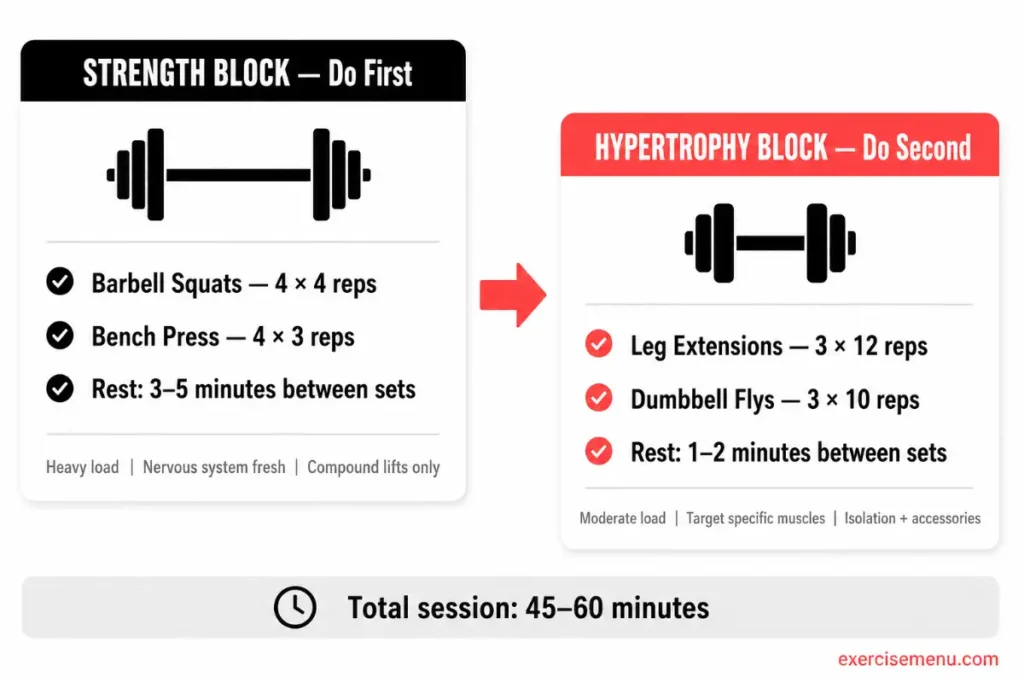
This is how most well-designed programs — including upper/lower splits and push/pull/legs — are already organized. The strength work comes first when the nervous system is fresh. The hypertrophy work follows, targeting muscles that need more volume.
For a complete framework on organizing these elements, the guide on how to structure a workout covers sequencing in detail.
When Combining Both Stops Working
As training age increases, the overlap shrinks. An advanced lifter can’t do 8 heavy sets of squats for strength AND 15 hypertrophy sets for quads and recover between sessions.
Signs you need to periodize rather than combine:
- Lifts plateau despite consistent effort and recovery
- Persistent joint discomfort that doesn’t resolve with deload weeks
- Feeling systemically drained — not just muscle soreness, but low motivation and poor sleep
- Both strength numbers and muscle measurements stalling simultaneously
At that point, dedicating 4–8 week blocks to one focus — then switching — produces better results than trying to maintain both at maximum effort year-round.
Should Beginners Start With Strength or Hypertrophy?
Beginners don’t need to choose. During the first 6–12 months of consistent resistance training, nearly any structured program builds both muscle and strength simultaneously. Neural adaptations happen fast, and untrained muscles respond to almost any progressive stimulus.
That said, hypertrophy-style training — moderate loads, 6–12 reps, controlled technique — is often the better starting point. The loads are more manageable, the injury risk is lower, and the higher rep counts give more practice with each movement pattern. Form develops faster when you do 10 reps per set instead of 3.
Once movement quality is solid and a base of muscle exists — usually 6–12 months in — shifting toward heavier strength work is safer and more productive. The muscle you built during the hypertrophy phase gives you more contractile tissue to recruit, and the technique you developed keeps you stable under heavier loads.
For specific beginner rep and set recommendations, starting with 3 sets of 8–12 reps on compound movements covers both bases.
When Should You Switch Between Hypertrophy and Strength Phases?
These triggers apply once you’re past the beginner stage where everything works.
Switch to strength when:
- You’ve built a solid muscle base but your lifts haven’t moved up in weeks
- You have a specific performance goal — a strength test, a sport, a PR target
- You want to “cash in” on new muscle mass by teaching your nervous system to use it
Switch to hypertrophy when:
- You’re coming off a heavy strength block and joints need lower-intensity work
- Lifts are stalling despite good recovery, sleep, and nutrition
- You want more muscle mass before pushing loads higher
- You’ve been training heavy for 8+ weeks without a volume-focused phase
Most non-competitive lifters do well alternating 4–8 week blocks. Undulating periodization — rotating emphasis within the same week — is another option that keeps both qualities progressing without full phase switches.
FAQ
Do I need to eat differently for hypertrophy vs strength training?
Hypertrophy requires a caloric surplus — eating more than you burn — plus 1.6–2.2 grams of protein per kilogram of body weight daily to support muscle repair and growth. Strength training is less dependent on surplus calories; you can gain strength at maintenance or even in a mild deficit, as long as protein intake stays adequate and neural recovery isn’t compromised.
Does hypertrophy training make women bulky?
No. Women produce significantly less testosterone than men, making large-scale muscle gain much slower and more difficult. Hypertrophy training typically produces a leaner, more defined physique. Noticeable “bulk” requires years of dedicated training combined with a sustained caloric surplus.
Is one approach better for fat loss?
Neither is inherently better for fat loss. Fat loss requires a caloric deficit regardless of training style. Both approaches build metabolically active muscle tissue, which increases resting calorie burn. A combination of both is often ideal for body recomposition.
Can I do hypertrophy and strength on the same day?
Yes. Start with 2–3 heavy compound lifts in the 1–5 rep range for strength, then follow with 2–3 moderate-load isolation or accessory exercises in the 8–12 rep range for hypertrophy. Heavy work goes first while the nervous system is fresh. This structure fits well inside a 45–60 minute session.
Can you build muscle with just 3 sets of 10?
Yes — if those sets are taken close to failure with proper form. Three challenging sets per exercise is enough stimulus for most muscles, particularly for beginners and intermediates. As you advance, you may need 10–20 sets per muscle group per week spread across multiple exercises.
