


You don’t need a cable machine, a lat pulldown station, or a gym membership to build a stronger back. A medicine ball and some floor space is enough.
This guide covers 10 exercises that target your lats, traps, rhomboids, erector spinae, and rear delts — with clear steps, form cues, and a ready-to-use workout at the end.
Grab a 6–10 lb ball. Let’s get to work.
10 back exercises with a medicine ball
Ordered easiest to hardest. Each one hits a different part of your back.
Before you start — five rules for every rep:
- Brace your core before you move.
- Control the speed — 2 seconds up, 3 seconds down. That slow lowering phase increases time under tension and forces your back muscles to work harder.
- Exhale on effort, inhale on the return.
- Keep a neutral spine. No rounding, no overextending.
- Muscle burn is fine. Sharp pain or tingling means stop.
1. Medicine ball superman
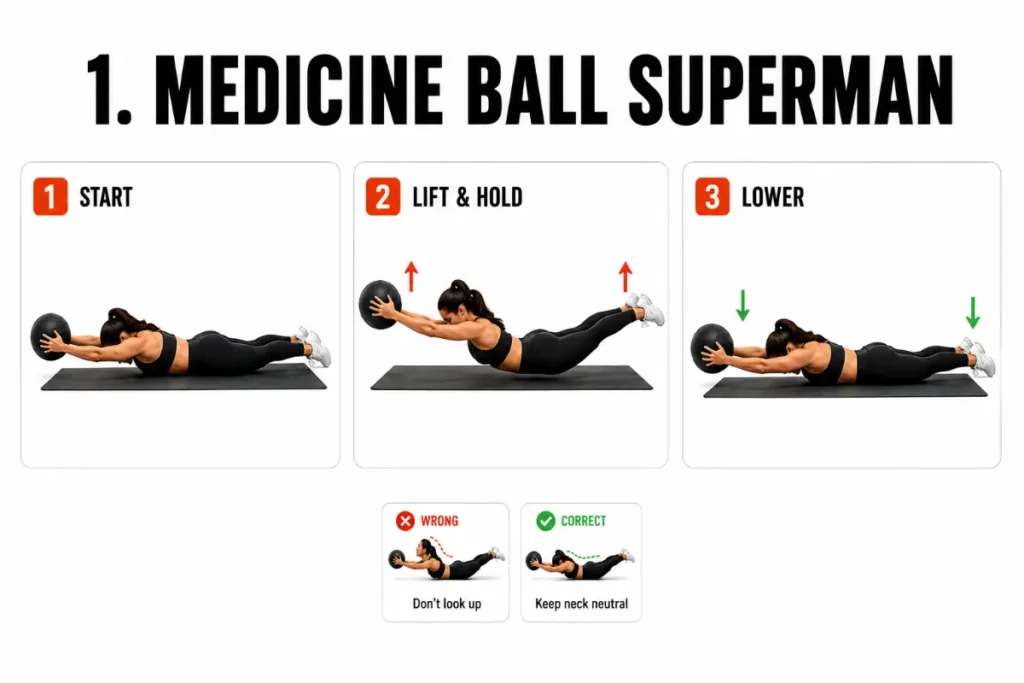
Muscles: Erector spinae, glutes, rear delts Sets × Reps: 3 × 10–12 | Rest: 45 sec
How to do it:
- Lie face down on a mat. Arms extended overhead, holding the ball with both hands. Legs straight, hip-distance apart.
- Squeeze your glutes and lower back muscles. Lift your arms, chest, and legs off the floor at the same time.
- Hold the top for 2–3 seconds. Lower back down with control.
Keep in mind: Your neck stays neutral — look at the floor, not forward. Lifting your chin strains your cervical spine.
Beginner tip: Start without the ball first. Add it only when you can hold the top for a full 3 seconds bodyweight.
Common mistake to avoid: Rushing the reps. The slower you go, the more your erector spinae has to stabilize. Speed kills the benefit here.
2. Bent over row
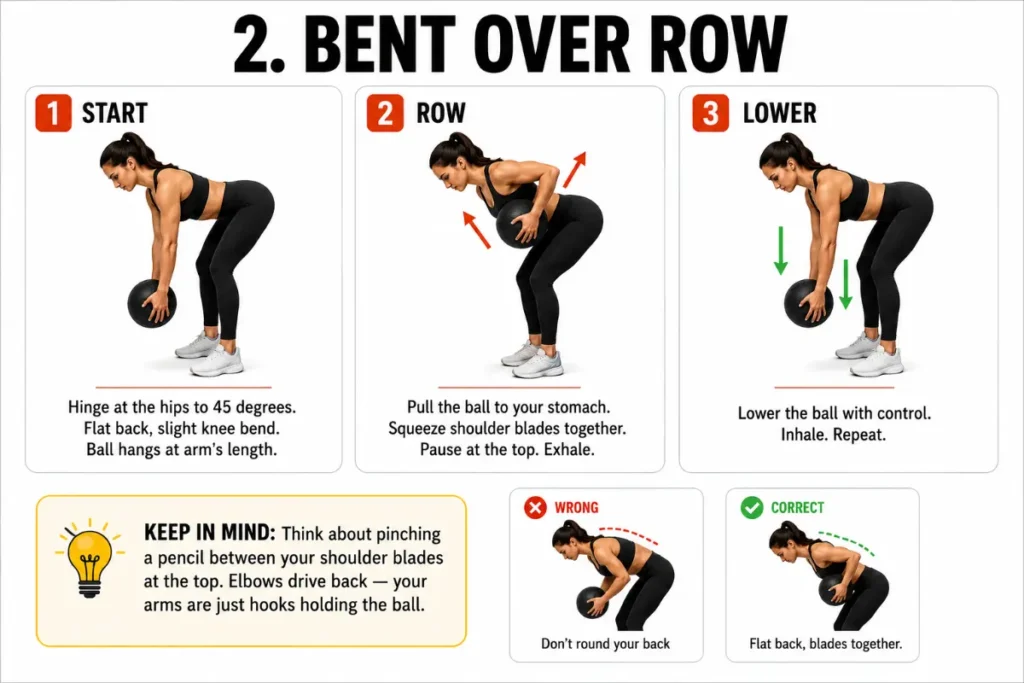
Muscles: Lats, rhomboids, traps, rear delts, biceps Sets × Reps: 3 × 10–12 | Rest: 45 sec
How to do it:
- Stand with feet shoulder-width apart, holding the medicine ball at your waist with both hands.
- Hinge at the hips — push your glutes back, slight bend in your knees — until your torso is at roughly 45 degrees.
- Let the ball hang at arm’s length. Pull it toward your stomach by squeezing your shoulder blades together. Pause at the top. Lower with control.
Keep in mind: Think about pinching a pencil between your shoulder blades at the top of every rep. That cue locks in your rhomboid and mid-trap activation.
Beginner tip: If your lower back rounds at 45 degrees, don’t go that deep. Hinge to whatever angle lets you keep a flat back.
Common mistake to avoid: Pulling with your arms instead of your back. Your elbows drive back, your shoulder blades squeeze — that’s the movement. Your arms are just hooks holding the ball.
3. Medicine ball pullover
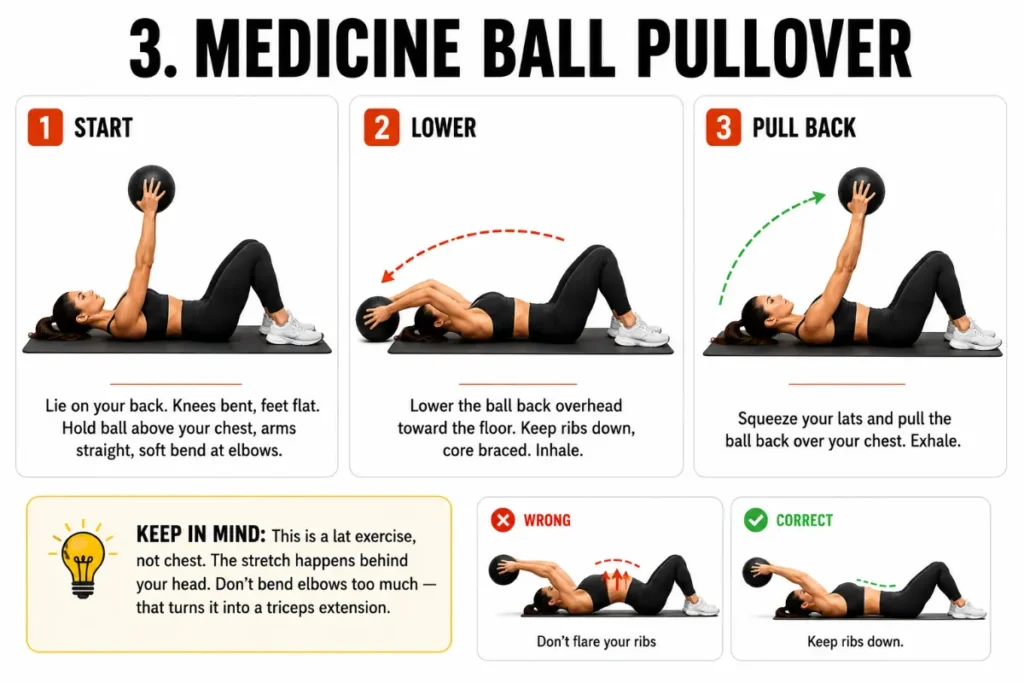
Muscles: Lats, teres major, triceps, core Sets × Reps: 3 × 10–12 | Rest: 60 sec
How to do it:
- Lie on your back on the floor — or a bench if you have one. Knees bent, feet flat. Hold the medicine ball directly above your chest, arms straight with a soft bend at the elbows.
- Lower the ball back overhead toward the floor behind you. Keep your core braced — don’t let your ribs flare.
- Once your arms are roughly parallel with the floor, squeeze your lats and pull the ball back to the starting position.
Keep in mind: This is a lat exercise, not a chest exercise. The stretch happens behind your head. The contraction happens when you pull the ball back over your chest by engaging your lats.
Beginner tip: Use a lighter ball (4–6 lb). The extended lever arm makes even light weight feel heavy at full stretch.
Common mistake to avoid: Bending your elbows too much on the way down. That turns it into a triceps extension. Keep them soft but fixed.
4. Medicine ball good morning
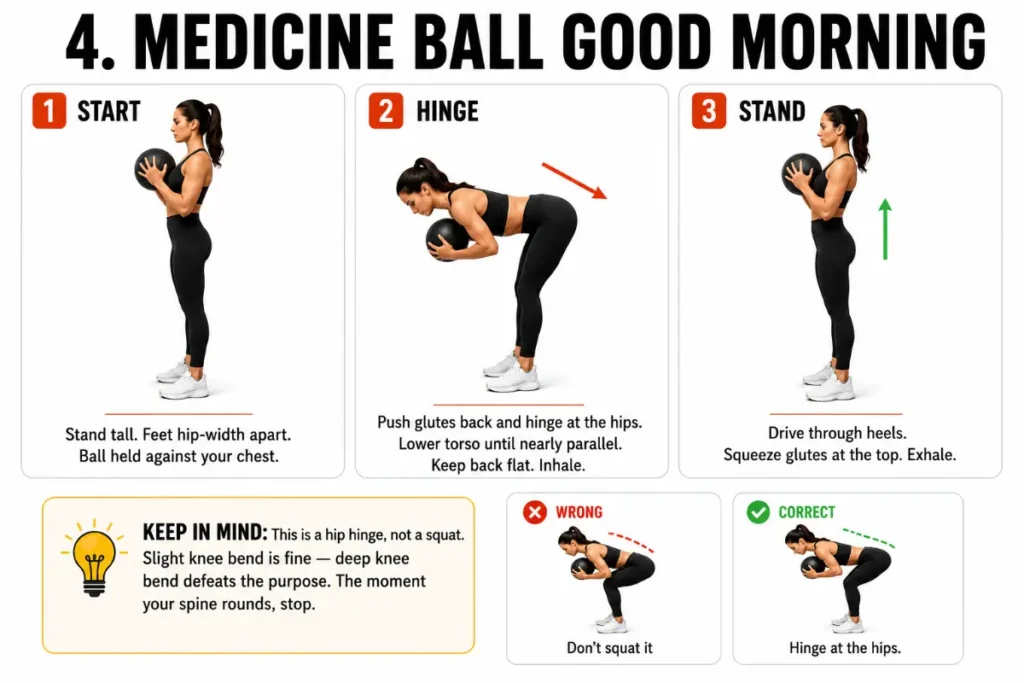
Muscles: Erector spinae, hamstrings, glutes Sets × Reps: 3 × 10–12 | Rest: 45 sec
How to do it:
- Stand with feet hip-width apart. Hold the medicine ball against your chest with both hands.
- Brace your core. Hinge at the hips — push your glutes backward — and lower your torso until it’s nearly parallel with the floor.
- Drive through your heels and squeeze your glutes to return to standing.
Keep in mind: Your back stays flat the entire time. The moment your spine rounds, the exercise stops working your erector spinae and starts loading your discs.
Beginner tip: Only hinge as far as your hamstring flexibility allows. Depth improves over time.
Common mistake to avoid: Bending at the knees instead of hinging at the hips. This is a hip hinge, not a squat. Slight knee bend is fine — deep knee bend defeats the purpose.
5. Medicine ball prone Y-raise
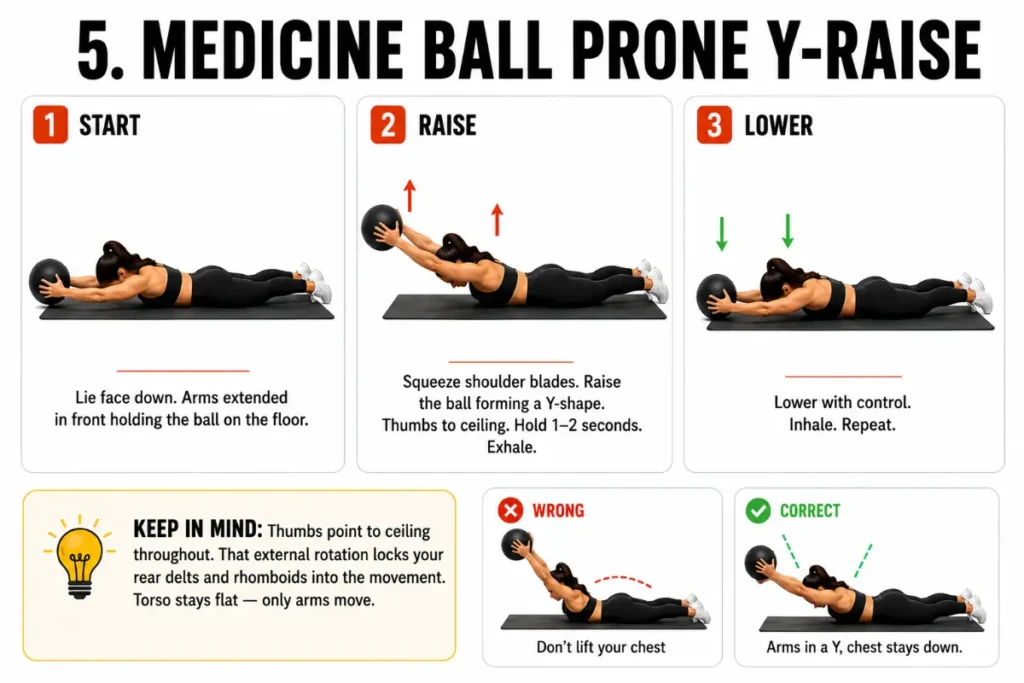
Muscles: Rear delts, rhomboids, mid traps, erector spinae Sets × Reps: 3 × 10–12 | Rest: 45 sec
How to do it:
- Lie face down on a mat. Hold the medicine ball with both hands, arms extended in front of you on the floor.
- Squeeze your shoulder blades together and raise the ball off the floor at a slight angle — forming a Y-shape with your arms and torso.
- Hold the top for 1–2 seconds. Lower with control.
Keep in mind: Your thumbs point toward the ceiling throughout the lift. That external rotation locks your rear delts and rhomboids into the movement instead of letting your upper traps take over.
Beginner tip: Use a 4 lb ball. This is a small-muscle exercise — your rear delts and mid traps fatigue fast. Perfect reps with light weight beat sloppy reps with heavy weight every time.
Common mistake to avoid: Lifting your chest off the floor to create momentum. Your torso stays flat on the mat — only your arms move. If your chest lifts, the erector spinae takes over and your upper back gets no work.
6. Overhead halo
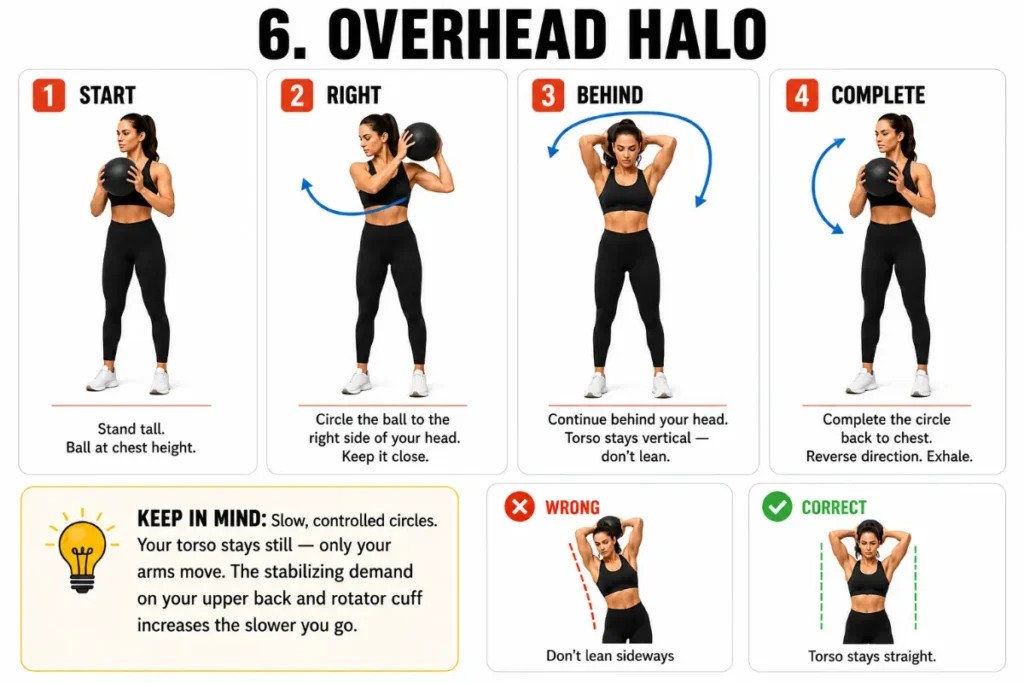
Muscles: Traps, rear delts, rotator cuff, core Sets × Reps: 3 × 8 each direction | Rest: 45 sec
How to do it:
- Stand tall, feet hip-width apart. Hold the medicine ball at chest height.
- Circle the ball around your head — first clockwise, then counterclockwise. Keep it close to your skull.
- Maintain a braced core throughout. Your torso stays still — only your arms move.
Keep in mind: Slow, controlled circles. This isn’t about speed. The stabilizing demand on your upper back, rotator cuff, and traps increases the slower you go.
Beginner tip: Start with a 4–6 lb ball. Heavier balls can strain your shoulders if your rotator cuff isn’t conditioned yet.
Common mistake to avoid: Leaning your torso as the ball moves behind your head. If your core is braced, your spine stays vertical.
7. Medicine ball bird dog
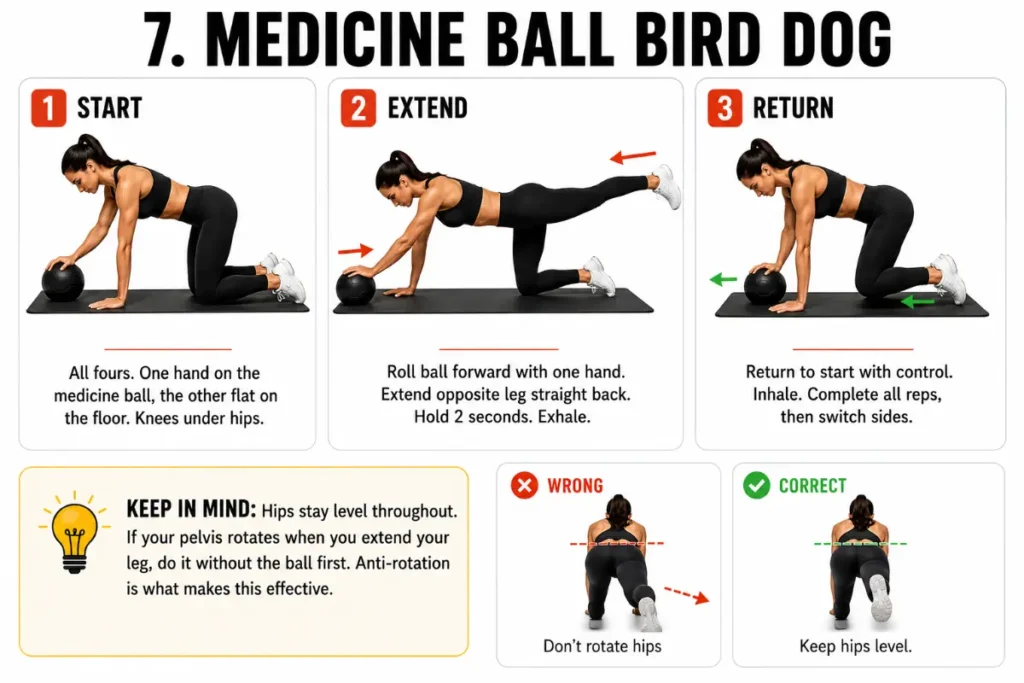
Muscles: Erector spinae, multifidus, glutes, core stabilizers Sets × Reps: 3 × 8 each side | Rest: 45 sec
How to do it:
- Get on all fours — wrists under shoulders, knees under hips. Place the medicine ball on the floor under one hand.
- Roll the ball forward with one hand while extending the opposite leg straight back. Hold for 2 seconds at full extension.
- Return to the starting position. Complete all reps on one side, then switch.
Keep in mind: Your hips stay level throughout. If your pelvis rotates when you extend your leg, the exercise is too advanced — do it without the ball first.
Beginner tip: Press your non-working hand firmly into the floor. It gives you a more stable base.
Common mistake to avoid: Rushing through reps. The anti-rotation demand on your spine is what makes this effective. Speed removes that demand.
8. Figure of 8 rotation
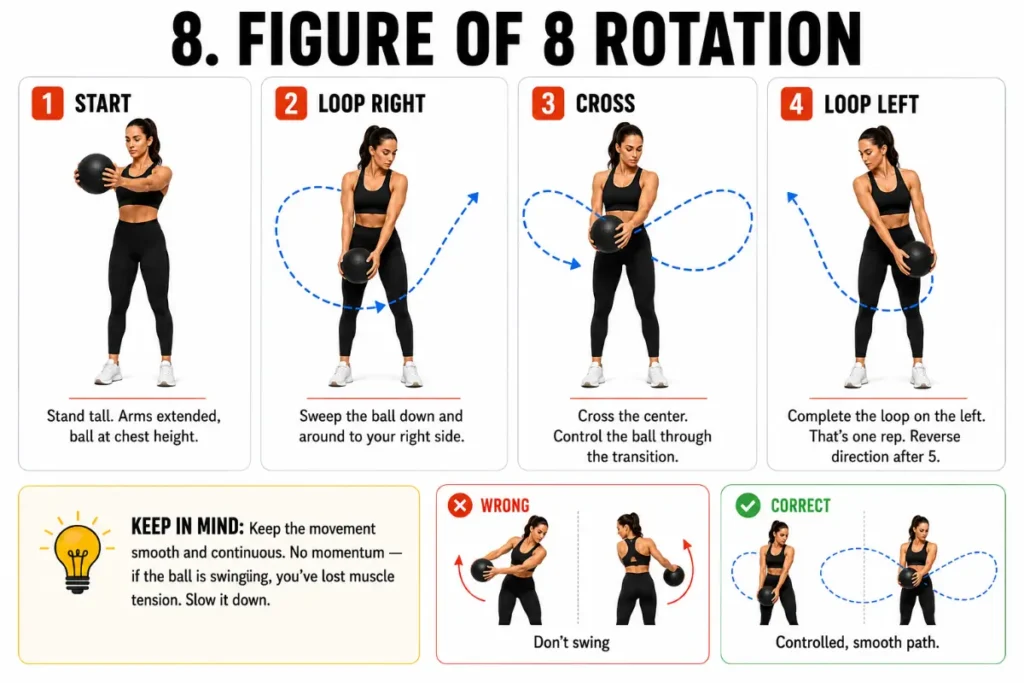
Muscles: Lats, traps, obliques, rear delts Sets × Reps: 3 × 10 total (5 each direction) | Rest: 45 sec
How to do it:
- Stand with feet shoulder-width apart. Hold the ball with both hands, arms extended in front of your chest.
- Move the ball in a figure-of-eight pattern — looping around and across your torso. Engage your lats and upper back to control the path.
- Reverse direction after 5 reps.
Keep in mind: Keep the movement smooth and continuous. The back muscles work hardest when they’re controlling the ball’s changing direction — not when the ball is moving in a straight line.
Beginner tip: Smaller loops first. Make the 8 bigger as your coordination and back strength improve.
Common mistake to avoid: Using momentum. If the ball is swinging, you’ve lost muscle tension. Slow it down.
9. Medicine ball slam
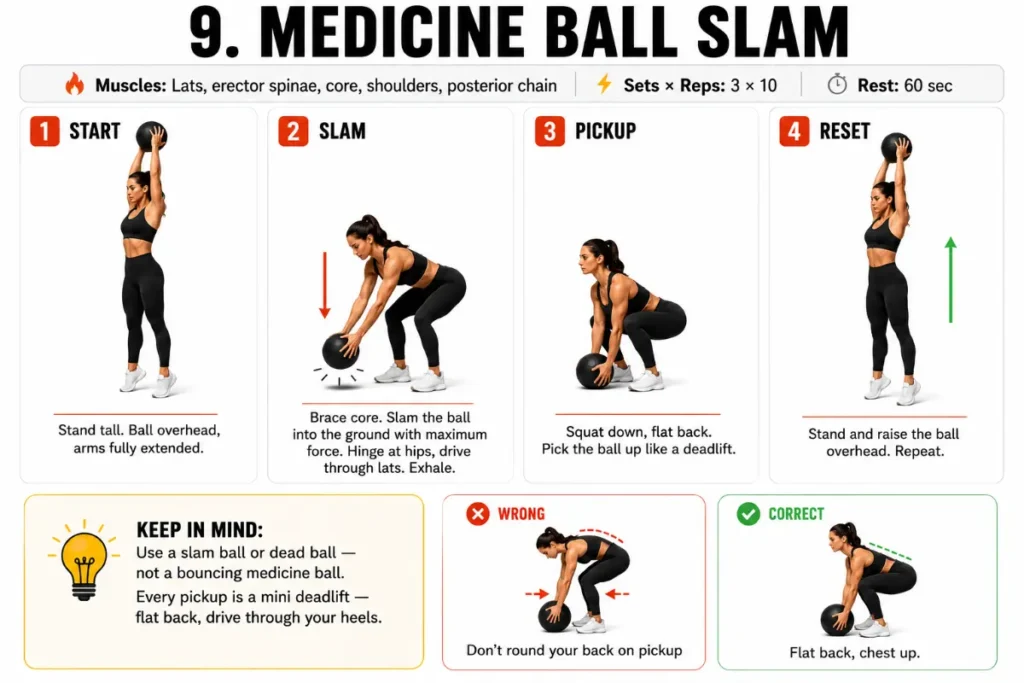
Muscles: Lats, erector spinae, core, shoulders, posterior chain Sets × Reps: 3 × 10 | Rest: 60 sec
How to do it:
- Stand with feet hip-width apart. Hold the ball overhead with both arms fully extended.
- Brace your core. Slam the ball into the ground with maximum force — hinge at the hips, drive through your lats.
- Squat down, pick it up, and repeat.
Keep in mind: Use a slam ball or dead ball — not a rubber bouncing medicine ball. Bouncing balls rebound unpredictably and can hit your face.
Beginner tip: Focus on the hinge, not the throw. Your lats and back initiate the slam. Your arms follow.
Common mistake to avoid: Rounding your back when you pick the ball up. Every pickup is a mini deadlift — flat back, drive through your heels.
10. Medicine ball deadlift to overhead press
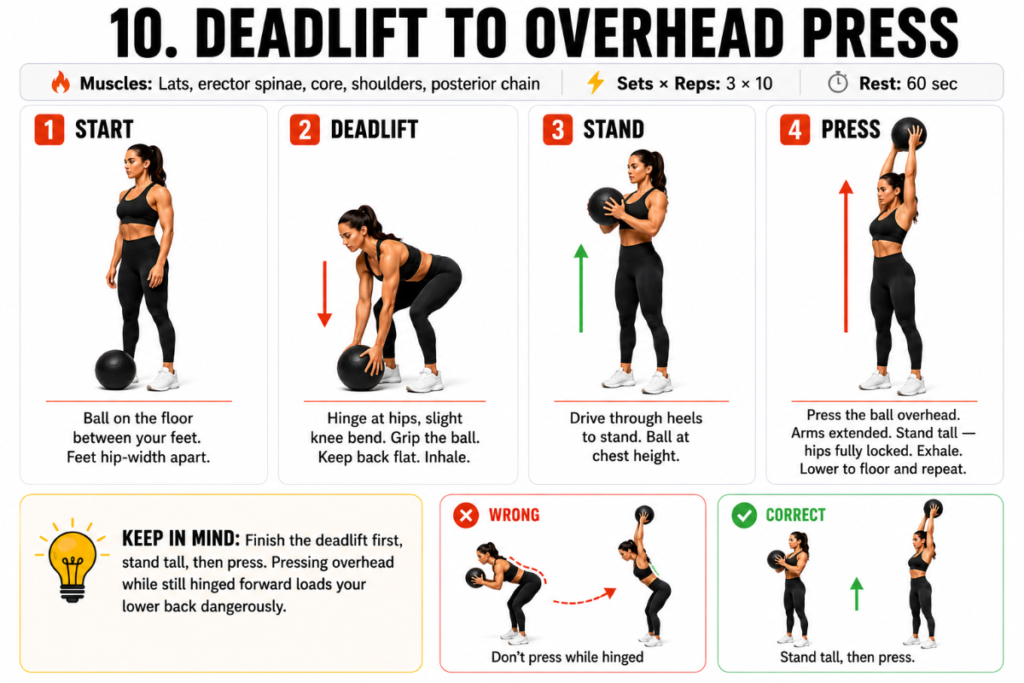
Muscles: Erector spinae, glutes, hamstrings, traps, shoulders Sets × Reps: 3 × 8–10 | Rest: 60 sec
How to do it:
- Stand with feet hip-width apart. Place the medicine ball on the floor between your feet.
- Hinge at the hips, bend your knees slightly, keep your back flat — grip the ball with both hands.
- Drive through your heels to stand. As you reach the top, press the ball overhead. Lower it back to the floor and repeat.
Keep in mind: This is a compound movement — posterior chain plus overhead press. It demands full-body coordination and loads your erector spinae through the entire range of motion.
Beginner tip: Break it into two parts first. Practice the deadlift and the press separately before chaining them together.
Common mistake to avoid: Pressing overhead before your hips fully extend. Finish the deadlift, stand tall, then press. Pressing while still hinged forward loads your lower back dangerously.
20-minute back workout you can do today
No equipment besides a medicine ball. No warm-up machines. Just movement.
Warm-up (3 minutes): 30 sec arm circles forward, 30 sec arm circles backward, 30 sec cat-cow on all fours, 30 sec standing hip hinges (no ball), 60 sec light jog in place
Circuit — repeat 3 rounds, 45 sec rest between rounds:
| Order | Exercise | Reps |
|---|---|---|
| 1 | Medicine ball superman | 10 |
| 2 | Bent over row | 12 |
| 3 | Medicine ball pullover | 10 |
| 4 | Good morning | 12 |
| 5 | Overhead halo | 8 each direction |
| 6 | Medicine ball slam | 10 |
Cool-down (2 minutes): 30 sec child’s pose, 30 sec cat-cow, 30 sec standing forward fold, 30 sec cross-body shoulder stretch each side
If you’re aiming for muscle growth, increase to 4 rounds and use a heavier ball. If you’re training for muscular endurance, keep 3 rounds but increase reps to 15–20 per exercise.
How to pick the right medicine ball weight
| Your level | Ball weight | When to go heavier |
|---|---|---|
| Beginner | 4–6 lb | When you can finish all sets with perfect form and 2 reps to spare |
| Intermediate | 8–10 lb | When the last 2 reps of each set no longer challenge you |
| Advanced | 12–20 lb | When you need external resistance to keep progressing |
Go heavier for slams and deadlifts. Go lighter for Y-raises and halos. Your rotator cuff muscles fatigue faster than your lats — load them accordingly.
Common questions
Are medicine balls good for your back?
Yes. Medicine balls add resistance to back exercises like supermans, rows, and deadlifts without needing a full gym setup. The unstable grip also forces your stabilizer muscles — multifidus, transverse abdominis — to work harder than they would with a barbell or dumbbell.
What are the big 5 back exercises?
Deadlifts, pull-ups, bent over rows, lat pulldowns, and face pulls. Those five cover every major back muscle. With a medicine ball at home, you can replicate the row, the deadlift, and the pullover — three of the five — without any gym equipment.
What are the top 10 back exercises?
Deadlifts, pull-ups, barbell rows, lat pulldowns, seated cable rows, face pulls, T-bar rows, single-arm dumbbell rows, supermans, and back extensions. Most need a gym. The 10 medicine ball exercises in this guide target the same muscles — lats, traps, rhomboids, erector spinae — using just a ball and floor space.
What exercise is good for high blood pressure?
Moderate-intensity aerobic exercise — walking, cycling, swimming — is most studied for blood pressure reduction. But resistance training at moderate loads also helps. Medicine ball circuits like the workout above keep your heart rate elevated while building strength, making them a practical option. Always check with your doctor before starting if you have diagnosed hypertension.
Can medicine ball exercises fix lower back pain?
Strengthening the erector spinae and core stabilizers can help reduce chronic lower back pain — research from the American College of Sports Medicine supports progressive strengthening for back health. Exercises like the bird dog, superman, and good morning in this guide specifically target those muscles. But if your pain is sharp, radiating, or persistent, see a physical therapist before loading your spine.
How heavy should a medicine ball be for back exercises?
Start with 6–8 lb for most exercises. Go lighter (4 lb) for prone Y-raises and halos where small muscles fatigue fast. Go heavier (10–20 lb) for slams and deadlift-to-press where your posterior chain can handle more load.
Can I train back with a medicine ball every day?
Your back muscles need 48–72 hours to recover between resistance sessions. Training the same muscles daily leads to overtraining, not growth. Hit this workout 2–3 times per week with at least one rest day between sessions. On off days, work your legs or arms instead.
What’s the difference between a medicine ball and a slam ball?
A medicine ball is a weighted ball — usually rubber or leather — that bounces. A slam ball (or dead ball) has a softer shell filled with sand and doesn’t bounce. Use a slam ball for overhead slams and floor throws. Use a standard medicine ball for rows, supermans, halos, and pullovers.
The medicine ball exercises guide covers chest, arms, shoulders, abs, and legs — each with 10 exercises and full circuits
