

Key takeaways:
- Environmental health is the branch of public health that studies how physical, chemical, biological, and social factors in our surroundings affect human health and well-being.
- Nearly one in four global deaths — 13.7 million in 2016 alone — are linked to modifiable environmental risks, according to the World Health Organization.
- The four main types of environmental health cover chemical, physical, biological, and social or psychosocial hazards.
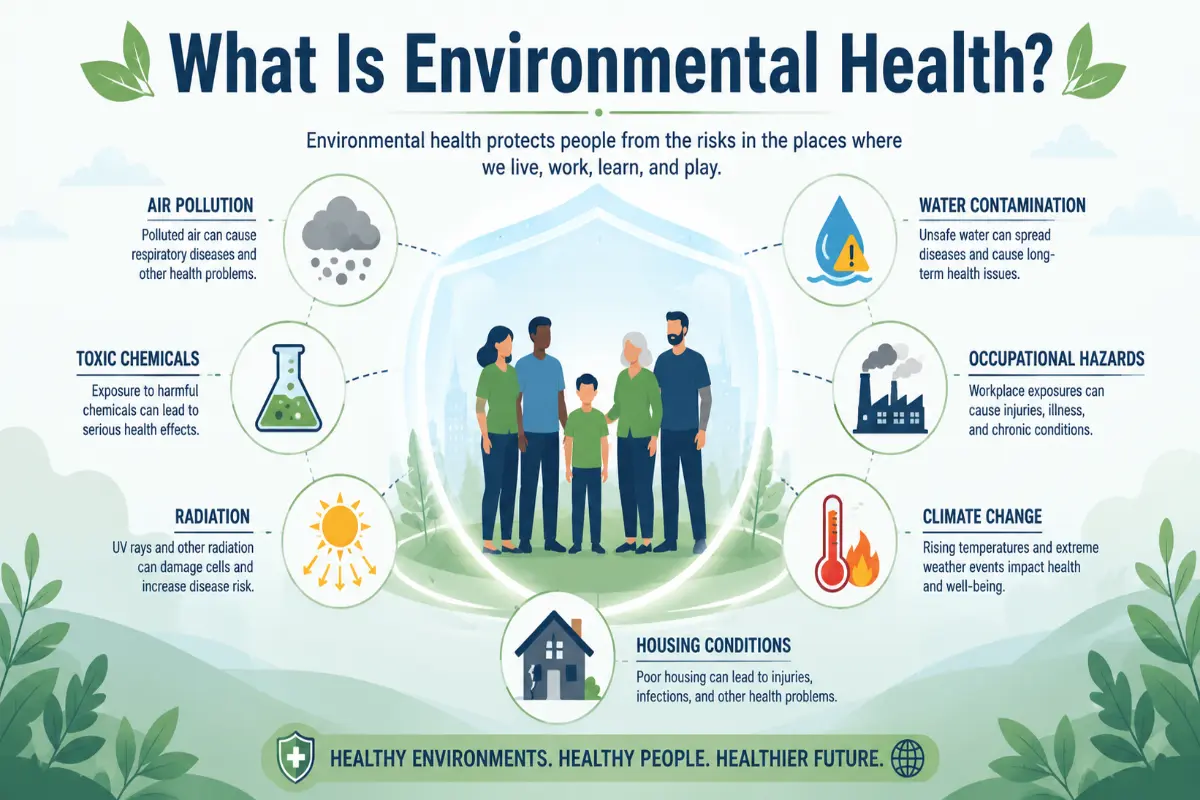
- Common environmental health threats include air pollution, unsafe drinking water, lead contamination, climate change, and hazardous workplace conditions.
- Organizations like the WHO, EPA, NIEHS, and APHA set the standards and policies that protect populations from environmental health hazards worldwide.
Environmental health is one of the most misunderstood branches of public health. Most people hear the term and think it’s about recycling or saving trees. It’s not. Environmental health is the science of understanding how the world around you — the air you breathe, the water you drink, the soil your food grows in, and the conditions you work in — directly affects whether you stay healthy or get sick.
The field covers everything from air pollution and drinking water contamination to workplace hazards, climate change, and toxic chemical exposure. And the data is not subtle. The World Health Organization estimates that a healthy environment could prevent nearly a quarter of the global disease burden. That means roughly 25% of all illness and death worldwide ties back to environmental factors that are, at least in part, preventable.
Environmental health matters because it connects where you live, what you’re exposed to, and what diseases you develop. This isn’t theory — it’s backed by decades of research from institutions like the National Institute of Environmental Health Sciences and the American Public Health Association. This guide breaks down what environmental health means, what types exist, and why it affects every person regardless of where they live.
- What is environmental health? Definition and scope
- Key environmental factors that affect human health
- Environmental health hazards and their impact on disease
- The global environmental burden of disease in numbers
- How climate change is reshaping environmental health risks
- Environmental justice and health inequality
- Key organizations and regulations protecting environmental health
- The future of environmental health — emerging trends and challenges
- Frequently asked questions
What is environmental health? Definition and scope
Environmental health refers to the branch of public health focused on the interrelationships between people and their environment. It examines how physical, chemical, biological, social, and psychosocial factors in our surroundings determine human health outcomes — both positive and negative.
Good health depends on access to clean air, safe drinking water, nutritious food, and safe places to live. The social environment — including economic conditions, housing quality, and community infrastructure — also shapes health outcomes. These are the core determinants of health that environmental health professionals work to protect.
The NIEHS defines environmental health as the science of identifying and understanding the impacts of environmental exposures to hazardous physical, chemical, and biological agents in air, water, soil, and food, as well as social stressors that may adversely affect human health. The goal is to prevent human injury and illness and promote well-being.
That definition covers a lot of ground. In practical terms, environmental health professionals study everything from outdoor air pollution levels in cities to pesticide residue in crops, lead paint in older homes, and noise pollution near airports. They measure exposures, determine whether those exposures cause harm, and develop policies to reduce risk at the population level.
The scope of the field extends across multiple disciplines — toxicology, epidemiology, exposure science, occupational health, and climate science all feed into environmental health. It’s not one narrow specialty. It’s a multidisciplinary field that draws on biology, chemistry, public policy, and data science to protect communities.
What separates environmental health from general medicine is the focus on prevention rather than treatment. Instead of treating a patient who already has lung cancer, environmental health works upstream — identifying that a factory is releasing carcinogens into the air and pushing for regulations that stop the exposure before anyone gets sick.
How Environmental Health Fits Within Public Health
Public health is the broader umbrella — it deals with disease prevention, health promotion, and health policy across entire populations. Environmental health sits within it as one of its core pillars, narrowing the focus specifically to how surroundings — the built environment, the natural environment, workplace conditions, chemical exposures — contribute to disease and well-being.
The two fields work together. Epidemiologists track disease spread. Environmental health specialists trace that spread back to contaminated water systems, polluted air corridors, or toxic waste sites. Policy experts then push for legislation that addresses the root cause.
Key environmental factors that affect human health
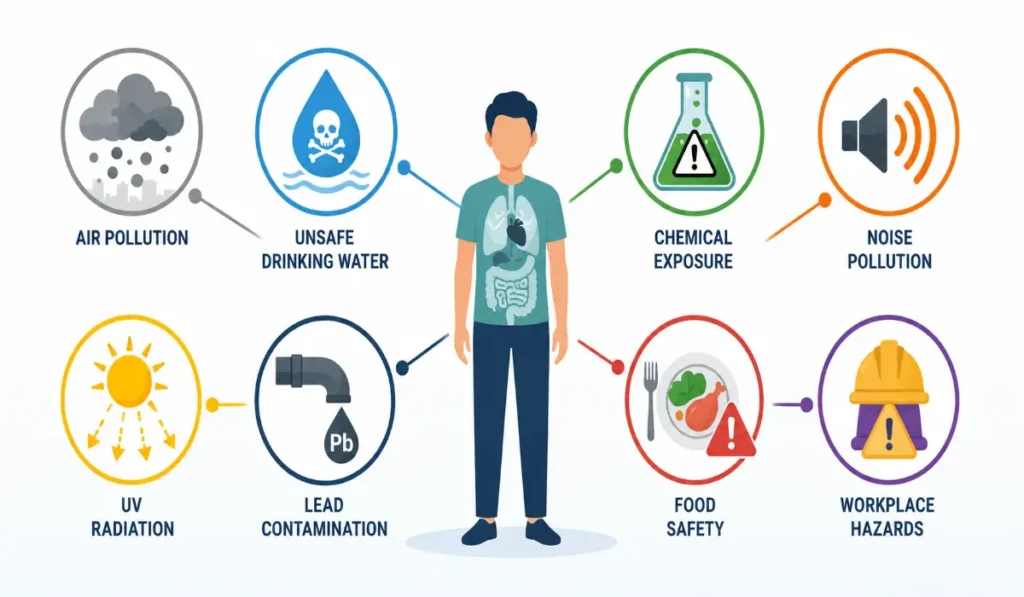
The environment affects health through multiple pathways. Some are obvious — breathing polluted air causes respiratory disease. Others are less visible but equally dangerous — chronic low-level lead exposure in children causes developmental delays that may never fully reverse.
Air quality and pollution
Air pollution is the single largest environmental risk to human health globally. The WHO reports that air pollution alone is responsible for millions of deaths each year, driving conditions like chronic respiratory diseases, cardiovascular disease, lung cancer, and stroke.
There are two main categories. Ambient air pollution — the outdoor pollution from vehicles, factories, power plants, and agricultural burning — affects entire populations. Household air pollution comes from indoor sources like solid fuel cookstoves, tobacco smoke, mold, and poor ventilation. Both contribute to the global burden of disease, but household air pollution disproportionately affects low-income communities and developing countries.
Water quality and contamination
Safe drinking water is a basic requirement for human health, but it’s far from guaranteed worldwide. Contaminated water transmits diseases like cholera, typhoid, and dysentery. Even in developed countries, water contamination remains a persistent threat — lead in aging pipe systems, agricultural runoff carrying nitrates and pesticides into groundwater, and industrial discharge polluting rivers and reservoirs.
The broader WASH framework — water, sanitation, and hygiene — is central to environmental health. The WHO estimates that unsafe water, sanitation, and hygiene drive at least 1.4 million preventable deaths each year.
Chemical exposures and toxic substances
People encounter toxic chemicals daily through water, air, food, and consumer products. Over 85,000 chemicals are registered for use in the United States alone, and most have never been fully tested for safety. Research links chronic chemical exposure to asthma, cancers, neurological disorders, reproductive problems, and endocrine disruption.
Specific chemicals carry well-documented risks. Lead exposure causes developmental delays and behavioral problems in children and increased blood pressure in adults. Asbestos exposure leads to lung cancer and mesothelioma.
Mercury — addressed globally through the Minamata Convention — damages the nervous system. PFAS, sometimes called “forever chemicals,” persist in the environment and accumulate in human tissue with long-term health consequences that researchers are still working to fully understand.
Food safety and foodborne illness
Environmental health covers the entire food chain — from agricultural practices and pesticide use to food processing, handling, storage, and preparation. Foodborne illness affects millions of people annually, caused by pathogens like Salmonella, E. coli, and Listeria that enter the food supply through contaminated water, soil, or unsafe handling.
Integrated pest management systems and food safety regulations — enforced by agencies like the FDA — aim to minimize exposure to harmful substances while maintaining food production levels that feed large populations.
Workplace and occupational hazards
Occupational health is a core discipline within environmental health. Workers face exposure to chemical, physical, and biological hazards depending on their industry — construction workers inhale silica dust, agricultural workers handle pesticides, factory workers face noise-induced hearing loss, and healthcare workers encounter infectious biological agents.
Organizations like OSHA in the United States set and enforce workplace safety standards designed to reduce these exposures. The field of industrial hygiene specifically focuses on recognizing, evaluating, and controlling workplace hazards to protect worker health.
Radiation and UV exposure
Both ionizing and non-ionizing radiation present environmental health risks. Ultraviolet radiation from sun exposure causes melanoma, non-melanoma skin cancers, and eye cataracts. On the other end, too little UV exposure contributes to vitamin D deficiency, which links to rickets, osteoporosis, and osteomalacia.
Indoor radiation risks include radon — a naturally occurring radioactive gas that seeps into buildings from the ground. Radon is the second leading cause of lung cancer after smoking in many countries. Testing and mitigation are standard environmental health practices in residential settings.
Environmental health hazards and their impact on disease
Environmental hazards don’t affect all diseases equally. The biggest impact falls on noncommunicable diseases — heart disease, chronic respiratory diseases, cancers, and stroke — which account for the majority of environment-related deaths. But infectious diseases, mental health conditions, and developmental disorders are also heavily influenced by environmental conditions.
Noncommunicable diseases
NCDs are the leading cause of death globally, and environmental factors are major contributors. Air pollution drives cardiovascular disease, chronic obstructive pulmonary disease, and lung cancer. Chemical exposures contribute to various cancers.
Noise pollution is linked to cardiovascular problems, insomnia, and psychophysiological stress. Even cold, damp housing conditions contribute to excess winter mortality in many countries.
Infectious diseases linked to environmental conditions
Unsafe water and poor sanitation spread diarrhoeal diseases — still one of the leading causes of death in children under five worldwide. Waterborne parasitic infections like giardiasis and cryptosporidiosis remain common even in developed countries with modern treatment systems.
Vector-borne diseases like malaria and dengue fever are transmitted by mosquitoes and ticks whose habitats expand or contract based on environmental conditions. Zoonotic diseases — infections that jump from animals to humans — are rising as ecosystem disruption pushes wildlife into closer contact with human populations.
Climate change is accelerating this pattern. Warmer temperatures extend the range of disease-carrying vectors into regions that were previously too cold to support them, creating new patterns of infectious disease that public health systems must adapt to.
Children’s environmental health
Children are disproportionately vulnerable to environmental health hazards. Their bodies absorb more toxins per kilogram of body weight than adults. Their developing organs and nervous systems are more susceptible to damage. And their behaviors — crawling on floors, putting objects in their mouths — increase exposure to lead paint dust, pesticide residue, and household chemicals.
The Environmental Protection Agency and WHO both recognize children’s environmental health as a distinct priority area, with specific guidelines for reducing lead exposure, improving indoor air quality in schools, and limiting pesticide use in areas where children live and play.
The global environmental burden of disease in numbers
The numbers make the case clearly. In 2016, an estimated 13.7 million deaths — representing 24% of all global fatalities — were attributed to modifiable environmental risks. That’s nearly one in four deaths worldwide linked to conditions in the environment that could, with the right interventions, be changed.
An earlier WHO analysis estimated that in 2002, environmental factors contributed to 23% of all deaths globally. Children under 15 were hit hardest, with 36% of all deaths in that age group traced to environmental causes. Even in developed countries like New Zealand, Australia, Japan, and Singapore, 17% of all deaths were attributable to environmental factors.
Pollution alone accounts for 16% of deaths worldwide. And 92% of pollution-related deaths occur in developing countries — a stark indicator of environmental health inequality. The informal workforce is especially exposed: roughly 2 billion people, or 60% of the world’s working population, work without any social or health protection from environmental hazards.
These numbers come from WHO research, the Global Alliance on Health and Pollution, and studies by researchers like Prüss-Üstün and Corvalán, who published the foundational report “Preventing Disease Through Healthy Environments” in 2006.
Environmental exposures and their health effects
| Environmental exposure | Examples of health effects |
|---|---|
| Outdoor air pollution | Respiratory conditions, cardiovascular disease, lung cancer |
| Unsafe drinking water | Diarrhoeal and gastrointestinal illnesses |
| Lead exposure | Developmental delays in children, increased blood pressure in adults |
| Second-hand smoke | Low birthweight, asthma, ischaemic heart disease, stroke, lung cancer |
| UV radiation | Melanoma, non-melanoma skin cancer, eye cataracts |
| Household crowding | Infectious diseases, lower respiratory infections |
| Cold and damp housing | Excess mortality |
| Asbestos | Breathing difficulties, lung cancer, mesothelioma |
| Noise pollution | Hearing loss, cardiovascular problems, insomnia |
| Hazardous substances | Poisoning, burns, dermatitis |
| Climate change | Heat stroke, vector-borne diseases, food insecurity |
| Mercury | Nervous system damage, developmental effects |
How climate change is reshaping environmental health risks
Climate change is not a future threat to environmental health — it’s a current one. The environmental crisis is already intensifying across multiple dimensions: extreme weather events are becoming more frequent and deadly, biodiversity is declining, and pollution is becoming more widespread.
Rising global temperatures trigger a cascade of health impacts. Deadly heatwaves kill thousands annually. Droughts reduce food production and threaten water supplies. More intense storms cause injuries, displacement, and infrastructure damage that disrupts healthcare access.
Climate change also shifts the distribution of climate-sensitive disease vectors. Mosquitoes carrying malaria and dengue fever are now establishing populations in higher altitudes and latitudes that were previously too cold. Tick-borne diseases like Rickettsial infections are expanding into new regions.
The connection between climate and food systems is equally direct. Changes in temperature and precipitation patterns affect crop yields, food prices, and nutrition quality. Migration driven by environmental degradation adds pressure to healthcare systems in receiving communities and deepens social inequalities.
The WHO identifies cross-sectoral collaboration — across health, energy, industry, agriculture, and transport — as essential for addressing these overlapping risks. Fossil fuels are the primary driver of both air pollution and greenhouse gas emissions, meaning that transitions to cleaner energy sources deliver co-benefits for both climate and health.
Individual choices contribute too — replacing car commutes with cycling or walking cuts emissions at the source, and research shows that exercise can positively affect your environmental health in ways most people don’t expect.
Environmental justice and health inequality
Environmental health hazards are not distributed equally. Low-income communities, communities of color, and marginalized populations consistently face higher exposure to pollution, toxic waste sites, contaminated water, and unsafe housing — while having less access to healthcare and fewer resources to protect themselves.
This pattern is known as environmental health inequality. When environmental risks are disproportionately distributed across social groups — to the detriment of the most vulnerable groups — the result is systemic harm that compounds existing health disparities. Multiple exposures often overlap in these communities, creating cumulative effects that are far worse than any single hazard in isolation.
The concept of environmental justice holds that all people have a fundamental right to live, learn, work, and play in safe and healthy environments, with equal environmental protections and meaningful involvement in decisions that affect their communities. The APHA, EPA, and numerous civil rights organizations recognize environmental justice as inseparable from public health.
The data supports this. Black, Indigenous, and People of Color communities and low-wealth neighborhoods are disproportionately burdened by proximity to industrial pollution sources, legacy lead contamination, poor indoor air quality, and limited access to green spaces and clean water.
Systemic and structural racism, combined with decades of disinvestment, has created health disparities that environmental health policy must actively work to reverse.
Housing is a critical factor. An estimated four million people in France alone live in substandard housing, including 300,000 who are homeless. Cold, damp, and overcrowded housing conditions directly cause respiratory infections, mental health deterioration, and excess mortality — particularly among children and elderly populations.
Key organizations and regulations protecting environmental health
Environmental health policy operates at local, national, and international levels. Multiple organizations set standards, fund research, enforce regulations, and coordinate global responses to environmental health threats.
Major organizations
The World Health Organization leads global environmental health policy, publishing guidelines on air quality, water safety, chemical management, and climate-health linkages. WHO’s work spans norms-setting, capacity building, emergency preparedness for environment-related disasters, and research coordination.
The Environmental Protection Agency in the United States enforces federal environmental laws including the Clean Air Act and the Clean Water Act — two foundational pieces of legislation that set standards for ambient air quality and water pollution discharge.
The National Institute of Environmental Health Sciences funds and conducts research on how environmental exposures affect human biology and disease, with major programs on PFAS, the Superfund Research Program, Tox21 toxicology testing, and the 15th Report on Carcinogens.
The American Public Health Association brings attention to environmental health issues with a focus on environmental justice, lead contamination, water equity, and climate change.
The CDC’s National Center for Environmental Health supports surveillance, research, and community-level programs addressing environmental health hazards across the United States.
Other key organizations include OSHA for workplace safety, FDA for food safety, NACCHO for local health department support, and international bodies like the UN and USAID that address environmental health in developing countries.
Major regulations and agreements
The Clean Air Act regulates air emissions from stationary and mobile sources, setting National Ambient Air Quality Standards that all states must meet.
The Clean Water Act establishes the framework for regulating pollutant discharges into U.S. waters and maintaining surface water quality standards.
The Toxic Substances Control Act gives the EPA authority to regulate new and existing chemicals, including the power to require testing and restrict use.
The Residential Lead-Based Paint Hazard Reduction Act of 1992 targets lead exposure from paint in older housing — one of the most well-documented environmental health risks for children.
Internationally, the Minamata Convention on Mercury addresses mercury emissions and releases. The Sustainable Development Goals include targets directly tied to environmental health — clean water, clean energy, sustainable cities, and climate action. The One Health framework, endorsed by WHO, FAO, OIE, and UNEP through a Quadripartite Memorandum of Understanding, recognizes that human health, animal health, and environmental health are interconnected and must be addressed together.
The future of environmental health — emerging trends and challenges
The field is evolving rapidly. Several trends are reshaping how environmental health is studied, regulated, and practiced.
Emerging contaminants — synthetic chemicals, microplastics, endocrine disruptors, and novel pathogens — present challenges that existing regulatory frameworks were not designed to address. PFAS contamination alone has prompted major research programs at NIEHS and EPA as scientists work to understand long-term health effects and establish safe exposure limits.
Artificial intelligence and big data are transforming environmental health surveillance. Predictive modeling can now forecast air quality, identify contamination hotspots, and map disease risk in real time. Digital tools allow researchers to process exposure data at scales that were impossible a decade ago.
Global health collaboration is increasing as countries recognize that environmental health problems — air pollution, climate change, antimicrobial resistance, electronic waste — cross national boundaries. The One Health framework reflects this by integrating human, animal, and environmental health into a single coordinated approach.
Community-based approaches are gaining traction. Instead of top-down regulation alone, environmental health programs increasingly involve affected communities in identifying hazards, collecting data, and advocating for solutions. Environmental justice movements have driven this shift, demanding that the people most affected by environmental health inequality have a meaningful voice in decisions that affect them.
Primary prevention remains the most cost-effective strategy. Strengthening prevention upstream — before exposure leads to disease — reduces the burden on healthcare systems and delivers savings that far outweigh the cost of intervention. Cross-sectoral collaboration across health, energy, agriculture, transport, and industry is essential for making this work at scale.
Frequently asked questions
What is the meaning of environmental health?
Environmental health is the branch of public health that studies how physical, chemical, biological, and social factors in our surroundings affect human health. It covers air quality, water safety, chemical exposures, workplace hazards, climate change, and housing conditions — with the goal of preventing illness before it occurs.
What are 5 examples of environmental health?
Five examples include air pollution monitoring to reduce respiratory disease, drinking water testing to prevent waterborne illness, lead remediation to protect children’s development, workplace safety enforcement to cut occupational injuries, and climate adaptation programs to prepare communities for heat waves and vector-borne disease outbreaks.
Which definition of environmental health is best?
The NIEHS definition is the most widely cited. It defines environmental health as the science of identifying how exposures to hazardous agents in air, water, soil, and food — along with social stressors — adversely affect human health, with the goal of preventing injury and promoting well-being.
What are the four types of environmental health?
The four types are chemical hazards (pesticides, heavy metals, industrial pollutants), physical hazards (radiation, noise, UV exposure, extreme temperatures), biological hazards (bacteria, viruses, mold, vector-borne pathogens), and social or psychosocial hazards (poverty, household crowding, unsafe workplaces, limited healthcare access).
