

Quick Answer: Partner medicine ball exercises use one ball between two people to build rotational core strength, explosive power, and coordination. The 10 exercises below cover core, upper body, lower body, and full-body movements. Use a 4–6 lb ball to start, 8–10 lb once the lighter weight stops being a challenge. Most sessions run 20–30 minutes.
Solo training is predictable by design. You control the weight, the timing, the effort — and your body learns to compensate for that predictability over time. Add a partner, and the ball has to reach them. The throw has to be accurate. The catch has to happen at the right moment. That external demand changes how your muscles work, particularly in the core and rotational chains, in ways that solo exercises simply can’t replicate.
These 10 exercises are built for two people and one medicine ball. No gym required — a flat open space and 6–10 feet of distance between partners is enough.
What Ball Weight and Equipment Do You Need?
Getting the weight wrong ruins the session before it starts. Too heavy and throws become sloppy, form breaks down, and the rotation that makes these exercises effective disappears. Too light and there’s no real training stimulus.
| Experience Level | Weight (lbs) | Weight (kg) | Ball Type |
|---|---|---|---|
| Beginner | 4–6 lbs | 2–3 kg | Soft rubber or slam ball |
| Intermediate | 8–10 lbs | 4–5 kg | Sand-filled slam ball |
| Advanced | 10–14 lbs | 5–6 kg+ | Sand-filled or dual-grip slam ball |
For partner work specifically, a sand-filled slam ball is the better choice over a hard rubber medicine ball. It doesn’t bounce unpredictably when dropped or received, the grip stays secure even with sweaty hands, and there’s no risk of the ball ricocheting during slams. Hard rubber balls work for controlled passes but introduce a safety variable during throws.
Medicine balls build strength and explosive power by working across multiple planes of motion — making them effective for NFL linebackers and 80-year-olds alike, according to Rob Silver, trainer and associate director at the National Council on Strength & Fitness.
Stand 6–10 feet apart for most throwing exercises each movement below specifies the exact spacing since distances vary by exercise type.
10 Partner Medicine Ball Exercises
1. Back-to-Back Rotation
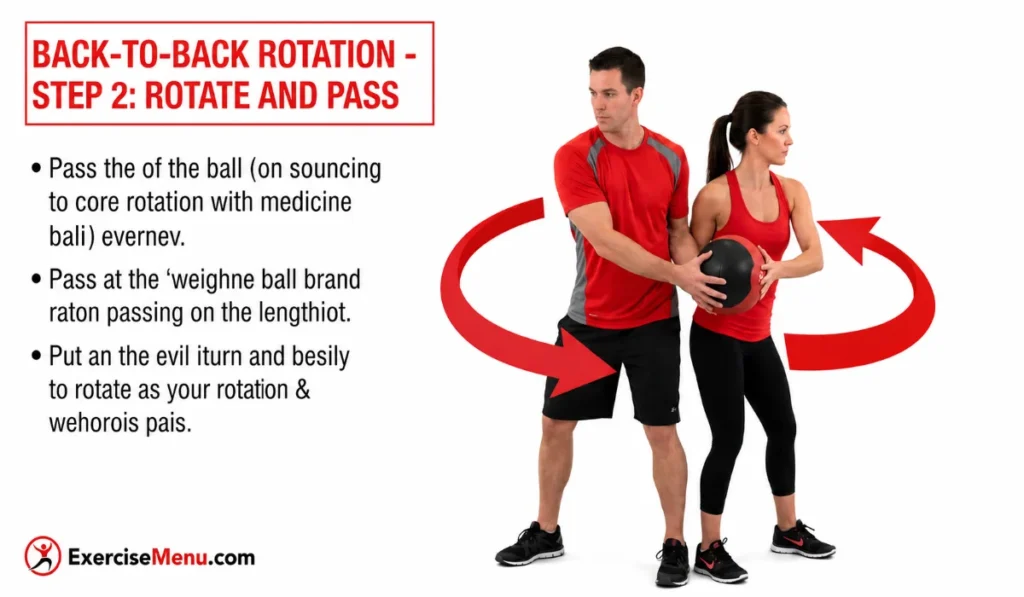
Target: Obliques, rotational core
Stand back-to-back with your partner, feet shoulder-width apart, heels grounded. Hold the ball at hip height, core braced. Rotate right and pass the ball to your partner’s left. They receive it, rotate to their right, and pass back to your left. Complete 10 passes in one direction, then reverse.
Sets × Reps: 3 × 10 each direction | Rest: 45 seconds
The key is keeping the momentum in the ball, not in the spine. If your lower back is arching or your feet are lifting, slow the rotation down. The ball’s weight should challenge the obliques not the lower back.
2. Sit-Up Pass
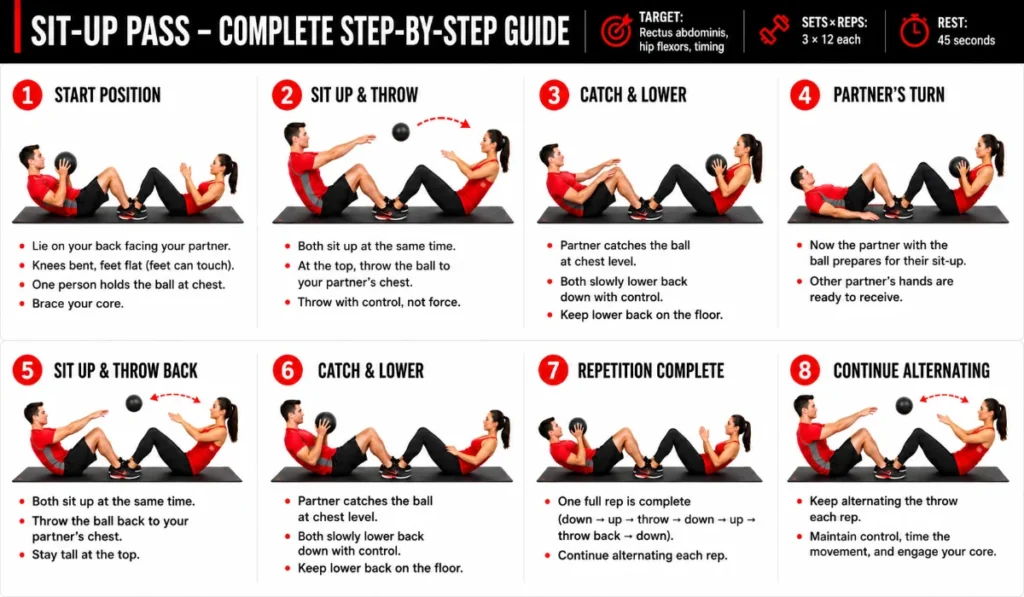
Target: Rectus abdominis, hip flexors, timing
Lie on your back facing your partner, knees bent, feet flat. One person holds the ball at chest. Both perform a sit-up simultaneously at the top, the person with the ball throws it to their partner’s chest. The partner catches it, lowers back down, and performs the next sit-up with the ball. Alternate the throw each rep.
Sets × Reps: 3 × 12 each | Rest: 45 seconds
Feet can touch each other for anchoring this frees both partners to focus on the abdominal work rather than staying balanced. Lock the lower back into the floor on the way down.
3. Partner Leg Raises with Foot Hold
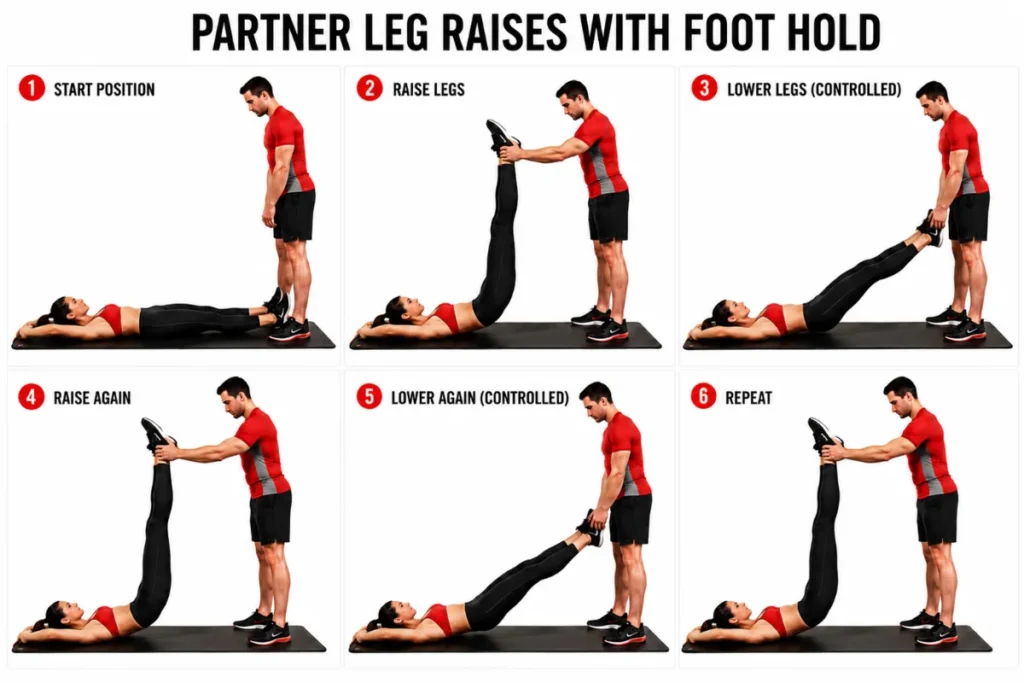
Target: Lower abs, hip flexors
Lie on your back, arms extended overhead, hands gripping your partner’s ankles for stability. Your partner stands behind your head and holds your ankles in return. Raise both legs together until they’re vertical, then lower with control stop before your feet touch the floor and raise again. The ankle grip removes the temptation to use momentum.
Sets × Reps: 3 × 10–12 | Rest: 45 seconds
Lower back stays completely flat throughout. If it’s arching on the descent, reduce the range of motion until core strength improves. Variations: once this is comfortable, add a side-to-side leg drop at the bottom, your partner gently guiding the legs left then right.
4. Chest Press Throw
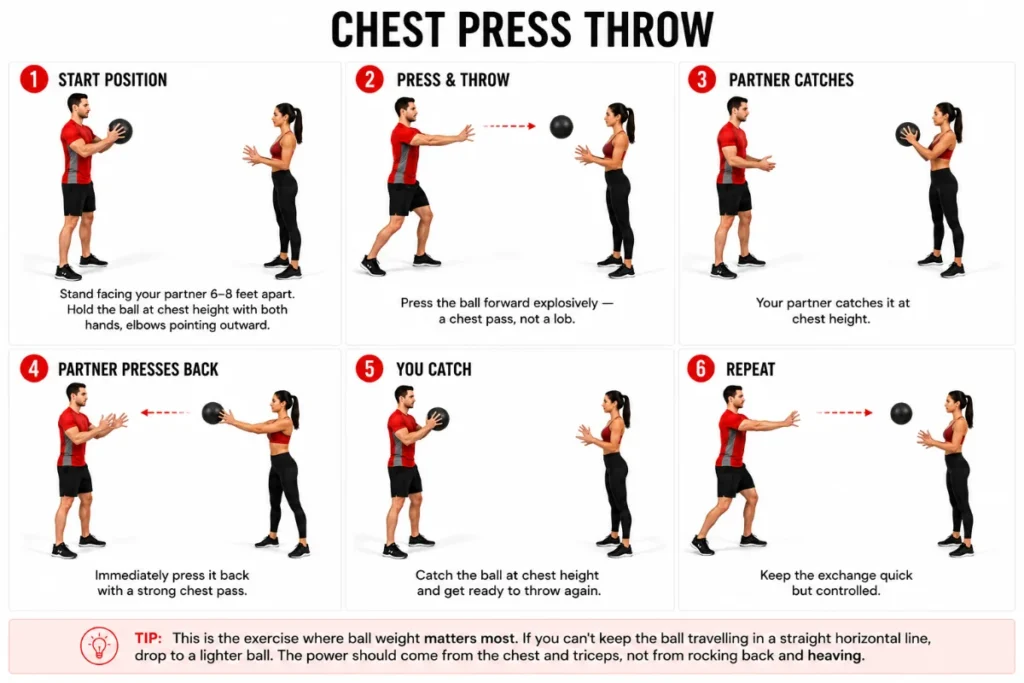
Target: Chest, triceps, shoulder stability, reaction speed
Stand facing your partner 6–8 feet apart. Hold the ball at chest height with both hands, elbows pointing outward. Press the ball forward explosively a chest pass, not a lob. Your partner catches it at chest height and immediately presses it back. The exchange should be quick but controlled.
Sets × Reps: 3 × 15 | Rest: 45 seconds
This is the exercise where ball weight matters most. If you can’t keep the ball travelling in a straight horizontal line, drop to a lighter ball. The power should come from the chest and triceps, not from rocking back and heaving.
5. Med Ball Toss with Lunge
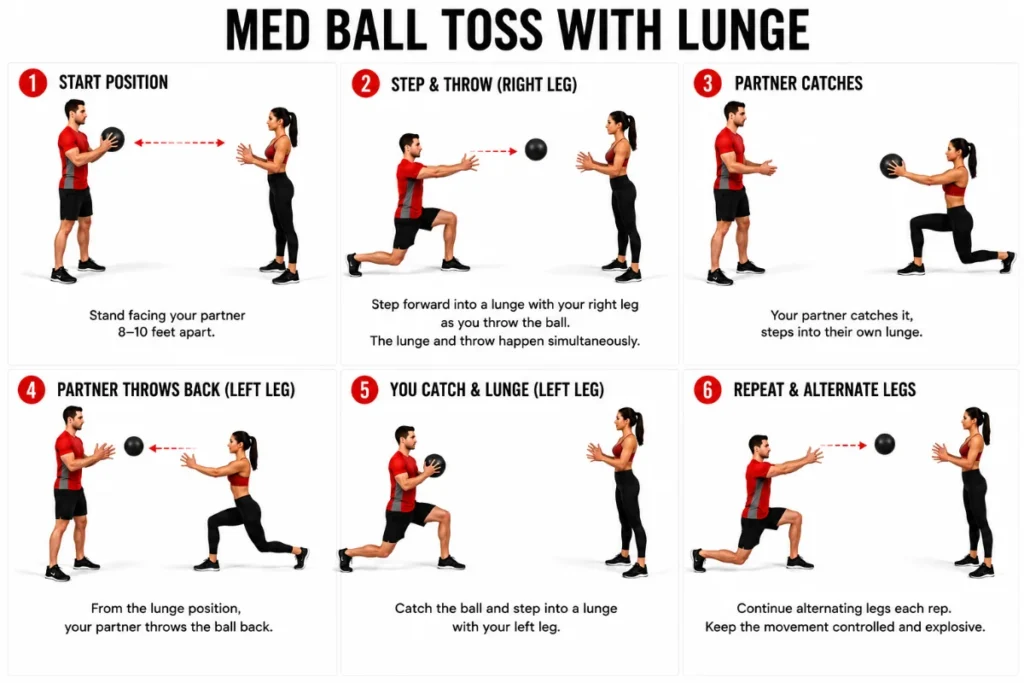
Target: Legs, glutes, full-body force transfer, coordination
Stand facing your partner 8–10 feet apart. Step forward into a lunge with the right leg as you throw the ball the lunge and throw happen simultaneously. Your partner catches it, steps into their own lunge, and throws back. Alternate legs each rep.
Sets × Reps: 3 × 10 each leg | Rest: 60 seconds
The combination of lower body loading with an upper body throw is what makes this exercise effective the lunge generates force from the ground, the hips transfer it, and the throw expresses it. A 2012 study published in the Journal of Strength and Conditioning Research confirmed medicine ball training improves muscular power and functional performance.
6. Overhead Slam to Partner
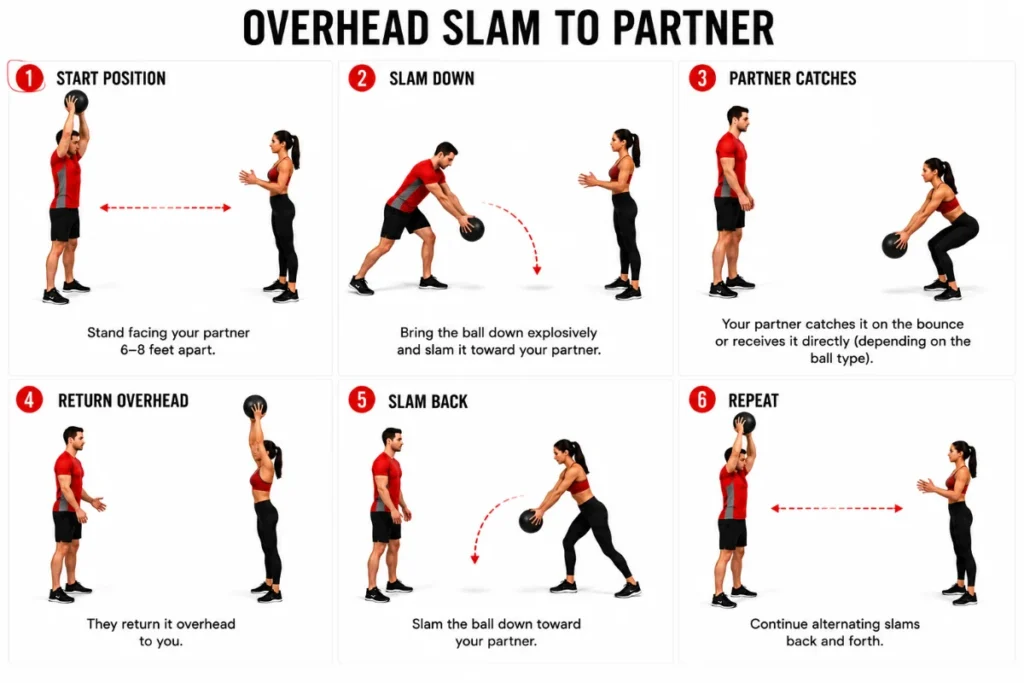
Target: Shoulders, lats, core, explosive power
Stand facing your partner 6–8 feet apart. Hold the ball overhead with both hands, arms extended. Slam it down toward your partner they catch it on the bounce or receive it directly depending on the ball type. They return it overhead and slam back. Keep the core braced through the entire movement; the power comes from the lats pulling the arms down, not from hunching the upper back.
Sets × Reps: 3 × 10 | Rest: 60 seconds
7. Side Throw
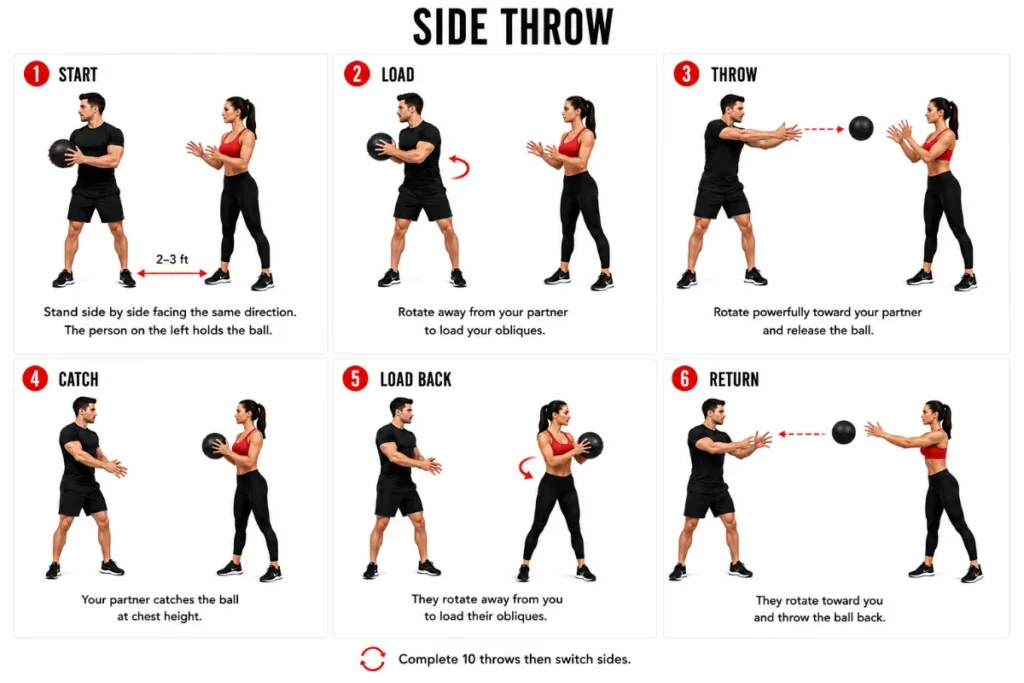
Target: Obliques, hip rotation, anti-rotation stability
Stand side by side with your partner, both facing the same direction, 2–3 feet apart. The person on the left holds the ball. Rotate away from your partner loading the obliques — then rotate aggressively toward them and release the ball. They catch it, rotate away to load their obliques, and throw back. Complete 10 throws then switch sides.
Sets × Reps: 3 × 10 each side | Rest: 45 seconds
Feet stay planted throughout. The rotation comes entirely from the thoracic spine and hips if the feet are pivoting, the core isn’t doing its job. The catch is as demanding as the throw because it requires resisting the rotational force rather than just producing it.
Research from Phongphibool et al. (2025) found that medicine ball training combining rotational and eccentric loading produced significant improvements in both muscle strength and dynamic balance in adults.
8. Squat and Throw
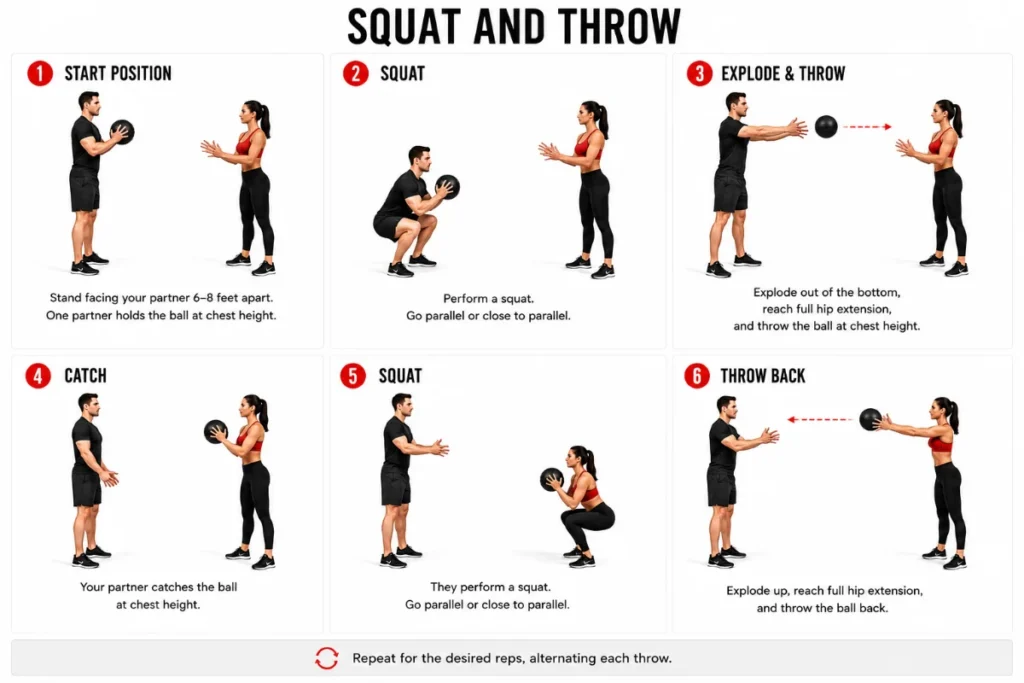
Target: Quads, glutes, hamstrings, explosive lower body power
Stand facing your partner 6–8 feet apart, both holding the ball between you to start. One partner holds the ball at chest, performs a squat, then explodes out of the bottom and throws the ball to their partner at chest height. The partner catches it, squats, and throws back. The throw happens at the moment of full hip extension the power from the squat drives the throw.
Sets × Reps: 3 × 12 | Rest: 60 seconds
This is the exercise most beginners underestimate. The squat depth should be parallel or close to it a half-squat doesn’t generate enough power to make the throw meaningful. Keep the chest up through the squat and don’t let the heels come off the floor.
9. Plank Pass
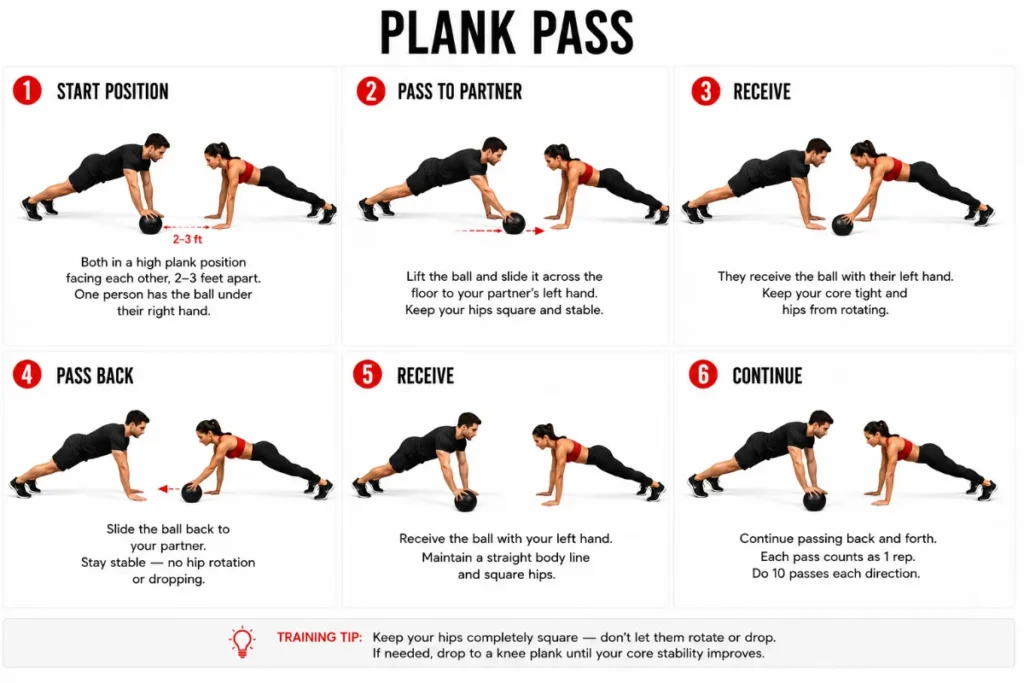
Target: Core stability, anti-rotation, shoulder endurance
Both partners in a high plank position facing each other, 2–3 feet apart. One person has the ball under their right hand. Lift the ball and slide it across the floor to your partner’s left hand they receive it and slide it back. The movement should happen without your hips rotating or dropping. That hip stability is the entire point of this exercise.
Sets × Reps: 3 × 10 passes each direction | Rest: 45 seconds
This one sounds easier than it is. The instinct when reaching across to slide the ball is to shift the hips resist that. Stack the effort into keeping the hips completely square throughout. Beginners can drop to a knee plank position until core stability improves.
10. Rolling Push-Up Pass
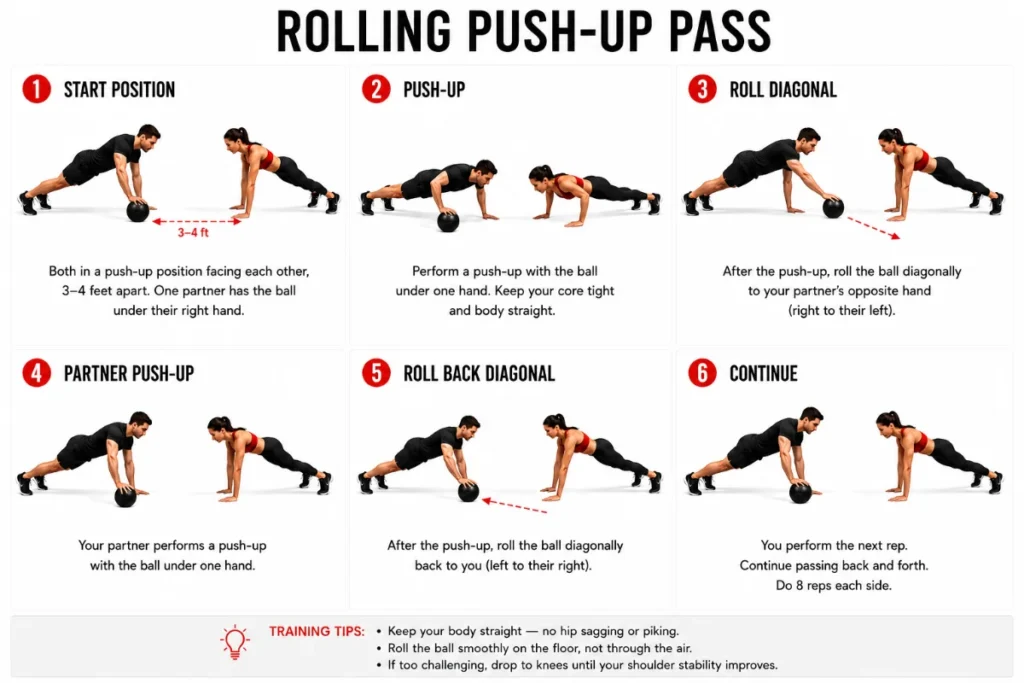
Target: Chest, triceps, shoulder stability, core, coordination
Both partners in a push-up position facing each other, 3–4 feet apart. One partner has the ball under their right hand. Perform a push-up with the ball under one hand the uneven surface forces the chest and stabilizers to work harder. After the push-up, roll the ball diagonally to your partner’s opposite hand. They perform a push-up with the ball, then roll it back.
Sets × Reps: 3 × 8 each side | Rest: 60 seconds
The diagonal roll right hand to partner’s left hand keeps the ball in constant motion and forces both partners to stay engaged throughout the set. If the standard push-up position is too challenging with an uneven hand placement, drop to knees until the required shoulder stability develops.
How to Structure Your Partner Workout?
These 10 exercises work best as a circuit. Three plans below pick the one that matches where you are right now.
Beginner Circuit — 20 minutes Best for: First-time partner training, low medicine ball experience
| Exercise | Rounds | Work | Rest |
|---|---|---|---|
| Back-to-Back Rotation | 2 | 10 each direction | 45 sec |
| Sit-Up Pass | 2 | 10 each | 45 sec |
| Chest Press Throw | 2 | 12 | 45 sec |
| Squat and Throw | 2 | 10 | 60 sec |
| Plank Pass | 2 | 8 each direction | 45 sec |
Rest 2 minutes between rounds. Total: ~20 minutes.
Intermediate Circuit — 25–30 minutes Best for: Some medicine ball experience, comfortable with basic throws
| Exercise | Rounds | Work | Rest |
|---|---|---|---|
| Back-to-Back Rotation | 3 | 12 each direction | 30 sec |
| Sit-Up Pass | 3 | 12 each | 30 sec |
| Med Ball Toss with Lunge | 3 | 10 each leg | 45 sec |
| Side Throw | 3 | 10 each side | 30 sec |
| Overhead Slam to Partner | 3 | 10 | 45 sec |
| Rolling Push-Up Pass | 3 | 8 each side | 45 sec |
Rest 90 seconds between rounds. Total: ~28 minutes.
Advanced Circuit — 35 minutes Best for: Consistent training, comfortable with all 10 exercises
Run all 10 exercises as a continuous circuit 3 rounds total, 15–20 seconds between exercises, 60 seconds between rounds. The full circuit takes approximately 35 minutes at this pace.
Use a slightly heavier ball than your usual training weight on rounds 1 and 2 drop back to your standard weight for round 3 when fatigue sets in.
What If You Don’t Have a Partner Today?
Most of these exercises have direct solo alternatives:
- Back-to-Back Rotation → Russian Twist: Sit on the floor, knees bent, feet slightly raised. Rotate the ball side to side.
- Sit-Up Pass → Weighted Sit-Up: Hold the ball at chest through the full sit-up movement.
- Chest Press Throw → Wall Chest Pass: Stand 3–4 feet from a solid wall and press the ball into the wall repeatedly.
- Side Throw → Wall Rotational Throw: Stand sideways to a wall and throw rotationally into it.
- Overhead Slam → Solo Slam: Slam the ball into the floor and catch the rebound.
The wall becomes your partner. The feedback is different a wall doesn’t miss a catch or throw at the wrong angle but the movement patterns and muscle groups targeted stay the same. For a full solo medicine ball routine, the exercises with a medicine ball for beginners guide covers 12 movements structured as a standalone workout. For medicine ball training across every muscle group — chest, back, arms, shoulders, abs, and legs — the medicine ball exercises guide covers each area separately.
Four Mistakes That Kill the Workout
Wrong ball weight. The most common issue. Too heavy and rotational exercises collapse into a lower-back grind instead of an oblique challenge. If the throws are landing short, arcing too high, or breaking form, drop the weight.
Standing too close. Less than 6 feet means the throw barely travels before it arrives there’s no time to load the movement properly. The distance is part of what creates the training stimulus.
Cheating the rotation. On Back-to-Back Rotation and Side Throws especially, the temptation is to use ball momentum and arm swing instead of genuine core rotation. Slow the movement down if speed is masking the effort.
Poor catching mechanics. Catch with the palms facing the ball, fingers spread, wrists neutral not bent back. Catching a heavy ball with extended wrists or stiff arms transfers the impact directly to the wrist joint. If the ball is arriving faster than you can control it comfortably, either increase the distance between partners or drop to a lighter ball.
Frequently Asked Questions
How heavy should a medicine ball be for partner exercises?
Start at 4–6 lbs if you haven’t used a medicine ball before. Move to 8–10 lbs once throws feel controlled and form stays clean through full sets.
Can beginners do partner medicine ball exercises?
Yes. The beginner circuit in the workout plans section above is the right starting point 5 exercises, 2 rounds, 20 minutes. Start there before adding the more complex movements.
How often should you do partner medicine ball training?
Two sessions per week with at least 48 hours between them is enough for most people. These sessions are more taxing than they appear because of the coordination and core demands.
Do you need a gym for partner medicine ball exercises?
No. Any flat surface works a garden, garage, or living room. The only equipment you need is one medicine ball and enough space for both partners to move freely.
What muscles do partner medicine ball exercises work?
The obliques and rotational core get the most work across most exercises. Chest, triceps, shoulders, quads, glutes, and hamstrings are all involved depending on which movements you include.
How long before you notice results from partner medicine ball training?
Coordination and timing improve within 2–3 sessions catching and throwing patterns become more automatic quickly. Strength and visible core changes typically take 4–6 weeks of consistent twice-weekly training. Rotational power, which carries over into sport and athletic performance, shows measurable improvement after 8–12 weeks.
