

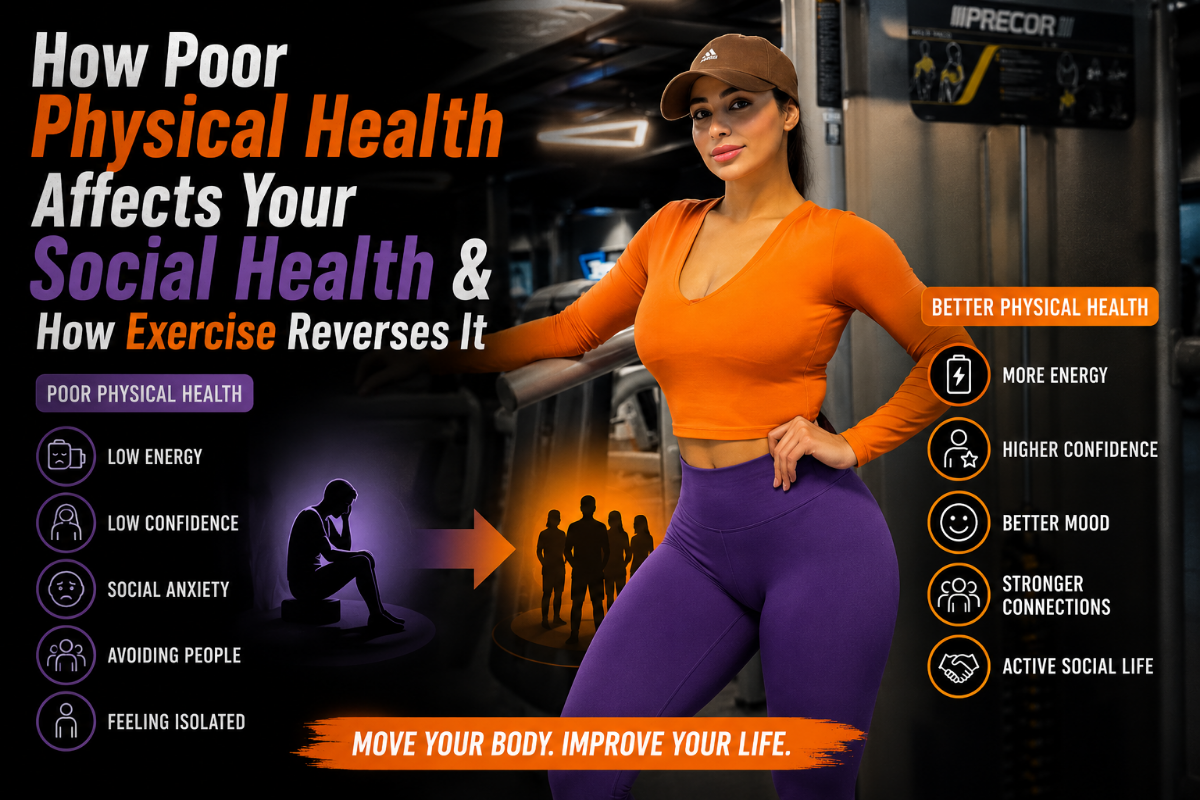
Poor physical health doesn’t just weaken the body. It quietly dismantles social life — the friendships, the relationships, the sense of belonging that most people take for granted until they start pulling away from all of it.
The connection runs deeper than “feeling too tired to go out.” Chronic pain reshapes how someone interacts with people. Low energy kills the motivation to show up. A changing body erodes the confidence to be seen.
And over time, the person who used to say yes to everything starts saying no to everything. Not because they want to, but because their physical condition makes it feel impossible.
Quick Answer: Poor physical health affects social health through six direct pathways — social isolation, reduced self-esteem, strained relationships, low energy, depression and anxiety, and loss of identity. The World Health Organization defines health as “a state of complete physical, mental, and social well-being” — meaning social decline is a direct consequence of physical decline. Exercise reverses all six effects, often simultaneously.
What Social Health Actually Means?
Social health is the ability to form and maintain meaningful relationships, participate in community life, and feel a sense of connection and belonging. The World Health Organization defines health as “a state of complete physical, mental, and social well-being,” not merely the absence of disease.
When one dimension declines, the others follow. A body in decline doesn’t exist in isolation — it pulls social well-being down with it.
Six Ways Poor Physical Health Damages Social Health
1. Social Isolation from Physical Limitations
Chronic pain, limited mobility, and fatigue make it physically difficult to attend social events, visit friends, or participate in group activities. Over time, declining invitations becomes the default — and eventually the invitations stop coming.
A 2010 meta-analysis by Holt-Lunstad et al., published in PLOS Medicine, found that people with weaker social connections had a 50% higher risk of premature death — a mortality impact comparable to smoking 15 cigarettes per day.
Physical limitations reduce social participation. Reduced participation compounds the health consequences of that isolation.
2. Reduced Self-Esteem and Confidence
Weight gain, muscle loss, visible physical decline, or dependence on mobility aids erode how someone sees themselves. When body image deteriorates, social avoidance follows — the person anticipates judgment and withdraws before anyone else has a chance to respond.
The pattern: avoid being seen → fewer interactions → deeper isolation → further decline in confidence. Each stage feeds the next.
3. Strained Relationships
Chronic illness shifts the dynamics of every close relationship. Partners become caregivers. Friends feel uncertain about what to say. Family members absorb stress they weren’t prepared for. Communication breaks down — not from lack of care, but from exhaustion and unmet expectations on both sides.
Romantic relationships are particularly vulnerable. When one partner’s physical limitations change the balance of daily responsibilities, resentment builds quietly on both sides. The person who’s unwell feels guilty. The caregiver feels drained.
4. Decreased Energy for Social Engagement
Low energy from physical deconditioning, chronic disease, poor sleep, or sedentary living directly reduces the capacity for social interaction. Socializing requires effort — conversation, travel, presence, emotional availability. When the body can barely get through the day, social life is the first thing dropped.
Work obligations stay. Family obligations stay. Friendships, hobbies, and community involvement disappear because they’re the easiest to let go.
5. Depression and Anxiety Feeding Social Withdrawal
Declining physical health significantly increases the risk of depression and anxiety. Both conditions drive social withdrawal — not through physical inability, but through psychological barriers: loss of interest, feelings of worthlessness, fear of being a burden, a persistent sense that nobody would notice the absence.
This is the most damaging layer because it’s invisible. Someone with chronic pain might want to see friends but can’t physically get there. Someone with depression might be physically capable but mentally unable to pick up the phone.
6. Loss of Identity and Purpose
For many people, physical capability defines a significant part of their identity — the weekend footballer, the parent who keeps up with their kids, the person who walks to work every day. When physical health declines, those activities stop. When the activities stop, the identity attached to them starts to dissolve.
That loss of purpose shows up socially as withdrawal, disengagement, and a quiet retreat from the life they used to live.
The Bidirectional Cycle
Poor physical health and poor social health don’t just coexist — they reinforce each other:
Physical decline → less social activity → increased isolation → worsened mental health → less motivation to move → further physical decline → deeper isolation
Sedentary behavior increases inflammation. Inflammation worsens chronic conditions. Worsened conditions reduce mobility. Reduced mobility drives isolation. Isolation increases cortisol and reduces immune function.
Each stage makes the next stage worse, which is why this cycle is so hard to escape without addressing both sides at once.
How Exercise Reverses Each Effect
| Poor physical health causes | Exercise reverses it by |
|---|---|
| Social isolation (can’t attend events) | Group classes, walking groups, and gym environments create built-in social contact without requiring separate effort |
| Reduced self-esteem (body image, weakness) | Strength gains, body composition changes, and visible progress rebuild confidence from the inside out |
| Strained relationships (burden, role changes) | Partner training, shared fitness goals, and reduced dependence restore relationship balance |
| Low energy (too tired for social life) | Cardiovascular fitness increases stamina — the energy for social activity comes from physical capacity |
| Depression/anxiety (psychological withdrawal) | Endorphin, serotonin, and dopamine regulation directly reduce symptoms that drive social avoidance |
| Loss of identity (can’t do what defined them) | New fitness goals, gym community, and physical milestones create a renewed sense of purpose |
Exercise Is Social by Nature
Most discussions treat exercise as a physical fix that indirectly helps social life. That misses what exercise actually is.
Walking with a neighbor is exercise and social connection at the same time. A group fitness class puts someone in a room with the same people twice a week — consistency builds familiarity, familiarity builds relationships. A gym environment provides passive social contact that isolated people lose first and need most.
A UK Biobank study of 497,544 participants found that social isolation amplified the mortality risk of physical inactivity at every activity level. But physical activity also reduced the harmful effects of isolation. Exercise and social connection aren’t separate health strategies — they overlap at every point.
Exercise Doesn’t Require a Gym
The social benefits of exercise don’t depend on a membership or equipment. Walking is the most accessible form of physical activity, and walking with another person turns a health habit into a social one. Bodyweight exercises at a park put someone in a shared public space. A home workout done on a video call with a friend builds accountability and connection.
The assumption most people carry — “I need to be fit enough to exercise socially” — runs backward. Exercise is how fitness returns. The social element is what makes it sustainable.
Where to Start
The worst advice is “just get out more.” It ignores the physical limitations that caused the withdrawal in the first place. A better approach works from the body outward.
Weeks 1–2: Movement first, not fitness. Ten minutes of walking daily. No performance goal. Just re-establishing the habit of moving. Consistency matters more than intensity here.
Weeks 3–4: Add one social element. Walk with someone — a partner, a neighbor, a colleague during lunch. Join a beginner group class. The activity matters less than the presence of another person.
Weeks 5–6: Build a routine that includes people. A regular walking partner. A twice-weekly class. A gym schedule that overlaps with someone else’s. Routine builds reliability, and reliability is how acquaintances become connections.
Weeks 7–8: Expand gradually. As physical capacity improves, social capacity follows. More energy means more willingness to show up. Better mood means more enjoyment in company. Improved confidence means less avoidance.
Physical recovery comes first — because the physical limitation is what created the social withdrawal.
Frequently asked questions
How does poor physical health affect your social health?
Poor physical health reduces the energy, mobility, and confidence needed to maintain relationships and participate in social activities. Over time, this leads to isolation, strained relationships, depression, and loss of identity — all of which compound each other in a cycle that’s difficult to break without physical intervention.
Can exercise really improve social health?
Yes. Exercise directly reduces depression and anxiety, increases energy and confidence, and opens natural opportunities for social interaction, especially group formats like classes, walking groups, and partner training. Research consistently shows that physically active people maintain stronger social connections than inactive ones.
What type of exercise is best for social health?
Any exercise done with other people. Group fitness classes, walking with a partner, team sports, or even training at a gym during consistent hours all create social contact. The format matters less than the presence of other people and the consistency of showing up.
How does social health impact physical health?
The relationship flows both ways. Poor social health — loneliness and isolation — increases inflammation, raises cortisol, disrupts sleep, and weakens immune function. Socially isolated individuals have higher rates of cardiovascular disease, cognitive decline, and premature mortality. The US Surgeon General declared loneliness a public health epidemic in 2023.
