

Quick Answer: High-protein foods pack the most protein per calorie. Lean poultry, fish and shellfish, egg whites, low-fat dairy, soy, and legumes lead the list. Shrimp, cod, chicken breast, and whey deliver 19 to 26 grams of protein per 100 calories, the most efficient sources for building muscle or losing fat.
The best high-protein foods share one trait: they deliver a lot of protein for the calories they cost. That ratio, protein per calorie, is what separates a food that helps you build muscle or lose fat from one that only adds protein on paper.
This list ranks more than 40 sources by that metric, grouped so you can find the right option for any meal. You also get the daily protein target backed by current research, how animal and plant sources compare, and the best picks for weight loss, muscle gain, or eating less meat.
The complete high-protein foods list, ranked by protein per calorie
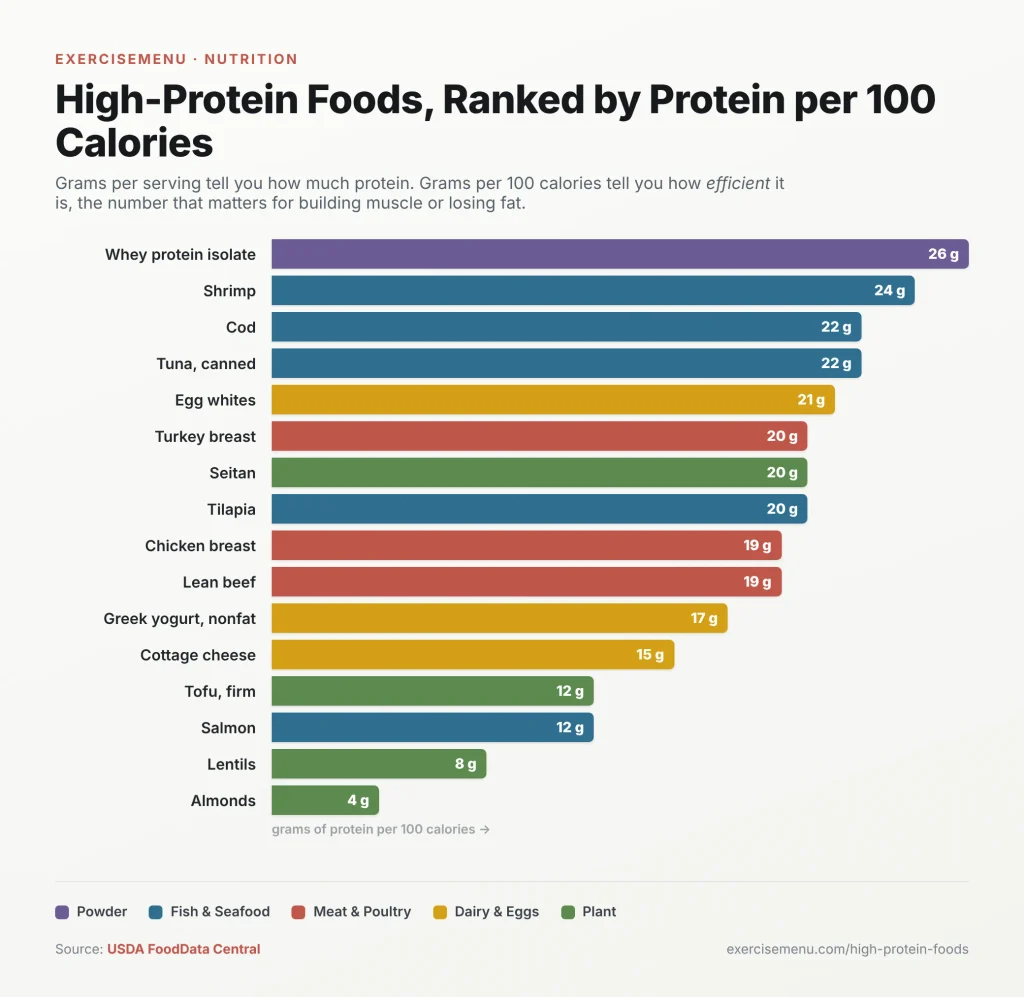
Protein per calorie tells you how much protein a food delivers for the energy it costs. Lean seafood, poultry, egg whites, and protein isolates sit at the top: they give 19 to 26 grams of protein per 100 calories. Fattier cuts, whole nuts, and seeds still provide protein, but their fat raises the calorie count and lowers the ratio, so they work better for gaining weight than cutting it.
All values below come from the USDA FoodData Central database. Each food links to its own breakdown as that guide goes live.
Meat & Poultry
| Food (serving) | Protein | Per 100 kcal |
| Turkey breast (3 oz) | 26 g | 20 g |
| Venison (3 oz) | 26 g | 19 g |
| Chicken breast, skinless (3 oz) | 27 g | 19 g |
| Lean beef, top round (3 oz) | 25 g | 19 g |
| Pork tenderloin (3 oz) | 22 g | 18 g |
| Bison (3 oz) | 24 g | 17 g |
| Ground beef, 90% lean (3 oz) | 22 g | 13 g |
| Ground turkey, 93% lean (3 oz) | 23 g | 13 g |
| Chicken thigh, skinless (3 oz) | 21 g | 13 g |
| Lamb, lean (3 oz) | 23 g | 12 g |
Skinless poultry and lean cuts give you the cleanest protein-to-calorie ratio. Fattier and cured options sit lower: lamb carries more fat than chicken, and a cured meat like chorizo trades density for flavor, which makes it a seasoning rather than a main protein.
Fish & Seafood
| Food (serving) | Protein | Per 100 kcal |
| Shrimp (3 oz) | 20 g | 24 g |
| Cod (3 oz) | 19 g | 22 g |
| Tuna, canned in water (3 oz) | 20 g | 22 g |
| Crab (3 oz) | 16 g | 19 g |
| Tilapia (3 oz) | 22 g | 20 g |
| Scallops (3 oz) | 17 g | 20 g |
| Halibut (3 oz) | 19 g | 17 g |
| Mussels (3 oz) | 20 g | 14 g |
| Canned salmon (3 oz) | 17 g | 15 g |
| Salmon (3 oz) | 22 g | 12 g |
Shellfish and white fish top the entire list for protein density. Salmon drops lower because its omega-3 fats add calories, a trade worth making a few times a week for heart and brain benefits.
Dairy & Eggs
| Food (serving) | Protein | Per 100 kcal |
| Egg whites (½ cup) | 13 g | 21 g |
| Skyr (¾ cup) | 17 g | 17 g |
| Greek yogurt, nonfat (¾ cup) | 17 g | 17 g |
| Cottage cheese, low-fat (½ cup) | 14 g | 15 g |
| Ricotta, part-skim (½ cup) | 14 g | 10 g |
| Whole eggs (2 large) | 12 g | 9 g |
| Parmesan (1 oz) | 10 g | 9 g |
| String cheese (1 oz) | 7 g | 9 g |
| Milk, 1% (1 cup) | 8 g | 8 g |
Egg whites and nonfat dairy are protein-dense; the yolk and full-fat versions add nutrients and calories. Cottage cheese is slow-digesting, which makes it a strong choice before a long gap between meals or overnight.
Plant Proteins
| Food (serving) | Protein | Per 100 kcal |
| Seitan (3 oz) | 21 g | 20 g |
| Tofu, firm (½ cup) | 11 g | 12 g |
| Tempeh (3 oz) | 17 g | 11 g |
| Hemp seeds (3 tbsp) | 10 g | 6 g |
| Edamame (1 cup) | 17 g | 9 g |
| Lentils, cooked (1 cup) | 18 g | 8 g |
| Black beans, cooked (1 cup) | 15 g | 7 g |
| Chickpeas, cooked (1 cup) | 15 g | 6 g |
| Quinoa, cooked (1 cup) | 8 g | 4 g |
Seitan (wheat gluten) and soy foods lead the plant side. Beans and lentils carry fiber along with protein, which lowers their density but adds a fullness benefit meat can’t match. For the full plant-based ranking, see the plant protein sources guide (coming soon).
Snacks & Powders
| Food (serving) | Protein | Per 100 kcal |
| Whey protein isolate (1 scoop) | 25 g | 26 g |
| Pea protein (1 scoop) | 15 g | 20 g |
| Tuna pouch (2.6 oz) | 17 g | 20 g |
| Beef jerky (1 oz) | 11 g | 15 g |
| Hard-boiled egg (1 large) | 6 g | 9 g |
| Roasted chickpeas (½ cup) | 7 g | 5 g |
| Pumpkin seeds (1 oz) | 8 g | 5 g |
| Almonds (1 oz) | 6 g | 4 g |
Protein isolates give the highest ratio of any food, which is why a shake fills protein gaps so efficiently. Nuts and seeds sit at the bottom: good fats, but calorie-dense, so measure portions. For portable options, see the healthy protein snacks guide (coming soon).
How much protein do you need?
The minimum to prevent deficiency is 0.8 grams of protein per kilogram of body weight, about 56 grams a day for a 70 kg (154 lb) adult. That figure, set by the National Academies, keeps a sedentary body from losing muscle, but research shows it falls short for anyone training, dieting, or aging.
For building muscle, losing fat, or staying active, current evidence points to 1.2 to 1.6 grams per kilogram. The International Society of Sports Nutrition places athletes at 1.4 to 2.0 grams per kilogram, and recommends the higher end when you’re eating in a calorie deficit to protect lean mass. A 2022 dose-response meta-analysis found that gains in muscle strength from training keep climbing as protein rises toward about 1.5 grams per kilogram, then level off, so more past that point adds little.
| Your goal | Protein per kg | For a 70 kg adult |
| Prevent deficiency (minimum) | 0.8 g | ~56 g/day |
| General health, active | 1.2–1.4 g | ~84–98 g/day |
| Build muscle | 1.6 g | ~112 g/day |
| Lose fat (protect muscle) | 1.8–2.0 g | ~126–140 g/day |
| Adults over 50 | 1.0–1.2 g | ~70–84 g/day |
How you spread protein matters as much as the total. Aim for roughly 0.4 grams per kilogram per meal (about 25 to 40 grams) across three or four meals, which research on protein timing links to better muscle maintenance than loading it all at dinner.
Losing weight fast raises the bar. On a GLP-1 medication or a steep calorie deficit, the body sheds muscle alongside fat unless protein is high, so the upper end of 1.6 to 2.0 grams per kilogram, spread across meals, protects lean mass while the fat comes off.
Animal vs plant protein: complete vs incomplete
A complete protein contains all nine essential amino acids your body can’t make on its own. Animal foods (meat, fish, eggs, dairy) are complete, and so are soy and quinoa. Most plant proteins are incomplete, missing or low in one or more amino acids.
That gap closes with variety. Eating beans with grains, or a mix of plant proteins across the day, covers every amino acid without any single “perfect” food.
| Animal protein | Plant protein | |
| Amino acids | Complete | Mostly incomplete (soy is complete) |
| Protein density | Higher | Lower (more fiber) |
| Comes with | B12, iron, zinc | Fiber, phytonutrients |
| Watch for | Saturated fat in fatty/processed cuts | Combine sources for full amino profile |
The one caveat sits on the animal side: fatty and processed meats carry saturated fat, which the Dietary Guidelines for Americans advise keeping under 10% of daily calories, so lean cuts, poultry, fish, eggs, and low-fat dairy are the better everyday choices.
Neither side wins outright. Lean animal protein is the most efficient for hitting a high target; plant protein brings fiber and nutrients that support gut and heart health. A plate using both covers the most ground.
Best high-protein foods for your goal
For weight loss: Pick the highest protein-per-calorie options: shrimp, cod, egg whites, nonfat Greek yogurt, and cottage cheese. Protein is the most filling of the three macronutrients, so these foods curb appetite while protecting muscle in a deficit.
For muscle gain: Total intake matters most, so reach 1.6 grams per kilogram. Leucine-rich sources like whey, eggs, chicken breast, and lean beef drive muscle repair most effectively.
For weight gain: Use calorie-dense protein like salmon, whole eggs, whole milk, and nuts to add protein and the extra energy a surplus needs.
For eating less meat: Seitan, tempeh, tofu, lentils, edamame, Greek yogurt, and eggs cover high protein without red or white meat.
Why hitting your protein target matters?
Protein does more than build muscle: it forms enzymes, hormones, antibodies, and the structure of every cell, and the body can’t stockpile it, so it needs a steady daily supply. The clearest payoff is still muscle. Protein rebuilds what you break down during training, which is why intake across the whole day, not just one post-session meal, drives recovery and growth, and why what you eat after a workout works best as part of a day that already hits your target.
Beyond muscle, protein keeps you full longer than carbs or fat, which makes a higher intake one of the simplest tools for managing weight. During a diet, enough protein steers the body toward burning fat while holding on to muscle. After about age 50, a slightly higher intake offsets the natural loss of muscle that comes with aging.
Can you eat too much protein?
For healthy people, intakes up to around 2 grams per kilogram are well tolerated, and the evidence does not show that higher protein harms normal kidneys. If you already have kidney disease, that changes, and your protein needs to be set with a doctor.
The real limit is balance. Protein shouldn’t crowd out the carbohydrates, fats, fruits, and vegetables that round out a diet. Hit your target, then fill the rest of the plate with whole foods.
Frequently Asked Questions
How much protein can your body use in one meal?
There’s no cap that “wastes” extra protein. Spreading intake across meals, roughly 25 to 40 grams each, maximizes muscle repair, but a larger single dose still counts toward your daily total.
Does cooking change a food’s protein?
Cooking doesn’t create or destroy much protein, but it drives off water, so cooked meat and fish hold more protein per gram than raw. The figures in this guide use cooked weights where noted.
Is whole food or protein powder better?
Whole foods come first: they carry vitamins, minerals, and fiber a powder lacks. Use whey or a plant isolate to close the gap on days you can’t reach your target from meals alone.
Do vegetarians and vegans get enough protein?
Yes, with variety. Soy foods, seitan, lentils, and beans, plus eggs and dairy for vegetarians, cover every essential amino acid across a day.
How many grams of protein should I eat to lose weight?
In a calorie deficit, aim for the higher end, about 1.8 to 2.0 grams per kilogram, to hold muscle while losing fat, and build meals around high-density, filling options like shrimp, cod, and nonfat Greek yogurt.
Which single food has the most protein per calorie?
Whey isolate leads at about 26 grams per 100 calories; among whole foods, shrimp and cod top the list at roughly 22 to 24.
Disclaimer: If you have a kidney condition or another medical issue, check with your doctor before sharply increasing your protein intake.
