

Quick Answer: Eat a meal with 20–40g protein and carbohydrates within a few hours of your session. Eggs, chicken, Greek yogurt, rice, sweet potatoes, and bananas are strong options. Match your carb-to-protein ratio to your training: 2:1 for strength, 3:1 for endurance, 1:1 for lighter sessions.
- Why Does Post-Workout Nutrition Matter?
- When Should You Eat After a Workout?
- How Much Protein, Carbs, and Fat Do You Need After a Workout?
- 15 Best Foods to Eat After a Workout
- Does Your Goal Change What You Should Eat After a Workout?
- What If You Train at Night, Eat Plant-Based, or Are a Woman?
- How Much Should You Drink After a Workout?
- What Should You Avoid Eating After a Workout?
- Frequently Asked Questions
- Your Next Step
Key Takeaways
- Your total daily protein intake matters more than exactly when you eat it — a meta-analysis of 23 studies found no muscle growth difference based on timing alone (Schoenfeld et al., 2013).
- Post-workout fat does not slow recovery. Avocado, nuts, or eggs alongside protein and carbs are fine — the old “avoid fat after training” advice is outdated.
- Whole eggs outperform egg whites for muscle repair. The yolk contains nutrients that amplify muscle protein synthesis beyond what protein alone provides.
- Plant-based eaters need 1.8–2.0g protein per kilogram daily — roughly 20% more than omnivores — because plant sources contain less leucine per gram.
- If you train fasted (early morning, no food), eat within 1 hour. Everyone else who had a meal 2–3 hours before training has a much wider window.
After a workout, your muscles need protein to repair and carbohydrates to restore glycogen — the stored fuel your body burned during training. What you eat, how much, and the ratio between protein and carbs should match the type of workout you did and your specific goal.
A meta-analysis by Schoenfeld, Aragon, and Krieger (2013) reviewed 23 studies and found that overall daily protein intake plays a larger role in muscle growth than the exact timing of protein consumption after training. Your post-workout meal matters, but not as much as what you eat across the entire day.
Post-Workout Nutrition at a Glance
| Your Training Type | Protein Target | Carb Target | Ratio | Example Meal |
| Strength / hypertrophy | 30–40g | 40–60g | 2:1 | Chicken breast + white rice |
| Endurance / cardio (60+ min) | 20g | 60g | 3:1 | Oatmeal + banana + whey |
| Light session (under 45 min) | 20g | 20g | 1:1 | Greek yogurt + berries |
| Fat loss (calorie deficit) | 25–35g | 20–30g | ~1:1 | Cottage cheese + fruit |
| Fasted morning training | 25–40g | 30–50g | 1.5:1 | Eggs + toast + banana |
Why Does Post-Workout Nutrition Matter?
Post-workout nutrition drives three processes that determine how quickly your body recovers: muscle protein synthesis, glycogen replenishment, and inflammation reduction.
During resistance training, muscle fibers sustain microscopic tears. Your body repairs these tears through muscle protein synthesis (MPS) — a process that requires amino acids from dietary protein. The International Society of Sports Nutrition recommends consuming 20–40g of protein every 3–4 hours to keep MPS elevated throughout the day.
At the same time, exercise depletes glycogen — the stored carbohydrate your muscles use for fuel. Carbohydrates after training restore those reserves so your next workout does not start at a deficit.
What Happens If You Skip Eating After a Workout?
Yes, you should eat after a workout — skipping it slows recovery, prolongs muscle soreness, and reduces performance in your next session. The effects compound over time. Consistently under-fueling after high-intensity training can also damage gut health.
In my clinical practice, clients who switch from skipping post-workout meals to eating within two hours typically report noticeably less next-day soreness within the first week. The change is especially dramatic in clients over 35.
A 2026 review in Frontiers in Microbiology documented that exercise directly reshapes gut bacterial composition and that this relationship works both ways. Adequate post-workout nutrition supports a healthy gut microbiome, while chronic under-fueling during intense training periods can shift bacterial profiles in ways that impair nutrient absorption and immune function.
When Should You Eat After a Workout?
Within a few hours of finishing your session. The rigid 30-minute “anabolic window” that dominated fitness advice for decades does not hold up to current evidence.
What 23 Studies Actually Found About the Anabolic Window
A meta-analysis by Schoenfeld, Aragon, and Krieger reviewed 23 studies involving 525 participants and found no significant difference in muscle growth whether protein was consumed right after training or hours later. When the researchers controlled for total daily protein intake (~1.6g per kilogram of body weight), the timing effect disappeared entirely.
A 2025 meta-analysis by Casuso et al. reinforced this position. After pooling data from randomized controlled trials that directly compared pre- vs. post-exercise protein intake, the researchers concluded that protein timing does not meaningfully modify changes in lean body mass. The real nutrient-sensitive period lasts 4–6 hours, and resistance training elevates MPS for 24–48 hours post-workout.
When Timing Still Matters
If you train fasted early morning without eating post-workout protein becomes more important. Without a recent meal, your body has no circulating amino acid pool to draw from. In this case, eating within an hour of finishing supports recovery more than waiting several hours.
For everyone else who ate a normal meal 2–3 hours before training, the urgency drops significantly. Eat when it fits your schedule. The priority is hitting your daily protein target, not racing to the kitchen.
How Much Protein, Carbs, and Fat Do You Need After a Workout?
Your post-workout meal should contain all three macronutrients. The ISSN recommends that active adults consume 1.4–2.0g of protein per kilogram of body weight daily, spread across 3–4 meals.
Protein and the Leucine Threshold
Aim for 20–40g of protein per meal, from sources that contain at least 2.5g of leucine — the amino acid that triggers muscle protein synthesis. For adults over 40, the threshold rises to roughly 3g of leucine per meal due to a natural decline in anabolic sensitivity.
A 2025 systematic review by Rivera-Bermúdez et al. in the journal Nutrire examined leucine supplementation across multiple randomized controlled trials in young active adults. If your meals already include high-quality protein sources like eggs, chicken, or dairy, you are likely hitting the leucine threshold naturally. Separate leucine supplements offer minimal added benefit — your money is better spent on whole food sources.
Carbohydrates That Match Your Training
Carbohydrates restore muscle glycogen — the fuel source depleted during exercise. The amount you need depends on your training type. The Quick Reference Table above gives you exact ratios.
Your carb-to-protein ratio changes based on your training goal — there is no single ratio for everyone. Higher-glycemic carbs like white rice (GI ~70) and ripe bananas restore glycogen faster than slow-digesting options. For a full breakdown, see our guide on high-glycemic carbs after a workout.
Fat Is Not the Enemy
A persistent piece of outdated advice says to avoid fat after training because it may slow digestion and protein absorption. Current evidence does not support this. The International Society of Sports Nutrition explains that nutrient timing should focus on the overall balance of your diet rather than avoiding specific macronutrients. Healthy fat sources like avocado, nuts, olive oil, salmon, eggs, and nut butter can still be part of a balanced recovery meal.
You do not need to add extra fat after a workout, but you also do not need to avoid it. If your meal naturally contains healthy fats, eat it without worry.
15 Best Foods to Eat After a Workout
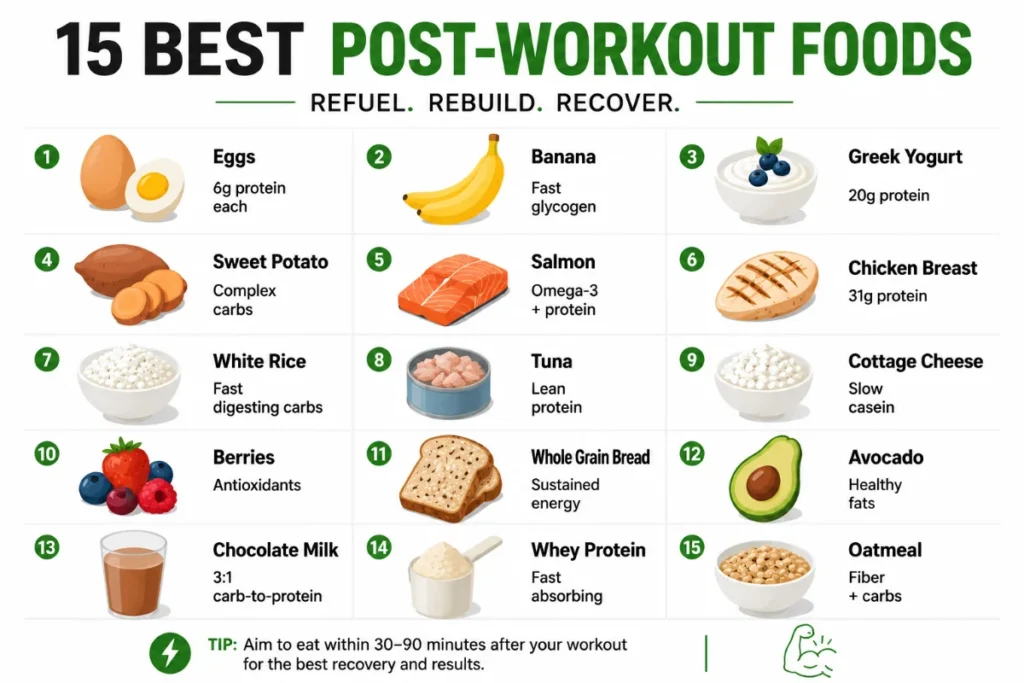
The best thing to eat after a workout is real food that covers protein, carbs, and micronutrients in one sitting. Protein content is listed per standard serving.
High-Protein Foods
1. Eggs — 6g protein each. Whole eggs outperform egg whites for MPS because the yolk contains additional nutrients that support muscle repair.
2. Greek yogurt — 15–20g protein per cup. Pairs with berries and granola for a ready-in-two-minutes meal.
3. Cottage cheese — 26.7g protein per cup (2% milkfat), only 194 calories. Rich in casein, a slow-digesting protein that supports overnight muscle repair.
4. Chicken breast — 31g protein per 100g. Grilled with rice or sweet potato, this is one of the most nutrient-dense post-workout options.
5. Salmon — 25g protein per 100g plus omega-3 fatty acids that reduce exercise-induced inflammation.
6. Whey protein shake — 20–30g protein per scoop. Fastest-absorbing option when a full meal is not practical.
7. Collagen peptides — 10–20g per day may reduce delayed-onset muscle soreness and support tendon and joint recovery, based on several randomized controlled trials.
Smart Carb Sources
8. Sweet potatoes — complex carbs with potassium that supports muscle function and rehydration.
9. Oatmeal — pairs well with protein powder, berries, or nut butter. Provides sustained energy alongside quick-digesting carbs.
10. Bananas — natural high-GI fruit (GI ~70) that rapidly restores glycogen. One medium banana delivers ~27g carbs.
11. White or brown rice — easy to prepare in bulk. White rice digests faster; brown rice offers more fiber.
12. Quinoa — a complete protein among grains (8g per cup cooked), making it especially useful for plant-based eaters.
Quick Combos
13. Egg on whole-grain toast + avocado — 20g protein, 35g carbs, healthy fats. Ready in five minutes.
14. Greek yogurt + berries + granola — 22g protein, 40g carbs. No cooking.
15. Protein smoothie with banana + almond milk — 25–30g protein, 30g carbs. Under two minutes.
For 12 complete meals with full macros organized by training intensity, see our post-workout meal ideas guide.
Does Your Goal Change What You Should Eat After a Workout?
Yes. Your goal changes the size and balance of your post-workout meal, although protein remains important in every case.
For muscle gain, aim for 30–40g of protein with 40–60g of carbohydrates as part of an overall calorie surplus. If a full meal is not practical, these high-protein post-workout snacks offer smaller, convenient options.
During fat loss, keep protein at roughly 25–35g to support muscle retention while adjusting carbohydrates and total calories to fit your daily deficit. Our guide to what to eat after a workout to lose weight provides suitable portions and complete meal examples.
After prolonged endurance training, carbohydrates take greater priority because these sessions use more muscle glycogen. A carb-to-protein ratio of around 3:1 can support refuelling when the workout lasts more than an hour or another training session follows soon.
What If You Train at Night, Eat Plant-Based, or Are a Woman?
The core advice above applies to most people training during the day on a mixed diet. But three situations shift the details:
Evening trainers should keep post-workout meals to 300–400 calories and choose casein-rich foods like cottage cheese or Greek yogurt. Casein digests slowly over 6–7 hours, which provides a steady amino acid supply during sleep without disrupting it.
Plant-based eaters need slightly more total protein — around 1.8–2.0g per kilogram of body weight daily — because most plant proteins contain less leucine per gram than animal sources. Tempeh, tofu, lentils, and pea protein powder are your strongest options.
Women benefit from consistent post-workout protein regardless of menstrual cycle phase. Research from the Gatorade Sports Science Institute recommends women aim for 1.4–1.6g/kg daily, rising to 1.6–2.2g/kg during heavy training or calorie restriction. The “cycle syncing” nutrition approach is not supported by current evidence — your protein target stays consistent.
How Much Should You Drink After a Workout?
Fluid and electrolyte balance directly affects how well your body absorbs the protein and carbs you just ate. Getting the food right while ignoring hydration cuts your recovery short.
A 2025 systematic review by Borra et al. found that carbohydrate-electrolyte solutions with 4–9% carbohydrate content may support more effective post-exercise rehydration than plain water alone. Electrolytes improve fluid absorption in the gut, while water alone can worsen electrolyte imbalance after heavy sweating by diluting sodium levels without replacing what you lost.
Drink 16–24 oz (500–700 ml) of fluid for every pound of body weight lost during exercise. After moderate sessions, water with a pinch of salt and a squeeze of citrus covers your needs. After intense or long sessions (60+ minutes), use a dedicated electrolyte mix with sodium, potassium, and a small amount of carbohydrate for faster absorption.
What Should You Avoid Eating After a Workout?
Some foods actively work against recovery when eaten in the post-workout window.
Sugary snacks and candy — spike blood sugar without providing the protein or micronutrients your muscles need. The crash that follows leaves you more fatigued than before you ate.
Fried foods — high in trans and saturated fats that trigger inflammation, the opposite of what a recovering body needs.
Alcohol — directly impairs muscle protein synthesis and dehydrates you further.
High-fiber-only meals — fiber slows digestion. Post-workout, you want nutrients absorbed relatively quickly. Save the high-fiber meals for other times of day.
Protein-only with zero carbs — protein without carbohydrates leaves glycogen stores empty. Your next session starts at a disadvantage.
Frequently Asked Questions
Can I eat the same meal after every type of workout?
You can, but your results will be better if you adjust. A leg day with heavy squats depletes more glycogen than an upper-body session — the first needs more carbs, the second can lean heavier on protein.
Does the size of my pre-workout meal change what I need after?
Yes. A large meal 2–3 hours before training means your body still has circulating amino acids and glucose post-workout. A small snack or no pre-workout meal shifts more recovery responsibility to your post-workout food.
Should I eat differently on rest days vs training days?
Your total daily protein target stays the same on rest days — muscle repair continues for 24–48 hours after training. You can reduce carbs slightly since you are not depleting glycogen, but protein should not drop.
Is there a difference between post-workout nutrition for beginners and advanced lifters?
The foods are the same. The amounts differ. Beginners recover faster and need less total protein per session (closer to 20g). Advanced lifters with more muscle mass need the higher end (30–40g) to support greater repair demands.
Can coffee or caffeine after a workout hurt recovery?
Moderate caffeine (1–2 cups of coffee) does not impair recovery. Some research suggests it may even help restore glycogen faster when consumed with carbohydrates. Avoid it within 4–6 hours of bedtime if sleep is a priority.
What does “post-workout” mean?
Post-workout refers to the period after a training session — typically the first few hours. Post-workout nutrition means the food and fluids consumed during this window to support recovery.
Your Next Step
Pick one meal from the food list above that matches your training type. Eat it within a few hours of your next session and track how your recovery feels over two weeks — energy levels, soreness, and performance in the next workout.
For morning trainers, check out the best post-workout breakfast guide.
Want a Nutrition Plan Built Around Your Training?
Generic meal plans don’t account for your training schedule, health history, or goals. Rimsha Shahid — Registered Dietitian, Certified Diabetes Specialist (USA), and Certified Pediatric Nutritionist — builds personalised nutrition plans that work alongside your programme, not against it.
Free initial consultation — no commitment required.
