

Quick Answer: A rest-pause set is one set broken into mini-sets with 10–20 second rests between them. You lift to failure, rest briefly, then continue for a few more reps. One rest-pause set produces roughly the same growth stimulus as three straight sets — in under two minutes.
You’ve been pressing the same weight for weeks. Three sets of ten, two to three minutes of rest between each, and nothing is moving. Adding more sets means adding more time — and your sessions are already pushing past an hour.
Rest-pause sets solve both problems at once. They let you reach failure multiple times within a single set, packing more growth-stimulating reps into less time than straight sets ever could. The technique has been a staple among bodybuilders since the 1970s — popularized by Mike Mentzer’s Heavy Duty philosophy and later refined into Dante Trudel’s DoggCrapp training system.
It works. But it only works on certain exercises, in certain positions within your workout, and for lifters with enough training experience to push safely to failure.
What Is a Rest-Pause Set?
Pick a weight you can lift for 10–12 hard reps. Push that first set to failure — true failure, where you cannot complete another rep with clean form. Set the weight down, take 10–15 seconds of rest (roughly 5–6 deep breaths), then pick it back up and rep out to failure again. Rest another 10–15 seconds and do one final mini-set to failure.
You’re done. That’s one rest-pause set for that exercise.
Here’s what it looks like with real numbers on a machine chest press:
| Mini-Set | Reps | Weight | Rest After |
|---|---|---|---|
| First set (to failure) | 12 | 180 lb | 15 seconds |
| Second mini-set | 5 | 180 lb | 15 seconds |
| Third mini-set | 3 | 180 lb | Done |
Total: 20 reps at 180 pounds in under 2 minutes. One rest-pause set for that exercise — then you move on.
Log it as: 180 × 12 + 5 + 3
That notation tells you everything you need to review next week: weight, first-set reps, and each mini-set. If any number goes up — first-set reps, mini-set reps, or the weight itself — you progressed.
Why Does Rest-Pause Work?
Two reasons.
Your muscles partially recharge in 10–20 seconds. Your body stores a quick-access energy source called phosphocreatine in muscle cells. Research on phosphocreatine recovery shows that roughly half of your ATP supply regenerates within the first 20 seconds after a hard set. Full recovery takes 3–5 minutes. Rest-pause exploits that partial window — you get just enough energy back to push out a few more quality reps without fully recovering.
Those extra reps are the ones that matter most. Consider a standard 3 × 10 bench press at 180 pounds. That’s 30 total reps — but only the last 2–3 reps of each set are hard enough to challenge your muscles into growing. That’s roughly 6–9 truly productive reps out of 30, spread across 9+ minutes of work including rest periods. A rest-pause set at the same weight produces 20 total reps (12 + 5 + 3) — and at least 11 of those reps happen at or near failure. More productive reps, less total work, under 2 minutes.
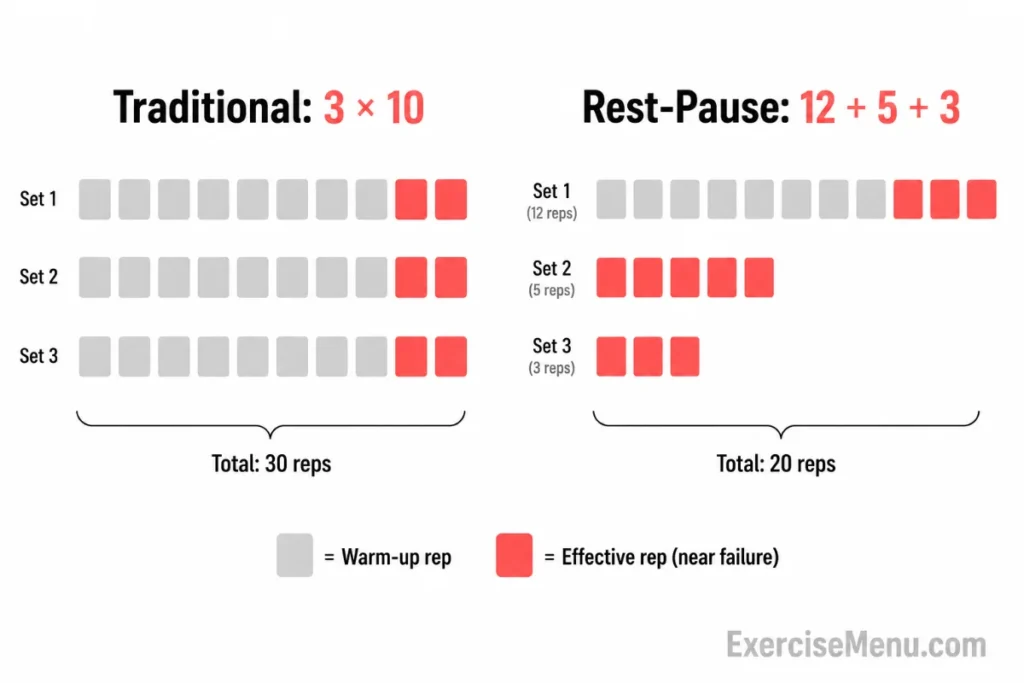
The research confirms this. Marshall et al. (2012) in the Journal of Science and Medicine in Sport found that rest-pause conditions produced greater muscle activation than traditional protocols — with the same total volume completed in dramatically less time.
A 2023 study by Karimifard et al. published in Stresses extended this to 12 weeks and found that trained men using rest-pause saw greater increases in maximal strength and muscle thickness than a traditional multi-set group. And a 2021 study by Enes et al. in Applied Physiology, Nutrition and Metabolism confirmed that rest-pause produced comparable hypertrophy to traditional training — in significantly less time.
Which Exercises Are Safe for Rest-Pause — and Which Aren’t?
This is where most guides get vague. They say “use machines” without explaining why. The reason comes down to what kind of fatigue hits you first.
Local fatigue means the target muscle itself gives out. Your chest can’t push the weight anymore. Your biceps can’t curl it. That’s productive failure — exactly what rest-pause is designed to exploit.
Central fatigue means your nervous system reduces the signal to your muscles before they’re actually exhausted. Your brain detects a massive cardiometabolic demand — heart rate through the roof, lactate building up fast — and dials back the output to protect you. This happens most on heavy compound lifts that load your entire body.
Barbell squats are the clearest example. You feel destroyed after a hard set of squats — but your quads often have more in the tank. What gave out was your cardiovascular system and your ability to brace under load, not the target muscle. Doing rest-pause here means you’re returning to a heavy barbell while your bracing, balance, and breathing are compromised. That’s where injuries happen.
Quick Reference: Which Exercises Work for Rest-Pause?
| Exercise Type | Safe? | Why |
|---|---|---|
| Machine presses, rows, pulldowns | ✅ Yes | Fatigue stays local. Fixed path, easy bail-out |
| Cable exercises (flys, curls, pushdowns) | ✅ Yes | Controlled movement, no balance demand |
| Dumbbells (curls, lateral raises) | ✅ Yes | Manageable load, easy to set down |
| Leg extension / seated leg curl | ✅ Yes | Isolation, machine-supported |
| Barbell bench (with safety pins) | ⚠️ Caution | Possible if safety setup exists and spotter available |
| Barbell squats | ❌ No | Central fatigue dominates. Bracing and balance fail first |
| Deadlifts / RDLs | ❌ No | Spinal fatigue, grip failure, form collapses under accumulated fatigue |
| Heavy barbell rows | ❌ No | Lower back rounds before upper back muscles reach failure |
| Overhead barbell press | ❌ No | Shoulder stability degrades before delts fail |
The general rule: if you can fail safely on the exercise without a spotter or safety pins, rest-pause works. If failing means dropping a barbell on yourself or rounding your spine under load, use straight sets with full rest instead.
How Do You Program Rest-Pause Into Your Workouts?
One rule keeps rest-pause productive: use it on the last set of 1–2 accessory exercises per session, after your main heavy work is done.
Your heavy compounds (squats, bench, rows with full rest periods) come first. They build strength with straight sets the way they always have. Rest-pause goes on the accessories — the machine press after your barbell bench, the cable row after your barbell rows, the leg extension after your squats.
Here’s what that looks like inside a push-pull-legs split:
Push day example:
- Barbell bench press: 3 × 8 (straight sets, 3 min rest)
- Machine chest press: 2 × 10, then 1 rest-pause set (12 + 5 + 3)
- Cable lateral raise: 2 × 12, then 1 rest-pause set (15 + 6 + 4)
Two rest-pause exercises. Both on machines. Both placed after the main barbell work. Total additional time: under 4 minutes.
How many total reps should a rest-pause set produce?
Aim for roughly 20 total reps across all mini-sets (range: 15–25). If your first set lands between 10–15 reps, the two mini-sets will typically add another 5–10 reps. If you’re getting fewer than 15 total, the weight is too heavy for rest-pause. If you’re clearing 25+ easily, the first set probably wasn’t close enough to real failure.
Recovery matters. Rest-pause is more fatiguing than straight sets for the same muscle group. If you rest-pause your chest on Monday, that muscle group needs at least 48–72 hours before the next session hitting chest. On a PPL split running twice per week, that timing works naturally. On a full-body program three days a week, rest-pause fits only on minor accessories — not main lifts.
One benefit that makes the rest-pause method worth considering for older lifters or anyone managing joint pain: because you’re working in the 10–15 rep range rather than grinding heavy 4–6 rep sets, the load on your joints is lower while the muscle stimulus stays high. You get the growth signal from accumulated fatigue near failure, not from maximal weight.
Rest-Pause vs Myo-Reps vs Drop Sets — What’s the Difference?
All three are advanced set techniques that push a set past normal failure. The mechanics are different:
Rest-pause: You keep the weight the same and rest 10–20 seconds between mini-sets. Reps drop each round because fatigue accumulates at the same load.
Myo-reps (created by Borge Fagerli): A rest-pause variant with a preset total rep target and shorter rests (10–15 seconds). Where rest-pause is open-ended — you go until you can barely get 2–3 reps — myo-reps give you a number to hit (e.g., 30 total reps) and you stop once you reach it. Myo-reps work well on lighter exercises like calf raises, lateral raises, and shrugs where you want to accumulate high volume fast.
Drop sets: You reduce the weight after failure instead of resting. A comparison of these techniques shows similar hypertrophy outcomes — the difference is practical. Drop sets require quick weight changes (plate-loaded machines or dumbbells), while rest-pause works on any equipment since the weight never changes.
When to use which:
- Time-crunched and training with machines → rest-pause
- High-rep accessories (calves, side delts, shrugs) → myo-reps
- Plate-loaded machines or dumbbell racks nearby → drop sets
Frequently Asked Questions
Can beginners use rest-pause training?
Not until you’ve trained consistently for at least 6–12 months with straight sets. Rest-pause requires you to recognize true muscular failure — not just discomfort — and maintain form under fatigue. A beginner hasn’t developed either skill yet.
How many rest-pause sets should you do per muscle group?
One. Two at most on separate exercises. Three or more rest-pause sets for the same muscle group in one session generates more fatigue than you can recover from without compromising your next training day.
Does rest-pause work for strength or just hypertrophy?
Both, but hypertrophy is the primary benefit. For pure strength goals where you need to handle the heaviest possible loads, straight sets with 3–5 minutes of full rest let your nervous system recover completely between efforts. Rest-pause keeps fatigue elevated intentionally — which builds muscle but limits how much weight you can handle per rep.
What if you can only get 1 rep on the second mini-set?
The weight is too heavy for rest-pause. Drop 10–15% and aim for a first set of 10–12 reps. You should get 4–6 on the second mini-set and 2–4 on the third.
Can you rest-pause every week or should you cycle it?
Cycle it. Run rest-pause on your accessories for 4–6 weeks, then return to straight sets for 2–3 weeks. Permanent high-intensity training without deload periods leads to accumulated fatigue and stalled progress.
Is 30 seconds too long between mini-sets?
Andy Baker — strength coach and DoggCrapp practitioner — uses 30-second rests (roughly 10–15 deep breaths) and considers that the sweet spot for heavier movements. Anything beyond 30 seconds starts resembling a short straight-set rest rather than a rest-pause. For lighter isolation work, 10–15 seconds is enough.
