

Quick Answer: The 15/30 HIIT protocol uses 15 seconds of sprint-level effort followed by 30 seconds of rest — a 1:2 work-to-rest ratio. It burns fat through high caloric expenditure and elevated post-exercise metabolism (EPOC), and it’s the most practical entry point into structured interval training for most adults. Two to three sessions per week is the right frequency. More than that stalls progress rather than accelerating it.
The 15/30 interval method is one of the most overlooked formats in high-intensity interval training. Most people know Tabata —20 seconds on, 10 seconds off. Far fewer know that a 1:2 work-to-rest ratio 15 seconds of hard effort, 30 seconds of recovery is often the smarter starting point, particularly if you haven’t yet built the conditioning to hold near-maximum output through a 2:1 structure.
The 15/30 protocol comes up repeatedly across all fitness levels, from people building their first cardio base to intermediates who’ve plateaued on longer, lower-intensity sessions. What follows is what the research supports and what holds up in practice.
- What Is HIIT 15/30 Interval Training?
- Why Does HIIT Work? The Science Behind It
- What Is the Right Interval Ratio for Your Level?
- Does HIIT Burn Belly Fat?
- HIIT 15/30 Workout Plans: From Beginner to Advanced
- What Exercises Work Best for the 15/30 Protocol?
- How Many Times a Week Should You Do HIIT?
- HIIT Workout Plan: A 4-Week Starting Framework
- What Are the Disadvantages of HIIT Training?
- HIIT vs. Steady-State Cardio: Which Burns More Fat?
- Is HIIT Good for Beginners?
- Frequently Asked Questions
What Is HIIT 15/30 Interval Training?
High-intensity interval training alternates short bursts of high-effort work with recovery periods at low or no intensity. What makes it HIIT rather than just interval training is that the work periods genuinely push your body close to its limit.
The 15/30 protocol means 15 seconds of sprint-level effort followed by 30 seconds of rest or very light movement a 1:2 work-to-rest ratio.
That ratio matters more than most people realise. HIIT only works when work intervals are truly high intensity. If rest is too short to recover before the next sprint, output drops and the session degrades into moderate cardio. The 1:2 ratio gives your cardiovascular system enough time to partially recover so each interval can be performed close to full effort.
This is what separates 15/30 from Tabata’s 20/10 structure. Tabata compresses rest to just 10 seconds — a ratio built for people who can hold near-maximum output even as recovery shrinks. The 15/30 method gives recovery the time it needs, and that’s what makes it more effective for most people starting out.
Why Does HIIT Work? The Science Behind It
High-intensity intervals push heart rate close to its maximum, meaning your body consumes oxygen at a very high rate. A 20-minute HIIT session burns between 200–400 calories depending on body weight and actual effort. Work intervals in genuine HIIT approach 80–95% of maximum heart rate, with recovery periods equal to or slightly longer than the work interval precisely the structure the 15/30 protocol is built on.
After the session ends, your body continues consuming oxygen at an elevated rate while it repairs — replenishing phosphocreatine stores, clearing lactate, and restoring hormones to baseline. This is excess post-exercise oxygen consumption, or EPOC.
Research by LaForgia and colleagues found high-intensity sessions produce a 6–15% increase in post-exercise metabolism lasting several hours a real but modest afterburn effect, not the “burn calories for 24 hours” headline you’ve seen elsewhere.
What the fat loss research actually shows: A 2017 meta-analysis of 13 randomized trials in overweight and obese adults found HIIT and moderate-intensity continuous cardio produce statistically similar reductions in body fat percentage, fat mass, and waist circumference. The key difference: HIIT groups trained 40% less time. A 2025 large-scale analysis of 36 randomized controlled trials further confirmed both HIIT and sprint interval training reduce body fat percentage and mass in overweight individuals.
HIIT is time-efficient. A calorie deficit is still required if fat loss is the goal.
What Is the Right Interval Ratio for Your Level?
The interval ratio is more important than the exercises you choose. Most people pick movements first and ratio second that’s backwards.
| Level | Work | Rest | Ratio | Who it’s for |
|---|---|---|---|---|
| Entry level | 15 sec | 45 sec | 1:3 | First 2–4 weeks, no prior training base |
| Beginner | 15 sec | 30 sec | 1:2 | The 15/30 protocol — start here |
| Advanced | 30 sec | 30 sec | 1:1 | Conditioned athletes |
| High intensity | 20 sec | 10 sec | 2:1 | Tabata protocol, trained individuals |
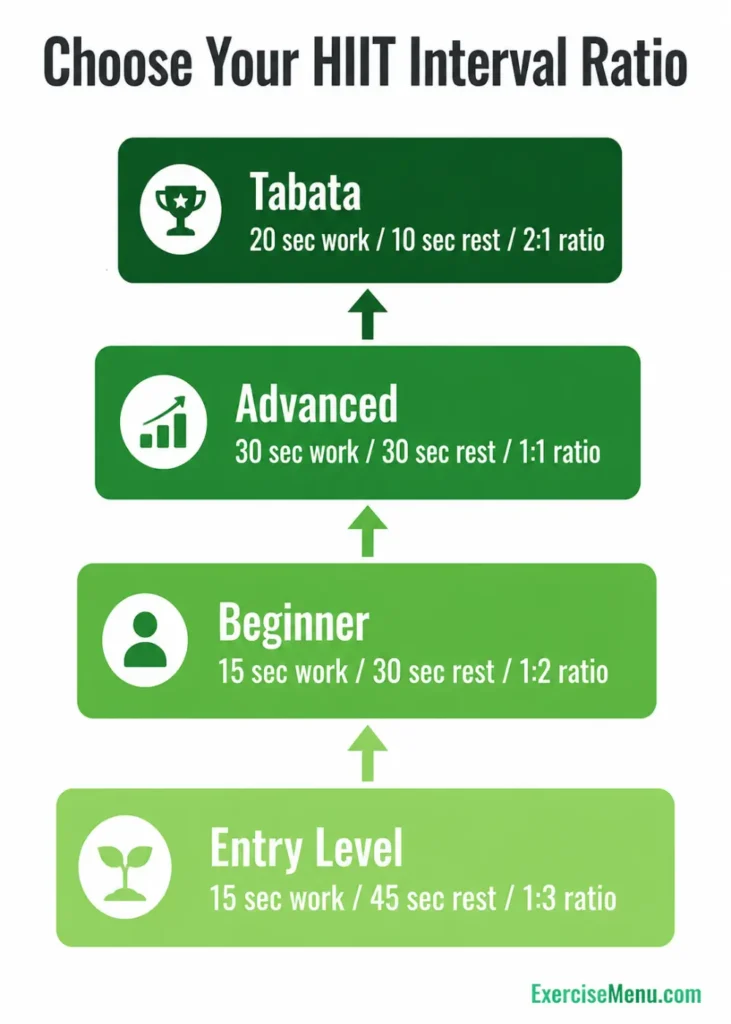
If you’ve been sedentary for more than three months or have no structured training history, spend two weeks at the 1:3 entry-level ratio 15 seconds work, 45 seconds rest before moving to 15/30. Two weeks at 1:3 is enough to prime your cardiovascular system for the step up.
The 15/30 method is where real training begins the first ratio where work is hard enough to create a genuine cardiovascular stimulus while rest is long enough to hold quality across all rounds.
People who jump straight to Tabata or a 30/15 structure go full effort for two rounds, crash by round four, and finish at 60% intensity. That’s moderate cardio, not HIIT. Start at 15/30 and progress the ratio when you’ve genuinely earned it.
Does HIIT Burn Belly Fat?
HIIT reduces visceral fat the deep abdominal fat stored around the organs — more effectively than moderate steady-state cardio in some populations. A 2025 study published in PLOS ONE found that after 12 weeks of HIIT, participants showed significantly lower body fat percentage and visceral fat area compared to a moderate-intensity continuous training group.
The mechanism isn’t a special “belly fat mode.” When HIIT creates a calorie deficit and elevates VO2 max — your body’s maximum oxygen-processing capacity the whole-body metabolic improvement reduces visceral fat storage over time.
HIIT 15/30 Workout Plans: From Beginner to Advanced
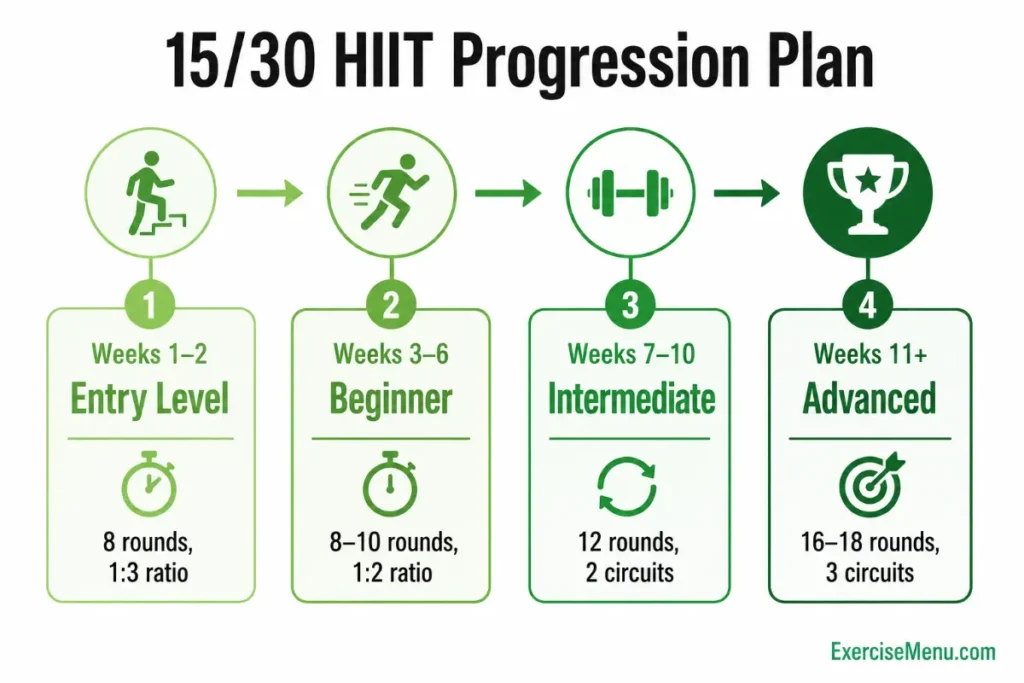
These workout plans are built on the 15/30 protocol. All four work at home with no equipment. Warm up for 5 minutes before every session light jogging on the spot, leg swings, and hip circles are enough.
Entry-level 15/45 plan (weeks 1–2, if no prior training base)
Structure: 15 sec work / 45 sec rest / 8 rounds / 1 circuit Total session time with warm-up and cool-down: ~14 minutes
| Round | Exercise | Work | Rest |
|---|---|---|---|
| 1–8 | Fast bodyweight squats | 15 sec | 45 sec |
Once 8 rounds feel manageable at genuine 8/10 effort without laboured breathing by round 6, move to the 15/30 plan. Run this 2 times per week with a full rest day between sessions.
Beginner 15/30 plan (weeks 1–4, or weeks 3–6 from entry-level)
Structure: 15 sec work / 30 sec rest / 8 rounds / 1 circuit Total session time with warm-up and cool-down: ~16 minutes
| Round | Exercise | Work | Rest |
|---|---|---|---|
| 1–8 | Fast bodyweight squats | 15 sec | 30 sec |
The goal isn’t volume it’s pushing at a genuine 8–9/10 effort for 15 seconds and recovering fully before the next round. Run this 2–3 times per week with at least one full rest day between sessions.
Intermediate 15/30 plan (weeks 5–10)
Structure: 15 sec work / 30 sec rest / 12 rounds / 2 circuits / 90 sec between circuits Total session time with warm-up and cool-down: ~25 minutes
| Circuit | Exercise | Work | Rest | Rounds |
|---|---|---|---|---|
| Circuit 1 | Burpees | 15 sec | 30 sec | 6 |
| 90 sec rest | ||||
| Circuit 2 | Mountain climbers | 15 sec | 30 sec | 6 |
Burpees spike heart rate fast and demand full-body coordination. Mountain climbers keep cardiovascular load high with less joint impact. Pace round one at 85% effort — consistent output across all rounds is the target, not an impressive opening.
Running interval training — 15/30 sprint protocol
Structure: 15 sec sprint / 30 sec walk / 10 rounds Total session time with warm-up: ~20 minutes
The sprint should sit at 90–95% of maximum running speed. Walk during the 30-second recovery jogging keeps heart rate too elevated to hit genuine output on the next sprint.
Advanced 15/30 plan (weeks 11+)
Structure: 15 sec work / 30 sec rest / 16–18 rounds / 3 circuits / 2 minutes between circuits Total session time with warm-up and cool-down: ~35 minutes
| Circuit | Exercise | Work | Rest | Rounds |
|---|---|---|---|---|
| Circuit 1 | Jump squats | 15 sec | 30 sec | 5–6 |
| 2 min rest | ||||
| Circuit 2 | Sprint on the spot | 15 sec | 30 sec | 5–6 |
| 2 min rest | ||||
| Circuit 3 | Explosive push-ups | 15 sec | 30 sec | 5–6 |
What Exercises Work Best for the 15/30 Protocol?
Exercises that suit a 15-second sprint format share three things: a short learning curve, technique that holds at high speed, and no equipment transitions mid-circuit.
Lower impact beginners or joint-sensitive individuals: Fast bodyweight squats, mountain climbers, high knees, lateral shuffles, step-back lunges at pace
Higher impact intermediate to advanced: Burpees, jump squats, sprint on the spot, jumping lunges, tuck jumps
Gym-based options: Treadmill sprints, rowing machine intervals, stationary bike sprints
Pick two to four movements and assign them to circuits. Rotating randomly through six exercises breaks the protocol a clear movement pattern per circuit is what drives the cardiovascular stimulus.
How Many Times a Week Should You Do HIIT?
Two to three sessions per week is the right frequency for most people. One session per week maintains fitness but produces slow progress. Four or more without elite-level recovery builds central nervous system fatigue that depresses output and blocks adaptation.
Space sessions at least 48 hours apart. If you’re also lifting weights, don’t stack HIIT directly after a heavy lower-body session — the order matters more than most people expect.
People who plateau on HIIT almost always added sessions thinking more is better. Effort per session drops, fatigue compounds, and results stop. Two quality sessions with full rest days between produce better output than four mediocre ones.
HIIT Workout Plan: A 4-Week Starting Framework
This plan runs entirely at home with no equipment.
Week 1–2: Foundation
- Monday: Beginner 15/30 8 rounds, fast squats
- Wednesday: Beginner 15/30 8 rounds, mountain climbers
- Friday: Rest or 20-minute light walk
Week 3–4: Build
- Monday: Beginner 15/30 10 rounds, burpees
- Wednesday: Running 15/30 sprint protocol 8 rounds
- Friday: Beginner 15/30 10 rounds, exercise of your choice
By week four, full effort should hold across all rounds with minimal drop-off in the final two. If it doesn’t, stay at this level for another week.
Most people feel the cardiovascular shift around week two. Fat loss takes longer to show visually expect body composition changes between weeks six and ten, depending on diet. Performance improves before appearance, and that’s normal.
What Are the Disadvantages of HIIT Training?
Injury risk is higher than most cardio. Burpees, jump squats, and tuck jumps put significant stress on knees, hips, and ankles. Someone with pre-existing joint issues who skips the beginner phase and starts with plyometric movements is taking a real risk. The beginner plan uses fast squats and mountain climbers for exactly this reason.
CNS fatigue accumulates quietly. HIIT taxes the central nervous system in a way moderate cardio doesn’t. Too many sessions without recovery and strength performance drops, sleep quality suffers, motivation disappears. These aren’t signs of laziness they’re signs the nervous system needs more time to recover.
A severe calorie deficit kills output. People who combine HIIT with very low calorie intake under 1,200 calories per day for women, under 1,500 for men — don’t have the glycogen to fuel genuine high-intensity work. At a severe deficit, moderate steady-state cardio is the better tool until intake reaches a sustainable level.
Beginners need an aerobic base first. Anyone with no structured exercise in the past 6+ months should build 4–8 weeks of basic aerobic work walking, light cycling, easy jogging — before their first 15/30 session.
HIIT doesn’t replace strength training. HIIT builds cardiovascular capacity and burns calories. Significant muscle mass requires resistance-based training with progressive overload. The two approaches work together, not against each other.
HIIT vs. Steady-State Cardio: Which Burns More Fat?
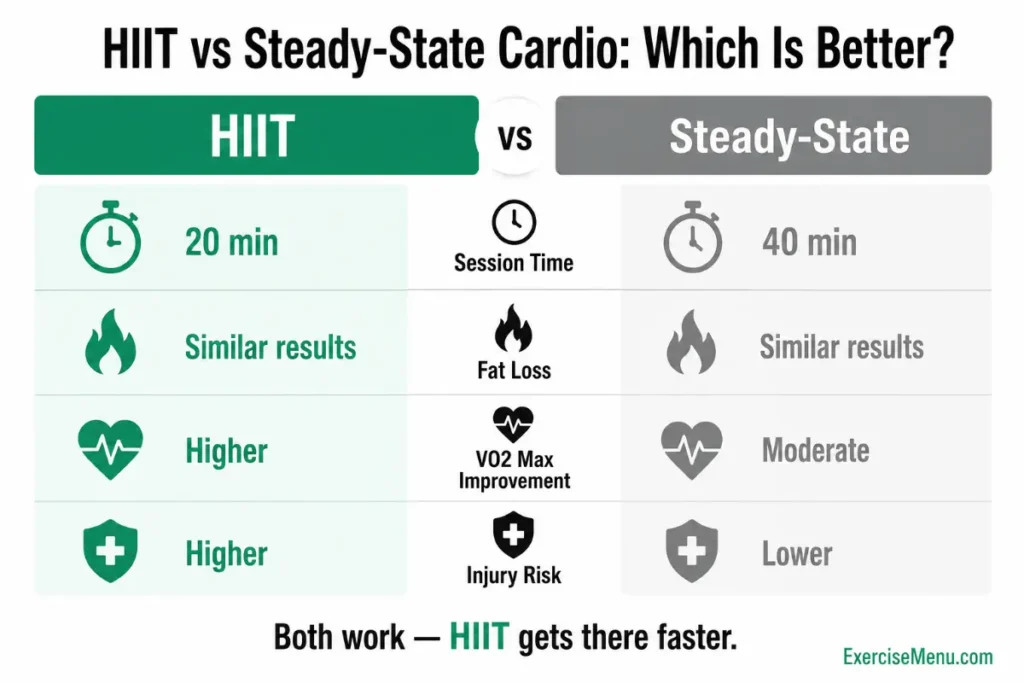
Trapp et al. (2008) split 45 overweight women into a HIIT group 8-second sprints, 12-second recovery, 20 minutes total and a steady-state group training 40 continuous minutes. After 15 weeks, the HIIT group lost significantly more fat mass at half the training time.
The Wewege meta-analysis (2017), covering 13 trials, showed fat loss outcomes are roughly equivalent when total work is matched HIIT groups got there training 40% less time.
Both approaches work. Steady-state is a legitimate fat loss tool if time isn’t a constraint and your joints handle sustained cardio well. For time-limited training or when improving VO2 max is the goal, HIIT is the stronger choice. VO2 max is the strongest predictor of long-term cardiorespiratory health, and a 2024 umbrella review by Poon and colleagues confirmed HIIT improves it more reliably than moderate-intensity continuous training across most populations.
Is HIIT Good for Beginners?
Yes with the right entry point and realistic expectations. Build a two-week aerobic base first. Walk briskly for 20–30 minutes, three times per week, before your first HIIT session. Skipping this step is the fastest way to go too hard too fast and quit in week two.
Pace the first session at 85% effort, not 100%. Starting at 85% leaves room to finish all rounds at consistent output. Separate discomfort from danger. Breathing too hard to talk is the target that’s the stimulus. Sharp joint pain, dizziness, or chest discomfort are different entirely and are reasons to stop immediately.
Use RPE as your intensity guide. Rate your effort on a 0–10 scale during work periods. Anything under an 8 won’t produce the cardiovascular adaptation HIIT is built on. Recovery periods should bring you back to a 2–3 before the next sprint.
Frequently Asked Questions
What is the 15/30 HIIT interval method?
The 15/30 method uses 15 seconds of sprint-level effort followed by 30 seconds of rest. This 1:2 work-to-rest ratio allows genuine high-intensity output each round because rest is long enough for partial recovery.
Is HIIT good for belly fat loss?
Yes, when paired with a calorie deficit. HIIT creates high caloric expenditure, elevates post-exercise metabolism through EPOC, and improves VO2 max — all of which drive body fat reduction including visceral abdominal fat over time.
How many times a week should I do HIIT?
Two to three sessions per week with at least 48 hours between them. More sessions without adequate recovery leads to CNS fatigue and declining performance.
What are the disadvantages of HIIT training?
Higher injury risk from explosive movements, CNS fatigue from high training frequency, poor performance on a severe calorie deficit, and unsuitability for complete beginners without a prior aerobic base.
Can beginners do HIIT at home?
Yes, with the right entry point. Start at a 1:3 ratio — 15 seconds work, 45 seconds rest — using low-impact exercises. Limit sessions to 8 rounds and two per week. Progress only when effort holds consistently across all rounds.
Does HIIT burn fat after the workout?
Yes, through EPOC. Research by LaForgia and colleagues found this adds roughly 6–15% to post-exercise calorie burn. For a 300-calorie session, that’s an estimated 20–45 additional calories — real but not dramatic.
What is the difference between HIIT and sprint interval training?
Sprint interval training (SIT) uses 100% maximal effort with longer rest periods between sprints. HIIT typically operates at 80–95% effort with shorter rest and applies to any exercise, not just running.

2 Comments
This HIIT 15/30 interval training sounds intense but super effective! I love that it combines sprints with short recovery periods. I will definitely going to give this workout a try this week. Thanks for this.
I love the concept of HIIT 15/30 Interval Training! It’s so efficient for fitting in a great workout when time is limited. I can’t wait to try this sprint workout—thanks for sharing these details!