


Reviewed by Sadia, FISAF-accredited Strength & Conditioning Coach All physiological claims in this article are cross-referenced against peer-reviewed research published in journals including the Journal of Physiology, Journal of Human Kinetics, and the NSCA’s Strength & Conditioning Journal. Citations link directly to primary sources.
When we talk about central nervous system adaptation in strength training, we mean one specific thing — your brain getting better at using the muscle you already have. More fibres recruited. Faster signals. Fewer internal limits on your output. This is the system that rep ranges are actually training, whether you realise it or not.
Most lifters operate on a simple model of strength: more muscle equals more force. That model is logical. It is also missing the system that determines how much of that muscle you can actually use on any given training day.
That system is your central nervous system. The rep ranges you select send fundamentally different signals to it — producing adaptations that are neurological, not just muscular. Here is what the research actually shows is happening inside your nervous system, and why it should change how you structure your training.
If you have ever walked into the gym feeling fresh, attempted a weight you have lifted before, and had it feel like a wall — that was your nervous system, not your muscles, limiting your output. Understanding that experience is the first step to training around it.
- What the CNS Actually Does During a Lift
- Low Reps (1–5): What Heavy Loading Does to Your Nervous System
- Why Your Body Holds Back Your Strength — And How Training Changes That
- Moderate Reps (6–12): Neural and Muscular Gains Working Together
- High Reps (12+): What Actually Happens to Your Nervous System
- Which Rep Range Should You Actually Be Training In?
- Full-Body Tension and CNS Irradiation: The Technique That Unlocks More Strength
- How to Prime Your Nervous System Before Every Heavy Set
- Why Training the Same Way Every Week Stops Working
- CNS Recovery: What the Evidence Actually Supports
- Key Takeaways
- Frequently Asked Questions
- Conclusion
- References
What the CNS Actually Does During a Lift
Every voluntary muscle contraction begins with an electrical signal from the motor cortex. That signal travels down the corticospinal tract — the primary neural highway connecting the brain to the spinal cord — and activates a motor neuron, which then triggers a bundle of muscle fibres called a motor unit to contract.
Two variables determine how much force you produce: how many motor units your nervous system recruits simultaneously, and how rapidly it fires signals to those units — a property called rate coding.
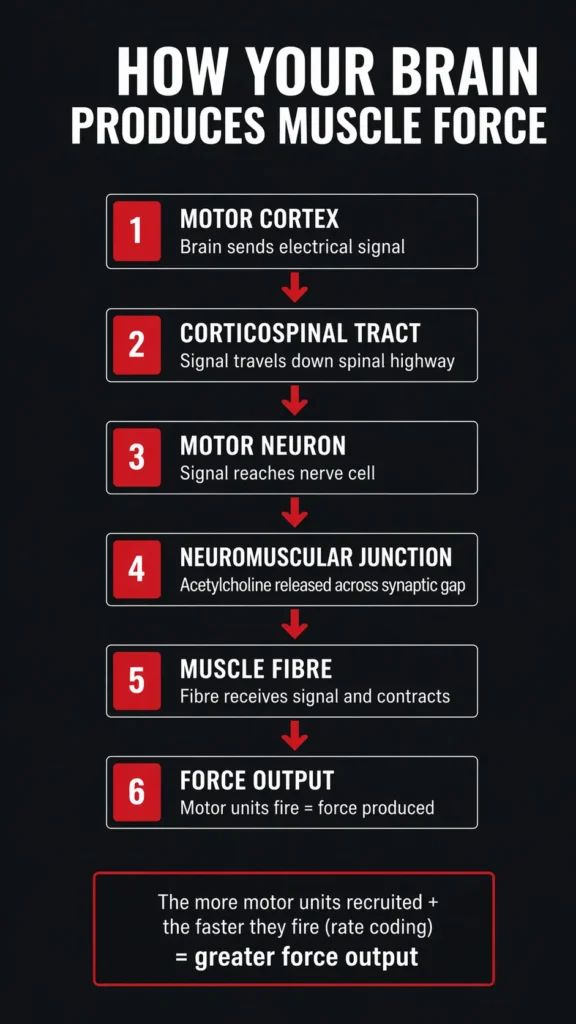
Two people with identical muscle size can produce markedly different levels of force depending on how efficiently their nervous system manages these two variables. That efficiency is the real multiplier on top of your raw muscular potential.
The Neuromuscular Junction: Where Neural Signal Becomes Force
The point at which a motor neuron communicates with a muscle fibre is called the neuromuscular junction. Here, the arriving electrical signal triggers the release of acetylcholine — a neurotransmitter that crosses the synaptic gap and initiates muscle fibre contraction. Consistent resistance training strengthens the efficiency of this junction, producing faster and more reliable signal transmission between nerve and muscle — a structural adaptation that compounds over years of training.
Low Reps (1–5): What Heavy Loading Does to Your Nervous System
Before getting into the neuroscience, if you are new to resistance training, our guide on what reps and sets actually are is a solid foundation to build on before coming back here.
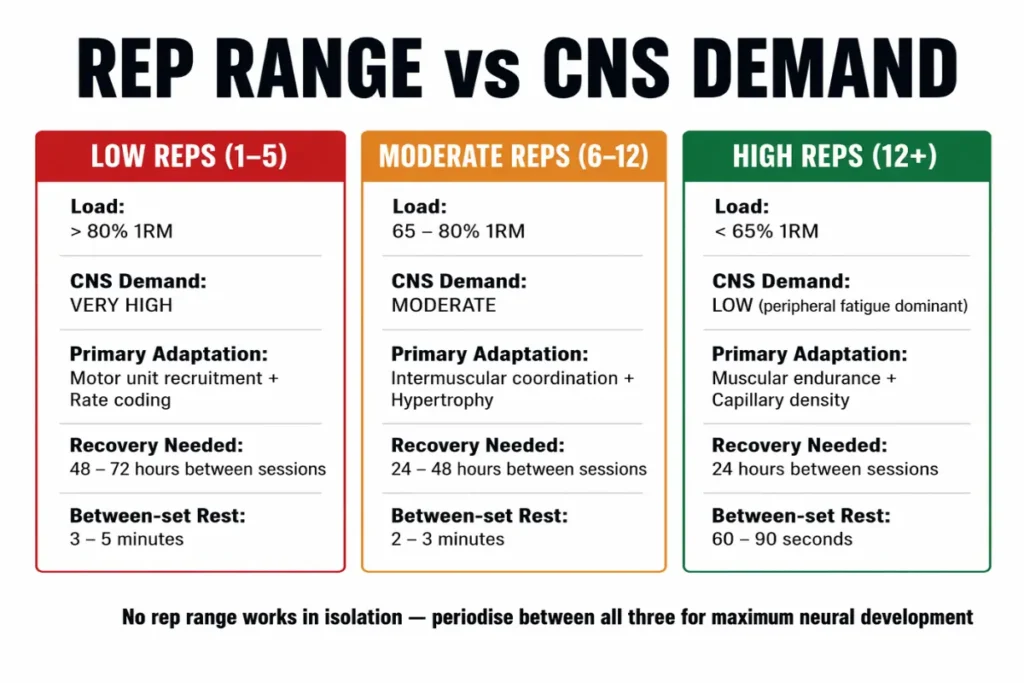
Lifting at 80–95% of your one-rep max forces your brain to recruit the highest-threshold motor units — the fibres that produce the most force but are rarely activated during everyday movement or lighter training. Reaching those fibres requires an intense, high-frequency neural signal along the corticospinal tract.
Over time, this type of loading teaches the CNS to recruit more motor units simultaneously, fire them at higher rates, and progressively reduce the protective inhibition that caps force output — all before your muscles necessarily grow any larger. Carroll et al. (2001) confirmed that the majority of early strength gains from resistance training are neural in origin, occurring before meaningful hypertrophy.
Del Vecchio et al. (2019) reinforced this through motor unit tracking across a four-week strength training intervention — discharge rates increased significantly while recruitment thresholds dropped, meaning the nervous system learns to access more muscle fibres at lower effort thresholds.
This is why experienced powerlifters do not simply get stronger because they are bigger. Their nervous system has learned to access a far greater proportion of their existing muscular capacity.
One of my beginner clients came in thinking she needed to eat more and train harder before anything would change. Instead, I kept her on a simple low-rep programme for two months — nothing fancy, just consistent work in the 2–4 rep range. Her bodyweight barely moved. But by week eight, the same weights that used to pin her down were moving faster and cleaner than ever. No new muscle. Just her nervous system finally learning how to use what was already there.
CNS adaptations are also movement-specific — neural gains built through the squat pattern do not transfer completely to unrelated movements, which is why exercise selection should remain consistent during intensification phases.
The trade-off is recovery. Heavy, low-rep lifting places genuine demand on the CNS. Your muscles may feel recovered in 24 hours, but full neural recovery from maximal effort sets typically requires 48–72 hours (Enoka & Duchateau, 2008). Programme too many of these sessions back-to-back without recovery and performance will stall — not because your muscles are fatigued, but because your motor cortex cannot generate the voluntary drive required for maximal recruitment.
Between-set recovery demands are equally significant — maximal-effort low-rep sets require 3–5 minutes of rest for sufficient ATP replenishment and motor neuron recovery before the next set can be performed at full neural output.
Best exercises for this range: Squats, deadlifts, bench press, overhead press, weighted pull-ups — compound movements that demand coordinated motor unit recruitment across multiple muscle groups simultaneously.
Why Your Body Holds Back Your Strength — And How Training Changes That
Embedded in your tendons are sensory receptors called Golgi tendon organs (GTOs). Their function is to monitor tension in the muscle-tendon unit. When that tension exceeds a threshold, they send an inhibitory signal to the spinal cord that reduces motor neuron firing — a protective mechanism called autogenic inhibition.
This is the reason you sometimes experience a sensation of your body switching off mid-rep under a heavy load, even when muscular fatigue has not fully accumulated. It is not weakness. It is a calibrated safety response.
The CNS also responds to psychological state — an athlete who believes a lift is beyond their capacity partially activates inhibitory circuits before the attempt begins, a documented property of the motor system, not motivational theory.
Muscle Spindles and the Stretch Reflex
Working in parallel with the GTOs are muscle spindles — sensory receptors embedded within the muscle fibres that monitor changes in muscle length and rate of stretch. When a muscle lengthens rapidly, spindles trigger the stretch reflex — a spinal-level response that initiates a protective contraction to resist the change in length.
In strength training, the elastic energy stored during the eccentric phase of a squat or bench press, combined with this reflex, directly contributes to force production in the concentric phase.
The GTO inhibition threshold is not fixed. Consistent, progressive heavy loading gradually raises it — the CNS learns these forces are manageable and allows greater force production before autogenic inhibition activates. That adaptation alone drives meaningful long-term strength gains, independent of muscle growth.
Moderate Reps (6–12): Neural and Muscular Gains Working Together
The 6–12 rep range at 65–80% of 1RM is where most training volume accumulates — and for sound physiological reasons.
At this load, you are still recruiting a substantial proportion of your motor unit pool, but the neural demand is not so extreme that recovery is compromised at the rate it is during heavy low-rep work. This allows higher training volume, faster inter-session recovery, and the accumulation of mechanical tension required to drive hypertrophy.
Intermuscular Coordination
Neurologically, this range is where intermuscular coordination improves — the capacity of multiple muscles to fire in more organised, temporally precise patterns. When you perform a compound movement like a squat, the quadriceps, hamstrings, glutes, adductors, and spinal erectors must activate in a specific sequence and at appropriate intensities.
The nervous system governs and refines that coordination with practice. If a weight that felt awkward three months ago now feels smooth and controlled, that is intermuscular coordination developing in this rep range.
For most natural lifters, this range produces a productive combination of neural efficiency gains and muscular hypertrophy — building the base on which heavy strength training can compound.
High Reps (12+): What Actually Happens to Your Nervous System
At 12 or more repetitions with sub-65% 1RM loads, CNS involvement drops significantly. High-threshold motor units are not being recruited, and firing rates remain well below those required for maximal force adaptation. This rep range primarily drives muscular endurance and metabolic adaptation — useful for capillary density and lactate threshold development.
High-rep training taken to momentary failure does recruit fast-twitch motor units — but only in the final repetitions, and not at the discharge frequencies required for maximal strength adaptation. As the NSCA’s (National Strength and Conditioning Association) research confirms, light training loads engage fewer and lower-threshold motor units across the majority of each set, making this rep range effective for endurance but insufficient as a primary driver of neural strength.
High-rep sets do not spare the CNS entirely. Extended set duration and metabolite accumulation — including lactate and inorganic phosphate — create a form of peripheral fatigue that progressively impairs motor neuron output over the course of the set, distinct from the acute neural fatigue produced by maximal loading.
If you want to understand exactly how to apply high-rep training within a structured programme, our guide on how many reps and sets for muscular endurance covers this in full detail.
Which Rep Range Should You Actually Be Training In?
| Training Goal | Rep Range | Load (% 1RM) | CNS Demand | Primary Adaptation |
|---|---|---|---|---|
| Maximum CNS strength | 1–5 reps | >80% | Very high | Neural recruitment, rate coding, GTO threshold |
| Strength + hypertrophy | 6–12 reps | 65–80% | Moderate | Intermuscular coordination, muscle growth |
| Muscular endurance | 12+ reps | <65% | Low | Metabolic, capillary density, lactate threshold |
| Power / rate of force development | 1–5 explosive | 40–70% | Very high | Rate coding, fast-twitch activation, RFD |
A well-designed programme does not sit permanently in one rep range. It moves between them with intention: heavy work drives neural adaptation, moderate work builds the muscular base, lighter work supports recovery volume without accumulating excessive central fatigue.
Full-Body Tension and CNS Irradiation: The Technique That Unlocks More Strength
There is a principle in neuroscience called irradiation: when you contract a muscle forcefully, the neural signal spreads to surrounding muscle groups, increasing total motor unit activation across the body. This is not a coaching cue — it is a measurable neurological phenomenon.
This is why competitive powerlifters grip the bar until their knuckles whiten, drive their feet into the platform, brace maximally through the torso, and squeeze their glutes before a maximal lift. By tensing the whole system, they are amplifying CNS activation before the rep begins.
To experience irradiation directly: squeeze an object in your hand as hard as possible while keeping the rest of your body relaxed. Then repeat while tensing your entire body simultaneously. The difference in grip force is the irradiation effect in real time.
This technique is effective only at low rep ranges — roughly 1–5 reps. At higher rep ranges, maintaining full-body tension causes premature fatigue and undermines the stimulus you are trying to create. Apply it on heavy compound sets only.
How to Prime Your Nervous System Before Every Heavy Set
Post-Activation Potentiation is the transient increase in muscular performance that follows a high-intensity conditioning activity. When you perform a near-maximal effort — a heavy squat, a loaded jump, or a maximal isometric contraction — your nervous system enters a state of elevated excitability. Motor unit recruitment thresholds drop temporarily and rate coding efficiency increases, meaning force output in the subsequent working set is measurably higher than it would otherwise be.
The PAP window is time-sensitive — working sets should begin within 3–15 minutes of the priming activity. Too soon, and residual fatigue competes with the potentiation effect. Too late, and the neural excitability has dissipated.
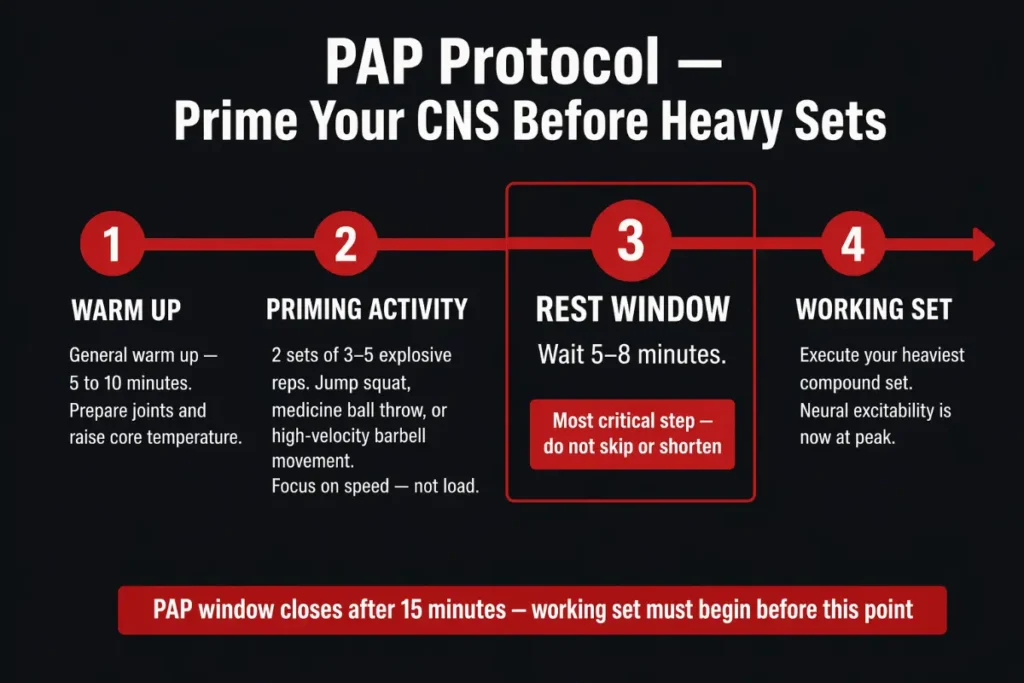
In practice: before your heaviest compound set, perform 2 sets of 3–5 explosive repetitions — a jump squat, a medicine ball throw, or a submaximal barbell movement at high velocity — rest 5–8 minutes, then execute your working set.
Why Training the Same Way Every Week Stops Working
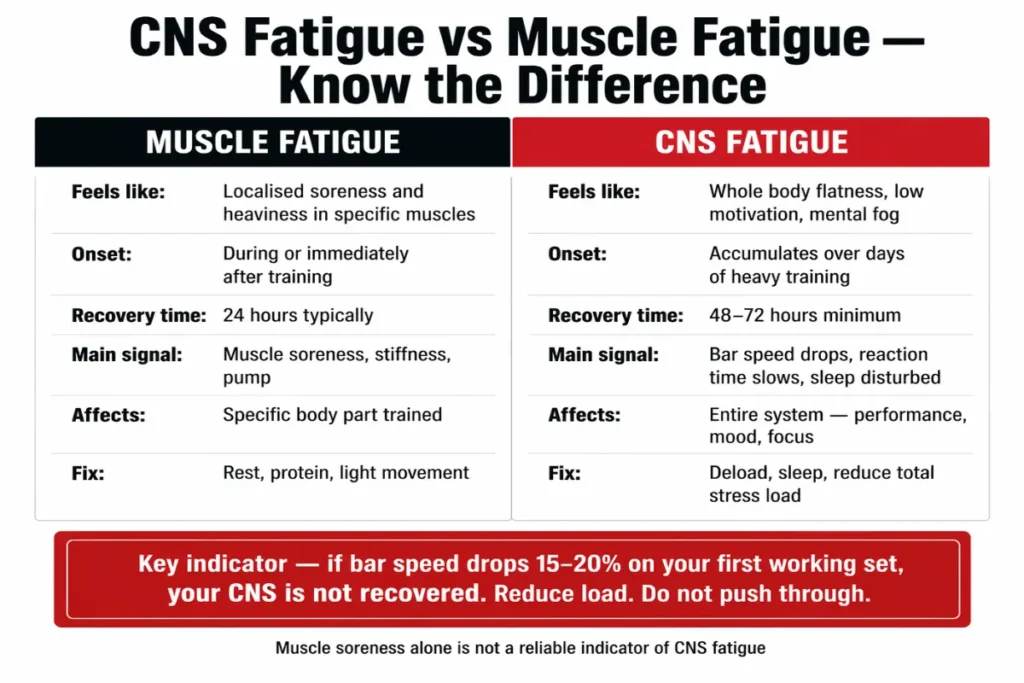
The CNS responds to progressive challenge but accumulates fatigue faster than peripheral tissue and recovers more slowly. Push maximal neural demand week after week without a planned reduction and performance deteriorates: bar speed slows, coordination breaks down, sleep quality drops, and motivation collapses. These are neurological signals of accumulated central fatigue, not signs of mental weakness.
Research published in the Journal of Human Kinetics confirms that central fatigue specifically impairs voluntary muscle activation through reduced motor cortex drive — an effect that compounds when training load is not periodically reduced.
The Three Phases of Periodised Loading
The evidence-based framework endorsed by both the NSCA (National Strength and Conditioning Association) and the UKSCA (UK Strength and Conditioning Association) structures training into three cyclical phases:
Accumulation: Higher volume, moderate load (65–75% 1RM). Neural demand is moderate; the CNS adapts to volume without excessive central fatigue.
Intensification: Lower volume, higher load (80–90% 1RM). Neural demand increases; motor unit recruitment thresholds are directly challenged.
Realisation (Peaking): Lowest volume, highest load (>90% 1RM). The athlete expresses the capacity built across the prior phases.
Deload weeks — a 10–30% reduction in intensity and approximately 50% reduction in volume for one planned week — are where neural adaptations consolidate. Not optional recovery. The mechanism through which gains from the preceding block are permanently encoded.
The Neurochemistry of CNS Fatigue
During prolonged or excessively frequent high-intensity training, serotonin rises in the brain while dopamine and noradrenaline drop. This neurochemical shift reduces motor neuron firing frequency, slows reaction time, impairs mood, and collapses motivation.
Noradrenergic neurons innervate the cerebral cortex, cerebellum, and brainstem — all directly involved in voluntary movement. When noradrenaline drops, the neural signal quality driving your lifts drops with it. This is why CNS-fatigued athletes feel systemically flat rather than simply sore.
CNS Recovery: What the Evidence Actually Supports
Total Stress Load
The CNS does not distinguish between the stress of a maximal deadlift and the stress of a difficult work week. Both activate the same neuroendocrine response — elevated cortisol, reduced dopaminergic tone, increased sympathetic activity. If total life stress is chronically high, neural recovery between sessions will be compressed regardless of how well training is programmed.
Managing CNS recovery means managing total stress load, not just gym variables. Bar velocity is the most accurate real-time indicator of CNS readiness — a drop of 15–20% from your established baseline on the first working set signals compromised neural drive, and load should be reduced accordingly.
Sleep
During slow-wave sleep, the nervous system consolidates motor learning, clears metabolic waste, and resets the motor cortex for the next training stimulus. Consistently poor sleep directly reduces motor unit recruitment capacity and rate coding efficiency in the subsequent session — making it the single most impactful CNS recovery variable available.
Nutrition
Carbohydrates are the CNS’s preferred fuel substrate. Glycogen depletion before or during high-demand training measurably impairs neural output — motor unit recruitment drops and rate coding efficiency decreases. Magnesium is essential for nerve signal transmission and is commonly deficient in athletes training at high intensity. Caffeine delays central fatigue onset by blocking adenosine receptors — a well-supported pre-training tool at 3–6 mg/kg bodyweight.
Key Takeaways
- Force output is governed by neural efficiency first, muscular cross-section second.
- Low-rep (1–5) training at >80% 1RM produces the strongest CNS adaptations: motor unit recruitment, rate coding, and GTO threshold elevation.
- Moderate-rep (6–12) training improves intermuscular coordination and builds the hypertrophic base for neural training to compound.
- Post-activation potentiation enhances neural readiness — use it within a 3–15 minute window before heavy working sets.
- Bar velocity is the most accurate real-time indicator of CNS readiness — not perceived exertion.
- CNS fatigue has neurochemical causes (dopamine/noradrenaline depletion) and requires 48–72 hours to resolve after maximal-effort sessions.
- Sleep, carbohydrate availability, and total stress load are the three most impactful CNS recovery variables.
Frequently Asked Questions
What is the best rep range for CNS training?
The 1–5 rep range at loads above 80% of 1RM produces the strongest CNS adaptations — increased motor unit recruitment, improved rate coding, and gradual elevation of the autogenic inhibition threshold. This range should form the core of intensification phases for athletes prioritising neural strength.
Why do beginners gain strength so quickly without getting noticeably bigger?
In the early months of training, the majority of strength gains are neural. The nervous system becomes more efficient at recruiting motor units and coordinating contractions. Visible hypertrophy requires sustained mechanical tension over a longer period — neural efficiency adapts far faster.
Can your brain actually limit how strong you are even when your muscles could handle more?
Yes. Golgi tendon organs trigger autogenic inhibition when tension exceeds a calibrated threshold. CNS fatigue reduces motor cortex drive and firing frequency. Both cap force output well below the muscles’ actual structural capacity. Progressive training raises these thresholds over time.
How long does the CNS take to recover after heavy lifting?
Muscles can feel ready within 24 hours. Full neural recovery after genuinely maximal-effort work typically requires 48–72 hours. Consecutive heavy sessions before neural recovery is complete produce stalled performance, not progress.
How do I know if my CNS is fatigued?
Bar speed declining at a given load, persistent lack of motivation, slower reaction time, disrupted sleep, and elevated resting heart rate. Muscle soreness is not the primary signal — CNS fatigue presents as systemic flatness and a reduced capacity to generate effort, not localised pain.
Does high-rep training build CNS strength?
Not meaningfully. High-rep sets to failure recruit fast-twitch motor units only in the final repetitions, and not at discharge frequencies sufficient for maximal strength adaptation. High-rep training develops muscular endurance, capillary density, and lactate threshold — not neural strength. If your reps have been climbing but your max hasn’t moved, this is exactly why — and what to do instead.
What is rate coding and why does it matter for strength?
Rate coding is the frequency at which motor neurons fire signals to muscle fibres. Higher firing rates produce more force from the same fibre pool. Heavier rep ranges improve rate coding over time — a primary reason experienced lifters generate substantially more force than beginners with comparable muscle mass.
Is the full-body tension technique worth using at all rep ranges?
Effective only at low rep ranges (1–5 reps). Global body tension through irradiation increases CNS activation and motor unit recruitment before and during the lift. At higher rep ranges, maintaining this tension causes premature fatigue and undermines the training stimulus.
What foods help CNS recovery between sessions?
Carbohydrates restore glycogen for neural fuel. Magnesium supports nerve signal transmission at the neuromuscular junction. Adequate total caloric intake prevents the energy deficit that accelerates central fatigue. Caffeine delays fatigue onset during training but does not accelerate recovery between sessions.
Is CNS fatigue real or a myth?
Real — with neurochemical and electrophysiological evidence. The debate is not about whether it exists but about its magnitude relative to peripheral fatigue in different contexts. For high-intensity, high-frequency training near 1RM, central fatigue becomes an increasingly significant limiting factor.
Conclusion
Force output is governed by neural efficiency first, muscular cross-section second. The rep ranges you select send distinct signals to your central nervous system — driving adaptations in motor unit recruitment, rate coding, autogenic inhibition thresholds, and neuromuscular junction efficiency that are entirely independent of hypertrophy.
Programme your rep ranges deliberately. Use post-activation potentiation to prime neural readiness before heavy sets. Monitor bar velocity as your primary performance indicator. Manage total stress load as part of your recovery strategy. Treat deload weeks as the mechanism through which neural adaptation consolidates.
The nervous system is not a passive background system. It is the primary driver of strength. Train it accordingly.
Ready to apply this to your training? Read our complete guide to structuring your first periodised training block — covering accumulation, intensification, and peaking phases in detail.
References
- Carroll TJ et al. (2001). Resistance training enhances the stability of sensorimotor coordination. Proceedings of the Royal Society B.
- Del Vecchio A et al. (2019). The increase in muscle force after 4 weeks of strength training is mediated by adaptations in motor unit recruitment and rate coding. Journal of Physiology.
- Enoka RM & Duchateau J (2008). Muscle fatigue: what, why and how it influences muscle function. Journal of Physiology.
- Zając A et al. (2015). Central and Peripheral Fatigue During Resistance Exercise. Journal of Human Kinetics.
- Leveritt M & Abernethy PJ (1999). Effects of carbohydrate restriction on strength performance. Journal of Strength & Conditioning Research.
- Gröber U et al. (2017). Magnesium in Prevention and Therapy. Nutrients.
- Glade MJ (2010). Caffeine — Not just a stimulant. Nutrition.

1 Comment
Pingback: Warm-Up Sets vs Working Sets - What's the Difference? Complete Guide