

Key Takeaways
- People who train with a personal trainer are 30% more likely to hit their fitness goals than those who train alone (IHRSA)
- Supervised training produces better strength gains and technical execution than self-guided training
- Exercise adherence without professional support drops below 20%
- 73% of people who trained with a PT moved up at least one fitness level in 10 weeks (ACE)
- Bad form without supervision doesn’t just slow results — it builds injury risk rep by rep
Most people who quit the gym don’t quit because they’re lazy. They quit because nothing is working. The weights aren’t going up. The body isn’t changing. After months of showing up, they stop seeing the point.
That’s not a willpower problem. That’s a system problem.
The question isn’t whether you should hire a personal trainer. The question is: what exactly changes when you do — and what do you keep losing when you don’t?
- Your Plan: Built for You vs. Built for Everyone
- Someone Watching vs. Nobody Watching
- Progress tracking — data-driven adjustments vs. hoping for the best
- Nutrition Guidance vs. No Guidance
- Built-In Accountability vs. Relying on Motivation
- Injury management — training around it vs. making it worse
- What You Pay vs. What You Lose Without One
- What personal training at Exercise Menu looks like
- FAQ
Your Plan: Built for You vs. Built for Everyone
| With a personal trainer | Without a personal trainer | |
|---|---|---|
| Program | Built around your goals, body, and movement limitations | Generic YouTube routine — same for everyone |
| Progression | Periodized — volume and intensity adjusted weekly | Same weights, same reps, same plateau |
| Rep ranges | Matched to your actual goal | Arbitrary — usually 3×10 because someone said so once |
| Updates | Reassessed every 4–8 weeks | Never, unless you research it yourself |
A program without progressive overload built in is not a program. It’s exercise. Your body adapts to what you repeatedly do — and once it adapts, it stops changing. That’s not a motivation issue. That’s physiology.
The most common pattern we see with clients who trained alone before coming to Exercise Menu: their weights haven’t moved in months. Same squat. Same bench. Same rows. They were consistent — their program just gave their body no reason to keep adapting.
A trainer designs specifically around that. Every week has a purpose. Every four to eight weeks, the program is reassessed and updated based on actual data — not guesswork.
Rep ranges matched to your goal:
| Goal | Rep range | Weekly sets per muscle | Training structure |
|---|---|---|---|
| Fat loss | 12–20 | 10–15 | Metabolic circuits, short rest |
| Muscle growth | 6–12 | 12–20 | Compound + isolation, moderate rest |
| Strength | 1–5 | 8–12 | Heavy compounds, long rest |
| Muscular endurance | 15–30 | 10–15 | Time-under-tension focus |
Most people training alone apply one approach to every goal. The table above shows why that fails — each goal requires a completely different training stimulus.
→ Use the Rep Range Recommender at Exercise Menu to find your starting point based on your specific goal.
Someone Watching vs. Nobody Watching
| With a personal trainer | Without a personal trainer | |
|---|---|---|
| Form check | Real-time correction every set | Mirror at best — you can’t see what you can’t see |
| Injury risk | Modifications built in before problems start | Form degrades under fatigue with no one watching |
| Load selection | Weight increases controlled and systematic | Ego lifting or under-loading — both stall results |
| Evidence | Supervised groups: heavier loads, better execution, superior strength gains | Unsupervised: technique degrades as fatigue increases |
A 2025 randomized controlled trial published in the Journal of Strength and Conditioning Research compared in-person supervision, online coaching, and self-guided training. Supervised subjects consistently achieved better strength outcomes and technical execution. A separate analysis in the same review found significant improvements in body composition and strength occurred only in supervised groups.
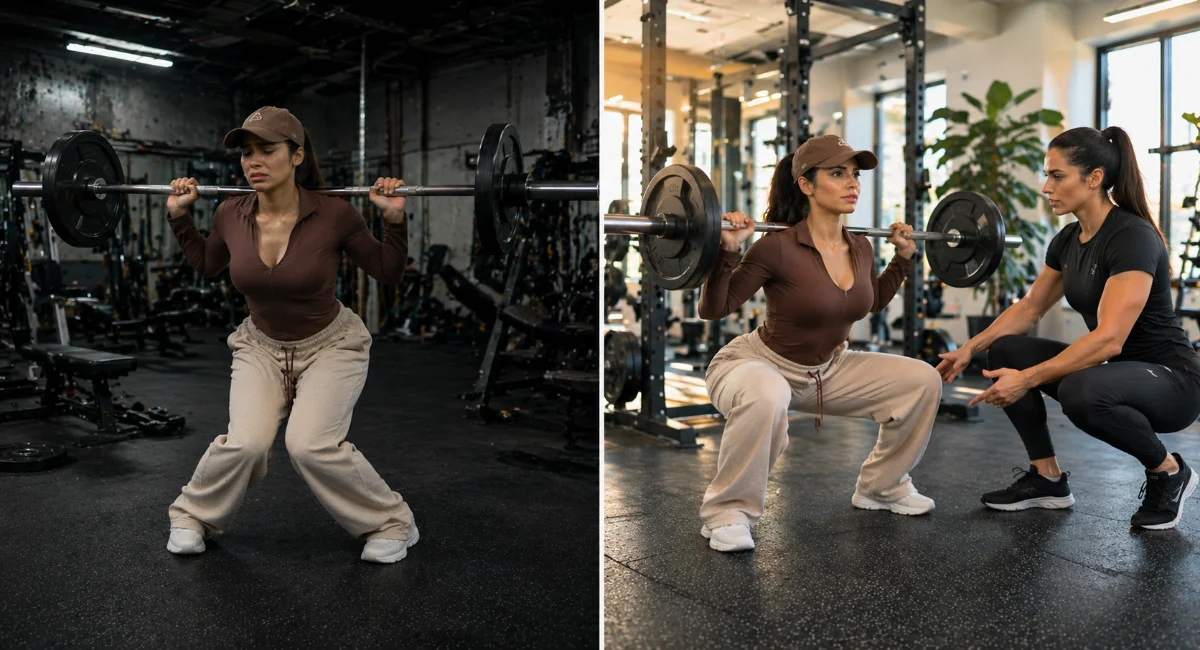
The problem with training alone isn’t effort. It’s feedback. Your body compensates — hip shifts, shoulder rolls, lower back overloads — and you feel nothing wrong because the compensation becomes your normal. Without someone watching every rep, that pattern gets reinforced session after session, sometimes for years.
A 2023 systematic review and meta-analysis in the International Journal of Strength and Conditioning — covering 12 studies and 577 participants — found a moderate effect favouring supervised training on strength outcomes.
A 2025 preprint from SportRxiv adds the mechanism: supervised trainees consistently trained with greater effort — measured by time under load — than those training alone in the same gym. Supervision raises intensity. Higher intensity produces better results.
Progress tracking — data-driven adjustments vs. hoping for the best
| With a personal trainer | Without a personal trainer | |
|---|---|---|
| Metrics tracked | Strength PRs, body composition, rep performance | Usually just bodyweight — incomplete and misleading |
| Plateau response | Program adjusted immediately | Same routine pushed harder — rarely works |
| Reassessment | Formal check-in every 4–8 weeks | Never, unless you decide to research it |
| Progress visibility | Measurable improvement tracked every session | Progress feels invisible — the top reason people quit |
The scale is the most misleading progress metric in fitness. It rises when you add muscle. It stays flat when fat loss and muscle gain happen simultaneously. It drops when you lose water. None of those movements tell you whether your body composition is actually improving.
A trainer tracks what matters: are your lifts going up? Is your body composition shifting? Can you do more work than you could eight weeks ago?
Without those benchmarks, most people who hit a plateau do one of two things — push the same routine harder, or give up. A trainer does neither. The program gets adjusted — deload, volume change, exercise variation — based on what the data actually shows.
Nutrition Guidance vs. No Guidance
| With a personal trainer | Without a personal trainer | |
|---|---|---|
| Guidance type | Protein targets, portion awareness, meal timing, habit coaching | Keto one week, fasting the next, detox tea after |
| Scope clarity | Trainer refers to a Registered Dietitian when clinical needs arise | No referral system — advice comes from social media |
| Nutrition-training link | Both designed together for maximum result | Training effort consistently undone by unmanaged eating |
| Accountability | Food habits reviewed as training load changes | Nobody checking between sessions |
Workouts take up 3–5 hours of your week. Nutrition affects the other 163. Without guidance on both, you’re optimizing 2% of your life and ignoring 98%.
A trainer’s nutrition scope is specific: protein targets, caloric awareness, meal timing around training, and habit-based coaching. When clinical needs arise — metabolic conditions, disordered eating history, therapeutic diets — a qualified trainer refers to a Registered Dietitian. That boundary matters. A trainer who doesn’t know it is one worth avoiding.
Without coordinated guidance, training and nutrition work against each other. You train hard and under-eat protein. You cut calories and drop training volume. The result is lost muscle alongside lost fat — a body that looks worse at a lower weight. That pattern is extremely common in people who manage both without professional input.
Built-In Accountability vs. Relying on Motivation
| With a personal trainer | Without a personal trainer | |
|---|---|---|
| Showing up | Booked session, trainer waiting, cancellation fee | Skipping is always an option — and often wins |
| Consistency | External accountability structure every week | Entirely motivation-dependent — unreliable by design |
| Bad week management | Trainer adjusts expectations, keeps you in motion | One bad week becomes one bad month |
| Goal adherence | 30% more likely to hit goals (IHRSA) | Exercise adherence without support: below 20% |
Motivation is not a system. A personal trainer is a system.
According to the American Council on Exercise, 73% of people who trained with a personal trainer over 10 weeks moved up at least one measurable fitness level. Without professional support, exercise adherence sits below 20%. That means eight out of ten people who start training alone stop before they see meaningful results — not because fitness doesn’t work, but because no structure exists to keep them in it.
Injury management — training around it vs. making it worse
| With a personal trainer | Without a personal trainer | |
|---|---|---|
| Existing injuries | Assessed in session one — program built around limitations | Ignored, aggravated, or used as a reason to stop entirely |
| Form under fatigue | Trainer catches breakdown before it causes damage | Fatigue breaks form silently — no one catches it |
| Referral system | PT refers to physiotherapist or sports medicine when needed | Google diagnosis + YouTube fix — usually wrong |
| Program modification | Exercises swapped to keep training productive | Push through and aggravate it, or stop training entirely |
Training with an existing injury and no supervision is not resilience. It’s how a manageable problem becomes a chronic one.
Knee pain is among the most common issues clients bring to a first session. Almost always, the pain is a symptom — the movement pattern creating it is the actual problem. Correct the pattern, adjust the load, modify the exercise selection, and training continues productively. That process requires someone watching every rep. Without it, the two outcomes are: aggravate the injury further, or stop training entirely.
A personal trainer does not treat injuries — that is a physiotherapist’s scope. But a trainer does assess movement limitations, build around them, watch for compensation in every set, and refer immediately when something beyond their scope appears.
What You Pay vs. What You Lose Without One
| Training type | Average cost (2025) | What’s included |
|---|---|---|
| In-person personal training | $40–$100 per session | Assessment, periodized program, real-time coaching, nutrition guidance, progress tracking |
| Online personal training | $100–$250 per month | Program design, check-ins, progress review, messaging support |
| Hybrid coaching | $150–$350 per month | In-person sessions + remote programming between sessions |
| Solo gym membership | $30–$60 per month | Equipment access. That’s it. |
A gym membership gives you access to equipment. A personal trainer gives you a system to use it. These are not the same investment.
If you’re not ready for in-person training yet, Exercise Menu’s Home Workout service gives you a structured, coach-built program you can follow from home — no gym or equipment needed. It’s a practical starting point before committing to full personal training.
The 2026 Fitness Mentors industry survey found that 58.7% of trainers now deliver hybrid coaching — in-person sessions combined with remote programming. Results improve when accountability and program design run seven days a week, not just during the session hour.
The real cost of not hiring a trainer isn’t the money saved. It’s months of inefficient training, a plateau that never breaks, a form error that becomes a chronic injury, and the motivation crash that resets everything back to zero.
What personal training at Exercise Menu looks like
Every program at Exercise Menu starts with a full intake and movement screen. Not a test — a diagnostic. No session gets written before the baseline is fully understood: movement quality, injury history, schedule, goal, and actual starting strength.
From there, rep ranges are matched to the goal, volume is matched to recovery capacity, and nutrition targets are set alongside training load. The program changes as the client changes. Reassessment happens every four to six weeks on a fixed schedule — not when it feels convenient.
The clients who progress fastest are not the ones who train the hardest. They’re the ones whose plan is the most precise.
→ Start with your numbers: use the Protein Calculator at Exercise Menu to set your daily protein target — one of the first variables established in every new program.
FAQ
Is a personal trainer worth it for beginners?
Yes — and beginners benefit more than anyone. Getting form, rep ranges, and program structure right from session one compounds over months and years. Getting them wrong costs months of progress and creates injury risk that compounds just as fast.
How often should a beginner train with a personal trainer?
Two to three sessions per week is the evidence-based starting point. This builds foundational habits, allows form coaching across a full range of movements, and provides enough training stimulus to adapt without overreaching. As technique improves, many clients shift to one supervised session per week and train independently the remaining days.
Can a personal trainer help me train around an injury?
Yes, within a defined scope. A trainer assesses movement, modifies exercises around limitations, watches for compensation patterns, and keeps training productive while managing load carefully. They do not treat injuries — that is physiotherapy. A qualified trainer refers without hesitation when something is beyond their scope.
What certifications should a personal trainer have?
Look for NCCA-accredited certification: NASM (National Academy of Sports Medicine), ACE (American Council on Exercise), or NSCA (National Strength and Conditioning Association). Any trainer who won’t verify their credentials is a red flag.
Can a personal trainer give me a meal plan?
A trainer provides nutrition guidance within their scope of practice: protein targets, caloric awareness, meal timing, and general habit coaching. Clinical nutrition — metabolic conditions, therapeutic diets, disordered eating — requires a Registered Dietitian. A good trainer knows the line and refers accordingly.
The difference between training with a personal trainer and training alone isn’t effort. Both groups work hard. The difference is structure, feedback, progression, and accountability — and those four things determine whether months of effort actually produce results.
