

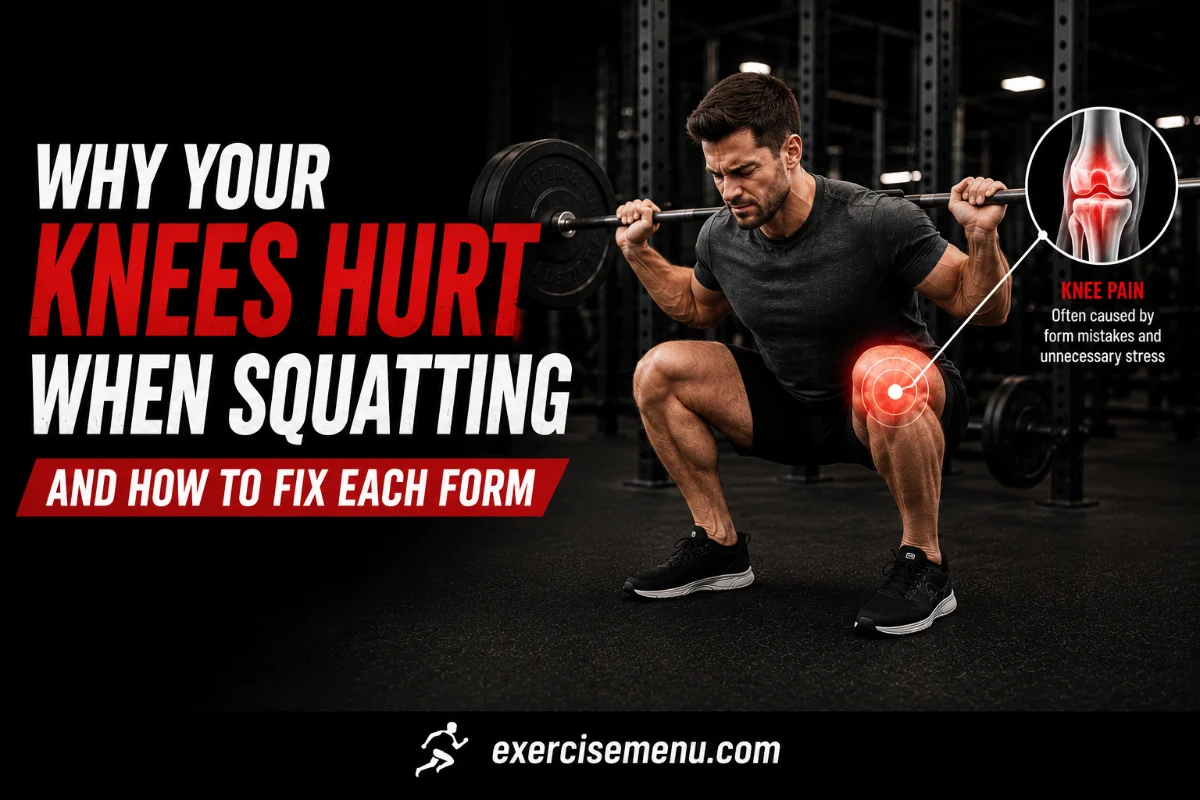
Quick Answer: Most squat-related knee discomfort comes from form errors, not the squat itself. Weight shifting onto the toes, knees collapsing inward, uncontrolled depth, forcing vertical shins, and jumping up in load too quickly all place stress on different areas around the knee. Fixing the specific error usually fixes the discomfort.
Knee discomfort during squats is one of the most common reasons people stop squatting altogether. That’s a mistake. Squats are not inherently hard on your knees. Poor squat mechanics are. When your form breaks down, the load that should be spread across your hips, ankles, and knees concentrates on structures around the kneecap and the tendons above and below it.
Most advice on this topic treats all squat-related knee discomfort the same way. It isn’t. Each form error loads a different part of the knee, and each one has a different fix. The five errors below are the ones I correct most often with clients, and each section gives you the specific fix so you can apply it in your next session.
- How Each Form Error Loads a Different Part of Your Knee?
- Why Letting Your Weight Shift Forward Overloads the Front of Your Knee?
- How Limited Ankle Mobility Forces Your Knees to Compensate?
- What Happens When Your Knees Collapse Inward During a Squat?
- Should Your Knees Go Past Your Toes When Squatting?
- Why Squatting Deeper Than You Can Control Increases Knee Stress?
- How Adding Too Much Load Too Fast Irritates the Tendons Around Your Knee?
- A Pre-Squat Warm-Up That Targets All Three Culprits
- When to Stop Squatting and See a Professional?
- Frequently Asked Questions
- Your Next Step
How Each Form Error Loads a Different Part of Your Knee?
Before walking through each error in detail, here’s a quick-reference table. Find the error that matches what you see in your squat, then read the corresponding section for the full fix.
| Form Error | Where Stress Shifts | Fix |
|---|---|---|
| Weight shifting forward onto toes | Front of the kneecap | Whole-foot pressure, hip flexor cue |
| Knees collapsing inward | Inner side of the knee | Knee tracking cue, glute activation |
| Forcing vertical shins | Hips and lower back (overcompensation) | Allow natural knee travel |
| Squatting deeper than you can control | Front of the knee, below the kneecap | Match depth to current mobility |
| Adding load too fast | Above or below the kneecap (tendon areas) | Reduce 20-30%, rebuild over 2-3 weeks |
Each of these errors creates a distinct pattern of stress. Correcting the right one often resolves the discomfort within a few sessions.
Why Letting Your Weight Shift Forward Overloads the Front of Your Knee?
When your weight creeps onto your toes during a squat, the barbell path drifts forward of your midfoot. This pushes extra compressive force onto the front of the kneecap. Straub and Powers confirmed in a 2024 biomechanical review published in the International Journal of Sports Physical Therapy that forward tibia inclination increases the knee flexion moment and therefore the demand on the quadriceps and the patellofemoral joint.
You’ll notice this error if your heels lift off the ground at the bottom of the squat, or if you feel like you’re about to tip forward with heavier loads.
The fix: Press through your entire foot on every rep. Think “whole foot pressure,” not just heels. The barbell should travel in a straight vertical line over your midfoot from start to finish. One cue that helps: think about actively pulling yourself into the bottom of the squat using your hip flexors, rather than letting gravity and the bar push you down. This keeps your centre of mass over the midfoot and prevents the forward drift that loads the knee.
If you consistently tip forward despite good cueing, the root cause is often limited ankle mobility, covered in the next section.
How Limited Ankle Mobility Forces Your Knees to Compensate?
If your ankles can’t bend far enough for your knee to travel forward naturally, the rest of the chain pays for it. The body shifts weight onto the toes, rounds the lower back at the bottom, or both. Either compensation changes how force moves through the knee.
Macrum et al. demonstrated in a 2012 study published in the Journal of Athletic Training that restricting ankle dorsiflexion during a squat increased knee valgus (inward collapse) and decreased quadriceps activation. In other words, tight ankles don’t just affect the ankle; they change how the knee moves and how the muscles around it work.
Test your ankle mobility (weight-bearing lunge test): Kneel on one knee facing a wall. Place the front foot about 10 cm (4 inches) from the wall. Drive the front knee forward, trying to touch the wall without lifting your heel. If your heel lifts before your knee reaches the wall, ankle dorsiflexion is limited.
Two drills that help:
- Wall ankle stretch: Face a wall with one foot about 15 cm back. Drive the knee forward over the second toe, keeping the heel down. Hold 20 to 30 seconds per side, 2 to 3 sets before squatting.
- Banded ankle distraction: Loop a resistance band around the front of the ankle, anchor it behind you so it pulls the joint backward. Step forward into a lunge position and drive the knee forward over the toe. The band pulls the talus posteriorly, creating more space in the joint. Hold 30 seconds per side.
If ankle mobility is a long-term limitation for you, heel-elevated squats (using squat wedges or weightlifting shoes) reduce the dorsiflexion demand while you work on improving range of motion.
What Happens When Your Knees Collapse Inward During a Squat?
Knee valgus, where the knees cave inward as you descend or drive out of the bottom, shifts rotational stress onto the inner side of the knee. A small amount of inward movement under maximal loads isn’t unusual, but repeated, uncontrolled collapse rep after rep increases wear on the cartilage and connective tissue around the kneecap.
The root cause is rarely the knee itself. Weak lateral glutes, specifically the gluteus medius, fail to control the femur, letting it adduct and internally rotate. The knee follows.
The fix: The cue “push your knees out” is common but often overcorrected. A better cue is “track your knees in line with your second and third toe.” This keeps the knee aligned without forcing an exaggerated outward push that creates its own problems.
Two exercises that strengthen the pattern:
- Banded lateral walks: Place a mini-band just above the knees. Take 15 to 20 steps per direction, keeping tension on the band throughout. This targets the gluteus medius directly.
- RNT (reactive neuromuscular training) split squat: Loop a light resistance band around the front knee of a split squat, anchored so it pulls the knee inward. Your lateral glutes will fire harder to resist the pull and keep the knee tracking correctly. Two to three sets of 10 to 12 reps per side, added to your warm-up before squatting.
If the difference between your front squat and back squat knee position is noticeable, the front squat often self-corrects valgus because the upright torso position allows more natural knee travel.
Should Your Knees Go Past Your Toes When Squatting?
Yes, in most cases. The old rule of “never let your knees pass your toes” is one of the most persistent myths in fitness, and it causes more problems than it solves.
Fry, Smith, and Schilling tested this directly in a 2003 study published in the Journal of Strength and Conditioning Research. They found that restricting forward knee travel reduced knee torque by about 22%, but increased hip torque by roughly 1,000%. The load didn’t disappear. It transferred to the hips and lower back, areas less equipped to handle it under heavy squatting conditions.
For most people, some forward knee travel is necessary for a good squat. How much depends on your limb proportions, squat style, and bar position. A high bar squat allows more forward knee travel than a low bar squat because the more upright torso shifts the balance point.
The one exception: If you currently have discomfort at the front of the knee that worsens as the knee travels further forward, temporarily reducing forward knee travel can help as a short-term modification. Use a box squat or a slightly more hip-dominant squat style until the discomfort settles. This is a temporary tool, not a permanent rule.
Why Squatting Deeper Than You Can Control Increases Knee Stress?
Depth itself is not the problem. A 2024 scoping review by Rojas-Jaramillo et al. published in Frontiers in Sports and Active Living concluded that deep squats appear safe for knee joint health when proper technique is maintained. The issue is squatting deeper than your current mobility and strength allow you to control.
When depth exceeds what the hips and ankles can handle, two things happen: the lower back rounds (posterior pelvic tilt) and foot pressure shifts. Both alter how load distributes through the knee. Straub and Powers noted in their 2024 review that patellofemoral joint stress increases steadily from 0 to 90 degrees of knee flexion, meaning the deeper you go, the more important it is that your technique stays consistent.
The fix: Squat to the deepest point where your heels stay flat, your knees track well, and your lower back doesn’t round. For some people, that’s below parallel. For others, it’s parallel or slightly above. Depth improves over time as ankle and hip mobility improve.
Two modifications when depth is currently limited:
- Box squat: Set a box at your controlled depth. Touch the box lightly on each rep without sitting down fully, then drive back up. This builds confidence in your depth and keeps each rep consistent.
- Heel-elevated squat: Place your heels on a 2 to 3 cm wedge or wear squat shoes. This reduces ankle dorsiflexion demand and often allows deeper, more controlled squats immediately.
How Adding Too Much Load Too Fast Irritates the Tendons Around Your Knee?
Discomfort above or below the kneecap that develops after increasing weight or training volume often comes from the patellar or quadriceps tendon being loaded faster than it can adapt. This is a load management issue, not a form error in the traditional sense, but it shows up in the same way: knee discomfort during squats.
This is common after a training break (vacation, illness, deload that went too long) when you jump back to your previous numbers instead of building back up gradually.
The fix: Reduce your squat working weight by 20 to 30% and rebuild over two to three weeks. End every set two to three reps before form starts to degrade. If your first rep looks different from your fifth, the set went too long. Fatigue that changes your squat pattern, where knees start caving, heels lift, or your torso pitches forward on later reps, shifts stress onto the tendons in ways they weren’t loaded at the start of the set. If you were squatting 100 kg before the discomfort started, drop to 70 to 80 kg and add 5 to 10% per week. Your 1RM can guide your percentages, but the priority is pain-free reps with consistent technique.
Tendons adapt more slowly than muscles. Patience here prevents weeks of forced rest later.
A Pre-Squat Warm-Up That Targets All Three Culprits
Most squat warm-ups are either skipped entirely or consist of five minutes on a bike followed by loading the bar. Neither addresses the three most common causes of squat-related knee discomfort: limited ankle mobility, inactive glutes, and poor movement patterning under load.
This four-exercise sequence takes about five minutes and targets all three.
1. Wall ankle dorsiflexion stretch (ankle mobility) Same drill from the ankle section above. 20 to 30 seconds per side, 2 sets.
2. Banded lateral walks (glute activation) 15 steps per direction, 1 to 2 sets. Mini-band above the knees, maintain tension throughout.
3. Bodyweight goblet squat hold (movement patterning and depth control) Hold the bottom position of a goblet squat for 15 to 20 seconds, pressing the elbows inside the knees. Focus on whole-foot pressure and knee tracking. 2 sets.
4. Light barbell set at 40 to 50% of working weight (tissue preparation) 8 to 10 controlled reps with the same squat style you’ll use for your working sets. Focus on bar path and foot pressure. This primes the tendons and joints for heavier loads.
When to Stop Squatting and See a Professional?
Form corrections resolve most squat-related knee discomfort. But some symptoms fall outside the scope of technique adjustments.
Stop the session and consult a physiotherapist or sports medicine professional if you notice any of the following:
- Significant swelling that develops during or immediately after squatting
- The knee locks, catches, or gives way under load
- Sharp pain that increases with every rep instead of settling
- Inability to bear weight on the leg after squatting
- Discomfort that persists for more than 48 hours after training
If you’ve corrected the relevant form errors from this article and the discomfort hasn’t improved within two to three sessions, that’s also worth having assessed. Not every issue is a form issue, and earlier assessment leads to faster resolution.
Frequently Asked Questions
Should I stop squatting completely if my knees hurt?
No. Stopping removes the very stimulus your legs and joints need to stay strong. Reduce the load, fix the form error that’s causing the problem, and use a modification like box squats or heel-elevated squats until the discomfort resolves. Full rest is only necessary if a professional recommends it after assessment.
Do knee sleeves help with squat-related knee discomfort?
Knee sleeves provide warmth and mild compression, which can make the knee feel more stable and reduce stiffness during warm-up sets. They don’t fix form errors or address underlying causes. If your knees only feel good when wrapped, the sleeves are masking a problem that still needs correction.
Are goblet squats easier on the knees than barbell squats?
The squat pattern is the same, but the lighter load and front-loaded position make it easier to maintain an upright torso and consistent knee tracking. Goblet squats are a useful regression when barbell squats are currently uncomfortable, and they’re an excellent teaching tool for building better movement patterns.
Can weak glutes cause knee pain during squats?
Yes. When the gluteus medius (the lateral glute muscle) is weak, it can’t control the femur effectively. The thigh rotates inward, the knee collapses, and stress concentrates on the inner side of the knee. Strengthening the glutes with targeted exercises like banded lateral walks and single-leg work often reduces knee discomfort during squats.
How long does it take for squat-related knee discomfort to improve after fixing form?
Most form-related discomfort improves within two to four sessions once the specific error is corrected and load is managed appropriately. Tendon-related discomfort from overloading can take two to three weeks of reduced load to fully settle. If there’s no improvement after three weeks of consistent correction, seek professional assessment.
Your Next Step
Each form error on this page has a specific fix. Pick the one that matches what you see in your squat, apply the correction for two to three sessions, and reassess. Most squat-related knee discomfort resolves faster than people expect once the right error is identified. Use the Exercise Menu training guides to build your squat programming around form that lasts.
Fitness Disclaimer: This article covers form education only. It does not replace medical advice. If you have an existing knee injury, persistent swelling, or pain that does not improve with form correction, consult a physiotherapist or doctor before continuing to squat.
