


- Key takeaways
- What does training to failure mean?
- Is training to failure necessary for muscle growth?
- Training to failure vs reps in reserve: which is better?
- Which exercises are safe for training to failure?
- Should beginners train to failure?
- How to program training to failure into your workouts
- The real risks of training to failure
- What happens after failure? Past-failure training techniques
- Training to failure FAQs
- The bottom line
Key takeaways
- Training to failure means performing reps until you physically can’t complete another one. There are three types: technical failure, muscular failure, and tempo failure.
- Research across 55 studies shows training closer to failure increases muscle growth — but has no extra benefit for strength gains.
- Stopping 1-3 reps short of failure (called “reps in reserve” or RIR) delivers comparable hypertrophy with far less fatigue and injury risk.
- Failure works best on isolation and machine exercises. Avoid it on heavy compound lifts like squats, deadlifts, and overhead presses.
- Beginners should train at 3-5 RIR for the first three months and introduce failure gradually on safe exercises only.
Research says one thing about training to failure for muscle size. It says something different about strength. And most people in the gym are applying it wrong — either pushing every set to failure or avoiding it completely.
Both are mistakes.
I’ve coached 257 clients over 7+ years, and the pattern I notice most is this: intermediate lifters chase failure on every set, burn out within weeks, and wonder why they’ve stopped growing. Meanwhile, beginners who never push hard enough leave muscle growth on the table because they stop every set five reps early.
This guide covers what the research actually says about training to failure, which exercises are safe for it, how to program it into your week, and when to skip it entirely. I’ve also included the latest 2025 research on past-failure techniques that no other guide covers yet.
At Exercise Menu, every recommendation is backed by peer-reviewed research and tested across real coaching practice — not copied from a textbook.
What does training to failure mean?
Training to failure means performing reps of an exercise until you can’t complete another one. There are three distinct types, and knowing the difference changes how you apply failure in your program.
Technical failure vs muscular failure vs tempo failure
Technical failure happens when your form breaks down, even though your muscles could keep going. Think of a set of pullups where you start swinging and kipping to get your chin over the bar. Your lats didn’t fail — your technique did. For most lifters, this is where you should stop.
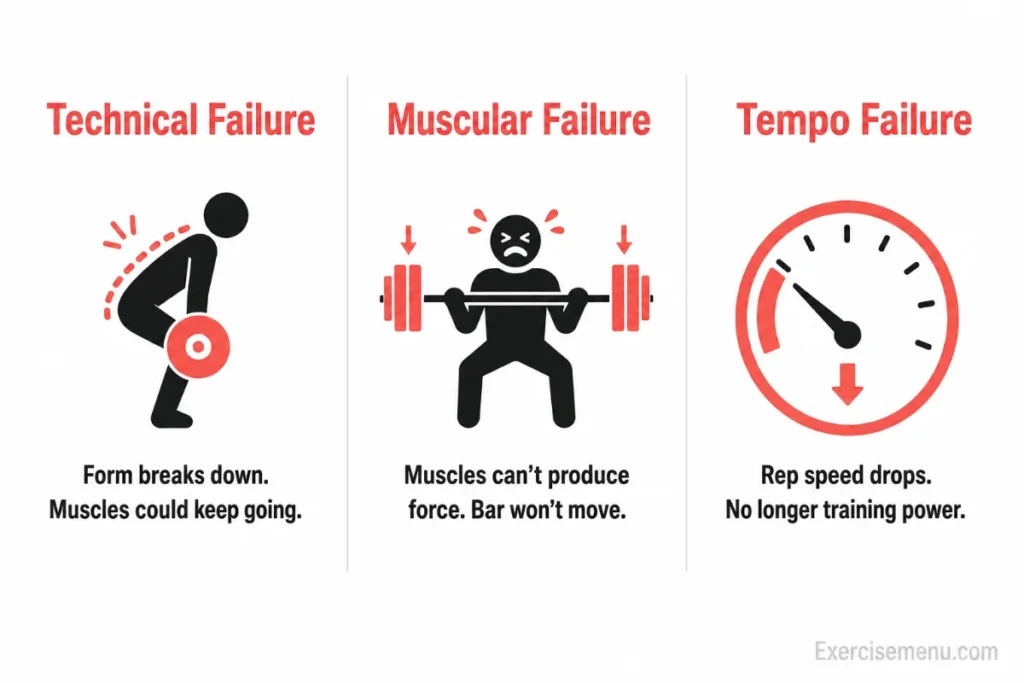
Muscular failure — also called absolute failure — happens when your muscles physically can’t produce enough force to move the weight. On a bench press, this is where the bar stalls mid-rep and won’t go up no matter how hard you push. The National Academy of Sports Medicine (NASM) distinguishes this from technical failure because form is no longer the limiting factor — force production is.
Tempo failure applies to power and explosive training. If you’re doing a clean or explosive press and your rep speed drops below about 1.2 seconds per rep, you’re no longer training for power. You’ve hit tempo failure — even if your muscles could grind out more slow reps.
Most people in the gym hit technical failure and think they’ve hit muscular failure. They haven’t. That distinction matters because the research on failure outcomes depends on which type of failure the study actually measured. And if your goal is muscular endurance rather than size, the failure question changes entirely — endurance training uses higher reps with moderate intensity, where failure isn’t the main driver of adaptation.
Is training to failure necessary for muscle growth?
No. Training to failure is not required to build muscle. But training close to it probably is.
A 2021 systematic review by Grgic et al. in the Journal of Sport and Health Science found no significant hypertrophy advantage when comparing training to failure versus stopping short — as long as total training volume was matched between groups.
But a 2024 meta-regression by Robinson et al. in Sports Medicine told a more nuanced story. Across 55 studies, they found that muscle growth increases the closer you get to failure. The relationship was dose-dependent — closer to failure meant more hypertrophy.
The catch? Strength gains showed no such relationship. You can build strength at any level of proximity to failure.
A 2024 study by Refalo et al. in the Journal of Sports Sciences confirmed this practically: resistance-trained individuals who stopped at 1-2 reps in reserve grew their quadriceps just as much as those who trained to full failure over eight weeks.
And in 2025, Hermann et al. published in Medicine & Science in Sports & Exercise that both failure and 2-RIR groups gained muscle. Hypertrophy slightly favored the failure group, but the absolute differences were small.
Hypertrophy vs strength — the research says different things
The practical split looks like this:
- For muscle growth: Get close to failure. Within 1-3 reps is enough. Going all the way to 0 RIR adds a small benefit but comes with much higher fatigue.
- For strength: Proximity to failure doesn’t matter much. You can build strength at 3-5 RIR — or even further from failure — as long as you’re using adequate load and progressing over time.
Why failure recruits more muscle fibers?
This comes down to Henneman’s Size Principle. Your body recruits motor units in order — smaller, fatigue-resistant Type I fibers fire first. The larger Type II fibers — the ones with the highest growth potential — only fully activate as the set gets harder and you approach failure.
That’s why proximity to failure matters for hypertrophy. Those last few reps before failure are where the highest-threshold motor units kick in. But you don’t need to reach absolute failure to recruit them. Getting within 1-3 reps achieves most of that recruitment.
There’s also a mental benefit. Pushing through those final grinding reps builds a tolerance for discomfort that carries into every other part of your training. I’ve seen clients who practice controlled failure on safe exercises develop noticeably better focus and effort regulation across their entire program.
Training to failure vs reps in reserve: which is better?
For most people, most of the time, stopping 1-3 reps in reserve beats training to failure. You get nearly identical muscle growth with significantly less fatigue, less injury risk, and better performance in subsequent sets and sessions.
This table shows the trade-offs at each level of intensity:
| Factor | 0 RIR (failure) | 1-3 RIR (near failure) | 3-5 RIR (moderate) |
|---|---|---|---|
| Hypertrophy | Highest stimulus per set | Nearly identical to failure | Reduced — may need more sets to compensate |
| Strength | No added benefit | Equally effective | Equally effective |
| Next-day performance | -7.2% predicted bench drop | +0.57% predicted bench improvement | Minimal impact |
| Injury risk | Higher — form breaks down | Low | Very low |
| Recovery demand | 48-72+ hours per muscle group | 24-48 hours | Standard recovery |
| Best for | Advanced lifters, isolation exercises, plateau-breaking | Most lifters, most of the time | Beginners, deload phases, compound lifts |
The next-day performance data comes from Data-Driven Strength research cited by strength coaches: finishing a set 2 reps before failure predicts a slight bench press improvement the next day (+0.57%). Training to failure predicts a -7.2% drop. Over a full training week, that compounds. Your Wednesday session suffers because Monday’s failure sets depleted you.
The most common mistake I see with intermediate lifters is chasing volume before fixing execution. They’re doing 25 sets per muscle per week but stopping every set 5 reps before failure. When we drop to 12 quality sets and push close to failure, they grow faster than they did at double the volume.
Why you can’t accurately judge your own RIR — and how to fix it
Most lifters think they’re at 2 RIR when they’re actually at 5. A meta-analysis published in Sports Medicine found that athletes consistently underpredict the number of reps they can do before failure — regardless of experience level.
Three ways to calibrate:
- Test true failure periodically. Pick a safe isolation exercise — like leg extensions or bicep curls — and push one set to actual muscular failure every few weeks. This teaches you what 0 RIR feels like so you can work backward.
- Start with bench press. Hermann et al. (2025) found that RIR estimation accuracy improves with practice, and it’s more accurate on bench press than squat. Use bench as your calibration exercise.
- Watch your rep speed. When the bar noticeably slows down — that grinding rep — you’re within 1-2 reps of failure. You don’t need a velocity tracker to notice this.
Which exercises are safe for training to failure?
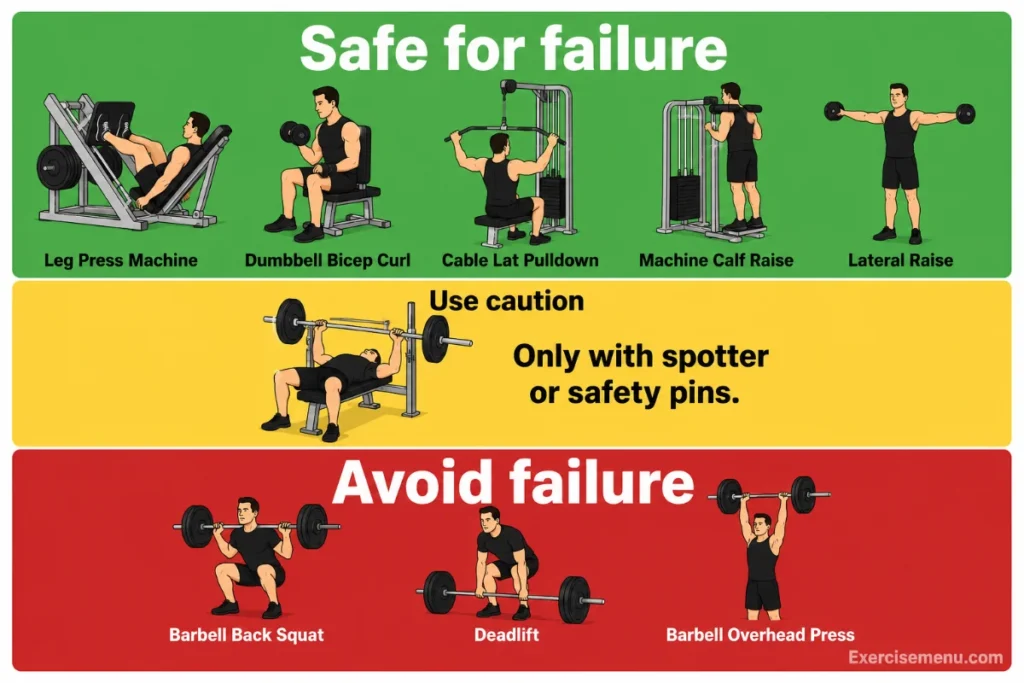
You’ve probably read “avoid failure on heavy compounds” a dozen times. But no one tells you which exercises are actually safe and which ones aren’t. This table does:
| Exercise | Safe for failure? | Why |
|---|---|---|
| Back squat | ❌ No | Axial spinal loading. Technique degrades under fatigue. Risk of getting pinned. |
| Deadlift | ❌ No | Spinal fatigue. Lower back rounds under exhaustion. High CNS demand. |
| Barbell overhead press | ❌ No | Shoulder impingement risk. Balance compromised under fatigue. |
| Bench press | ⚠️ Conditional | Only with a spotter or safety pins. The bar can pin you. |
| Leg press | ✅ Yes | Fixed path. Easy to stop. No balance demand. |
| Leg extension / leg curl | ✅ Yes | Single-joint isolation. Minimal injury risk. |
| Bicep curls (dumbbell/cable) | ✅ Yes | Low load. Easy to drop. Isolation movement. |
| Lateral raises | ✅ Yes | Light weight. Low risk. Great for post-failure partials. |
| Cable rows / lat pulldowns | ✅ Yes | Controlled path. Weight stack returns safely. |
| Machine calf raises | ✅ Yes | Isolation. Strong research support from Larsen et al. (2025). |
Why compound lifts and failure don’t mix
Three reasons compound lifts are poor candidates for failure:
First, central fatigue. Compound movements recruit multiple muscle groups and demand more from your central nervous system. Training them to failure generates systemic fatigue that carries over to every exercise that follows — and sometimes into the next day.
Second, axial loading. Squats and deadlifts load your spine. Under fatigue, your ability to brace your core and maintain spinal position declines. That’s when disc injuries happen.
Third, multi-joint technique degradation. A squat involves your ankles, knees, hips, and spine working together. When one link in that chain fatigues, the whole movement pattern shifts. On a bicep curl, there’s one joint — the elbow. Form breakdown on a curl is harmless. Form breakdown on a squat is not.
Where failure works best — isolation and machine exercises
Fixed-path machines and single-joint exercises are built for failure training. You can stop at any point. The weight returns to a resting position. And form degradation is minimal because the movement path is constrained.
The strongest failure research supports this. Larsen et al. (2025) studied calf raises. Schoenfeld et al. (2015) used low-load isolation protocols. Both found clear hypertrophy benefits from training to or near failure — on isolation exercises.
Research also shows that proximity to failure matters more when using lighter loads (30-50% of your 1RM) than heavier ones, because lighter loads need those final reps to recruit the high-threshold fibers that heavy loads activate from the start.
Should beginners train to failure?
Most beginners should not train to failure. New lifters build muscle effectively at 3-5 reps in reserve while learning proper movement patterns. Introducing failure too early leads to poor technique habits, unnecessary soreness, and the kind of week-one burnout that kills consistency.
The most common beginner mistake I see isn’t doing too little — it’s doing too much too soon. Week one enthusiasm leads to week three burnout. I always tell new clients: start at the lower end of every range, build the habit first, then add volume as your body adapts.
A beginner’s failure progression roadmap
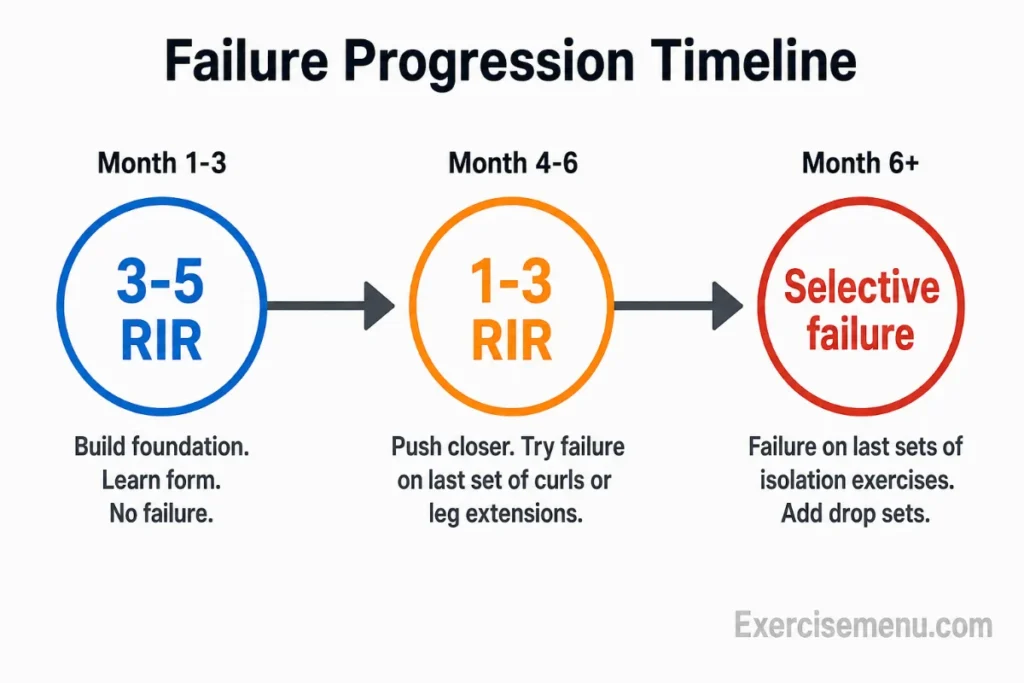
Phase 1 — Month 1-3: Build the foundation (3-5 RIR)
Focus entirely on learning movement patterns. No failure on any exercise. Your job is to learn what a proper rep and set structure looks like — good depth, controlled tempo, full range of motion. End every set feeling like you could do 3-5 more reps.
Phase 2 — Month 4-6: Push closer (1-3 RIR)
Move to 1-3 RIR on most working sets. On your last set of 1-2 isolation exercises per workout — like bicep curls or leg extensions — try pushing to technical failure. Stop the moment your form breaks. Log how many reps you got.
Phase 3 — Month 6+: Selective failure
At this point, most research would classify you as a “trained” individual — someone with 6+ months of consistent resistance training. Use failure strategically on last sets of machine and isolation exercises. Begin experimenting with drop sets on accessories. Never train compound lifts to failure without a spotter or safety equipment.
Five beginner-safe exercises to practice failure
- Dumbbell bicep curls — light load, easy to drop when you’re done.
- Machine leg extensions — fixed path, no balance required, stop anytime.
- Cable tricep pushdowns — weight stack returns safely, single-joint movement.
- Machine chest press — guided movement, no bar pinning risk.
- Machine calf raises — isolation movement with strong research support.
How to program training to failure into your workouts
Failure isn’t a default setting. It’s a tool you place deliberately within your program.
When in your workout — last sets, last exercises
Failure goes at the end of a training block, not the beginning. If you train your first exercise to failure, every set that follows suffers. The data shows a -7.2% performance drop after failure — that’s your remaining workout tanking.
The rule: push to failure on the last set of your last 1-3 exercises in the session. This means your body is warmed up, your heavy work is done, and you can safely push the limit on isolation or machine movements without compromising the rest of your training.
How often per week — by split type
Your training split determines how frequently you can use failure:
Full body (3x/week): Use failure 1-2 times per week maximum. Each muscle group needs 48+ hours before you train it again, and failure extends that recovery window.
Upper/lower split (4x/week): Failure 2-3 times per week works. Each muscle gets 3-4 days of recovery between sessions.
Body part split (5-6x/week): Failure 3-5 times per week is possible because each muscle group only gets trained once. You have a full week to recover before hitting it again.
Cycling failure in 4-8 week blocks
Don’t use failure year-round. Run 4-8 week intensification blocks where you push last sets to failure on isolation exercises. Then pull back to a non-failure phase — training at 2-3 RIR — for the next 4 weeks.
I had a client who was training 6 days a week and making zero progress. Her CNS was fried. We dropped to 4 days, kept the intensity high, added a deload every fourth week — and she hit PRs she hadn’t seen in over a year. Sometimes less really is more, but only when the intensity on the remaining sessions is high.
The real risks of training to failure
Failure isn’t dangerous by default. But applying it carelessly — on the wrong exercises, too often, without recovery — creates real problems.
Injury, overtraining, and diminishing returns
Injury comes from technique breakdown. When you push a squat or deadlift to muscular failure, your spinal position changes, your knees track differently, and your joints absorb forces they aren’t designed to handle repeatedly. A scientific review published in the Journal of Strength and Conditioning Research confirmed that training to failure increases both injury risk and overtraining risk when done repeatedly over long periods.
Overtraining happens when you train to failure too frequently without adequate recovery. Research shows it can suppress testosterone and IGF-1 — both critical for muscle building — while elevating cortisol. Chronically high cortisol is linked to increased abdominal fat storage, poor sleep, and weakened immune function.
Diminishing volume returns cap the value of failure. A 2016 dose-response meta-analysis by Schoenfeld et al. found that training above 20 sets per muscle group per week yields almost no additional growth. Training to failure on too many sets pushes you past that threshold in terms of fatigue cost — without added muscle.
The next-day performance cost most people ignore
This is the number that changed how I program failure for clients:
Finishing a set 2 reps short of failure predicts a +0.57% improvement in bench press the following day. Training to failure on the same exercise predicts a -7.2% drop.
That’s not a small difference. If you train chest on Monday and shoulders on Wednesday, Monday’s failure sets will still be dragging down your pressing performance on Wednesday. Over a training block, those compounding losses add up. This is the strongest practical argument for RIR over failure as your default approach.
What happens after failure? Past-failure training techniques
Most guides stop at “should you or shouldn’t you.” But recent research has moved past that question entirely.
Past-failure techniques extend a set beyond the point of muscular failure using modified reps. When applied correctly on the right exercises, they can meaningfully increase hypertrophy.
Lengthened partial reps — 43% more muscle growth
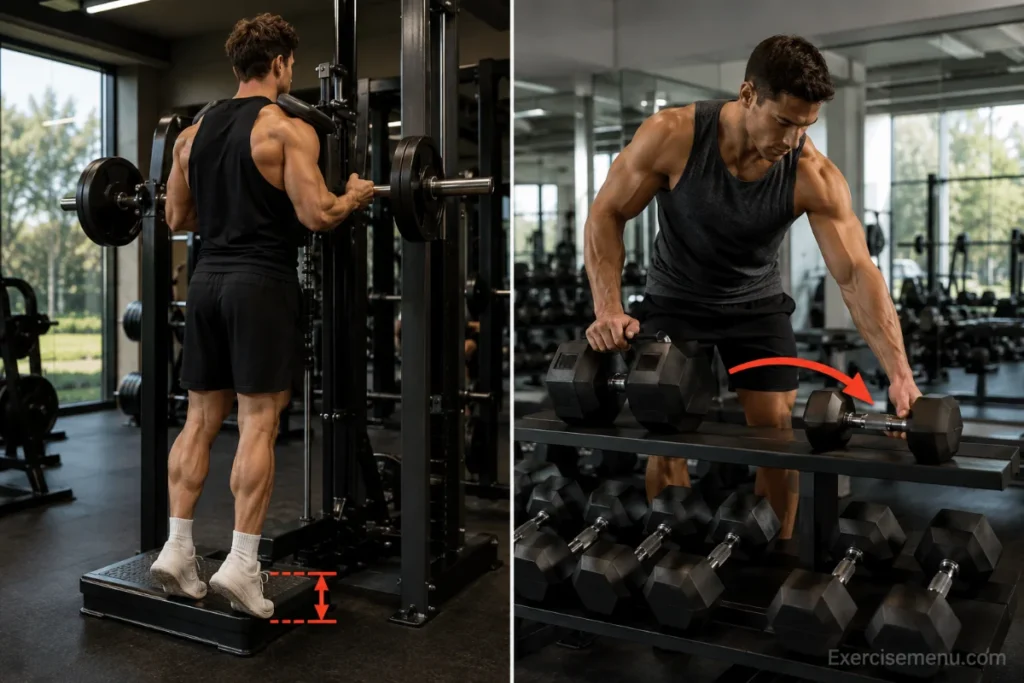
Larsen et al. (2025) published the first direct study on past-failure partial reps in Frontiers in Psychology. Participants performed Smith machine calf raises for 10 weeks. One leg trained to muscular failure. The other leg trained to failure and then continued with partial reps in the stretched (lengthened) position.
The results: the leg with post-failure partials grew 9.6% versus 6.7% for failure only. That’s roughly 43% more growth from a few extra seconds of work in the stretched position.
This works best on exercises that are hardest at the top of the movement — like calf raises, lateral raises, and cable rows — because you can continue performing partial reps in the stretched range after full-range reps fail.
Drop sets — same growth, less time
A drop set means hitting failure, immediately reducing the weight by 20-30%, and continuing for more reps without rest. Enes et al. (2021) found that drop sets produce similar hypertrophy and strength adaptations compared to traditional straight sets.
The time-efficiency angle is the real win. Analysis from RP Strength shows drop sets can deliver equivalent muscle growth in 30-70% less training time. If you’re short on gym time, drop sets on your last exercise let you get the same stimulus in fewer total sets.
Best for: machine and dumbbell isolation exercises where you can change weight fast. Not practical for barbell compounds.
Rest-pause training and forced reps
Rest-pause means hitting failure, resting 10-20 seconds, then grinding out 2-3 more reps. It extends time under tension without requiring a spotter. Works well on most isolation movements.
Forced reps require a training partner who assists you through the sticking point after you’ve hit failure. Practical for bench press and shoulder press but limited by needing a reliable spotter.
Both have less research support than lengthened partials and drop sets, but they’re useful tools for intermediate and advanced lifters who want variety in their high-intensity sets.
| Technique | How it works | Best exercises | Research support | Risk level | Spotter needed? |
|---|---|---|---|---|---|
| Lengthened partials | Partial reps in the stretched position after failure | Calf raises, lateral raises, rows | Strong — Larsen et al. (2025) | Low | No |
| Drop sets | Reduce weight immediately, continue reps | Machine and dumbbell isolation | Strong — Enes et al. (2021) | Low | No |
| Rest-pause | Rest 10-20s at failure, then continue | Any isolation exercise | Moderate | Medium | No |
| Forced reps | Spotter assists past sticking point | Bench press, shoulder press | Limited | Higher | Yes |
Training to failure FAQs
How long should you rest between sets when training to failure?
Rest 2-3 minutes between sets if you’re training to failure on compound-adjacent exercises like bench press. For isolation exercises taken to failure — like curls or leg extensions — 60-90 seconds is enough. Failure sets deplete more energy than sub-maximal sets, so you need slightly longer rest to maintain performance on your next set.
Does training to failure affect your cardio performance?
Yes. Repeated failure training increases systemic fatigue and central nervous system load, both of which reduce your cardiovascular output in the days that follow. If you run, cycle, or play a sport alongside lifting, limit failure sets to 1-2 per session and schedule them on days that aren’t followed by intense cardio work.
Can you train to failure with bodyweight exercises?
You can, and bodyweight movements are actually among the safest options for failure training. Pushups, bodyweight squats, lunges, and inverted rows carry low injury risk because there’s no external load pinning you down. If you train at home without equipment, taking your last set of pushups or split squats to failure is a practical way to push intensity.
Should you train to failure during a calorie deficit?
Be careful. During a calorie deficit your recovery capacity drops because your body has fewer resources for repair. Training to failure while cutting increases the chance of muscle loss and overtraining. Stick to 2-3 RIR during a cut and focus on maintaining your current strength levels rather than chasing failure.
How do you know if failure training is causing overtraining?
Watch for persistent fatigue that doesn’t improve with rest days, strength regression across multiple sessions, disrupted sleep, increased irritability, and frequent illness. If your performance is declining over 2-3 weeks despite adequate rest, you’re likely exceeding your recovery capacity. Pull back to 3-5 RIR for 2-4 weeks and reassess.
Is training to failure the same as training to exhaustion?
No. Training to failure refers to one set — you perform reps until you can’t complete another. Training to exhaustion describes a broader state where your entire body feels drained, often from excessive total volume or too many failure sets stacked together. One failure set is a controlled tool. Full exhaustion is a sign you’ve gone too far.
The bottom line
Training to failure is a tool, not a requirement. Every major study from the past three years points the same direction: 1-3 RIR produces nearly identical muscle growth with much less fatigue, less injury risk, and better session-to-session performance. Use failure selectively — on the last set of isolation and machine exercises, in planned training blocks, and only after you’ve built a solid technique foundation.
