

Quick Answer: A 2026 study on untrained lifters found progressive overload roughly doubles muscle growth versus training with the same weight and reps every session. Beginners should add a little weight almost every workout for the first 6 to 12 months, starting light enough to master the movement, and reset when progress stalls two sessions in a row.
You don’t strictly need progressive overload to see results in your first few months of training. A 2026 study published in Medicine & Science in Sports & Exercise put untrained women through eight weeks of resistance training, comparing a group that progressively added load to a group that trained with the same weight and reps the entire time. Both groups gained muscle, but the group that progressively overloaded came out noticeably ahead.
This is a more honest starting point than the usual claim that progressive overload is non-negotiable from day one. It isn’t. It’s just the difference between decent results and considerably better ones, and for a beginner, capturing that difference is almost entirely a matter of knowing what to do, not how hard to work.
For the full breakdown of how progressive overload works and the methods experienced lifters use, see our complete guide to progressive overload. This article covers the part that guide doesn’t: exactly how a true beginner should start, week by week.
- How to Start: Your First Session
- Can You Really Add Weight Every Session?
- The Beginner Progressive Overload Plan (Week by Week)
- Progressive Overload for Bodyweight-Only Beginners
- Does It Matter How You Progress? (Weight vs. Reps)
- What to Do When You Stall (The Reset Protocol)
- When to Move Off Linear Progression
- Common Beginner Mistakes
- Frequently Asked Questions
How to Start: Your First Session

Your first session isn’t about finding your limits. It’s about picking a weight you can control through a full range of motion, for every rep, with room to spare. If you’ve never lifted before, start lighter than you think you need to. For a barbell squat or press, that might mean the empty bar. For dumbbells, pick a weight you could comfortably do 15 reps with, then do sets of 8 to 10.
The goal of session one and two is learning the movement pattern, not testing how much you can move. Adding weight too early, before your form holds up under fatigue, is one of the fastest ways to stall out or get hurt before you’ve made any real progress.
You’ll know a weight was too light if the last few reps of your final set still feel easy. You’ll know it was too heavy if your form breaks down, your range of motion shortens, or you’re grinding reps that don’t look like the ones before them. Somewhere in between is where you want to be for your first real working sets.
Can You Really Add Weight Every Session?
Yes, and this is the part that surprises most new lifters. For roughly your first 6 to 12 months, your strength gains come mostly from your nervous system getting better at using the muscle you already have, not from building new muscle. That process, called neural adaptation, happens fast, which is why a true beginner can often add a small amount of weight almost every time they train a lift.
This is the same mechanism behind the doubled hypertrophy in the 2026 study mentioned above. Your body is unusually responsive to a new stimulus right now. The plan below is built around taking advantage of that while it lasts.
The Beginner Progressive Overload Plan (Week by Week)
The simplest and most effective approach for a true beginner is linear progression: add a small, fixed amount of weight to a lift each time you complete all your prescribed sets and reps with good form. Different lifts can handle different jumps. Bigger, more technical lifts like the squat and deadlift tolerate larger jumps early on; upper-body pressing movements like the bench press or overhead press need smaller ones.
| Lift | Typical Starting Jump | After a Few Sessions |
|---|---|---|
| Squat | 5–10 lb per session | 5 lb per session |
| Deadlift | 10–15 lb per session | 5–10 lb per session |
| Bench Press / Overhead Press | 5 lb per session | 2.5–5 lb per session |
| Row | 5 lb per session | 2.5–5 lb per session |
A basic week looks like this, using a squat as the example:
- Week 1: 3 sets of 5 reps at your starting weight
- Week 2: Add 5 lb if all sets of 5 were completed with good form
- Week 3: Add 5 lb again if the previous session’s sets were clean
- Week 4 onward: Continue adding weight each session until progress slows
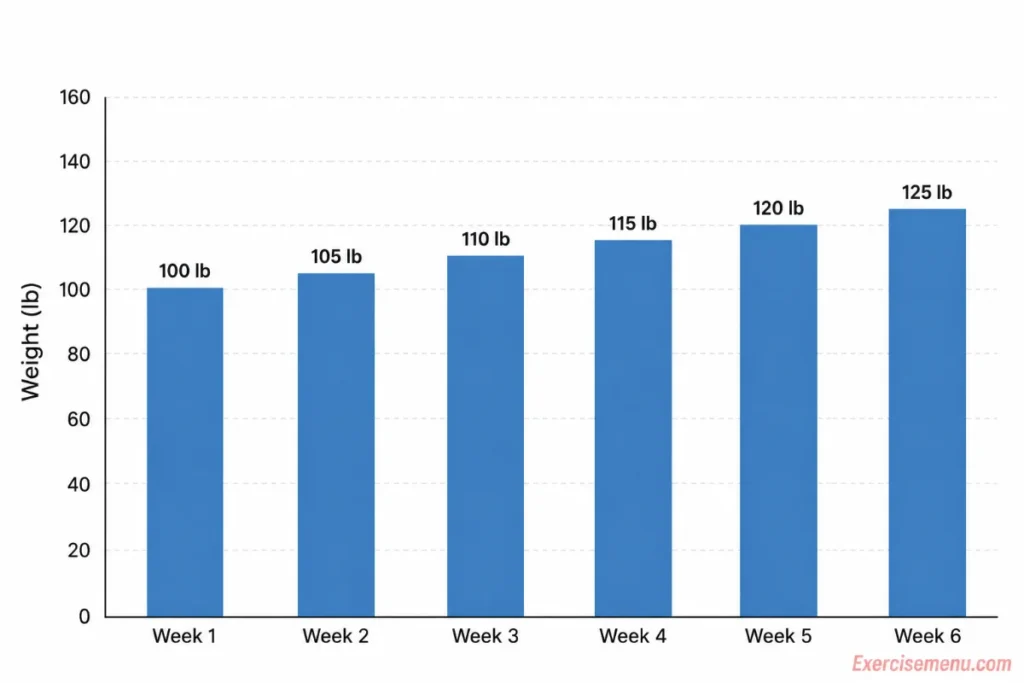
If adding weight every single session feels too aggressive, or you’d rather build up reps before load, the double progression method works well too: pick a rep range, like 8 to 12, and add reps each session until you hit the top of that range for every set.
Once you do, add weight and drop back to the bottom of the rep range, then repeat. It’s slightly slower than pure linear progression but gives you more room to dial in form before the weight goes up. If you want a deeper breakdown of how to structure sets and reps specifically for someone new to training, our guide on how many reps and sets a beginner should do covers that in more detail.
Progressive Overload for Bodyweight-Only Beginners
The same principle applies without any equipment. You just change what you’re allowed to increase.
Start by adding reps: if you can do 8 push-ups with good form, work toward 12 before changing anything else. Once a bodyweight exercise gets easy at a high rep count, increase the difficulty of the movement itself rather than just doing more reps of an easy version.
That might mean progressing from knee push-ups to full push-ups, or from an assisted squat to a full bodyweight squat to a single-leg variation. Slowing down each rep, adding a pause at the hardest point of the movement, or increasing range of motion are all valid ways to add difficulty once reps and exercise variation stop being enough on their own.
Does It Matter How You Progress? (Weight vs. Reps)
Not as much as most people assume. A 2022 study in PeerJ compared lifters who progressed by adding weight against lifters who progressed by adding reps at a fixed weight, and found the two approaches produced nearly identical muscle growth over eight weeks.
That study was done in experienced lifters rather than total beginners, but the underlying takeaway holds for anyone starting out: the method of progression matters less than showing up consistently and training hard enough to challenge the muscle. If you’d rather build reps before adding load, or alternate between the two depending on how you feel that day, you’re not doing it wrong.
What to Do When You Stall (The Reset Protocol)
At some point, usually a few months in, you’ll show up ready to add weight and won’t be able to complete all your reps. The first time this happens, repeat the same weight next session. If it happens two sessions in a row on the same lift, that’s your signal to reset rather than keep grinding.
To reset, drop the weight to about 90% of the heaviest weight you completed successfully, and spend a full week training at that lighter load before resuming your normal progression. This isn’t a failure or a step backward. It’s a deliberate way to let your body catch up to the demands you’ve been placing on it, and it works far better than either pushing through a stall or abandoning the lift entirely.
When to Move Off Linear Progression
Linear progression eventually stops working, and that’s expected, not a sign you did something wrong. For most beginners, this happens somewhere between 3 and 12 months in, depending on the lift, your training age, and how consistent you’ve been. Smaller, more technical lifts like the bench press tend to stall first; bigger lifts like the squat and deadlift often keep progressing session to session for longer.
The clearest sign you’re ready to move on is resets becoming frequent, needing one every week or two instead of every month or so. At that point, session-to-session linear progression has done its job, and it’s time to shift toward progressing week to week instead of workout to workout. This is a different phase of training with its own approach, and not something to worry about until you’re there.
Common Beginner Mistakes
- Ignoring the reset rule and grinding at a stuck weight for weeks. This wastes training time and often leads to form breakdown as you fight to complete reps you’re not actually ready for.
- Changing too many variables at once. Adding weight, changing rep ranges, and cutting rest time in the same session makes it impossible to tell what’s working.
- Abandoning linear progression too early. Some beginners switch to a more complex program after a few weeks because progress feels slow, without giving simple linear progression the 6 to 12 months it’s actually built to last.
Frequently Asked Questions
How many days a week should a beginner train to make progressive overload work?
Three sessions a week, on non-consecutive days, is enough for most beginners to progress on every session while getting adequate recovery. Training more often than that without more experience under your belt usually adds fatigue without adding extra progress.
Does progressive overload work the same way for older beginners?
The same principle applies, but with more caution around recovery. Older beginners generally benefit from slightly longer warm-ups and more rest between sessions, with weight progression still driving results as long as joint health and recovery are respected.
What if you miss a session? Should you still try to add weight at the next one?
No. Treat your next session as a repeat of the one you missed rather than skipping straight to the following jump. A short gap doesn’t erase your progress, but showing up and immediately trying to add weight on top of lost momentum is a common way to fail a lift you would have otherwise hit.
