


Quick Answer: Medicine ball exercises train the shoulders through pressing, stability, and explosive movements that dumbbells can’t replicate, building strength and control together. Start with a 4–8 lb ball for pressing moves and a 6–8 lb slam ball for explosive work like the overhead slam, and pick exercises based on your goal: strength, stability, or power.
The shoulder isn’t built like most other joints. It trades stability for range of motion, which is why it can reach overhead, behind your back, and across your body, and also why it’s one of the easiest joints to hurt when training gets sloppy. Most shoulder programs lean on dumbbells and cables, which is fine, but they miss something a medicine ball does well: training the shoulder to absorb and produce force in a single, uninterrupted motion.
A dumbbell press asks your shoulder to move weight through a fixed path. A medicine ball throw asks it to accelerate a load, release it, then be ready to catch and control something coming back, often at an angle you didn’t fully choose. That unpredictability is what builds the kind of shoulder stability that carries over to sport, to lifting things awkwardly in real life, and to staying injury-free as you load heavier weight elsewhere.
Below are 10 exercises organized by what they’re actually good for: building raw pressing strength, building control and stability, and building explosive power. Pick based on your goal rather than working through the list top to bottom.
- What Muscles Do Medicine Ball Shoulder Exercises Work?
- What Size Medicine Ball Should You Use for Shoulder Exercises?
- Best Medicine Ball Shoulder Exercises
- Sample Medicine Ball Shoulder Workout
- Is It Safe to Train Shoulders With a Medicine Ball?
- Medicine Ball vs. Dumbbell Shoulder Exercises: Which Is Better?
- Frequently Asked Questions
What Muscles Do Medicine Ball Shoulder Exercises Work?
The deltoids do most of the visible work — front, side, and rear heads, depending on the exercise. Underneath them, the rotator cuff muscles (supraspinatus, infraspinatus, teres minor, subscapularis) keep the ball of the shoulder joint centered in its socket while the deltoids move it, which matters more with a medicine ball than with a dumbbell because the load isn’t moving in a fixed, predictable line.
Two supporting muscles come up more than people expect. The upper trapezius fires heavily any time you’re pressing or throwing overhead, and the serratus anterior — the muscle along your ribs that rotates your shoulder blade — becomes especially active during throws and catches, since it has to reposition your shoulder blade fast enough to keep the joint stable as force moves through it.
If you’re already using dumbbells for shoulder work and want to see how the two approaches differ mechanically, our guide to training deltoids and biceps with dumbbells breaks down the fixed-path version of this same muscle group.
What Size Medicine Ball Should You Use for Shoulder Exercises?
This is where most people either overthink it or guess wrong, and it’s worth separating into two categories, because pressing exercises and throwing exercises call for different weights entirely.
For pressing and control exercises (shoulder press, front raise, halo, overhead carry), start light. A 4–8 lb (1.8–3.6 kg) ball is enough for most beginners, and even intermediate lifters rarely need more than 10–12 lb (4.5–5.4 kg) here. The point of these movements is control, not maximal load.
For throws and slams, you can go heavier, but “heavier” is relative. A 6–10 lb (2.7–4.5 kg) ball is a sensible starting point for the overhead slam and similar explosive moves. Going much past that before your technique is solid is how people end up with a strained lower back or a jammed shoulder on the catch.
| Level | Pressing & Control | Throws & Slams |
|---|---|---|
| Beginner | 4–6 lb (1.8–2.7 kg) | 6–8 lb (2.7–3.6 kg) |
| Intermediate | 6–10 lb (2.7–4.5 kg) | 8–12 lb (3.6–5.4 kg) |
| Advanced | 10–15 lb (4.5–6.8 kg) | 12–20 lb (5.4–9 kg) |
One equipment note that matters: a standard medicine ball bounces, which is what you want for wall throws and catches. A slam ball is filled with sand and dead on impact, so it’s the right choice for slams and floor throws, since a bouncing ball on those movements is a genuine hazard.
If you’re brand new to training with a med ball at all, it’s worth starting with our beginner medicine ball exercises guide before jumping into shoulder-specific work, since it covers the basic ball-handling patterns this article builds on.
Best Medicine Ball Shoulder Exercises
Strength and Pressing
1. Medicine Ball Shoulder Press Target:
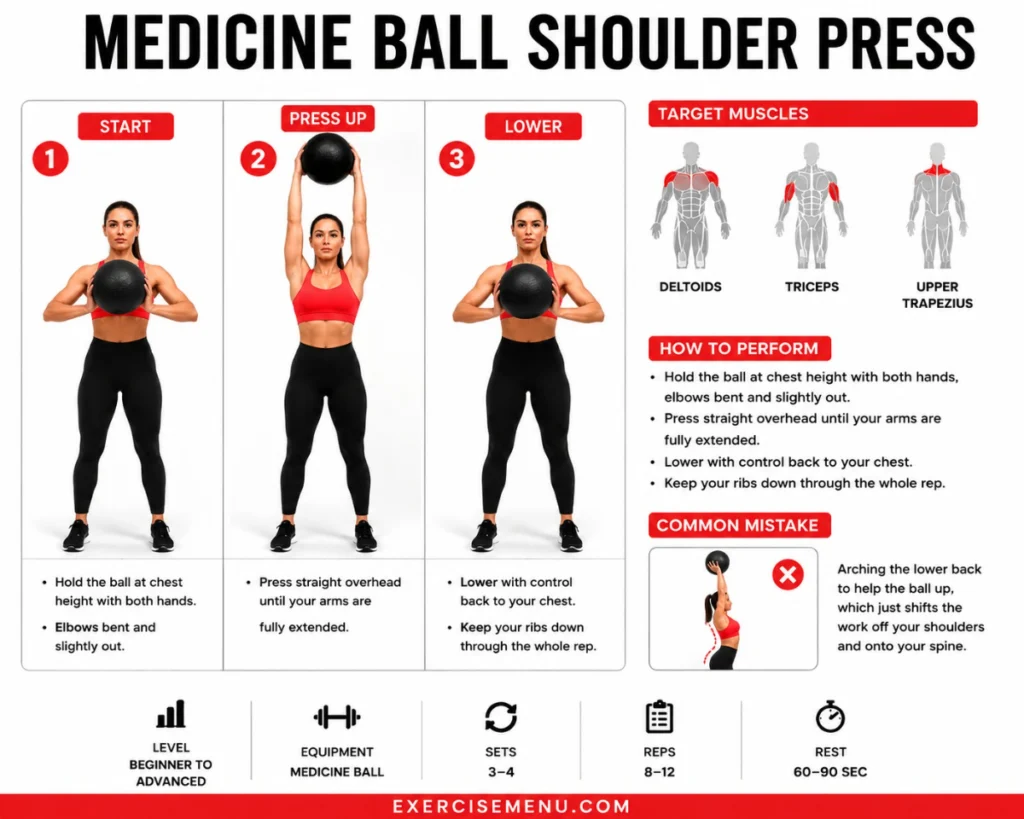
Deltoids, triceps, upper trapezius Hold the ball at chest height with both hands, elbows bent and slightly out. Press straight overhead until your arms are fully extended, then lower with control back to your chest. Keep your ribs down through the whole rep. The most common breakdown here is arching the lower back to help the ball up, which just shifts the work off your shoulders and onto your spine.
Sets × Reps: 3 × 8–12 | Rest: 60 sec
2. Medicine Ball Front Raise Target:
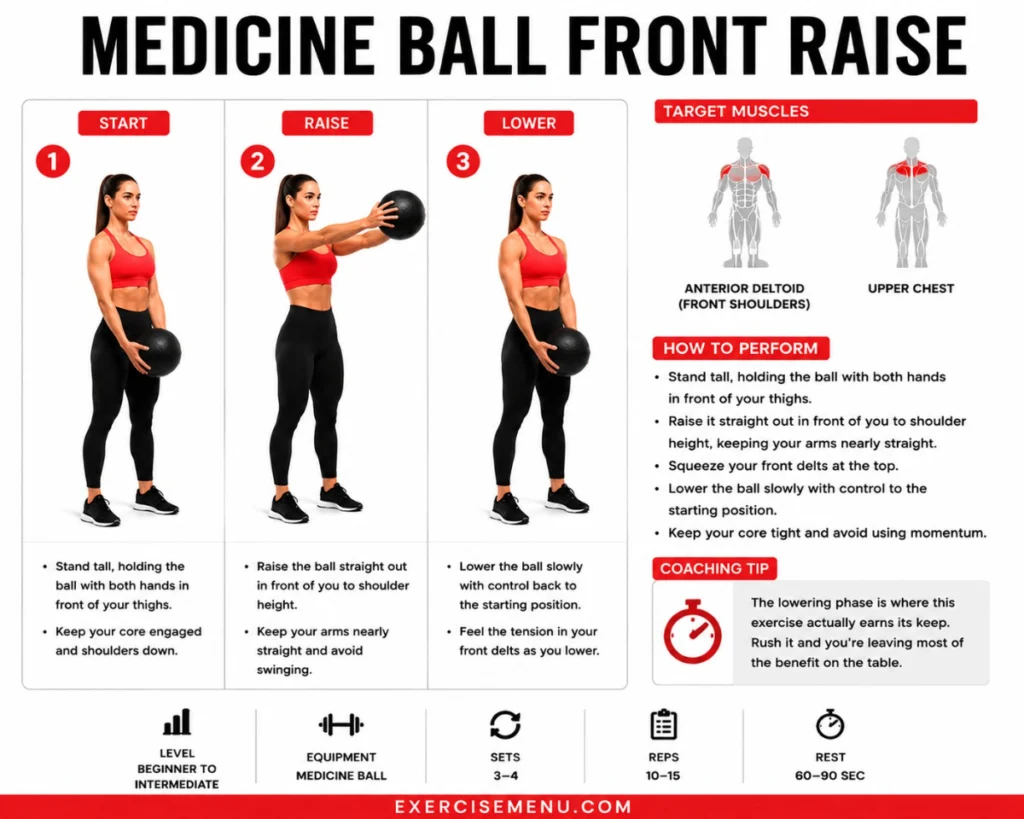
Anterior deltoid, upper chest Stand tall, holding the ball with both hands in front of your thighs. Raise it straight out in front of you to shoulder height, keeping your arms nearly straight, then lower slowly. The lowering phase is where this exercise actually earns its keep. Rush it and you’re leaving most of the benefit on the table.
Sets × Reps: 3 × 10–12 | Rest: 45 sec
3. Medicine Ball Push-Up Target:
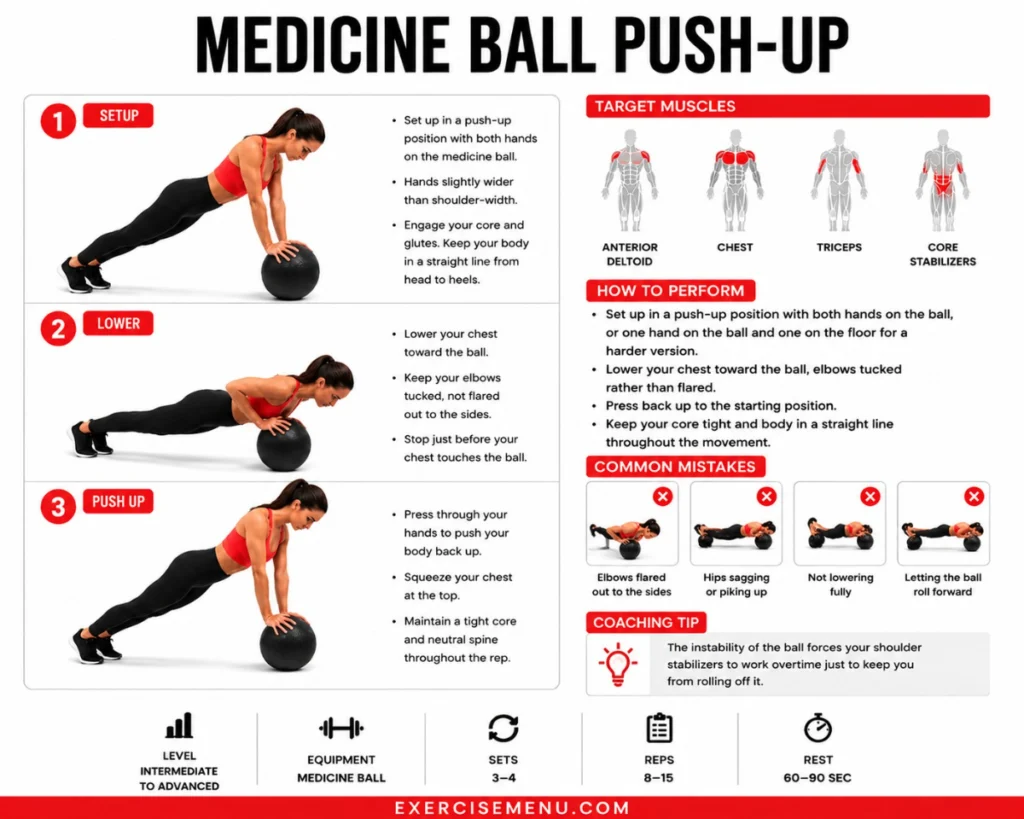
Anterior deltoid, chest, triceps, core stabilizers Set up in a push-up position with both hands on the ball, or one hand on the ball and one on the floor for a harder version. Lower your chest toward the ball, elbows tucked rather than flared, and press back up. The instability of the ball forces your shoulder stabilizers to work overtime just to keep you from rolling off it.
Sets × Reps: 3 × 8–10 | Rest: 60 sec
4. Medicine Ball Upright Row Target:
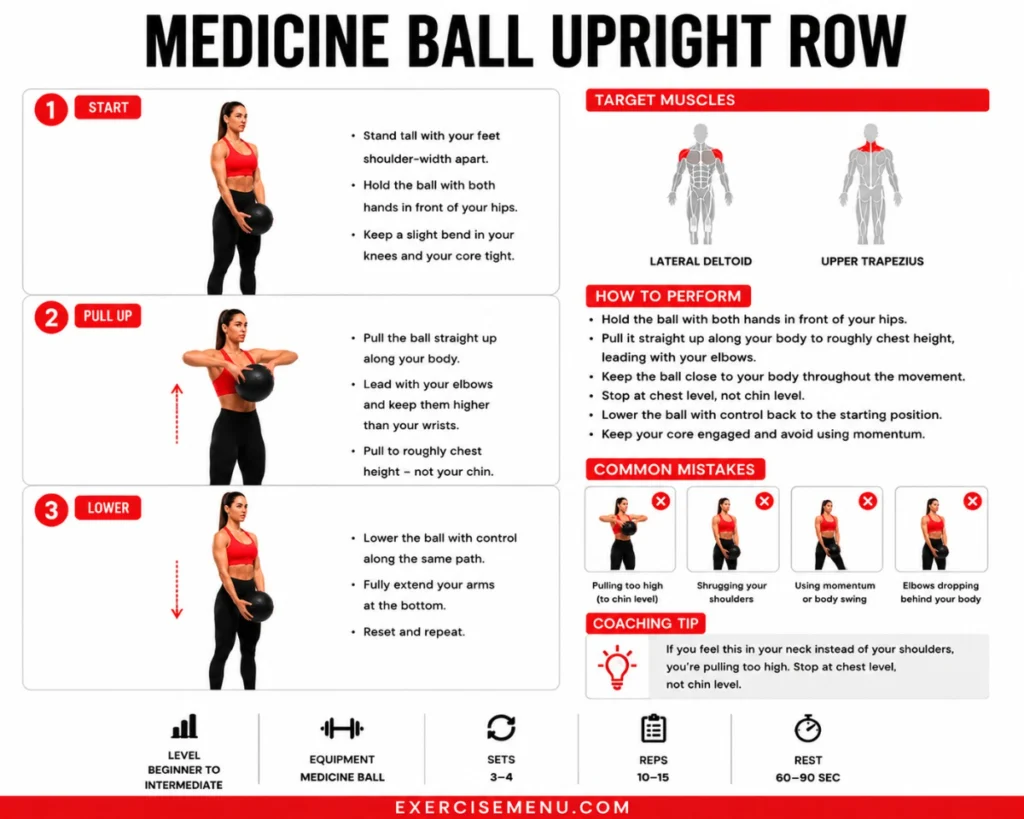
Lateral deltoid, upper trapezius hold the ball with both hands in front of your hips. Pull it straight up along your body to roughly chest height, leading with your elbows, then lower. If you feel this in your neck instead of your shoulders, you’re pulling too high. Stop at chest level, not chin level.
Sets × Reps: 3 × 10–12 | Rest: 45 sec
Stability and Control
5. Medicine Ball Halo Target:
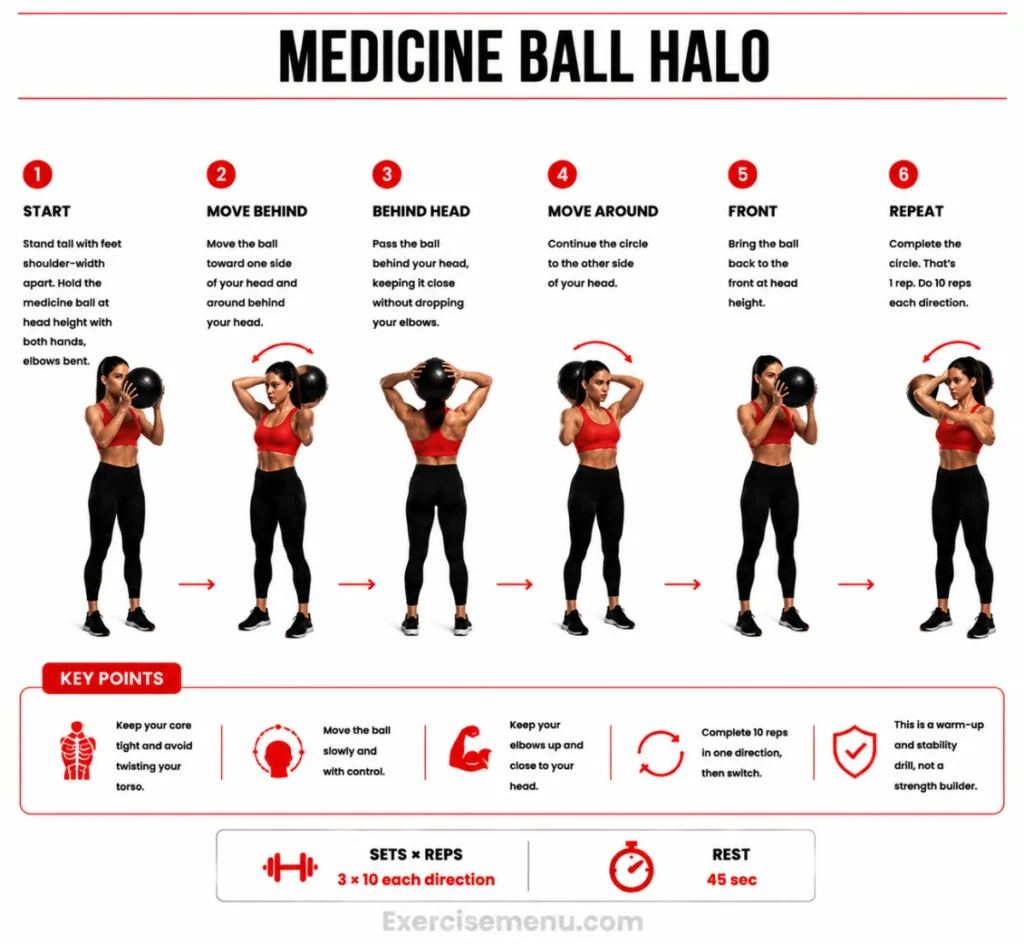
Rear deltoid, rotator cuff, upper trapezius Hold the ball at head height with both hands, elbows bent. Circle it slowly around your head, staying tight through your core so your torso doesn’t twist with it. Ten reps each direction is enough, since this is a warm-up and stability drill more than a strength builder. It’s also covered from a back-focused angle in our medicine ball back exercises guide, because the same movement loads the rear delts and upper traps just as much as it does the lats
Sets × Reps: 2 × 10 each direction | Rest: 30 sec
6. Medicine Ball Overhead Carry Target:
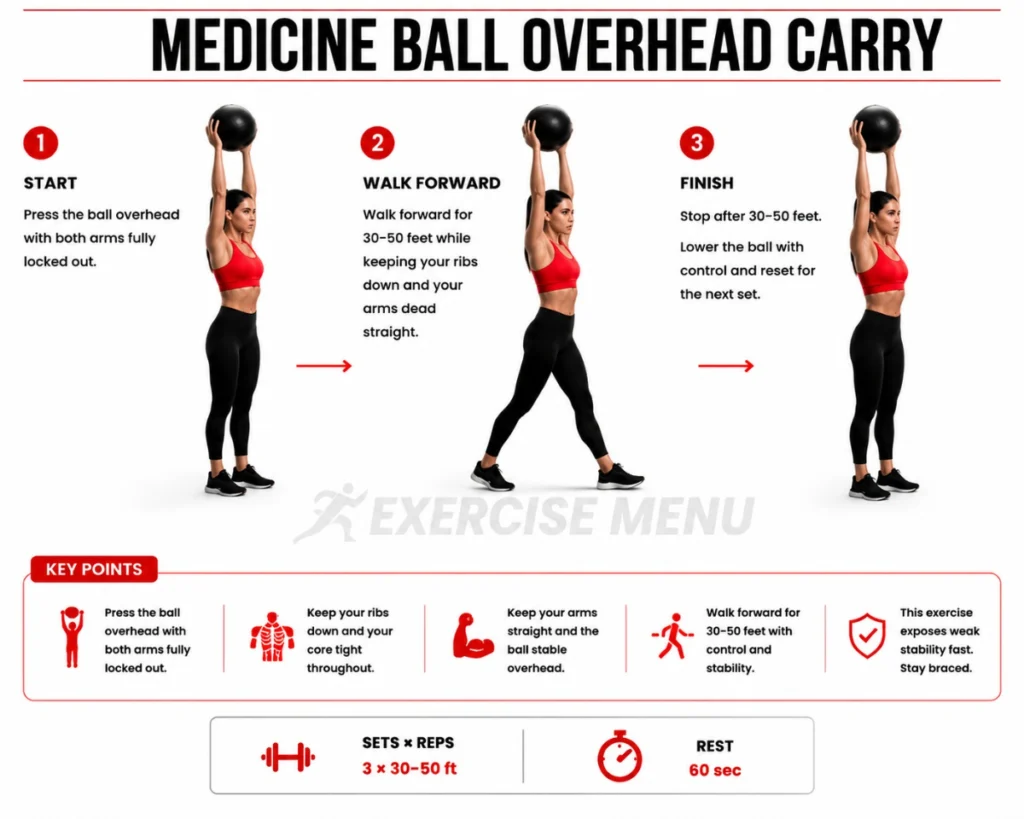
Deltoids, rotator cuff, core press the ball overhead with both arms fully locked out, then walk forward for 30–50 feet while keeping your ribs down and your arms dead straight. This one exposes weak stability fast. If your arms start drifting forward as you walk, that’s your shoulders telling you the load is too heavy or your bracing has broken down.
Sets × Reps: 3 × 30–50 ft | Rest: 60 sec
7. Wall Sit with Overhead Hold Target:
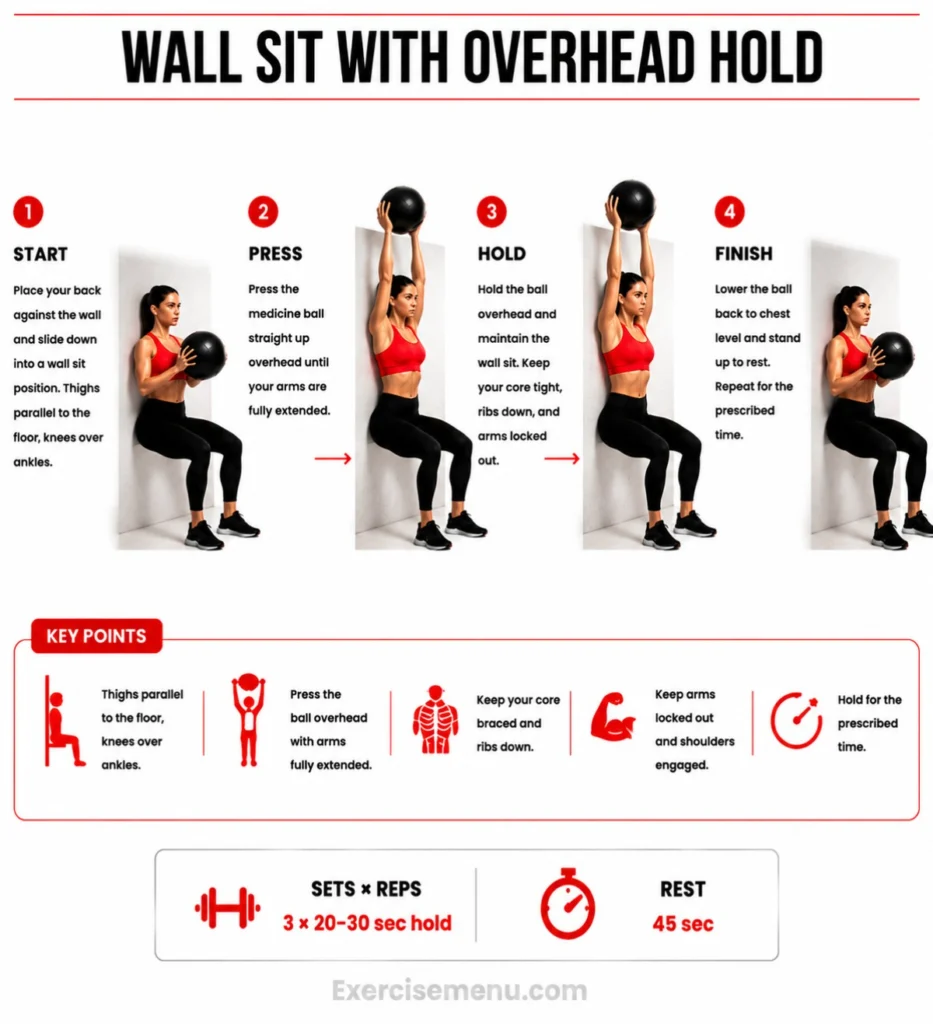
Deltoids, rotator cuff, quadriceps (isometric) get into a wall sit with your thighs parallel to the floor, then press the ball overhead and hold it there for the duration of the set. Your legs will fatigue first, which is intentional: it forces your shoulders to maintain a static overhead position while the rest of your body is under stress, a much closer simulation of real fatigue-under-load than a fresh, isolated set.
Sets × Reps: 3 × 20–30 sec hold | Rest: 45 sec
8. Medicine Ball Overhead March Target:
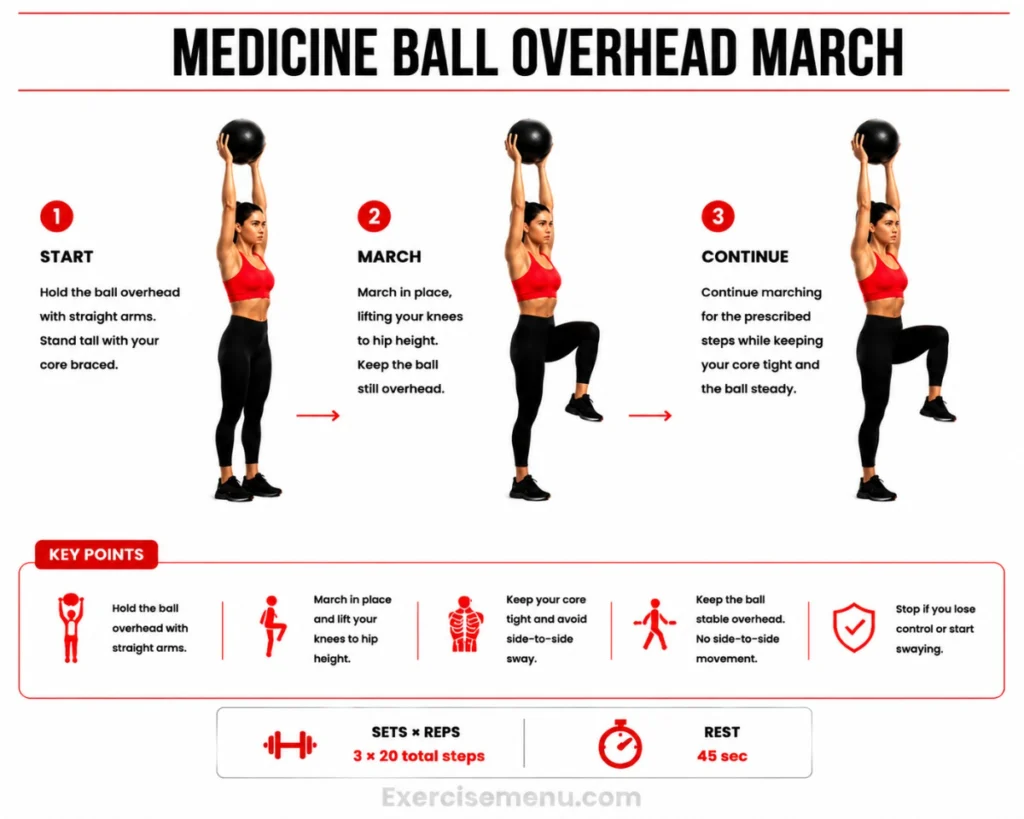
Deltoids, rotator cuff, core hold the ball overhead with straight arms and march in place, lifting your knees to hip height. Keep the ball still. Any side-to-side sway means your core isn’t controlling the load, and the exercise stops doing what it’s meant to do.
Sets × Reps: 3 × 20 total steps | Rest: 45 sec
9. Figure-8 Pass Target:
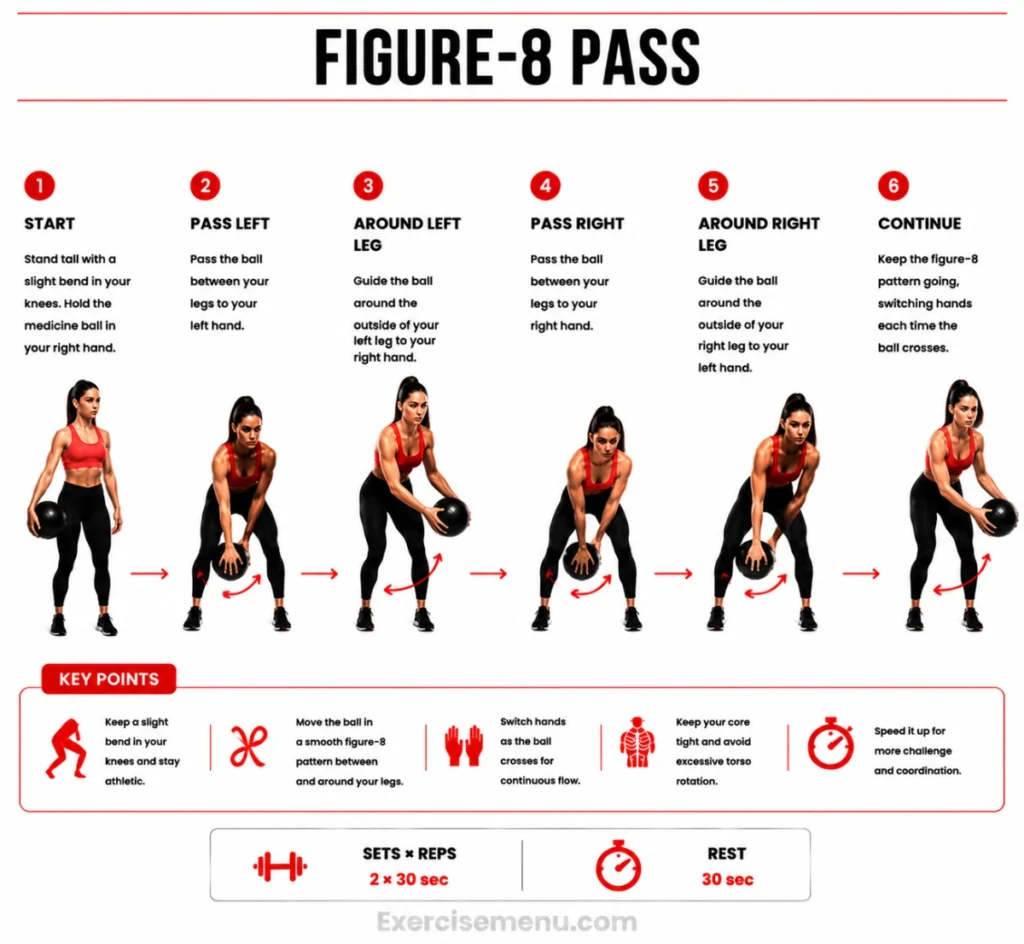
Deltoids, obliques, coordination standing with a slight knee bend, pass the ball in a figure-eight pattern between and around your legs, switching hands as it crosses. It looks more like a mobility drill than a shoulder exercise, but the constant hand-to-hand transitions demand real shoulder coordination, especially as you speed it up.
Sets × Reps: 2 × 30 sec | Rest: 30 sec
Power and Explosive Movement
10. Medicine Ball Overhead Slam Target:
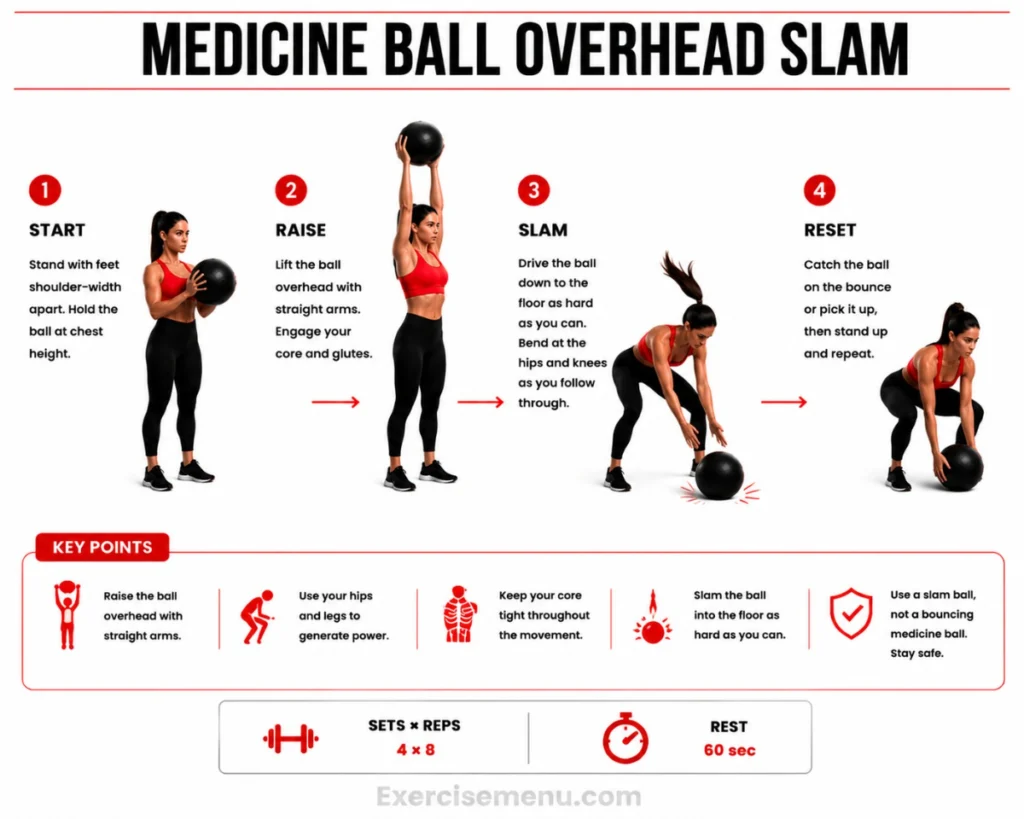
Deltoids, lats, core, full-body power Raise the ball overhead with straight arms, then drive it into the floor as hard as you can, bending at the hips and knees as you follow through. Catch it on the bounce or pick it up and reset. Use a slam ball here, not a bouncing medicine ball. You don’t want 10 lb coming back at your face because you guessed wrong on equipment.
Sets × Reps: 4 × 8 | Rest: 60 sec
Sample Medicine Ball Shoulder Workout
Beginner circuit — 3 rounds, 60 seconds rest between rounds
- Medicine Ball Shoulder Press — 10 reps
- Medicine Ball Halo — 10 reps each direction
- Medicine Ball Front Raise — 10 reps
Intermediate/advanced circuit — 4 rounds, 45 seconds rest between rounds
- Medicine Ball Push-Up — 10 reps
- Medicine Ball Overhead Slam — 8 reps
- Medicine Ball Upright Row — 10 reps
- Medicine Ball Halo — 10 reps each direction
- Overhead Carry — 40 feet
Run either circuit two to three times a week, ideally not on back-to-back days, since the rotator cuff needs recovery time between sessions that load it this directly.
Is It Safe to Train Shoulders With a Medicine Ball?
For most people, yes, but the shoulder is unforgiving of bad form in a way other joints aren’t, and a few things are worth knowing before you load it with a moving weight.
If you have an active shoulder impingement, a recent labrum or rotator cuff injury, or you’ve had shoulder surgery within the last few months, skip the overhead slam entirely and check with a physical therapist before doing even the pressing exercises.
A 2025 study published in Scientific Reports examined how reduced effort affects muscle response during loaded medicine ball throws, specifically to help build safer return-to-training protocols for people recovering from injury. It’s a useful reminder that even “light” med ball work still places real demand on a joint that isn’t at full capacity yet.
The most common technical mistakes:
- Shrugging your shoulders up toward your ears during presses instead of keeping them pulled down and back
- Catching thrown or bounced balls with locked elbows instead of slightly bent ones
- Letting your elbows flare out wide during push-ups and rows, which shifts stress toward the front of the shoulder joint
One detail matters here: EMG research on the overhead medicine ball throw found that shoulder muscle activity stays high well past the point where the ball leaves your hand, with sustained load on the upper trapezius and rotator cuff through the entire deceleration phase, not just during the explosive part of the throw. That’s a reminder to stay controlled through the catch and follow-through, not just the release.
Medicine Ball vs. Dumbbell Shoulder Exercises: Which Is Better?
Neither replaces the other, and the honest answer depends on what you’re training for. Dumbbells win for controlled strength building. The load path is fixed and predictable, which makes it easier to isolate a specific muscle and progressively add weight over time. It’s still the most reliable way to build raw shoulder size and strength.
Medicine balls win for power and reactive stability. Because the load can be released, thrown, and caught, they train your shoulder to produce force quickly and absorb it safely, which dumbbells simply can’t replicate. That’s also closer to how your shoulder actually gets used in sport and in daily life, where you rarely move weight through one clean, fixed path.
If your goal is general shoulder health and performance, the strongest programs use both: dumbbells for the steady strength work, medicine balls for the explosive and stability work this article covers. For medicine ball training across every other muscle group — chest, back, arms, abs, and legs — the medicine ball exercises guide covers the complete cluster in one place.
Frequently Asked Questions
Should you warm up before a medicine ball shoulder session, and what should that look like?
Yes, especially before throws or slams. Two to three minutes of arm circles and light halos is enough to get blood into the joint before you load it with speed. Skipping this and going straight into a heavy overhead slam is a common way to tweak an otherwise healthy shoulder.
How do you tell normal soreness from pushing a shoulder too hard?
Normal soreness shows up a day or two later, feels dull, and eases as you warm up. Pain from overdoing it hits sooner, feels sharp rather than achy, and often worsens with movement instead of easing. If it’s the second kind, rest that shoulder for a few days.
Can these exercises be done without a wall, a partner, or outdoor space?
Yes, all of them. Every exercise on this list, including the overhead slam, only needs floor space in front of you. Since none of them require throwing the ball at a wall or to a partner, this entire routine works fine in a small room or a home gym corner.
Do medicine ball shoulder exercises build visible muscle size, or are they mainly for strength and stability?
Mostly strength, stability, and power rather than size. The loads are usually too light and the movements too fast to create the sustained muscle tension that drives hypertrophy. For visible shoulder size, dumbbells or a barbell with heavier, slower sets get you there faster.
Does the order you do these exercises in during a session matter?
Yes. The overhead slam should come first, while your nervous system is fresh enough to produce real speed. Save strength and stability work for after, since attempting an explosive slam on a fatigued shoulder is both less effective and more likely to break down your form.
