


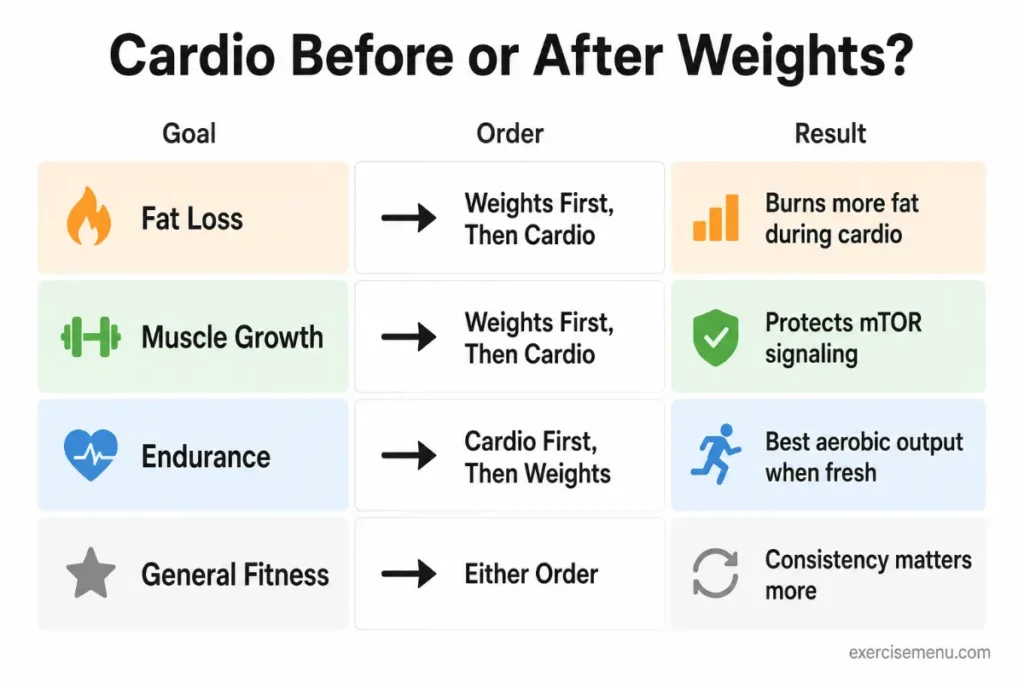
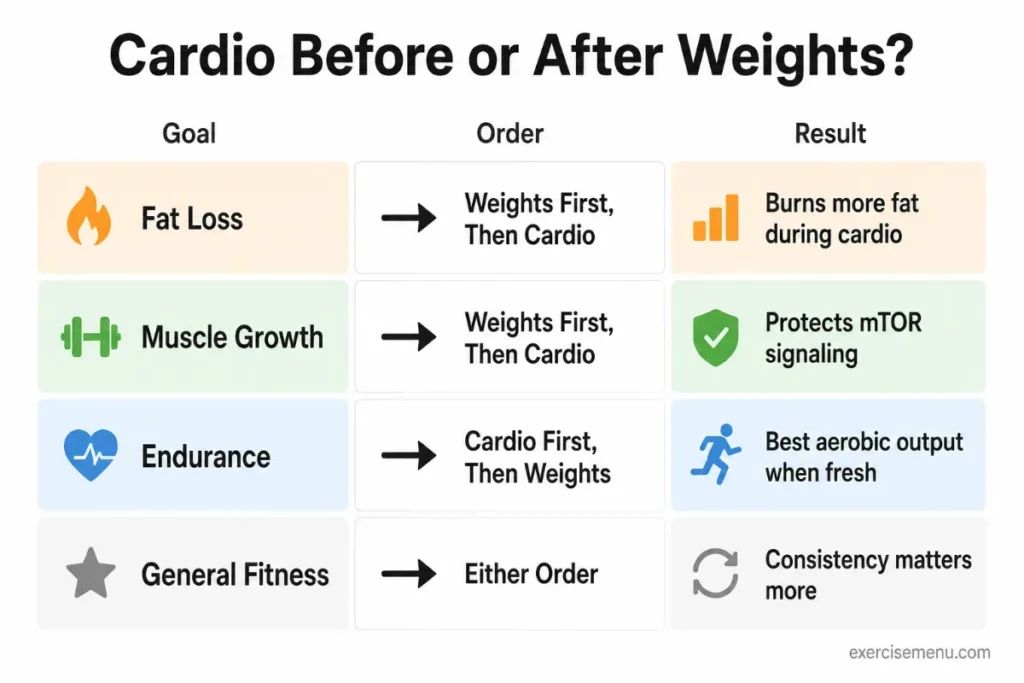
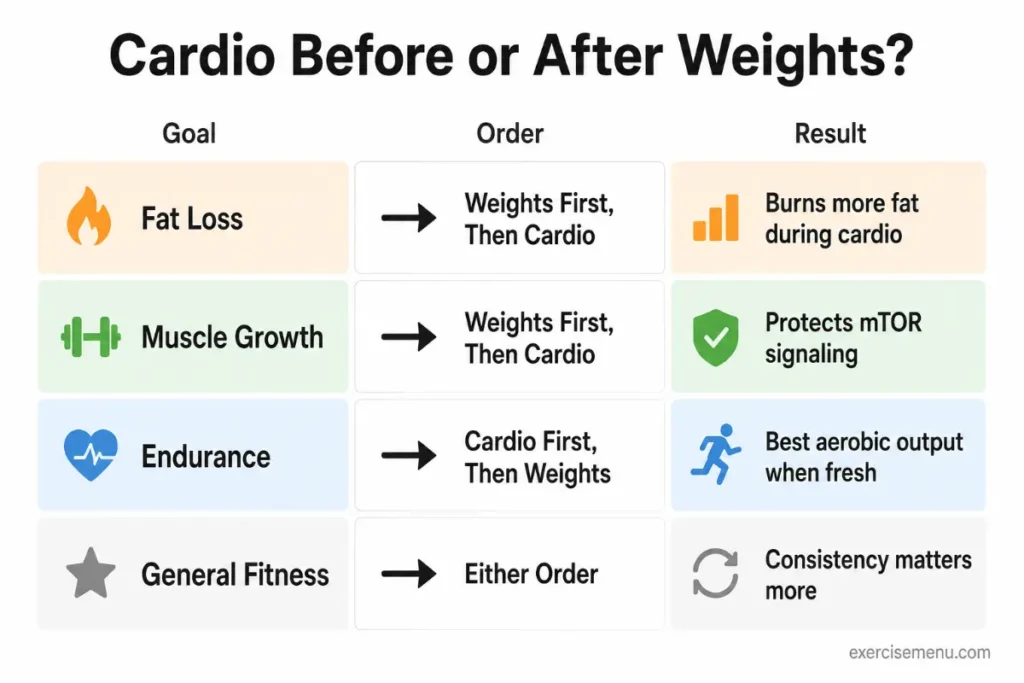
Quick Answer: For fat loss and muscle growth, do weights first, cardio after. For endurance performance, cardio comes first. For general fitness with no specific goal, order has minimal impact. The type of cardio matters as much as the order a 20-minute walk and a 45-minute HIIT session are not the same decision.
- Key Takeaways
- Cardio before or after weights for fat loss?
- Cardio before or after weights for muscle growth?
- Cardio before or after weights for endurance?
- Cardio before or after weights for general fitness?
- Cardio and weights on leg day — what most people get wrong
- Should you do cardio and weights on the same day?
- How much cardio per week alongside weights?
- Does the order change for women?
- What about beginners?
- The cardio type that changes everything
- Frequently asked questions
- The bottom line
Key Takeaways
- For fat loss and muscle growth, weights before cardio is the consistent recommendation lifting on pre-fatigued muscles compromises session quality and hormonal response.
- For endurance athletes, cardio comes first weight training second at low volume.
- HIIT before lifting activates AMPK, a pathway that suppresses the anabolic signaling that drives muscle growth. That activation persists for up to 4 hours after high-intensity cardio.
- A 10–15 minute easy walk before lifting is a warm-up. A 30-minute HIIT session is a training stimulus these are not the same decision.
- If splitting sessions, leave at least 4–6 hours between cardio and weights, with weights second.
Most people asking this question already do both. They’re not looking for a lecture on why cardio and weights both matter they want to stop guessing which order is costing them results.
Order does matter. But not equally for every goal, and not in the same way depending on what type of cardio you’re doing. A 20-minute walk after a lifting session is a completely different physiological decision than 45 minutes of HIIT before one.
The sections below break it down by goal fat loss, muscle growth, endurance, and general fitness — and cover the specific situations most people overlook: what to do on leg day, how much cardio per week is too much alongside weights, and whether the rules change for women or beginners. This is what the research shows and what holds up in real training programs at Exercise Menu.
Cardio before or after weights for fat loss?
Weights first, cardio after.
Resistance training depletes muscle glycogen. When you move into cardio after lifting, glycogen stores are lower and the body burns more fat during that cardio than it would at the start of a fresh session. That’s the actual reason for the weights-first recommendation not just energy management, but what your body uses for fuel.
There’s a second reason. Lifting on pre-fatigued muscles reduces training quality. A squat set performed after 30 minutes of running uses less load, your muscles produce less force, and the hormonal response is weaker than the same set performed fresh. Muscle mass is a primary driver of resting metabolic rate, and anything that compromises training quality works against fat loss over time.
What type of cardio after weights for fat loss?
The type of cardio you add after lifting matters as much as the order.
A 20-minute walk after weights adds calorie expenditure and improves circulation without meaningful recovery cost. It’s low-impact, it doesn’t spike cortisol, and it doesn’t interfere with the sessions that follow.
Forty-five minutes of HIIT after a heavy lower body session is a different demand entirely. That combination — high-load resistance training followed by high-intensity cardio compromises recovery between sessions. If you’re training multiple days per week, post-weight cardio should stay moderate in intensity.
The most effective post-weight cardio for fat loss isn’t the most intense option. It’s the one you can repeat consistently without accumulating recovery debt across the week.
For fat loss programming specifics — set counts, rep ranges, and how to structure resistance training during a cut — the fat loss training guide covers the full approach.
Cardio before or after weights for muscle growth?
Weights first — and the reason goes deeper than pre-fatigue.
Resistance training activates the mTOR pathway the primary signal for muscle protein synthesis. Endurance exercise activates a competing pathway, AMPK (AMP-activated protein kinase), which tells the body to restore energy. The problem is that when AMPK is active, it works against the muscle-building signal that lifting creates.
Research published in the Journal of Physiology confirms that AMPK activation following endurance exercise can transiently inhibit mTOR signaling meaning cardio done immediately before lifting may blunt the muscle-building response of the session that follows. This is the interference effect, and how long it lasts depends on what type of cardio triggered it.
How long does the interference effect last?
After moderate steady-state cardio, AMPK returns to baseline within roughly an hour. After high-intensity cardio HIIT, sprint intervals, tempo runs elevated AMPK activity can persist for up to 4 hours.
Lifting immediately after a HIIT session is not the same decision as lifting after a brief easy warmup. The first case means starting resistance training when the pathway that drives muscle growth is still partially suppressed. The second has minimal interference.
The most common mistake I see with clients who are training for muscle growth is stacking high-intensity cardio immediately before their lifting session usually because they’re doing a group class that runs back-to-back with their gym time. Moving the cardio to after the session, or to a completely separate time, fixes the problem without changing the total work being done.
For muscle growth, keep post-session cardio low-to-moderate in intensity. How you structure the resistance sessions themselves — sets, reps, volume per muscle group matters as much as where the cardio sits. The muscle growth training guide covers that in full.
Cardio before or after weights for endurance?
Cardio first.
If endurance is the primary goal running, cycling, swimming, or any sport built around sustained aerobic output cardio comes first when both are done in the same session.
The logic is simple: do your most important work when you’re freshest. For an endurance athlete, that’s the aerobic session. Lifting before a long run means carrying fatigue into the activity that matters most to your performance.
Keep the resistance work that follows short and lower in volume compound movements at moderate load, not max-effort sessions. Heavy squats and deadlifts after a long run are a recovery problem most endurance athletes don’t account for until they’re already overtrained.
If you’re building toward a specific event, weights should support the cardio — not drain the same recovery budget.
Cardio before or after weights for general fitness?
Order has minimal impact — do whichever you’ll actually complete.
If you’re training for general health with no specific performance target, the sequence matters far less than whether you actually show up. A 2022 systematic review and meta-analysis published in Sports Medicine found that concurrent aerobic and strength training produces similar adaptations regardless of which comes first, as long as total volume and intensity are matched.
Do whichever you’re more likely to complete without skipping. If you consistently avoid the treadmill when it’s last, do it first. Showing up consistently over months produces the results, not the specific order within sessions.
One rule applies regardless of goal: don’t begin a heavy resistance session with high-intensity cardio. Thirty minutes of hard effort before lifting generates fatigue that reduces what every set can produce. Easy movement to warm up is fine. A full cardio session is not.
Cardio and weights on leg day — what most people get wrong
Heavy leg training followed by cardio that loads the lower body creates a recovery problem that goes beyond session fatigue. Squats, Romanian deadlifts, and leg presses already place significant demand on the quads, hamstrings, and glutes. Running, stair climbing, and cycling after a heavy lower body session extends that demand without giving the tissue time to begin recovery.
The issue isn’t just soreness. It’s that the muscles can’t produce full output in either activity when both happen in the same session, and recovery before the next lower body session is compromised.
If you want cardio on leg day, choose options that don’t load the same muscles:
- Upper body ergometer (arm bike)
- Easy swimming — avoid kick-heavy sets
- Light walking at Zone 1 pace
- Rowing if legs are not significantly fatigued

Avoid running, cycling at meaningful resistance, stair climbing, or any jump-based cardio on the same day as heavy lower body training.
Should you do cardio and weights on the same day?
For most people training 3–4 days per week, combining both in one session is practical and effective — if the structure is right.
When combining works
- Cardio is low-to-moderate intensity and under 30 minutes
- Weights come first, cardio follows
- Total session stays under 75–80 minutes
- The cardio modality doesn’t load the same muscle groups as the lifting session
When to separate them
- You’re doing high-intensity cardio and want to preserve lifting performance
- Muscle growth is the primary goal and you’re training at high volume
- You can leave at least 4–6 hours between sessions, with resistance training second
The 4–6 hour gap matters because it allows AMPK activity from the cardio session to return to baseline before resistance training begins. Barbell Medicine’s review of concurrent training research confirms this timing window minimizes the interference effect for those prioritizing strength and hypertrophy.
If splitting sessions isn’t realistic, weights first with moderate cardio after is the consistent recommendation.
How much cardio per week alongside weights?
Most people ask about the order without asking about the total volume and volume matters more than most realize when both are being done in the same training week.
Most people training for fat loss or muscle maintenance do well with 2–3 cardio sessions per week alongside their resistance work, keeping cardio sessions under 30 minutes at moderate intensity. That range tends to support both goals without eating into recovery between lifting sessions.
Beyond that — particularly with high-intensity cardio — the interference effect stops being just a within-session issue. It starts degrading how well you recover between lifting sessions. You’ll notice it as declining lifting performance across the week before you notice it as soreness.
If cardio volume needs to be high training for a race, for example reduce resistance training volume proportionally. Trying to run a high cardio load and a full lifting program simultaneously stretches recovery beyond what most schedules can handle.
One thing worth knowing: a 20-minute HIIT session burns more total calories than a 45-minute moderate jog once the post-exercise calorie burn (EPOC) is factored in — but creates significantly more recovery demand. If recovery is already tight, more low-intensity movement achieves more than fewer high-intensity sessions.
Does the order change for women?
The same principles apply weights before cardio for fat loss and muscle growth, cardio before for endurance. The AMPK/mTOR interaction works the same way regardless of sex.
A few things are worth adjusting based on how women train and recover:
Training goals. Many women are working toward fat loss and muscle tone at the same time rather than pushing one goal in isolation. Weights first serves both — it builds and preserves muscle while setting up the cardio that follows to pull more from fat stores.
Cycle phase. During the follicular phase (first half of the cycle), estrogen is higher and aerobic performance tends to be better — higher-intensity cardio is generally easier in this window. During the luteal phase, recovery slows. Adjusting cardio intensity around the cycle, rather than following a fixed weekly template, makes a real difference for both output and recovery.
What about beginners?
For anyone in the first 6–12 months of consistent training, order matters less than quality and consistency.
The interference effect shows up most at higher training volumes and intensities. At beginner loads — 2–3 days per week, moderate effort, 30–45 minute sessions the AMPK/mTOR conflict is minimal. Doing the work consistently matters more than the order.
The one thing to avoid: don’t start a beginner resistance session with intense cardio. Not because of the interference effect, but because beginners have smaller energy reserves and the risk of form breaking down under fatigue is higher.
Easy cardio as a warm-up, then lifting, then optional easy cardio after — that works well for beginners at any goal. As training intensity increases over months, order becomes a more meaningful variable.
The cardio type that changes everything
Most people treat all cardio as one variable. It’s not — what you’re doing and how hard determines how long the interference lasts.
Zone 1 — walking and easy cycling
Heart rate 50–60% of maximum. Minimal AMPK activation. No meaningful interference with lifting before or after, including on leg day. This is the cardio that doubles as warm-up, cooldown, and active recovery — without affecting how well you recover between sessions.
Steady-state moderate cardio
Heart rate 60–75% of maximum a conversational run, moderate cycling, easy rowing. AMPK activates here, but clears within about an hour. Order starts to matter: doing this before heavy lifting reduces what your sets can produce.
HIIT and high-intensity intervals
Heart rate 80–95% of maximum — sprint intervals, HIIT formats, tempo runs. AMPK stays elevated for up to 4 hours after the session. Doing this before lifting means starting resistance training when the muscle-building pathway is still suppressed. Done after lifting, it adds significant recovery demand. When HIIT is in the plan, separate it from lifting by as many hours as possible — or put it on a different day entirely.
Frequently asked questions
Should I do cardio before or after weights to lose weight?
Weights first. Lifting depletes glycogen, so the body burns more fat during the cardio that follows. Running before lifting reduces session quality and the hormonal response that supports fat loss.
Should women do cardio before or after weights?
Same order applies — weights first for fat loss and muscle, cardio first for endurance. Adjust cardio intensity based on cycle phase, but the sequence doesn’t change.
Is walking before a workout bad?
No. A 10–15 minute easy walk before lifting is a warm-up, not a cardio session. It doesn’t interfere with resistance training.
Should I do cardio before or after weights to lose belly fat?
Spot reduction isn’t possible — fat comes off systemically. For overall fat loss, weights first. Lifting preserves muscle during a calorie deficit, and more muscle means a higher resting metabolic rate.
Can I do cardio and weights every day?
Recovery breaks down without rest days. High-intensity cardio and heavy lifting daily accumulates fatigue faster than most schedules can absorb. Most people do better with 3–4 lifting sessions and 2–3 cardio sessions per week.
The bottom line
For fat loss and muscle growth, weights first. For endurance, cardio first. For general fitness, do whichever you’ll actually complete.
But the order is one piece. The type of cardio, how hard it is, how much you’re doing across the week, and whether you’re loading the same muscle groups twice in the same session — all of that determines whether the combination works or just accumulates fatigue.
The mistake most people make isn’t the order. It’s stacking high-intensity cardio and heavy lifting in the same session, then wondering why performance drops across the week.
To find out how many calories your cardio is actually burning per session, use the Calorie Burn Calculator — it factors in body weight and intensity, not just time.
