

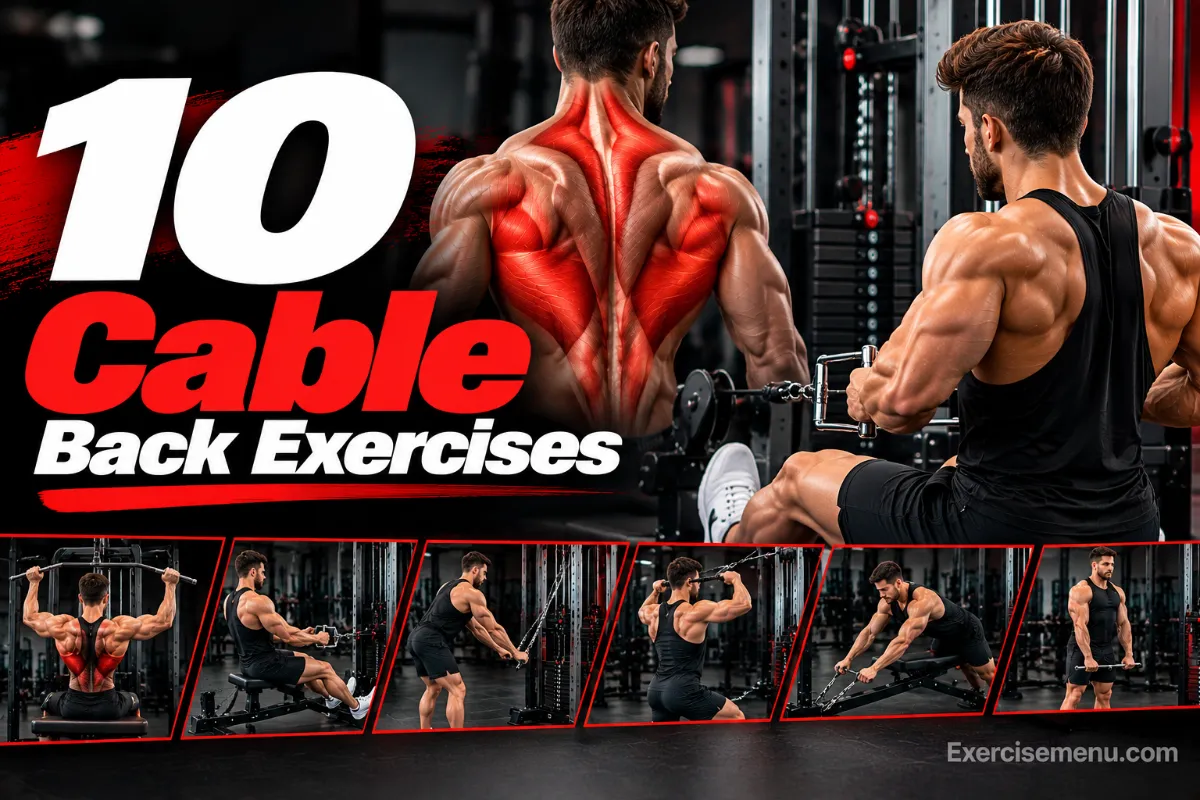
Quick Answer: 39 words / 244 characters Overhead pulls like lat pulldowns build width through the lats. Horizontal pulls like seated rows build thickness through the mid-back. Train both directions each session. Set the pulley above head height for pulldowns and at waist height for rows.
- Key Takeaways
- What Are the Best Cable Back Exercises?
- Which Muscles Do Cable Back Exercises Work?
- What Decides Back Width Versus Thickness?
- Why Do Cable Back Exercises Feel Like Arm Exercises?
- What Does a Full Cable Back Workout Look Like?
- How Often Should You Train Back With Cables?
- Frequently Asked Questions
Key Takeaways
- A 2026 review of 23 EMG studies found grip width an unreliable predictor of lat activation on the pulldown — but on the seated row, a narrower grip did produce more (Di Fonza et al., 2026).
- The cable pullover appears on most back exercise lists, yet the pullover evidence the same review gathered shows the pectorals outworking the lats.
- Cable back work braces the lower back rather than training it — the erector spinae holds position isometrically, so direct lower back work needs hinge patterns instead.
- Think about where your elbow finishes, not where your hand is — that single change fixes most of the “I feel it in my arms” problem.
- Split your weekly back volume across two sessions rather than one — grip and torso position fail long before the lats do.
Almost every cable back guide organises its exercises around grip width: wide for width, close for thickness. A 2026 review of 23 electromyography studies found that grip width does not reliably change lat activation on the pulldown at all. What does change it is the direction you pull from.
The ten exercises below are grouped by that principle, overhead pulls, horizontal pulls, and straight-arm work, with the pulley height, attachment and stance for each. After them you get the muscles each direction loads, why pulldowns so often turn into arm exercises, two complete workouts, and the two popular moves the evidence does not support.
What Are the Best Cable Back Exercises?
The best cable back exercises split into three groups by the direction the cable pulls from: overhead pulls that load the lats, horizontal pulls that load the mid-back, and straight-arm work that trains the lats without the biceps. A complete session takes at least one from each group. Cables earn their place here because the line of pull holds tension on the lat at full stretch, where a dumbbell row loses it. If the pulley adjuster or weight stack is still unfamiliar, the cable machine setup guide covers that first.
Vertical Pulls — Lats and Back Width
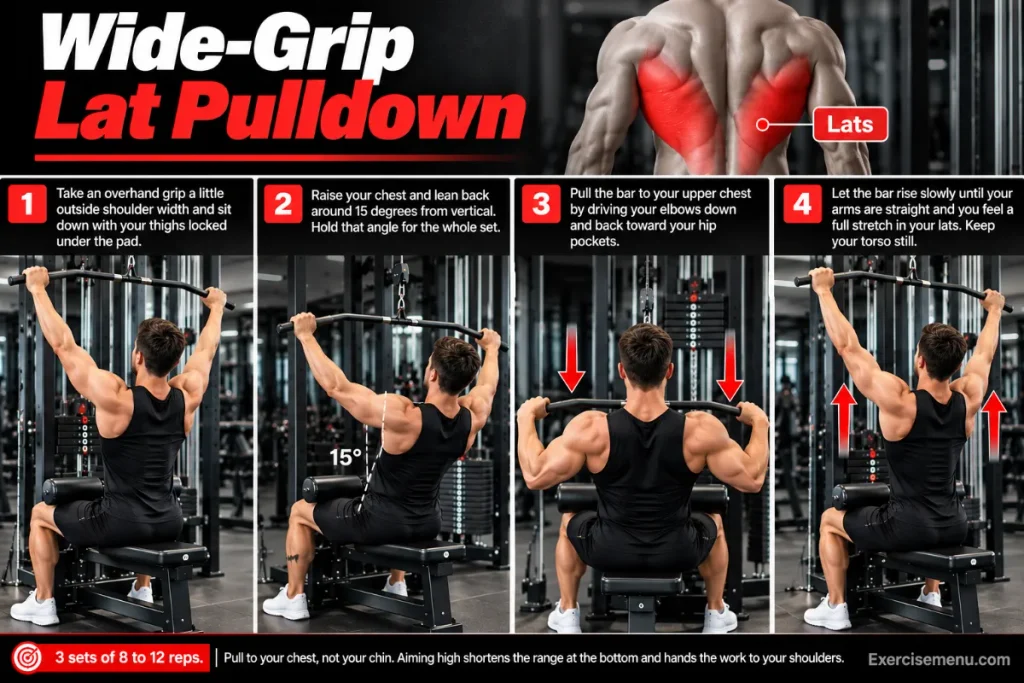
1. Wide-Grip Lat Pulldown
Pulley at the top · wide lat bar · seated, thigh pad snug.
- Take an overhand grip a little outside shoulder width and sit down with your thighs locked under the pad.
- Raise your chest and lean back around 15 degrees from vertical. Hold that angle for the whole set.
- Pull the bar to your upper chest by driving your elbows down and back toward your hip pockets.
- Let the bar rise until your lats are at full stretch and your shoulders have travelled up, without your torso following.
3 sets of 8 to 12 reps. Pull to your chest, not your chin. Aiming high shortens the range at the bottom and hands the work to your shoulders.
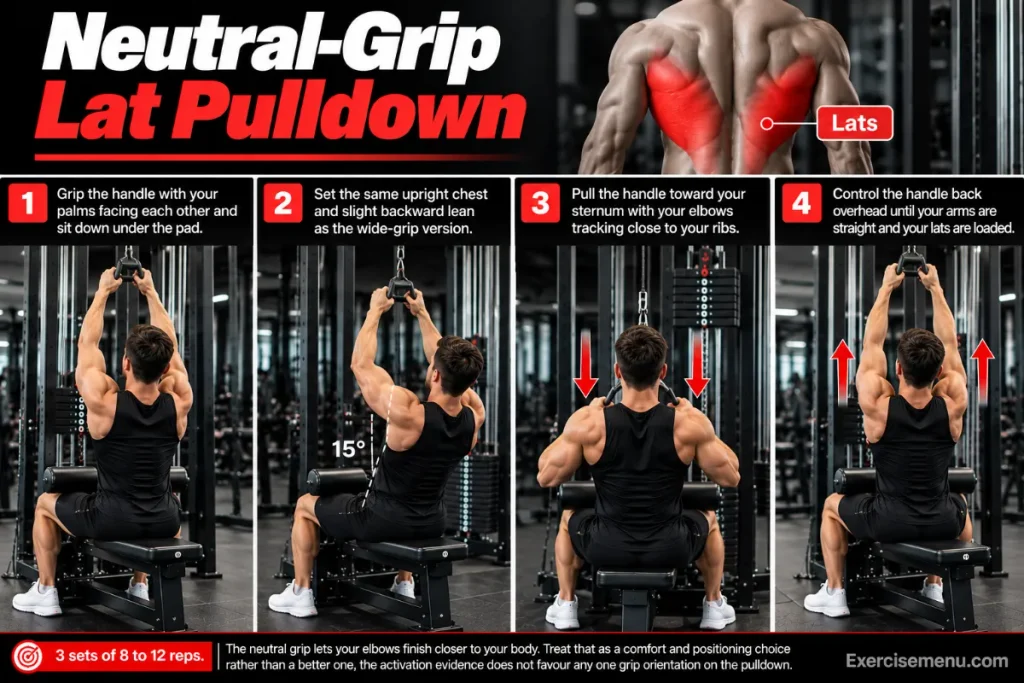
2. Neutral-Grip Lat Pulldown
Pulley at the top · V-bar or neutral handle · seated.
- Grip the handle with your palms facing each other and sit down under the pad.
- Set the same upright chest and slight backward lean as the wide-grip version.
- Pull the handle toward your sternum with your elbows tracking close to your ribs.
- Control the handle back overhead until your arms are straight and your lats are loaded.
3 sets of 8 to 12 reps. The neutral grip lets your elbows finish closer to your body. Treat that as a comfort and positioning choice rather than a better one, the activation evidence does not favour any one grip orientation on the pulldown.
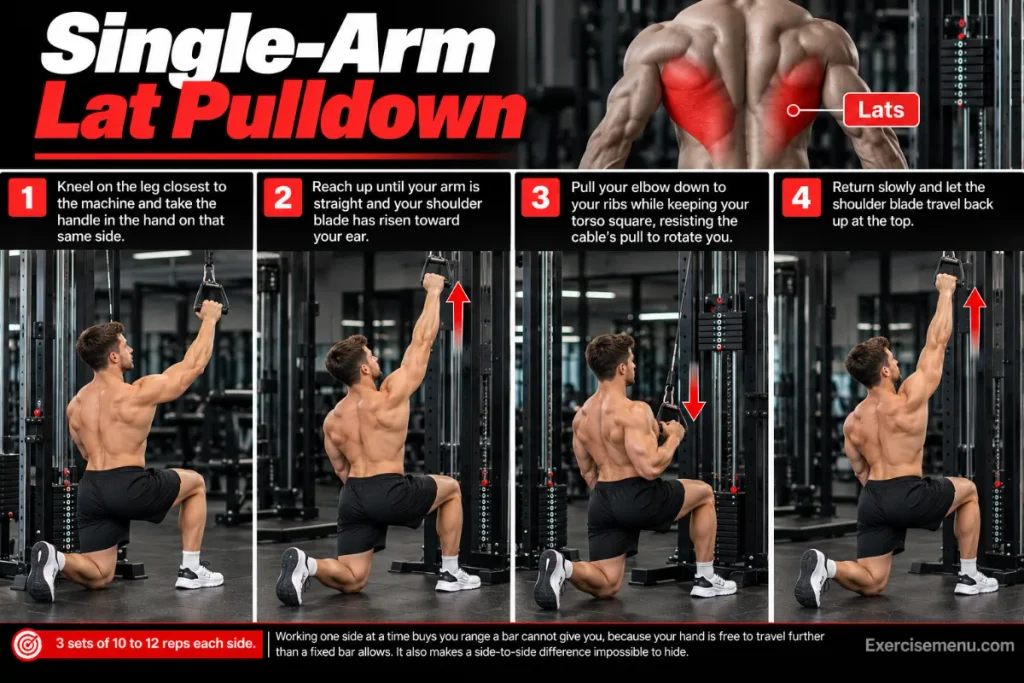
3. Single-Arm Lat Pulldown
Pulley at the top · D-handle · half-kneeling, side-on to the column.
- Kneel on the leg closest to the machine and take the handle in the hand on that same side.
- Reach up until your arm is straight and your shoulder blade has risen toward your ear.
- Pull your elbow down to your ribs while keeping your torso square, resisting the cable’s pull to rotate you.
- Return slowly and let the shoulder blade travel back up at the top.
3 sets of 10 to 12 reps each side. Working one side at a time buys you range a bar cannot give you, because your hand is free to travel further than a fixed bar allows. It also makes a side-to-side difference impossible to hide.
Horizontal Pulls — Mid-Back and Thickness
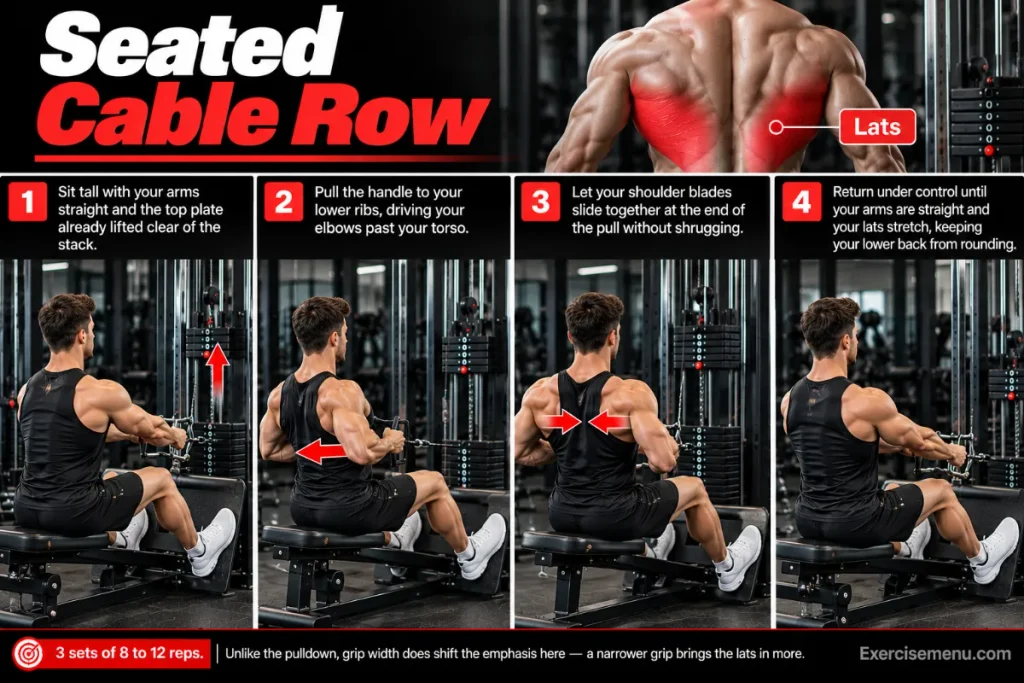
4. Seated Cable Row
Low pulley · V-bar · feet on the platform, knees soft.
- Sit tall with your arms straight and the top plate already lifted clear of the stack.
- Pull the handle to your lower ribs, driving your elbows past your torso.
- Let your shoulder blades slide together at the end of the pull without shrugging.
- Return under control until your arms are straight and your lats stretch, keeping your lower back from rounding.
3 sets of 8 to 12 reps. Unlike the pulldown, grip width does shift the emphasis here — a narrower grip brings the lats in more.
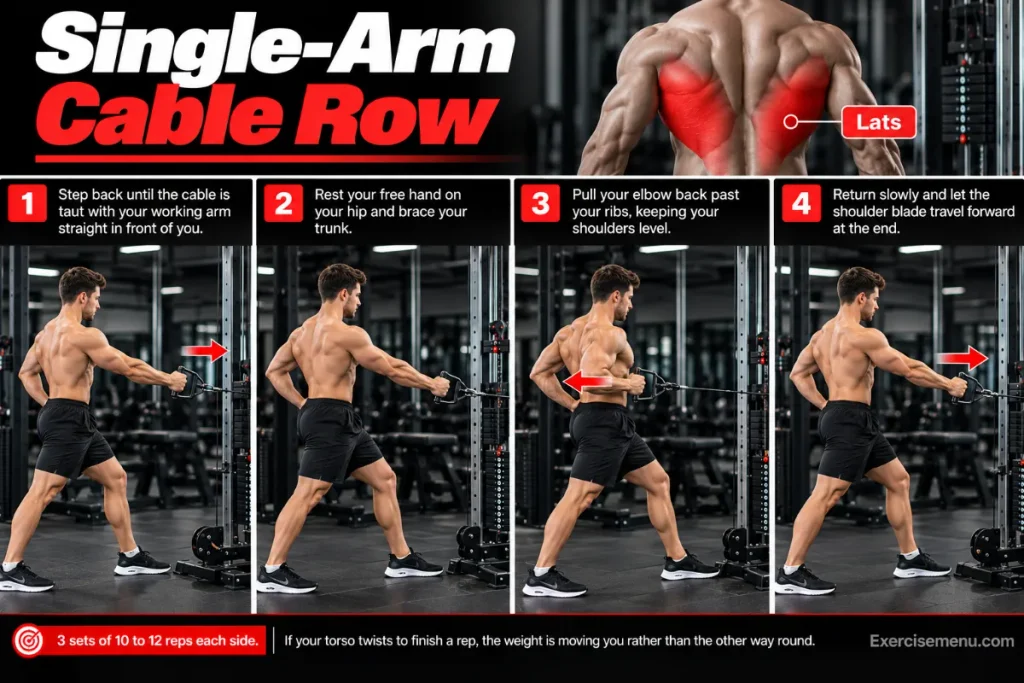
5. Single-Arm Cable Row
Low pulley · D-handle · split stance facing the column.
- Step back until the cable is taut with your working arm straight in front of you.
- Rest your free hand on your hip and brace your trunk.
- Pull your elbow back past your ribs, keeping your shoulders level.
- Return slowly and let the shoulder blade travel forward at the end.
3 sets of 10 to 12 reps each side. If your torso twists to finish a rep, the weight is moving you rather than the other way round.
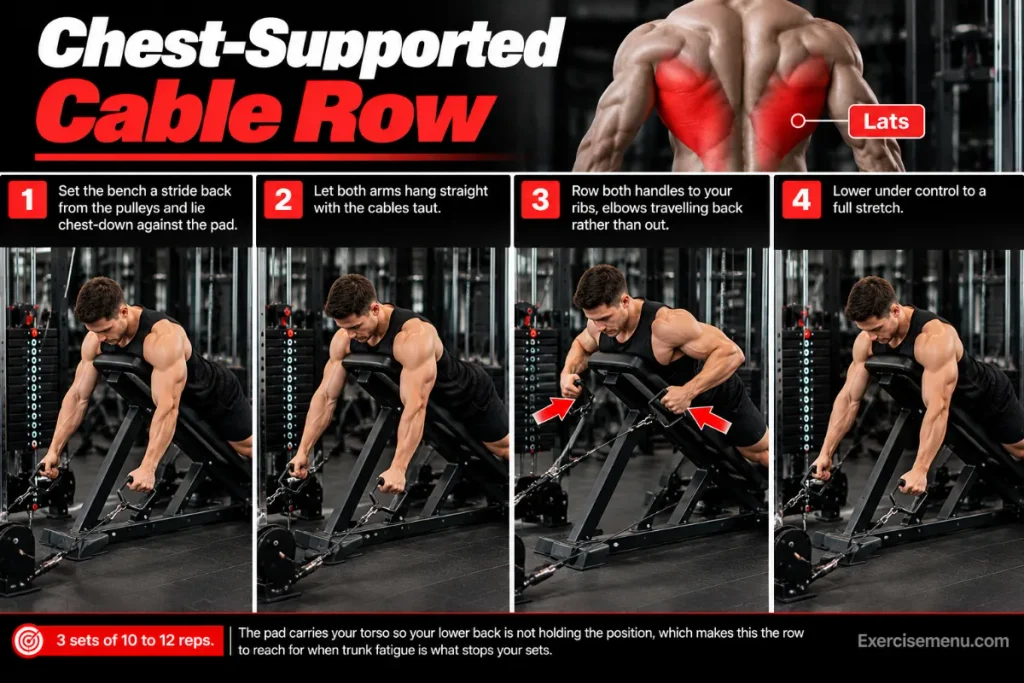
6. Chest-Supported Cable Row
Low pulley · two D-handles · incline bench at roughly 45 degrees, facing the column.
- Set the bench a stride back from the pulleys and lie chest-down against the pad.
- Let both arms hang straight with the cables taut.
- Row both handles to your ribs, elbows travelling back rather than out.
- Lower under control to a full stretch.
3 sets of 10 to 12 reps. The pad carries your torso so your lower back is not holding the position, which makes this the row to reach for when trunk fatigue is what stops your sets.
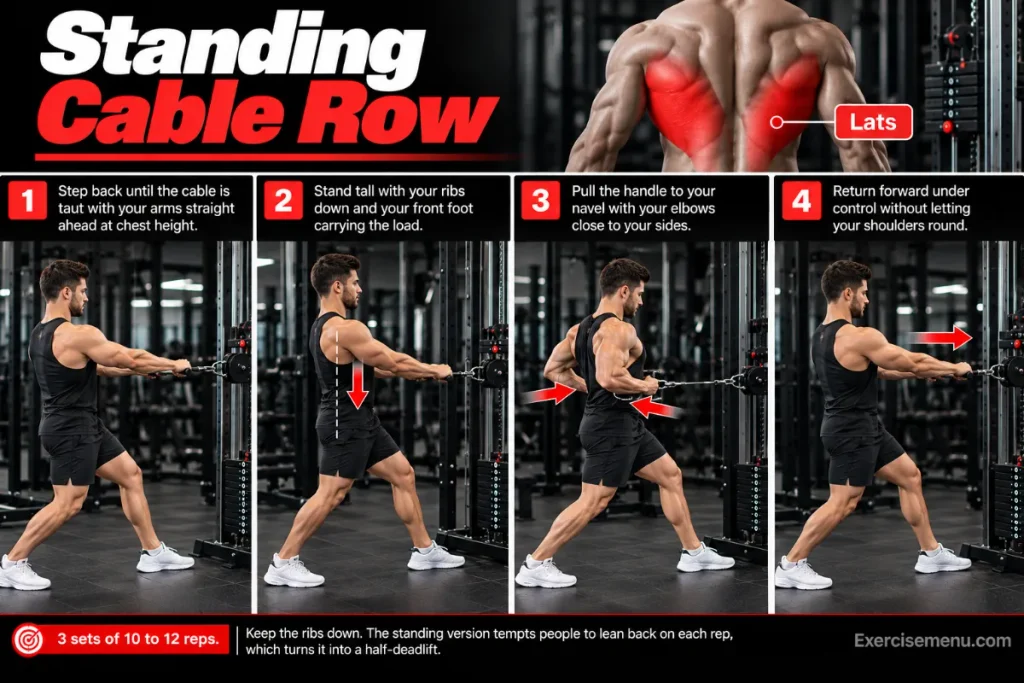
7. Standing Cable Row
Pulley at mid-torso height · straight bar or rope · split stance.
- Step back until the cable is taut with your arms straight ahead at chest height.
- Stand tall with your ribs down and your front foot carrying the load.
- Pull the handle to your navel with your elbows close to your sides.
- Return forward under control without letting your shoulders round.
3 sets of 10 to 12 reps. Keep the ribs down. The standing version tempts people to lean back on each rep, which turns it into a half-deadlift.
Straight-Arm and Rear-Delt Work
8. Straight-Arm Pulldown
Pulley at the top · straight bar or EZ bar · standing an arm’s length back, hips hinged slightly.
- Hold the bar with arms nearly straight and a small fixed bend at the elbow.
- Sweep the bar down in a wide arc until it reaches the front of your thighs.
- Hold for a count with your lats shortened.
- Let your arms rise back overhead until you feel the stretch.
3 sets of 12 to 15 reps. The elbow angle stays locked for the entire set. If it opens and closes, you have turned a lat exercise into a triceps pushdown.
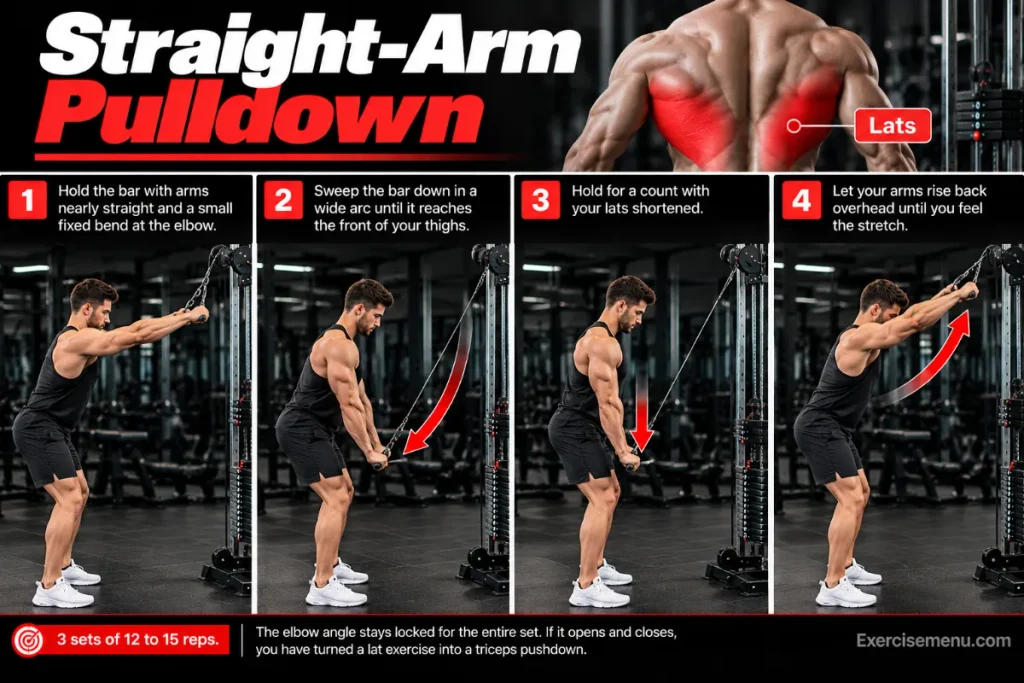
9. Rope Face Pull
Pulley slightly above head height · rope · split stance.
- Take an end of the rope in each hand with your thumbs pointing back.
- Step back until the cable is taut with your arms straight ahead.
- Pull toward your forehead, separating your hands as they arrive and keeping your elbows level with your shoulders.
- Return forward under control.
3 sets of 15 reps. The hands have to split apart at the end — that separation is what brings the external rotators in, and a straight bar makes it impossible. Set the pulley too low and the movement stops being a face pull and becomes an upright row.
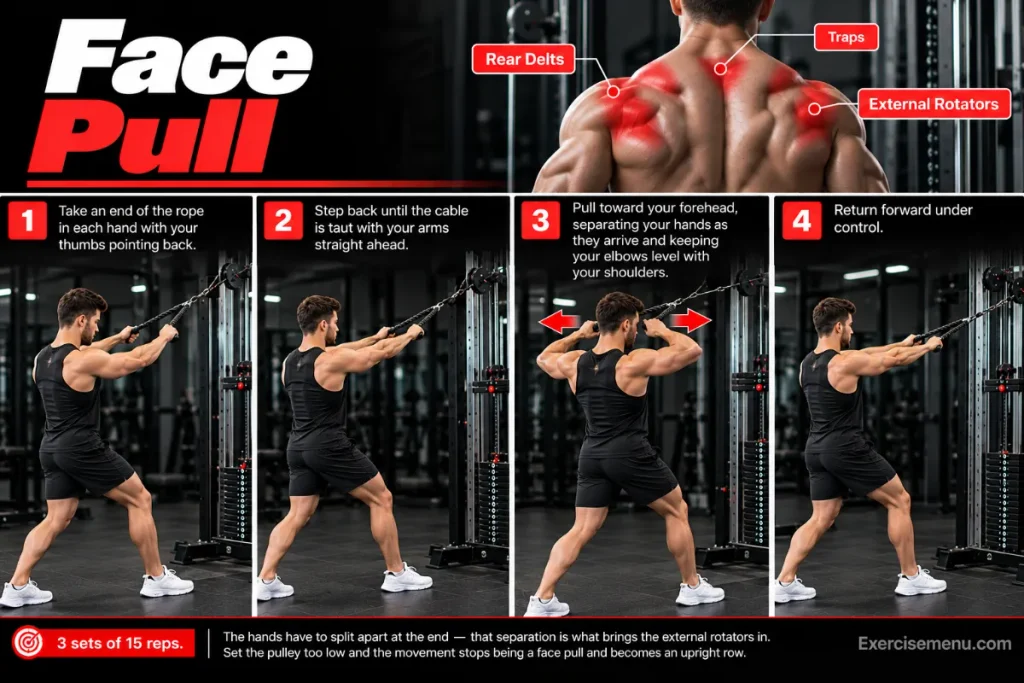
10. Cable Shrug
Lowest pulley · straight bar or two D-handles · standing tall.
- Stand with your arms straight down and the cable taut.
- Lift your shoulders straight up toward your ears.
- Pause at the top for a count.
- Lower under control until your traps are at full stretch.
3 sets of 12 to 15 reps. Straight up and straight down. Rolling the shoulders adds range the traps never use and loads the joint instead.
Ten exercises in three groups covers the whole back. Which muscle each group actually loads is where the grouping earns its place.
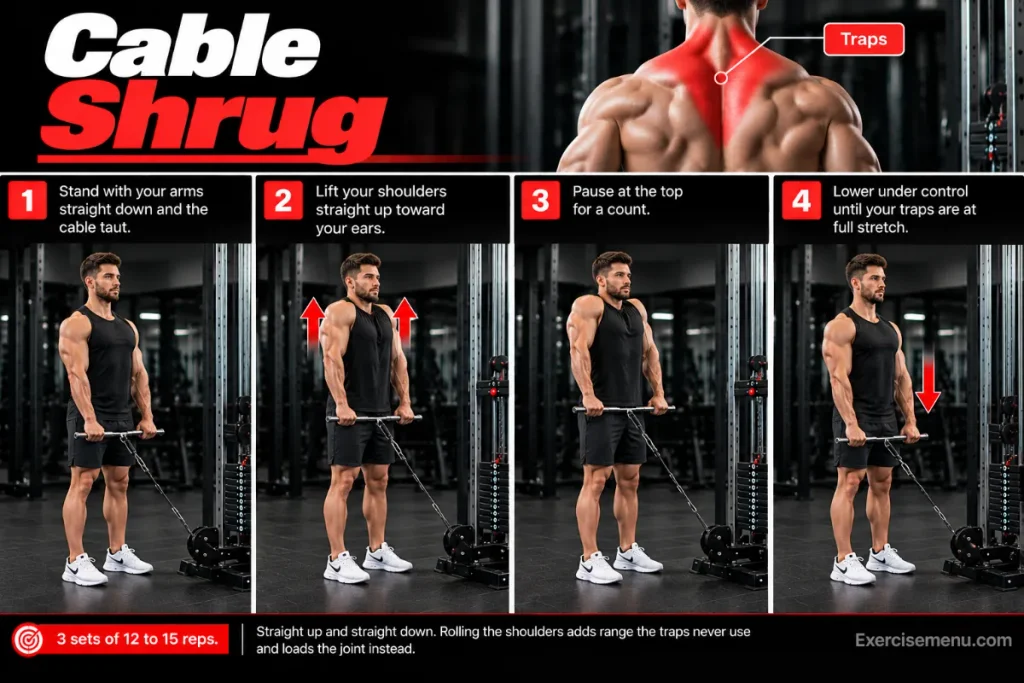
Which Muscles Do Cable Back Exercises Work?
Overhead pulls load the lats and teres major, horizontal pulls load the mid and lower traps and the rhomboids, and high horizontal pulls bring in the rear delts. The erector spinae works isometrically through every standing variation, holding your spine in place rather than moving it.
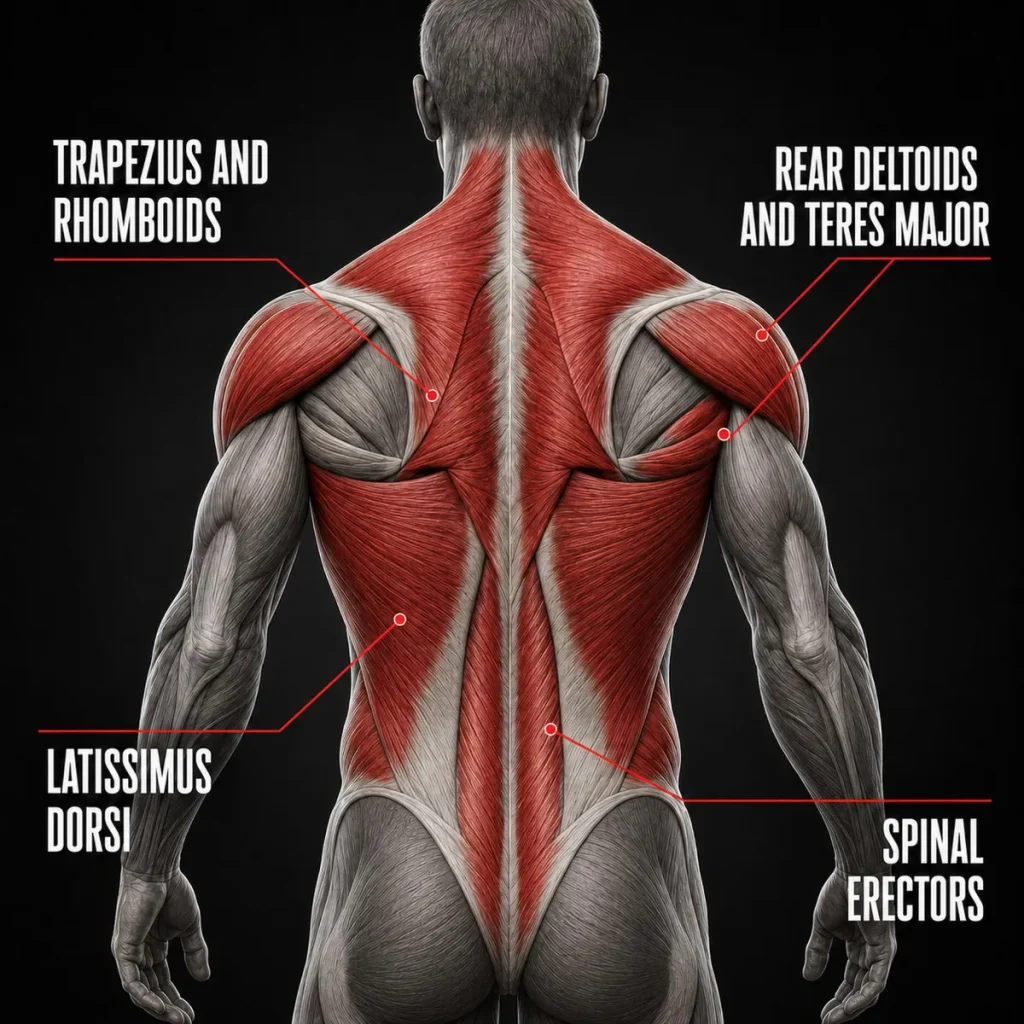
| Muscle | What it does in a back exercise | Pull direction that loads it | Best cable exercise |
| Latissimus dorsi | Pulls the upper arm down and back toward the body | Vertical | Wide-grip lat pulldown |
| Teres major | Assists the lats in pulling the arm down | Vertical | Neutral-grip pulldown |
| Mid and lower trapezius | Draws the shoulder blades together and down | Horizontal | Seated cable row |
| Rhomboids | Pulls the shoulder blades toward the spine | Horizontal | Chest-supported row |
| Rear deltoids | Pulls the upper arm backward and outward | Horizontal, above shoulder | Rope face pull |
| Upper trapezius | Lifts the shoulder blade | Vertical, loaded from below | Cable shrug |
| Erector spinae | Holds the spine braced (isometric, not moving) | All standing variations | Standing cable row |
| Biceps and forearms | Bend the elbow and hold the grip | Every pull | All ten |
Note the erector spinae row: on cable back work these muscles brace rather than lift. Training them directly needs hinge patterns, which is a separate job from the ten movements above.
Read down the third column and the pattern is hard to miss. Direction, not grip, is what moves the work from one muscle to another.
What Decides Back Width Versus Thickness?
The direction you pull from, not how wide you grip. Pulling from overhead loads the lats, which run down the sides of your back and create width. Pulling horizontally loads the traps and rhomboids between your shoulder blades, which create thickness. Both belong in the same session.
The grip-width idea is older than the evidence behind it. A 2026 narrative review by Di Fonza and colleagues in the Journal of Functional Morphology and Kinesiology pooled 23 EMG studies and found grip width an inconsistent predictor of lat activation during the lat pulldown. On the seated row it was a different story: a narrower grip and a lower arm angle each produced more lat activity.
So grip width is worth adjusting on rows and worth ignoring on pulldowns. The review also found an anterior bar path, in front of the head, more consistently linked to lat activation than pulling behind the neck.
Two limits are worth stating. These studies measured muscle activity during single sessions, not muscle gained over months, and the samples were small and mostly male. Treat the findings as a sensible starting point rather than a rule.
Why the Cable Pullover Keeps Appearing on Back Lists
Four of the most widely read cable back guides include a cable pullover. The pullover research the same review gathered does not support it as a lat exercise: in the study it cites, pectoralis major activity exceeded latissimus dorsi activity, and the review concludes the pullover should not be a first choice for loading the lats in isolation from the pecs.
That testing was done on the barbell version, and the cable variation has not been measured the same way, so the fair reading is that the pullover family is unproven for lats rather than proven useless. If you enjoy the movement, keep it, but do not count on it to do your lat work.
Knowing which exercises load the back is one problem. Feeling them there is a different one.
Why Do Cable Back Exercises Feel Like Arm Exercises?
Because the biceps bend the elbow on every single back pull, and if you think about moving your hands, the biceps lead. Shifting your attention to where the elbow finishes is the fastest fix, and five habits undo it.
Thinking About Your Hands Instead of Your Elbows
Your hands are only hooks. Pick the point your elbow should finish at, hip pocket on a pulldown, past your ribs on a row, and drive it there. Deliberately focusing on the working muscle has a measurable effect on which muscle does the work, which is the practical side of the mind-muscle connection.
Crushing the Grip
A white-knuckle grip recruits the forearms and biceps before the pull even starts. Hold the bar firmly enough not to drop it and no tighter.
Locking the Shoulder Blades
Holding your shoulder blades pinned in one position for the whole rep cuts out the range where the lats and traps do most of their work. Let the blade travel: up at the top of a pulldown, forward at the end of a row.
Swinging the Torso
Rocking back on a pulldown or lurching on a row moves the weight using your body mass. Fix the torso angle at the start and hold it. If you cannot, the pin is too low.
Pulling to the Chin on Pulldowns
Stopping the bar high cuts the bottom of the range where the lats are shortest and working hardest. Bring it to your upper chest.
Pulling Behind the Neck
Behind-the-neck pulldowns offer no consistent lat advantage over the front version, and they force the shoulder into extreme external rotation under load. There is no reason to accept that trade.
With the execution sorted, the remaining question is how to arrange these movements into a session.
What Does a Full Cable Back Workout Look Like?
Two vertical pulls, two horizontal pulls and one straight-arm or rear-delt movement covers the whole back in about 45 minutes. Run the heaviest pulls first while you are fresh, and finish with the lighter isolation work.
Workout A — Complete Cable Back Session
| Exercise | Sets × Reps | Rest |
| Wide-Grip Lat Pulldown | 4 × 8–10 | 2 min |
| Seated Cable Row | 4 × 8–10 | 2 min |
| Single-Arm Lat Pulldown | 3 × 10–12 each side | 90 sec |
| Chest-Supported Cable Row | 3 × 10–12 | 90 sec |
| Rope Face Pull | 3 × 15 | 60 sec |
Workout B — 25-Minute Version
| Exercise | Sets × Reps | Rest |
| Neutral-Grip Lat Pulldown | 3 × 8–12 | 90 sec |
| Single-Arm Cable Row | 3 × 10–12 each side | 90 sec |
| Straight-Arm Pulldown | 2 × 12–15 | 60 sec |
Add a rep before you add a plate, and only move the pin once every set finishes at the top of its range with the same control it started with. If you are pairing this with a pushing session, the cable chest exercises guide follows the same structure.
Either session is a single day’s work. How many of them you run in a week is what decides whether the back grows.
How Often Should You Train Back With Cables?
Twice per week suits most lifters, with 10 to 20 hard sets for the back spread across those sessions. The back recovers well because no single exercise fatigues all of it, pulldowns and rows load different muscles, so alternating them lets you train more often than a single movement would allow.
The weekly total matters more than how you split it. A 2025 meta-regression of 67 studies and 2,058 participants concluded that raising training frequency has a negligible effect on muscle growth once weekly volume is accounted for (Pelland et al., 2025). The practical case for two sessions is quality rather than growth: the back half of a long session is done with a tired grip and a fading position. Set counts by training age are covered in how many sets per muscle group per week.
If cables are your only back work, use the higher end of that set range. If they follow pull-ups or barbell rows, six to ten cable sets on top is usually enough.
Frequently Asked Questions
Should You Use Lifting Straps for Cable Back Exercises?
Use them when your grip gives out before your back does, which usually happens on the last sets of heavy rows. Keep your earliest sets strap-free so your grip still gets trained, then strap up when it becomes the limiting factor rather than the target.
Can You Build a Strong Back Using Only Cables?
You can build a well-developed one, though not an optimal one. ACE-sponsored testing of eight back exercises found pull-ups and chin-ups produced clearly higher lat activation than any machine-based pull, so adding even one bodyweight pulling movement fills the gap cables leave (Edelburg, Porcari et al., 2018).
Which Cable Back Exercises Are Safest If You Have Lower Back Pain?
Anything that keeps your torso supported by a bench or a seat, rather than holding it up yourself. Standing pulls and hinged positions ask the lower back to stabilise the whole load, which is the part most people cannot tolerate on a bad day. Persistent pain is a reason to see a physiotherapist before picking exercises at all. [Lower back cable exercises are covered separately — bold placeholder until that article is live.]
How Do You Fix a Left-Right Strength Difference With Cables?
Start every single-arm set with your weaker side, then match that exact rep count on the stronger side even if it has more left. Running the weaker side first and capping the stronger one stops the gap widening while the difference closes.
Do You Need to Train to Failure on Cable Back Exercises?
No. Stopping one to three reps short gives you most of the growth stimulus with far less fatigue, which matters on back work because grip and lower-back position usually fail before the target muscle does. Save true failure for the final set of an isolation movement, if at all.
Pick one overhead pull, one horizontal pull and one straight-arm movement, drive your elbows rather than your hands, and keep your grip width adjustments for rows. Run Workout A twice this week and change nothing else until both sessions feel repeatable.
Disclaimer: If you have an existing shoulder, neck or back injury, check with your doctor or physiotherapist before starting loaded pulling work.

2 Comments
Pingback: Cable Chest Exercises: 10 Best Moves and a Full Workout
Pingback: How to Use a Cable Machine (And Read the Weight Right)