

Quick Answer: Set the pulley height for your exercise, clip on an attachment, choose a light weight, then step away from the column until the cable is taut before your first rep. On most dual-stack machines the weight you feel is half the number on the pin.
- Key Takeaways
- What Are the Parts of a Cable Machine?
- How Do You Set Up a Cable Machine?
- Why Doesn’t the Weight Match the Number on the Stack?
- Which Cable Attachment Should You Use?
- Where Should You Stand on a Cable Machine?
- What Mistakes Do Beginners Make on the Cable Machine?
- What Should Your First Cable Workout Look Like?
- Frequently Asked Questions
Key Takeaways
- Machines and free weights build muscle at the same rate, but strength carries over to whichever one you trained on — a 2022 meta-analysis found no difference in muscle size and a clear difference in how strength tested (Heidel et al., 2022).
- A 2:1 pulley also doubles how far the cable travels, which is why the same movement feels longer on a functional trainer than on a fixed machine.
- The attachment changes your grip and the direction the cable pulls from — it does not change which muscle does the main work, so pick it for comfort and angle.
- Never compare your cable weights against another machine; two gyms can use different ratios and the same pin number means different loads.
- How far you stand from the column decides how much tension you get at the start of the rep, and standing too close removes the hardest part of the movement.
The number on the weight stack is not the weight in your hand. On most dual-stack cable machines the pulley arrangement halves the load, so a 100 lb pin gives you around 50 lb at the handle. Nobody tells beginners this, and it is the reason your first cable session feels like the numbers make no sense.
This guide covers the machine itself rather than a list of exercises: what each part does, how to set the height and attachment, why the weight reads the way it does, where to stand, the errors that cost you tension, and five movements to run on your first session.
What Are the Parts of a Cable Machine?
A cable machine has five parts you touch: the weight stack and its pin, the pulley carriage and its adjuster, the cable, the carabiner clip, and the attachment. Everything else is frame.
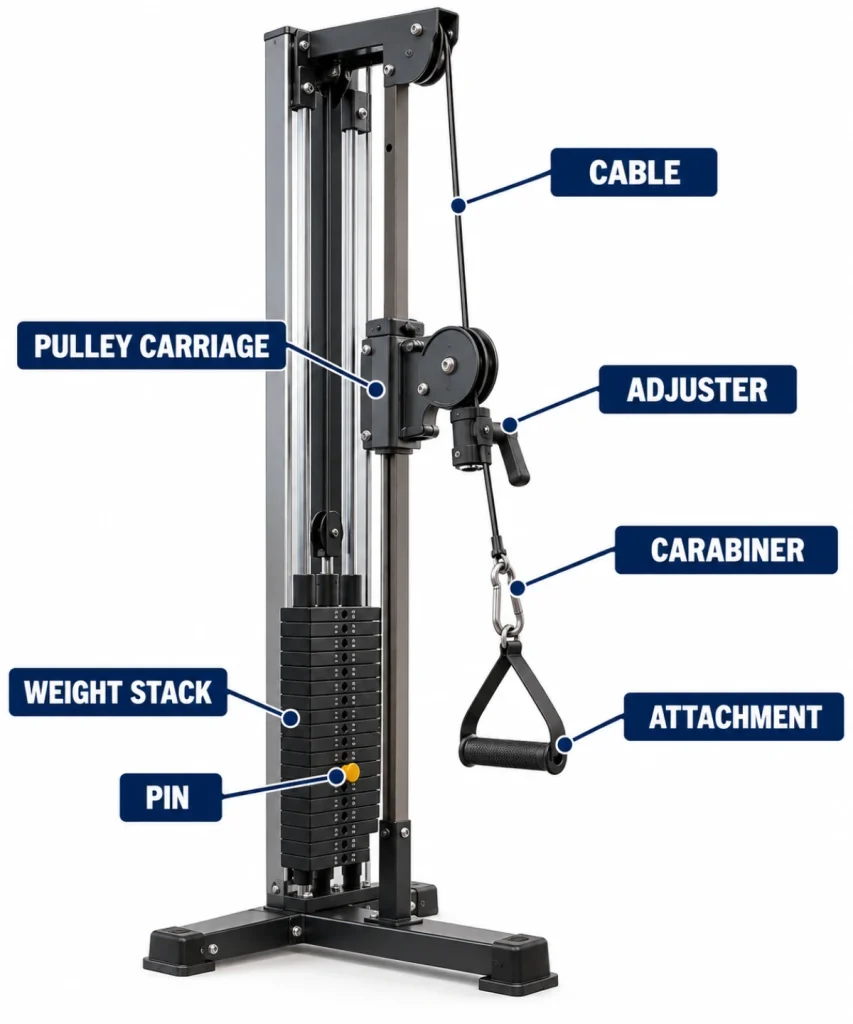
- Weight stack — the column of plates. The pin slots into a hole to pick up everything above it, so a lower pin means more weight.
- Pulley carriage — the sliding block the cable runs through. This is what you move up and down to change the angle of the pull.
- Adjuster — the lever, pin, or spring-loaded knob that releases the carriage. Every brand builds this differently, which is why the machine at a new gym can stump you for a minute.
- Carabiner — the spring-gate clip on the end of the cable. Attachments hook onto this.
- Attachment — the handle, rope, bar, or strap you actually hold.
| Is the machine worth learning? A meta-analysis by Heidel and colleagues (2022) found no difference in muscle growth between machine-based and free-weight training (effect size −0.01, 95% CI −0.525 to 0.545). Strength was a different story: it tested higher on whichever equipment the group had trained with. So the cable station builds size as well as anything else, but if your goal is a heavier barbell lift you still need the barbell. What the machine adds over dumbbells is tension that never drops off inside the rep, weight increments small enough to progress in 5 lb steps, and a path that holds its line while you learn the movement. |
Knowing the parts is enough to follow the setup. The order you touch them in is what keeps the process quick.
How Do You Set Up a Cable Machine?
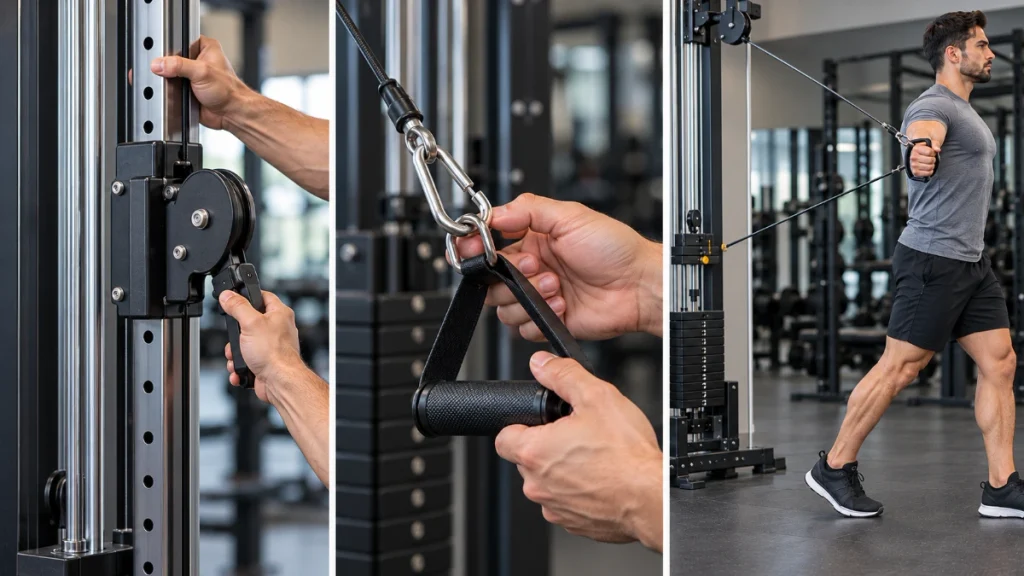
Set the pulley height first, clip the attachment second, load the pin third, then step out and remove the slack before you move. Doing it in that order means you never have to reach across a loaded cable.
Step 1: Set the Pulley Height
Find the adjuster on the side of the carriage and release it. You will meet one of three designs: a pull-pin you tug outward, a lever you squeeze or flip up, or a spring-loaded knob you pull and hold. Slide the carriage to the height you need, then let the mechanism seat itself and give it a short tug to confirm it has locked.
As a rough guide, the pulley sits below your knee for anything that travels upward, at shoulder height for anything that travels straight forward or back, and above your head for anything that travels down.
Step 2: Clip On the Attachment
Open the carabiner gate with your thumb, hook the attachment through, and let the gate snap shut. Then look at it. A carabiner that has closed on the webbing instead of through the ring will hold for a few reps and then release, usually at the worst moment.
Step 3: Load the Pin
Push the pin all the way in until it seats against the stop. A pin resting halfway can slip out mid-set. Start lighter than you think — the first set is for finding the right distance and path, not for proving anything.
Step 4: Step Out and Take the Slack Out
Walk away from the column until the cable pulls straight and the top plate lifts slightly off the stack. You should feel resistance while standing still. If the cable sags at your starting position, the first part of every rep is unloaded and the muscle never sees the hardest range.
Step 5: Run One Slow Test Rep
Move through the full range once, slowly. If you cannot pause for a second at the hardest point of the movement, drop the pin a plate or two. If the stack bangs on the way back, you are lowering too fast rather than lifting too heavy.
That sequence works on every cable station you will meet. The part that confuses people next is the number they just loaded.
Why Doesn’t the Weight Match the Number on the Stack?
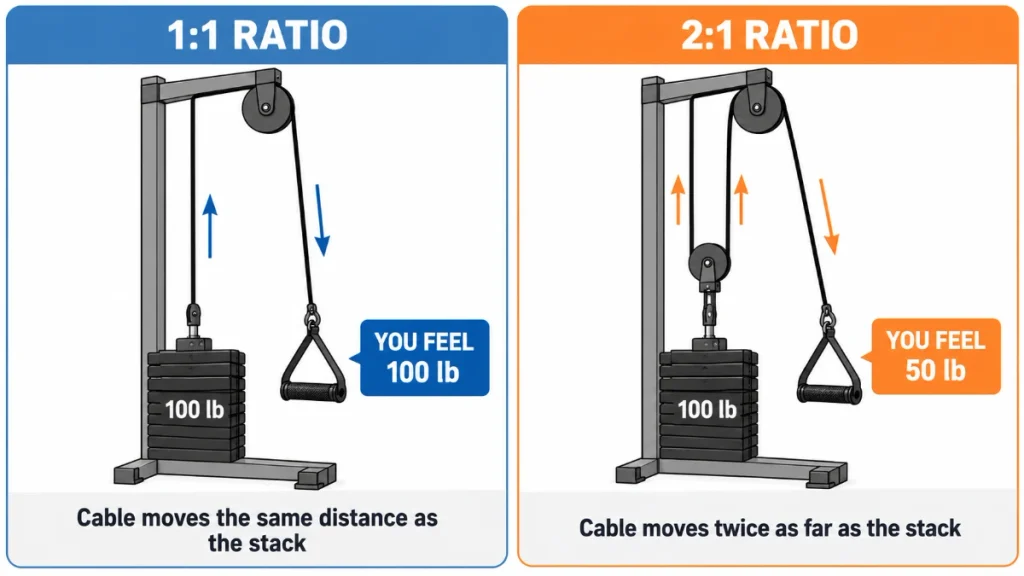
Because the pulley arrangement changes the load before it reaches your hand. Cable machines are built to one of two common ratios, and only one of them gives you the number printed on the plate.
| Pulley ratio | 100 lb pin feels like | Cable travel | Usually found on |
| 1:1 | 100 lb | Same as the stack moves | Lat pulldown, seated row, single-stack towers |
| 2:1 | About 50 lb | Twice the stack movement | Dual-stack functional trainers, cable crossovers |
Ratios per REP Fitness equipment specifications.
The halved load is not a flaw. The trade is cable travel: a 2:1 setup lets the handle move twice as far as the plates do, which is what makes wide sweeping movements like crossovers and woodchops possible on the same frame. Machines built for heavy straight pulls use 1:1 instead, because range matters less than load there.
What This Means in Practice
Three things follow from it. Your cable numbers will look higher than your dumbbell numbers for the same muscle, and that is expected. Your numbers from one gym will not match another gym, so track progress on the machine you actually use. And if you run out of plates on a 2:1 station, you are closer to its ceiling than the printed total suggests.
Do Both Stacks Need the Same Weight?
Only when both arms are working at once. For a two-handed movement, matching the stacks keeps the pull even side to side. For single-arm work you load one stack and leave the other alone. Nothing breaks if they differ — the machine does not link them.
Load sorted, the next thing in your hands is the piece that decides how the weight reaches you.
Which Cable Attachment Should You Use?
Pick the attachment that lets your wrists sit comfortably through the full movement, then let the pulley height handle the rest. The attachment changes your grip and the line the cable pulls along; it does not decide which muscle does the work.
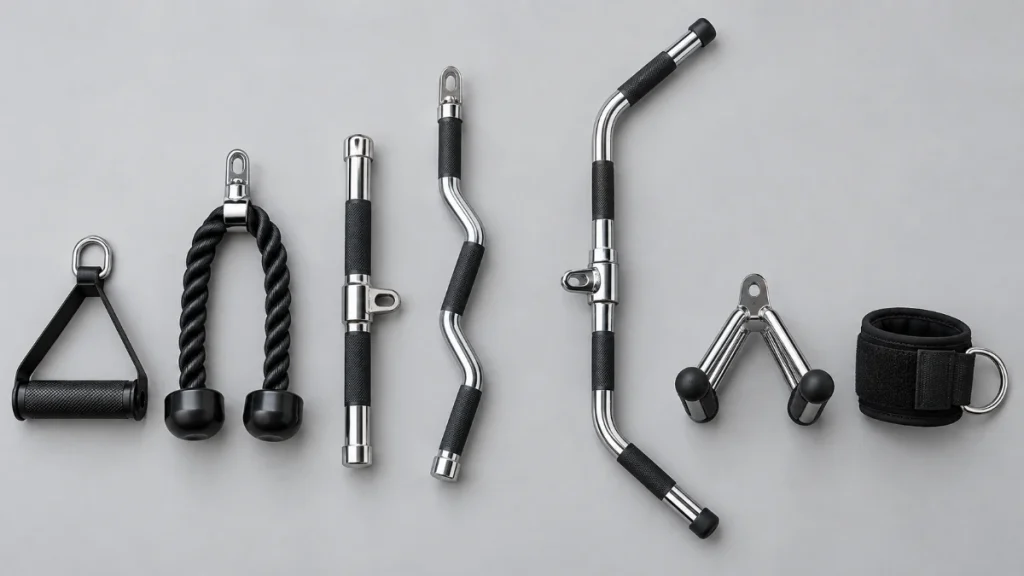
| Attachment | Best used for | What it changes |
| D-handle (single) | Single-arm rows, presses, flyes, lateral raises | Lets the wrist rotate freely; the default for one-arm work |
| Tricep rope | Pushdowns, face pulls, overhead extensions, crunches | Lets the hands separate at the end of the rep |
| Straight bar | Pushdowns, curls, upright rows, rows | Fixes both hands in line; simple but harder on the wrists |
| EZ bar | Curls, overhead extensions | Angled grip that takes strain off the wrists and elbows |
| Lat pulldown bar | Pulldowns, straight-arm pulldowns | Wide grip positions for overhead pulling |
| V-bar | Close-grip rows and pulldowns, pushdowns | Neutral palms-facing grip, usually the most comfortable |
| Ankle strap | Kickbacks, hip abduction, leg extensions | Moves the anchor point to the leg and frees the hands |
Attachments are not universal between brands. Most use a standard carabiner and swap freely, but some manufacturers build proprietary clips, so a handle bought online may not fit a gym machine. Check the clip before buying anything for home use.
With the attachment chosen, the last setup variable is the one most people never think about.
Where Should You Stand on a Cable Machine?
Your distance from the column decides how much tension the muscle gets at its longest, weakest position — the part of the rep that drives most of the growth. Get it wrong in either direction and the exercise still looks correct while doing considerably less.
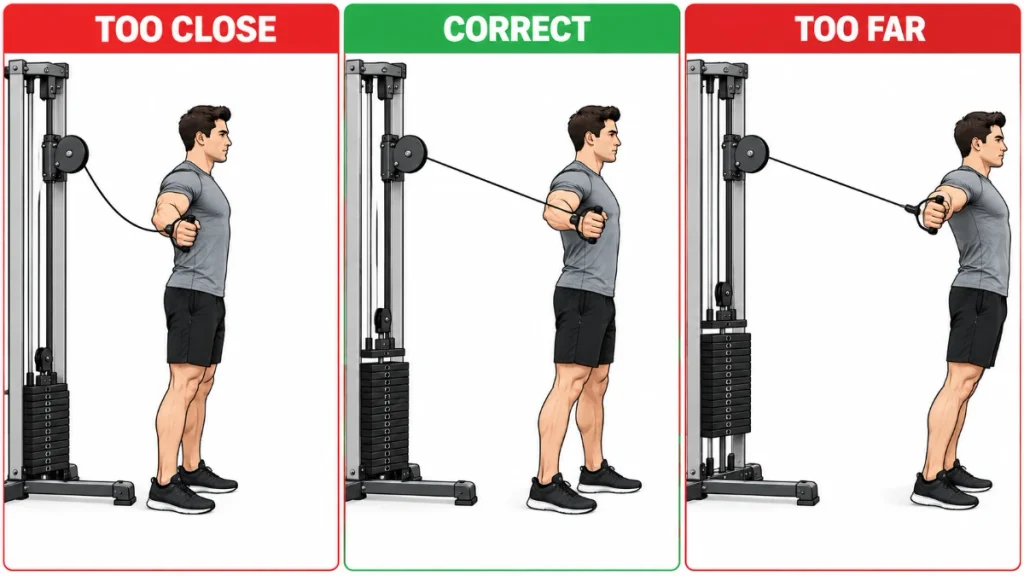
Too close and the cable goes loose at the start. The muscle only begins working partway through the rep, and the stretched position — where the most useful tension sits — gets skipped entirely. Too far and the tension at full stretch exceeds what the working muscle can hold, so the joint takes the difference. You want a stretch across the muscle, not a pull at the joint.
Direction matters as much as distance. The cable should run in a straight line from the pulley to your hand with nothing fouling it, and your body should be angled so that the line of pull opposes the direction you plan to move. If the cable rubs against your arm or crosses your torso on the way, reposition before adding weight.
If Your Gym Only Has One Column
A single adjustable column covers every one-arm movement, and it handles two-arm exercises by running one side at a time. The session takes longer, but the training effect per arm is unchanged. Working one side at a time also removes the chance of one arm quietly doing more than the other.
Height, attachment, load, and position cover the setup. What goes wrong after that tends to be the same handful of habits.
What Mistakes Do Beginners Make on the Cable Machine?
The most common cable mistake is swinging the body to start the weight moving, which hands the work to momentum instead of the muscle. Five more follow close behind, and most are fixed before the weight moves at all.
Using Your Body to Start the Rep
Leaning back on a pushdown or rocking forward on a row gets the plates moving, but the muscle you came to train skips the hardest part. If you cannot start the rep from a dead stop with the working joint alone, the pin is too low.
Changing the Pin Mid-Set
Reaching into a moving stack is how fingers get caught. Finish the set, let the plates settle, then change the pin. If the weight is wrong, stop the set rather than fixing it mid-rep.
Letting the Stack Slam
Dropping the plates means the lowering half of the rep did no work, and that half is where a good share of the growth stimulus comes from. Control the return. The noise is the symptom, not the problem.
Using the Wrong Attachment for the Angle
A straight bar on a face pull forces the hands together where they need to separate. A rope on a heavy row collapses under load. If a movement feels awkward and the weight is sensible, change the attachment before changing the exercise.
Comparing Weights Between Machines
Two gyms, two ratios, two different loads at the same pin number. Track your cable progress on one machine and judge it by reps and control, not by matching a figure you hit somewhere else.
Setting the Pulley Once and Forgetting It
Leaving the carriage at shoulder height for the whole session limits what the station can do. The height is the machine’s main variable — changing it is the point of using cables rather than a fixed machine.
Avoiding those six is most of what separates a productive cable session from a frustrating one. The rest is knowing what to do first.
What Should Your First Cable Workout Look Like?
Five movements covering a push, a pull, an arm exercise, a leg exercise, and a core exercise will cover the whole body in about 35 minutes. Run a few minutes of general warm-up first, then work through the list in order.
1. Standing Cable Chest Press
Pulley at shoulder height · D-handles on both sides · split stance, back to the machine.
Step forward until the cables are taut with your elbows back, then press both hands forward and together. For the full range of chest options once you are comfortable here, the cable chest exercises guide covers ten variations by pulley height.
2. Seated or Standing Cable Row
Pulley at mid-torso height · V-bar or straight bar · feet planted, torso upright.
Sit or stand far enough back that your arms are straight with the stack lifted, then pull the handle to your lower ribs and let your shoulder blades slide together at the end.
3. Triceps Pushdown
Pulley at its highest setting · rope attachment · feet hip-width, elbows pinned to your sides.
Stand about a forearm’s length from the column. Keep the upper arms still and extend only at the elbow, separating the rope ends at the bottom.
4. Cable Squat
Pulley at the lowest setting · straight bar or rope · feet shoulder-width, facing the machine.
Hold the attachment at chest height and lean back slightly against the cable’s pull. The cable counterbalances you, which makes this a useful way to learn squat depth before loading a bar.
5. Pallof Press
Pulley at chest height · D-handle · stand side-on, both hands on the handle.
Step out until the cable is taut, hold the handle at your sternum, and press it straight forward. The cable tries to rotate you; your job is to not let it. This is a movement cables do better than any free weight.
| Exercise | Sets × Reps | Rest |
| Standing Cable Chest Press | 3 × 10–12 | 90 sec |
| Cable Row | 3 × 10–12 | 90 sec |
| Triceps Pushdown | 2 × 12–15 | 60 sec |
| Cable Squat | 3 × 12 | 90 sec |
| Pallof Press | 2 × 10 each side | 45 sec |
Run this twice a week for a month before changing anything. Add a rep before you add a plate, and move the pin only once you can finish every set at the top of its rep range with the same control you started with — that pattern is what progressive overload looks like in practice. The reasoning behind those rep ranges is covered in how many reps and sets build muscle.
Frequently Asked Questions
Are Cable Machine Attachments Universal?
Mostly. Standard carabiners accept almost any attachment, which is why gym handles get swapped between stations without trouble. Some home-equipment brands use proprietary clips, so check the connector before buying an attachment for a machine you own.
What’s the Difference Between a Functional Trainer and a Cable Crossover Machine?
A functional trainer has two independently adjustable columns close together and usually runs a 2:1 ratio for longer cable travel. A crossover machine spaces the columns wide apart for sweeping arc movements. The setup steps are identical on both.
Is a Cable Machine as Good as Free Weights?
For muscle size, the evidence says yes. A 2025 within-subject trial by Amanuma and colleagues trained one leg with free weights and the other with a machine for nine weeks and found comparable growth in both, though with only eight untrained participants the finding is preliminary.
Why Does the Cable Machine Feel Harder Than Dumbbells at the Same Weight?
Because the tension never lets up. A dumbbell unloads at the top of a curl or the lockout of a press, while a cable keeps pulling through the whole range, so the muscle gets no rest point inside the rep.
Can You Use a Cable Machine If You’ve Never Lifted Before?
Yes, and the guided path makes it one of the better places to start. The cable sets the line of movement for you, so there is less to coordinate than with a loose dumbbell and no bar to balance overhead.
Set the height, clip the handle, load light, and step out until the cable is tight before your first rep. Those four habits cover most of what goes wrong on a cable station. Run the five-exercise session above twice this week and change nothing else until it feels routine.
| Disclaimer If you have an existing shoulder, back, or knee injury, check with your doctor or physiotherapist before starting loaded resistance training. |

1 Comment
Pingback: Cable Chest Exercises: 10 Best Moves and a Full Workout