

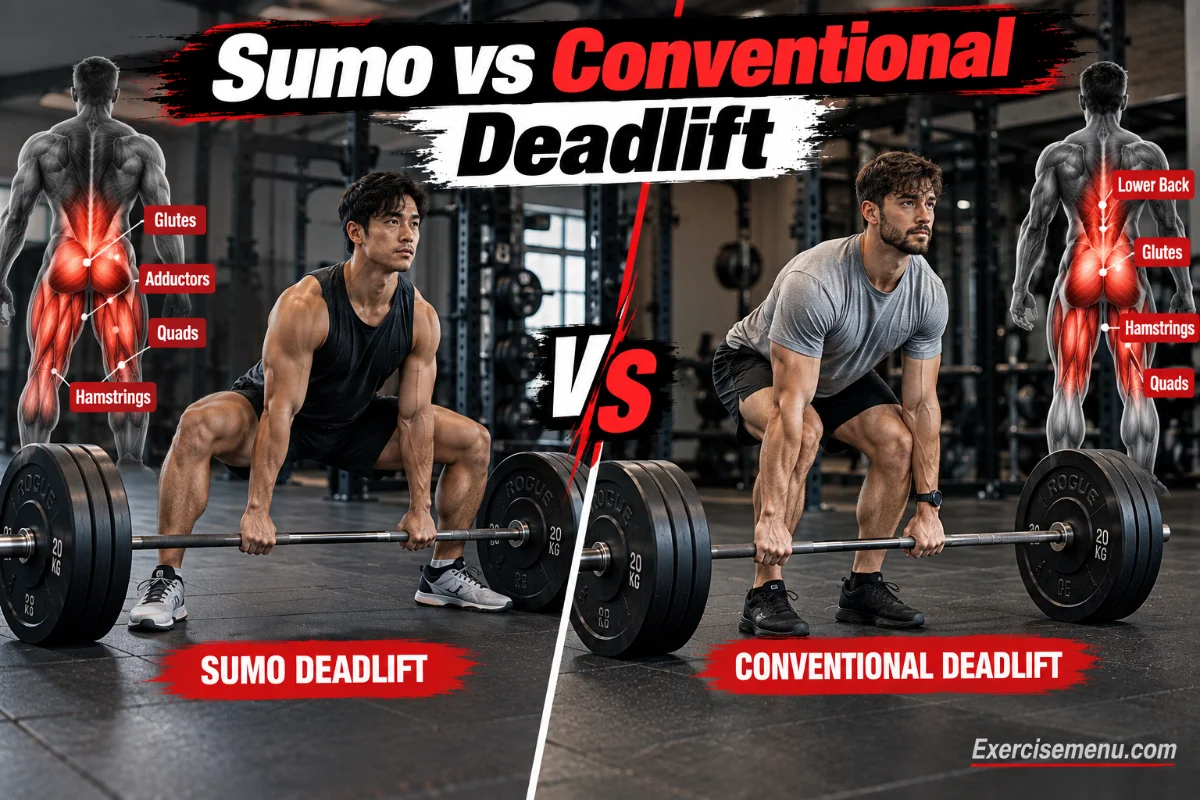
⚡ Quick Answer: Sumo and conventional deadlifts are both hip-hinge pulls from the floor. Sumo uses a wide stance and loads your quads, adductors, and glutes more. Conventional uses a narrow stance and loads your hamstrings, erector spinae, and upper back more. Which you should use depends on your body proportions, hip mobility, and training goals, not preference alone.
Both lifts do the same fundamental thing: pick a loaded barbell off the floor using a hip hinge. The difference is where you stand and how your body distributes the work from there.
That stance change shifts which muscles carry the load, how much range of motion the bar travels, where the lift is hardest, and which body types have a mechanical advantage. Once you understand what each lift is actually asking your body to do, the choice between them, or the case for training both, becomes clear.
- What Is the Difference Between Sumo and Conventional Deadlift?
- What Muscles Does Each Deadlift Work?
- Sumo Deadlift: Muscles Worked
- Conventional Deadlift: Muscles Worked
- What Are the Key Biomechanical Differences?
- Which Deadlift Suits Your Body Type?
- Which Deadlift Is Better for Your Goal?
- How to Do the Sumo Deadlift?
- How to Do the Conventional Deadlift?
- Can You Train Both Sumo and Conventional?
- What Safety Risks Should You Know?
- Frequently Asked Questions
What Is the Difference Between Sumo and Conventional Deadlift?
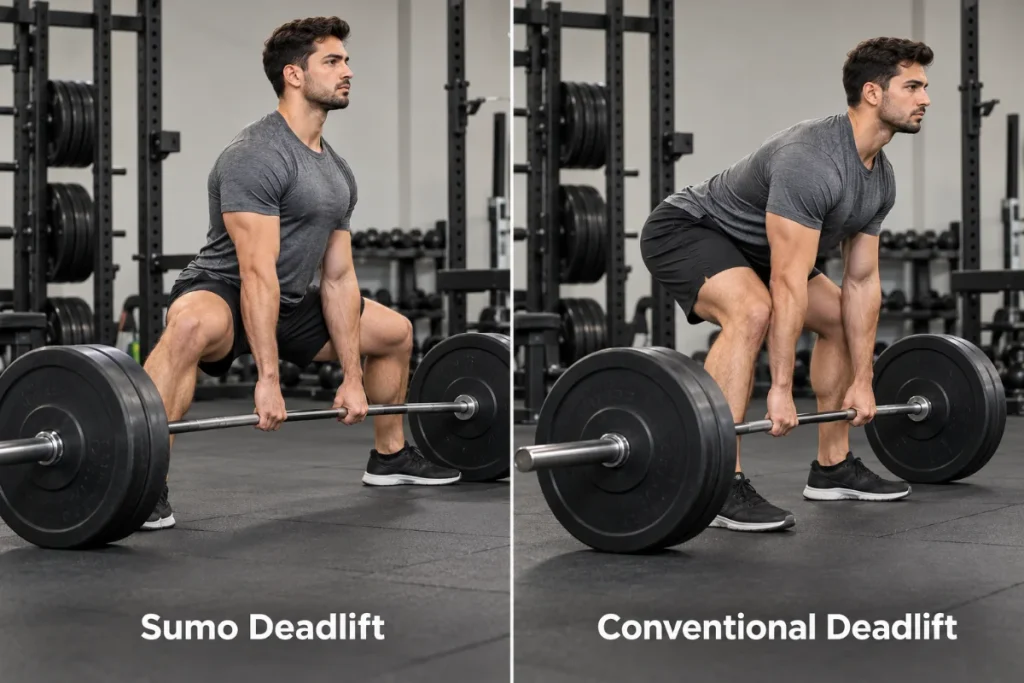
In a conventional deadlift, your feet sit hip-width apart with your hands gripping the bar just outside your legs. Your torso angles forward at roughly 35–55 degrees from horizontal. In a sumo deadlift, your feet are 1.5–2 times shoulder-width apart, toes angled out 30–45 degrees, and your hands grip the bar inside your knees. Your torso stays more upright, typically 55–70 degrees from horizontal.
That single change in foot position creates five measurable mechanical differences:
| Factor | Sumo | Conventional |
| Stance width | Wide (1.5–2× shoulder width) | Hip-width |
| Grip position | Inside knees | Outside knees |
| Torso angle at setup | More upright (55–70°) | More forward (35–55°) |
| Range of motion | 20–25% shorter | Full |
| Hardest point in lift | Breaking bar off the floor | At the knees / through lockout |
| Lower back stress | Lower | Higher |
| Hip mobility required | High (external rotation) | Moderate |
The shorter range of motion in sumo does not mean easier, the hips and adductors carry more load at the bottom of the pull in a mechanically demanding position, where the conventional lifter’s back muscles would otherwise take that demand.
What Muscles Does Each Deadlift Work?
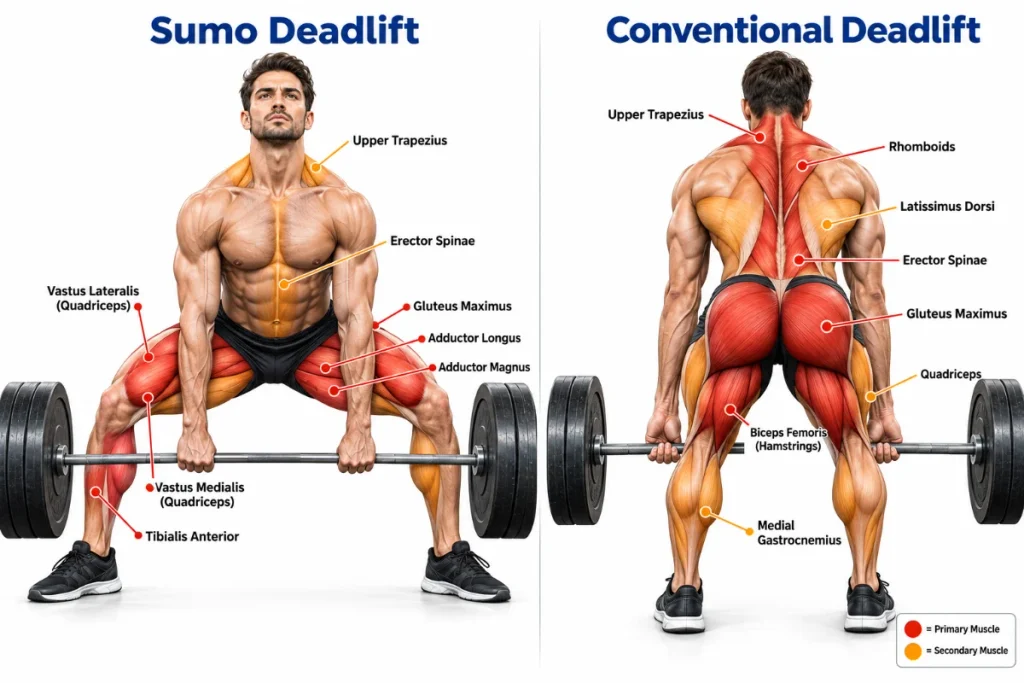
Both lifts are full-body compound movements. The same major muscle groups are involved — the difference is which ones carry more of the load.
Sumo Deadlift: Muscles Worked
Glutes (Gluteus Maximus)
Primary driver of hip extension throughout the pull. The wide stance places the glutes under hip abduction and external rotation demand that the conventional stance does not replicate.
Quadriceps (Vastus Lateralis, Vastus Medialis)
The upright torso and deeper knee flexion place heavy demand on the quads throughout the lift. An EMG study by Escamilla et al. (2002) found vastus medialis and vastus lateralis activation were both greater in the sumo deadlift at 12-RM intensity.
Adductors (Adductor Magnus, Adductor Longus)
The wide stance creates constant demand on the inner thigh muscles to keep the knees tracking over the toes. Adductor demand in sumo is genuinely unique, conventional barely loads them. Lifters with underdeveloped adductors find sumo harder than expected regardless of overall strength.
Hamstrings
Active throughout, particularly during descent and the initial pull. Less loaded than in conventional because the reduced hip hinge depth limits peak hamstring stretch.
Erector Spinae
Work isometrically to maintain a neutral spine, but with lower peak demand than conventional because the upright torso reduces the lumbar moment arm.
Tibialis Anterior
Greater activation in sumo, confirmed by Escamilla et al. (2002), due to the ankle dorsiflexion demand of the wide stance.
Conventional Deadlift: Muscles Worked
Hamstrings (Biceps Femoris)
The deeper hip hinge places the hamstrings under a greater stretch at setup and demands more from them across the pull. Hanen et al. (2025) confirmed biceps femoris activation was greater in the conventional deadlift across both phases of the lift.
Glutes (Gluteus Maximus)
Primary hip extensor in both lifts. The conventional deadlift generates higher hip extension moments, Hanen et al. (2025) recorded greater hip extension moments during Phase 1 of the conventional pull. At the very end of the lift, the same study found marginally higher gluteus maximus activation in sumo, though at substantially lower absolute levels than the peak hip extension values conventional produces.
Erector Spinae
The more horizontal torso demands more from the spinal erectors to maintain neutral spine under load. Erector spinae thoracis activation was greater in Phase 2 of the conventional deadlift per Hanen et al. (2025).
Upper Back (Trapezius, Rhomboids, Lats)
The forward lean of the conventional pull places the upper back under constant isometric demand. Heavy conventional pulling builds upper back and trap density that sumo does not match.
Medial Gastrocnemius
Escamilla et al. (2002) found greater calf activation in conventional, a consequence of the ankle plantar flexor demand at the hip-width stance.
Muscle Comparison at a Glance
| Muscle | Sumo | Conventional | Edge |
| Glutes | High | High (higher hip ext. moment) | Conventional |
| Quadriceps | Higher | Moderate | Sumo |
| Hamstrings | Moderate | Higher | Conventional |
| Adductors | High | Low | Sumo (exclusive) |
| Erector spinae | Moderate | Higher | Conventional |
| Upper back / traps | Moderate | Higher | Conventional |
| Tibialis anterior | Higher | Moderate | Sumo |
| Medial gastrocnemius | Moderate | Higher | Conventional |
What Are the Key Biomechanical Differences?
Range of Motion and Mechanical Work
Research by Escamilla et al. (2000), using three-dimensional biomechanical analysis at a national powerlifting championship, found that vertical bar distance, mechanical work, and predicted energy expenditure were 25–40% greater in the conventional deadlift. Less bar travel in sumo does not mean less muscular effort, the hip and adductor demands compensate, but it does explain why many lifters handle more absolute load in the sumo position.
Where Each Lift Is Hardest
In a conventional deadlift, the most demanding point is off the floor and through the knee, the back is in its most forward position. In a sumo deadlift, breaking the bar off the floor is the hardest part because the hips must generate force from a deep, externally rotated position. Once past the knees in sumo, the lockout is typically fast. Conventional lifters often grind through lockout.
Lumbar Spine Load
Hanen et al. (2025) confirmed the conventional deadlift generates higher hip extension moments throughout Phase 1 of the pull. Earlier analyses estimated the sumo style produces an 8–10% reduction in lumbar joint moment compared to conventional, due to the more upright torso reducing shear force on the lumbar spine.
Mediolateral Stability Demands
Hanen et al. (2025) found sumo deadlifts produce greater frontal and transverse plane joint moments at the hip and knee than conventional. Sumo requires more lateral stability, which is why hip impingement and adductor strain occur in sumo but not in conventional.
Which Deadlift Suits Your Body Type?
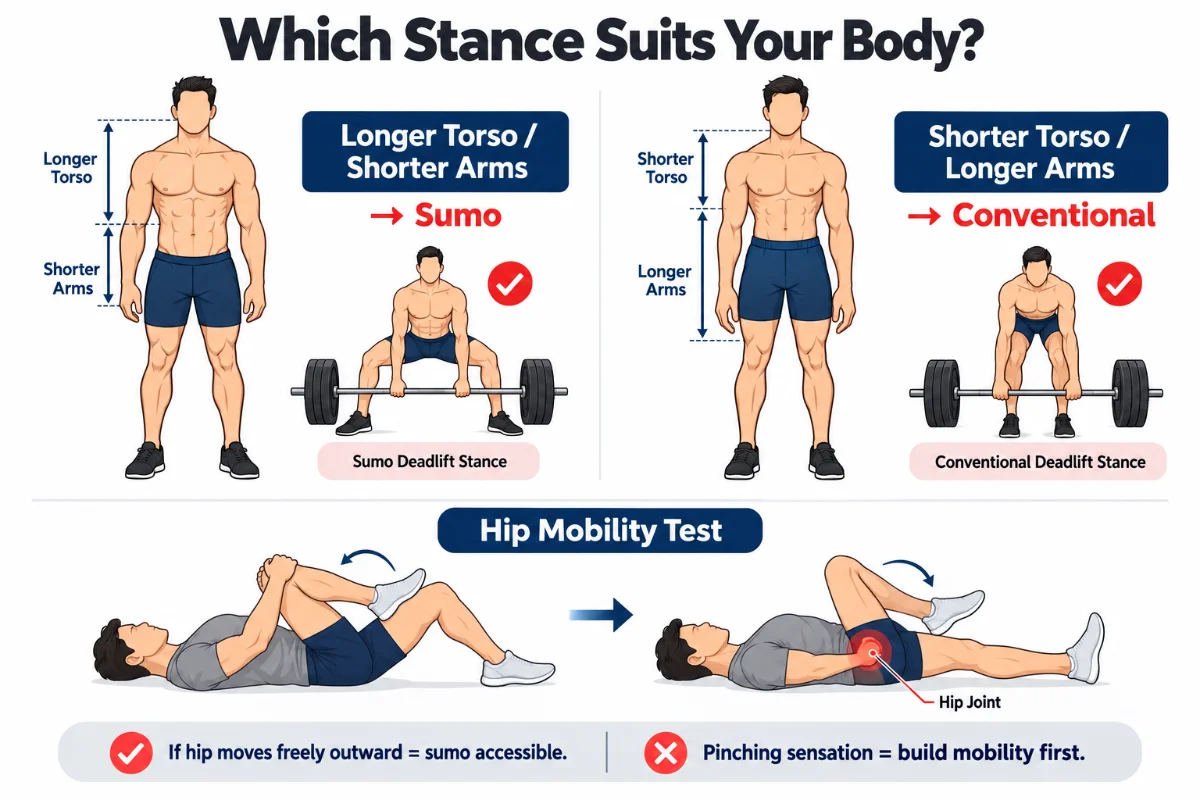
Body proportions have a meaningful effect on which stance gives you a mechanical advantage.
Torso Length
Research by Hales (2010) in the NSCA Strength and Conditioning Journal, provides a practical framework: divide your torso length, measured from the hip bone (greater trochanter) to the top of your head, by your overall height. A ratio above 32% indicates a longer torso. These lifters tend to be stronger in sumo because the wider stance reduces the forward lean a longer torso would otherwise require. Below 32% points toward conventional.
Arm Length
Divide your arm length — shoulder joint to tip of middle finger, by your overall height. A ratio above 38% means longer arms. These lifters can reach the conventional setup without excessive forward lean, giving conventional a mechanical edge. Below 38% tends to favor sumo, where the closer grip compensates for shorter reach.
Hip Mobility Self-Test
Lie on your back, bring one knee toward your chest, and slowly let it fall outward. If the hip moves freely through that arc without the pelvis rolling, sumo is accessible for you. If the hip hits resistance early or produces a pinching sensation at the front of the joint, start with conventional and build hip mobility first.
Quick Reference: Which Stance to Try First
| Your Profile | Start With |
| Long torso (>32%) + short arms (<38%) | Sumo |
| Short torso (<32%) + long arms (>38%) | Conventional |
| Average proportions | Try both — use whichever is stronger after 6 weeks |
| Limited hip mobility | Conventional |
| Lower back sensitivity | Sumo |
Which Deadlift Is Better for Your Goal?
Building Quad and Adductor Size
Sumo. The deeper knee flexion and wide stance create quad and inner thigh demand that conventional does not replicate.
Building Hamstring and Lower Back Strength
Conventional. The deeper hip hinge and higher erector spinae demand make it the more direct route to posterior chain development.
Lower Back Sensitivity
Sumo. The reduced lumbar moment arm and upright torso allow heavy pulling with less spinal loading.
Functional Strength and Athletic Carryover
Conventional. Real-world picking patterns and most sport mechanics use a hip-width stance. Conventional deadlift strength transfers more directly.
New to Deadlifting
Start with conventional. It requires less hip mobility, the setup is simpler to learn, and the hip hinge pattern it builds transfers to every pulling exercise.
Maximizing Load
Test both. Many lifters with longer torsos handle more absolute load in sumo due to the shorter range of motion. But this is not universal, the only reliable test is to train both for 6+ weeks near maximal intensity and compare.
How to Do the Sumo Deadlift?
Step-by-Step Instructions
- Set your stance. Feet 1.5–2 times shoulder-width apart, toes angled out 30–45 degrees. Shins near-vertical when you grip the bar. Start slightly wider than feels natural and narrow it if the hips produce a pinching sensation.
- Grip inside the knees. Grip the bar at shoulder width, arms straight inside your knees. Double overhand or mixed grip.
- Set your back. Drop your hips, drive your knees out over your toes, chest up, spine neutral. Squeeze your lats before the bar moves.
- Drive the floor apart. Push your feet outward and into the floor — as if spreading the floor apart. This activates the adductors and glutes powerfully from liftoff.
- Keep hips and shoulders rising together. If your hips rise before your chest, you’ve lost the position.
- Lock out with the hips. Drive your hips through to full extension. Squeeze your glutes. Stand tall — no lean back.
How to Do the Conventional Deadlift?
Step-by-Step Instructions
- Set your stance. Feet hip-width apart, toes straight or angled out 5–15 degrees. Bar over mid-foot, approximately one inch from your shins.
- Grip outside the knees. Hinge at the hips and grip just outside your legs at shoulder width.
- Build tension before you pull. Lats engaged, chest up, shoulders back. Pull upward against the bar without moving it until you feel full-body tension. Then drive.
- Push the floor away. Drive your feet into the ground. Hips and shoulders rise at the same rate — if the hips shoot up first, you’ve lost leg drive.
- Keep the bar close. The bar drags along your shins and thighs throughout. Any gap increases lower back demand.
- Stand tall at lockout. Hips and knees fully extended, shoulders back. Lower by pushing hips back first, then bending the knees once the bar clears them.
If the conventional setup feels awkward early on, particularly the forward lean — the trap bar deadlift positions the load at your sides and removes the bar-in-front-of-shins challenge, making it a natural entry point to pulling from the floor.
Can You Train Both Sumo and Conventional?
Yes — and for most intermediate lifters, training both produces better results than committing to one permanently. Sumo builds the hip and adductor strength that reinforces conventional, and conventional builds the posterior chain that supports sumo mechanics.
Designate one as your primary lift (heavier loads, 80–90% of max) and one as an accessory (moderate load, 65–75%). Commit to one primary stance for 8–12 weeks before reassessing. Apply progressive overload consistently, adding load or reps over time is what drives long-term strength gains. For the right volume per session, how many sets and reps to use depends on your goal.
What Safety Risks Should You Know?
Sumo-Specific Risks
Hip Impingement
Deep external rotation can compress the hip joint for lifters with certain hip socket anatomy. If you feel a pinching sensation at the front of the hip at the bottom of the pull, your stance is too wide or your toes are angled too far out. Narrow the stance and reduce toe angle gradually — do not push through the pinch.
Adductor Strain
Sumo places extreme demand on the inner thigh at the start of the pull. Pulling heavy without a proper warm-up or widening the stance faster than your flexibility supports is how adductor strains happen. Ramp through lighter sets before working sets.
Knee Valgus
Under heavy loads, the knees can cave inward when the adductors and glutes fatigue. Drive your knees actively outward throughout the pull. When valgus appears, the set ends.
Conventional-Specific Risks
Lower Back Rounding
The most common and most consequential error. A rounded lumbar spine under load compresses spinal discs unevenly. If your back rounds off the floor, reduce the load and fix the setup before adding weight.
Bicep Tear With Mixed Grip
The supinated hand in a mixed grip places the bicep tendon under a stretch-load combination. Jerky pulls can tear the distal bicep tendon. Keep the supinated arm fully locked out, avoid bouncing the bar, and consider hook grip for maximum loads.
Frequently Asked Questions
Is the Sumo Deadlift Cheating?
No. Sumo is legal in every major powerlifting federation including the IPF, USPA, and WPC. It is not permitted in strongman competitions, which require conventional. The sumo style is not inherently easier, it trades back demand for hip and adductor demand and removes a portion of range of motion. The shorter bar path is offset by the mechanically disadvantaged hip position at the bottom of the pull.
Why Is My Sumo Deadlift Weaker Than My Conventional?
Sumo requires well-developed adductors and hip external rotators, muscles most people have not trained specifically. It also demands hip mobility that many lifters lack initially. A weaker sumo usually means those specific muscles or that mobility are the limiting factor, not that conventional is your permanently better stance. Give sumo a minimum of 6–8 weeks of consistent practice before drawing conclusions.
Can I Switch Between Sumo and Conventional Mid-Set or Mid-Workout?
Not mid-set — each stance uses a distinct motor pattern and switching under load dramatically increases injury risk, particularly to the hips and lower back. Between sets, switching is technically possible but rarely productive. Each stance fatigues different muscles, swapping between them in the same session dilutes the stimulus for both and makes it harder to track where your weaknesses are. Separate them by session or training block.
Is Sumo Deadlift Better for Women Than Conventional?
Not categorically — but women on average have wider hip angles and greater natural hip mobility, which can make the wide sumo setup more accessible. Hales (2010) points to torso-to-height ratio as the primary predictor regardless of sex. Women with longer torsos benefit from sumo for the same mechanical reasons men do. The choice still comes down to individual anatomy, not sex.
Do I Need Different Shoes for Sumo vs Conventional?
Both benefit from a flat sole, no running shoes. For conventional, minimal or zero heel is ideal because a raised heel shifts the load forward. For sumo, a slight heel elevation can help, it increases ankle dorsiflexion range, making the wide stance easier to set up from. Weightlifting shoes work well for sumo specifically, though most lifters deadlift in flat shoes across both variations.
If you have an existing lower back injury, hip impingement, or joint condition, get clearance from a physiotherapist before loading either deadlift variation.
