

Quick Answer: Medicine ball chest exercises target the pectoralis major, anterior deltoid, and triceps through pressing, throwing, and push-up movements. The 10 exercises below are organized from beginner to advanced — use a 4–6 lb ball for push-ups, 8–12 lb for throws. No bench required.
A medicine ball trains the chest differently from a barbell or dumbbell. The neutral grip reduces shoulder strain, the unstable surface increases chest muscle activation, and the ability to throw it adds explosive training that controlled pressing cannot replicate.
These 10 exercises cover the full chest upper, mid, and lower organized from fundamental to advanced. The angle determines which part works hardest: flat movements train the lower and mid chest, incline targets the upper, explosive throws recruit fast-twitch fibers across the full pectoralis major.
For every other muscle group, the medicine ball exercises guide covers back, arms, shoulders, abs, and legs.
- What Weight Medicine Ball Should You Use?
- Upper Chest Exercises with a Medicine Ball
- Full Chest Exercises with a Medicine Ball
- Explosive Chest Exercises with a Medicine Ball
- Advanced Medicine Ball Chest Exercises
- How to Structure Your Medicine Ball Chest Workout
- Can Medicine Ball Chest Exercises Replace Bench Press?
- Frequently Asked Questions
- Ready to Build Your Chest Routine?
What Weight Medicine Ball Should You Use?
| Level | Weight (lbs) | Weight (kg) | Best For |
|---|---|---|---|
| Beginner | 4–6 lbs | 2–3 kg | Push-up variations, floor press |
| Intermediate | 8–10 lbs | 4–5 kg | Chest throws, wall passes |
| Advanced | 10–14 lbs | 5–6 kg | Explosive plyometric movements |
Start lighter for push-ups — the unstable ball surface already makes them harder. For throws and passes, use a weight that lets you move fast. If you slow down noticeably toward the last few reps, the ball is too heavy for power work.
Upper Chest Exercises with a Medicine Ball
1. Medicine Ball Incline Push-Up
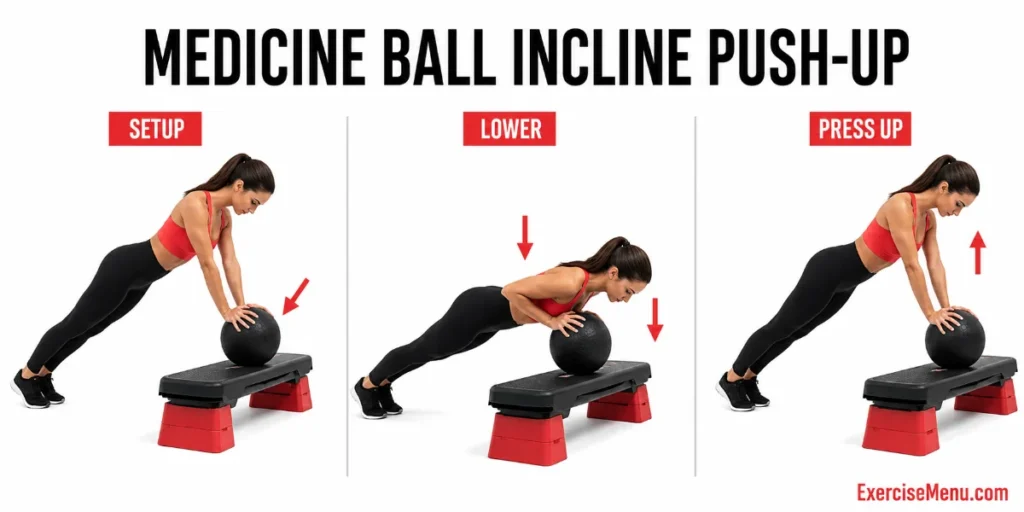
Target: Pectoralis major (upper/clavicular head), anterior deltoid, triceps, serratus anterior
Place the ball on a step or low chair. Both hands on the ball, feet on the floor, body straight from head to heels. Lower your chest toward the ball — elbows at 45 degrees, not flaring. Press back up.
The elevated hands create the incline angle that shifts work to the upper chest.
Sets × Reps: 3 × 10–12 | Rest: 60 seconds
2. Medicine Ball Staggered Push-Up
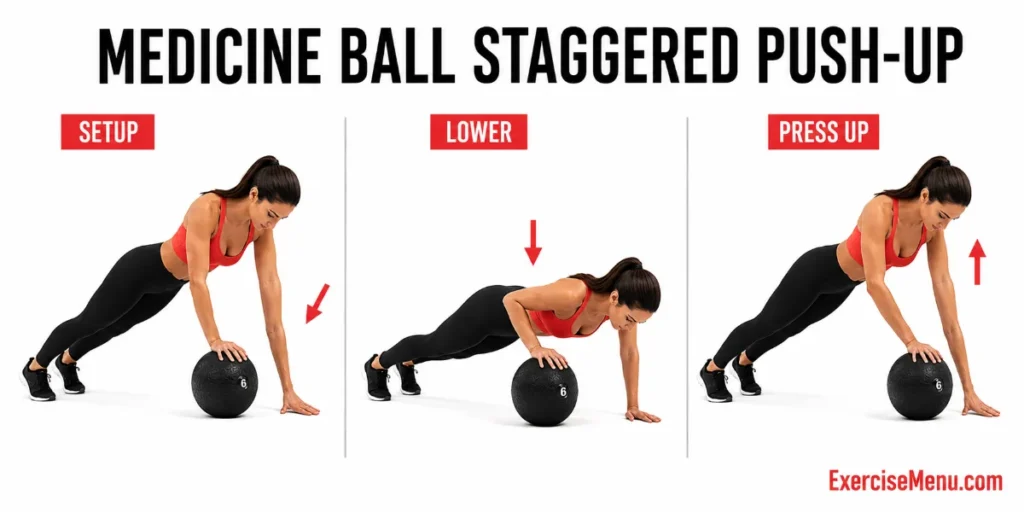
Target: Pectoralis major (upper chest, unilateral), triceps, core, shoulder stabilizers
One hand on the ball, one on the floor. Push-up position, body straight. Lower your chest, press back up. Complete all reps then switch hands.
The ball-side arm handles more load — effective for fixing left-right chest strength imbalances.
Sets × Reps: 3 × 8–10 each side | Rest: 60 seconds
Full Chest Exercises with a Medicine Ball
3. Medicine Ball Floor Press
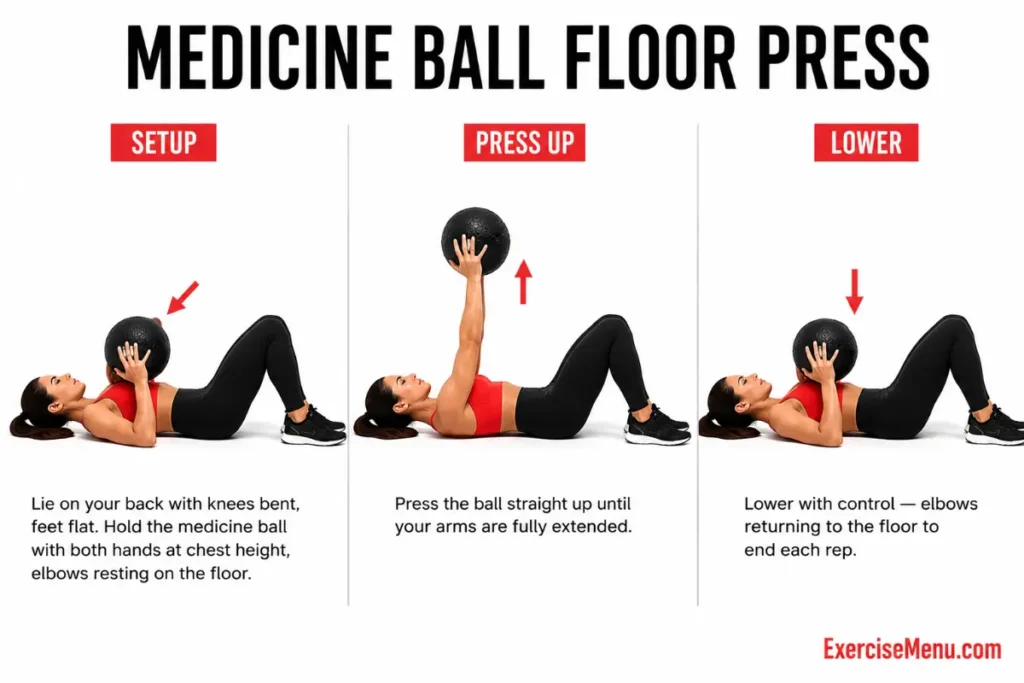
Target: Pectoralis major (sternal head), triceps, anterior deltoid
Lie on your back, knees bent, feet flat. Hold the ball at chest height, elbows on the floor. Press straight up to full arm extension, lower with control — elbows back to the floor each rep.
The neutral grip reduces shoulder strain. Comfortable option for anyone with shoulder impingement history.
Sets × Reps: 3 × 10–12 | Rest: 60 seconds
4. Medicine Ball Push-Up (Both Hands)
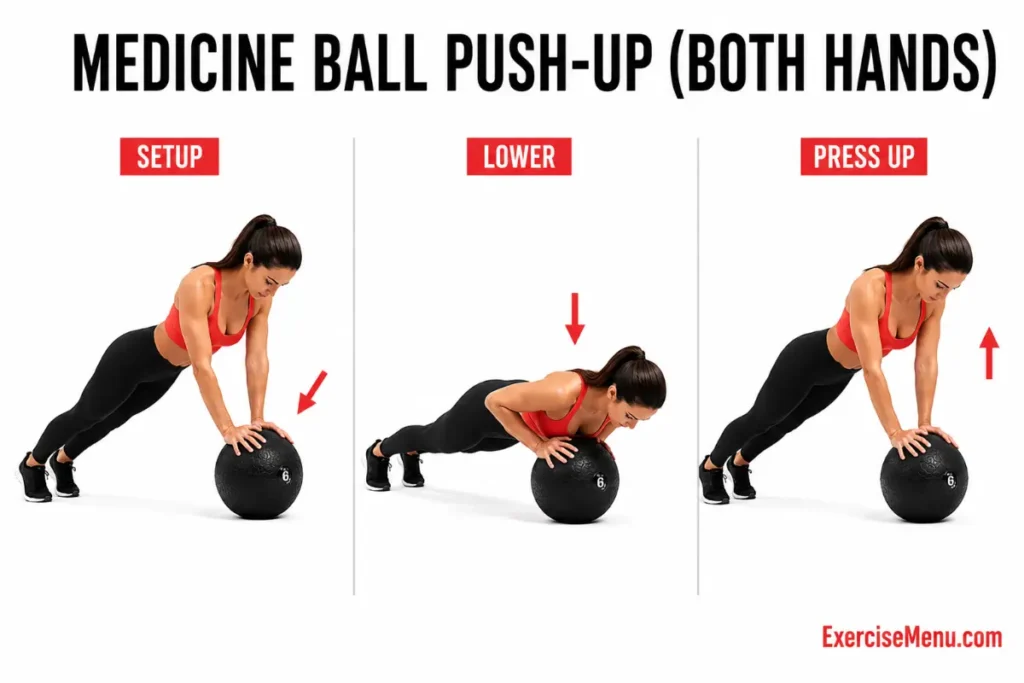
Target: Pectoralis major, triceps, serratus anterior, transverse abdominis
Both hands on the ball, fingers spread. Push-up position, body straight. Lower until chest touches the ball, press back up.
Harder than a standard push-up — the unstable surface forces constant stabilization from the chest and core. If the ball rolls or hips sag, do fewer reps with better control.
Sets × Reps: 3 × 8–12 | Rest: 60 seconds
5. Medicine Ball Lying Chest Toss
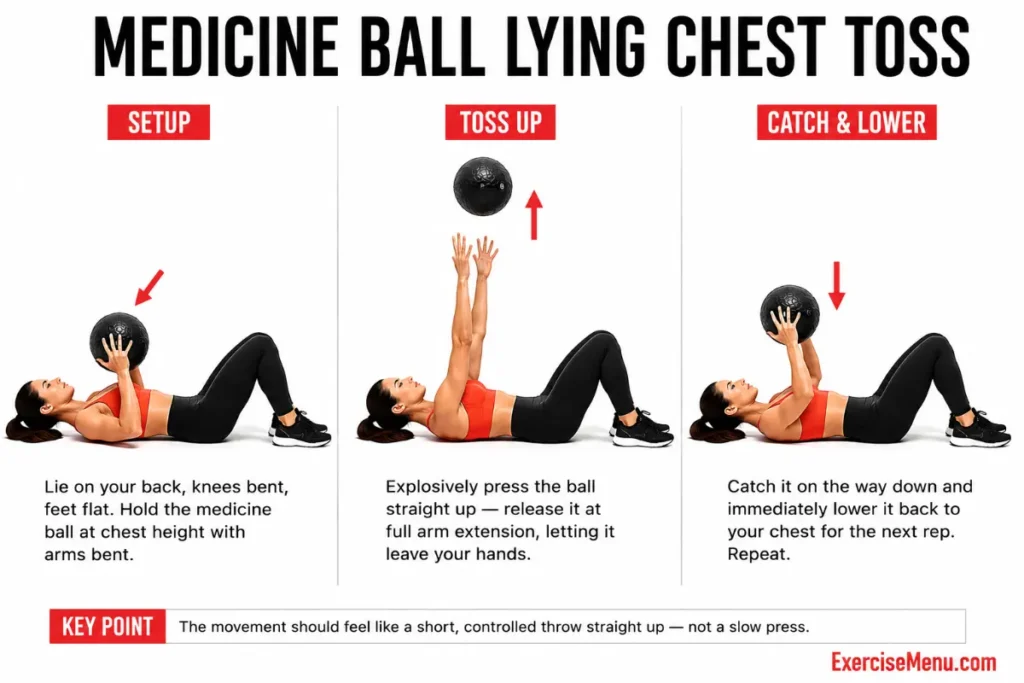
Target: Pectoralis major, triceps, fast-twitch fiber activation
Lie on your back, knees bent. Hold the ball at chest, arms bent. Press the ball straight up explosively — release it, let it leave your hands at full extension. Catch it on the way down, lower to chest, repeat.
The intent is speed, not control. Research on explosive medicine ball training confirms it develops muscular power that controlled pressing cannot replicate.
Sets × Reps: 3 × 6–8 | Rest: 90 seconds
Explosive Chest Exercises with a Medicine Ball
6. Medicine Ball Chest Pass (Wall)
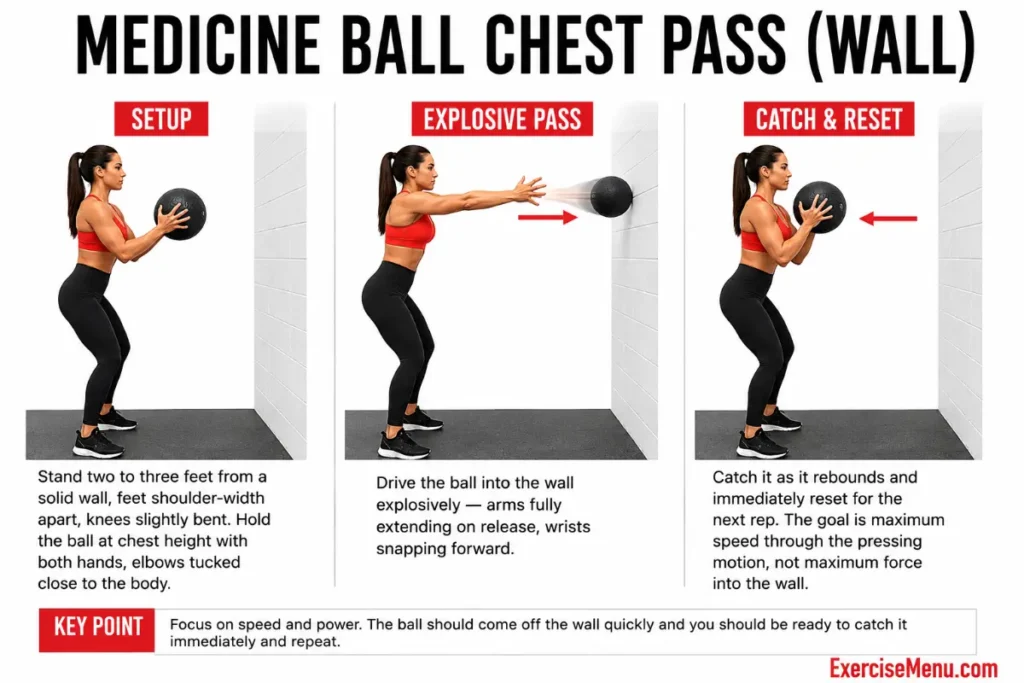
Target: Pectoralis major, anterior deltoid, triceps, scapular protractors
Stand 2–3 feet from a wall, feet shoulder-width, knees soft. Ball at chest, elbows tucked. Drive the ball into the wall as fast as possible — arms fully extend on release. Catch the rebound, reset, repeat immediately.
Maximum speed on every rep. This trains the horizontal force production that carries over to pushing and blocking in sport.
Sets × Reps: 3 × 8–10 | Rest: 90 seconds
7. Medicine Ball Chest Throw (Partner)
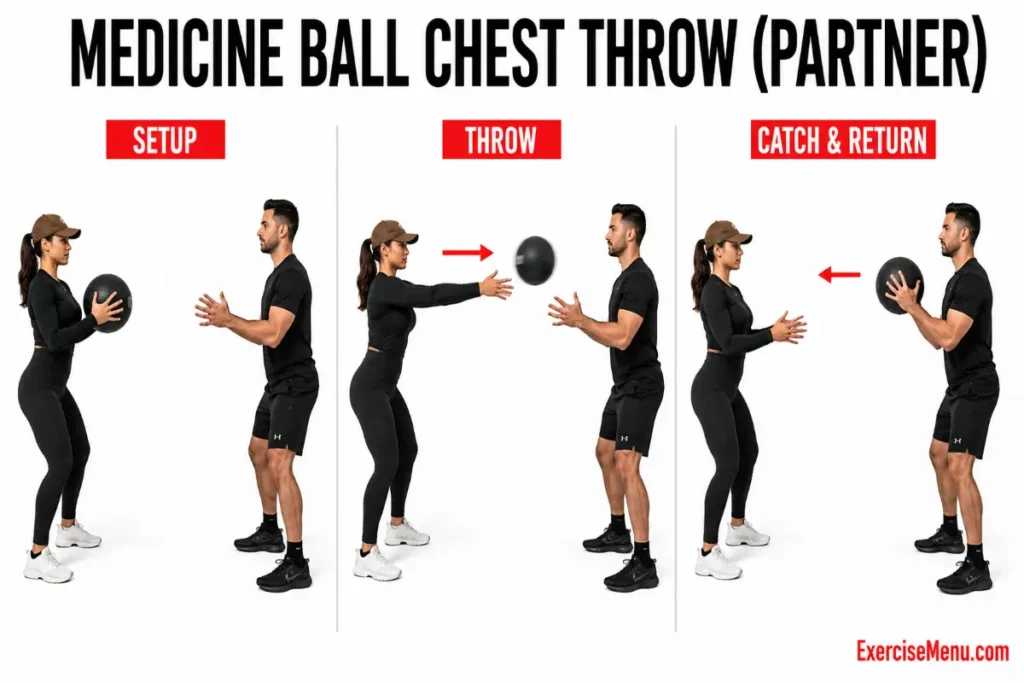
Target: Pectoralis major, anterior deltoid, triceps, coordination, reaction time
Stand 6–8 feet from your partner, both in athletic stance. Drive the ball from chest height forward with both hands — partner catches it, lets elbows absorb the momentum, drives it straight back. Quick exchange, no pausing.
The partner introduces variable timing and reaction that a wall cannot. For more partner medicine ball movements, the partner medicine ball exercises guide covers 10 exercises with full circuits.
Sets × Reps: 3 × 10–12 | Rest: 60 seconds
8. Medicine Ball Rolling Push-Up
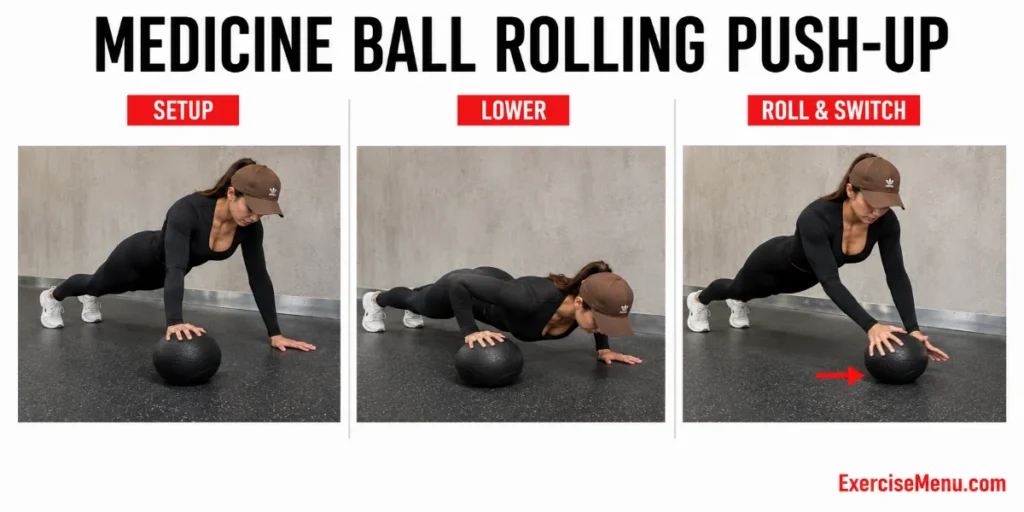
Target: Pectoralis major (unilateral), triceps, core, scapular stabilizers
One hand on the ball, one on the floor. Do a push-up. At the top, roll the ball to the other hand. Do the next push-up. Alternate every rep.
Each push-up loads one side more than the other. The core prevents the hips from rotating on every roll.
Sets × Reps: 3 × 6–8 each side | Rest: 90 seconds
Advanced Medicine Ball Chest Exercises
Build a solid base with exercises 1–8 before attempting these two. Both demand explosive power or compound control across multiple joints.
9. Plyometric Medicine Ball Push-Up
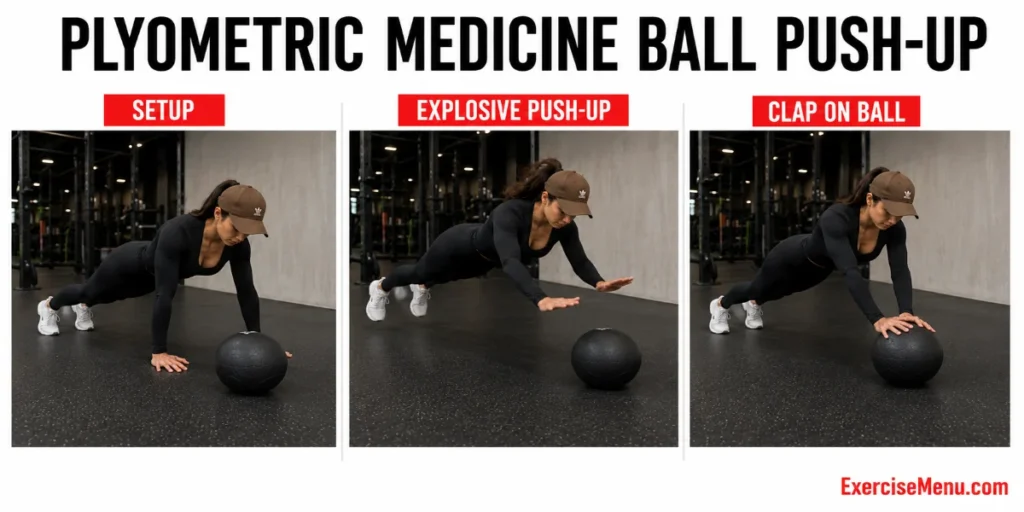
Target: Pectoralis major, triceps, explosive chest power, fast-twitch fibers
Start in push-up position, ball in front. Lower chest to floor — full range. Drive up explosively — hands leave the floor. Land hands on the ball, then back to the floor for the next rep.
Maximum power output per rep. Anyone with wrist sensitivity should master exercises 3–5 first.
Sets × Reps: 3 × 4–6 | Rest: 2 minutes
10. Medicine Ball Squat to Chest Press
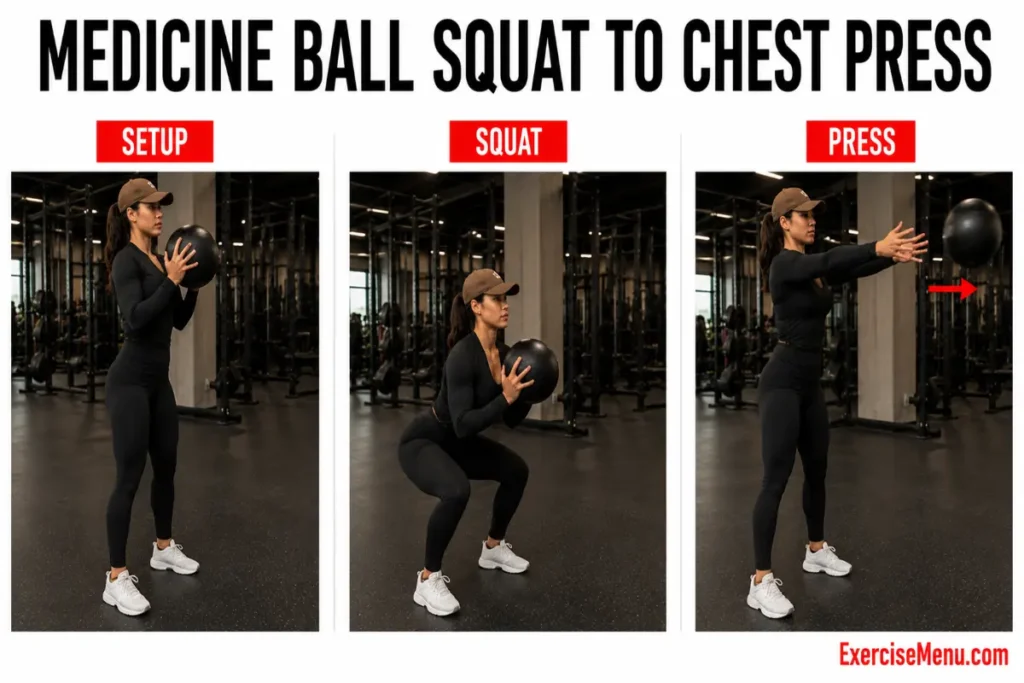
Target: Pectoralis major, triceps, quadriceps, glutes, full-body force transfer
Feet shoulder-width, ball at chest. Squat to parallel — chest up, heels flat. Drive through heels to stand. At full hip extension, press the ball forward explosively toward a wall or partner.
The legs generate the power, the trunk transfers it, the chest expresses it. The most demanding exercise in this list — cardiovascularly and technically.
Sets × Reps: 3 × 8–10 | Rest: 90 seconds
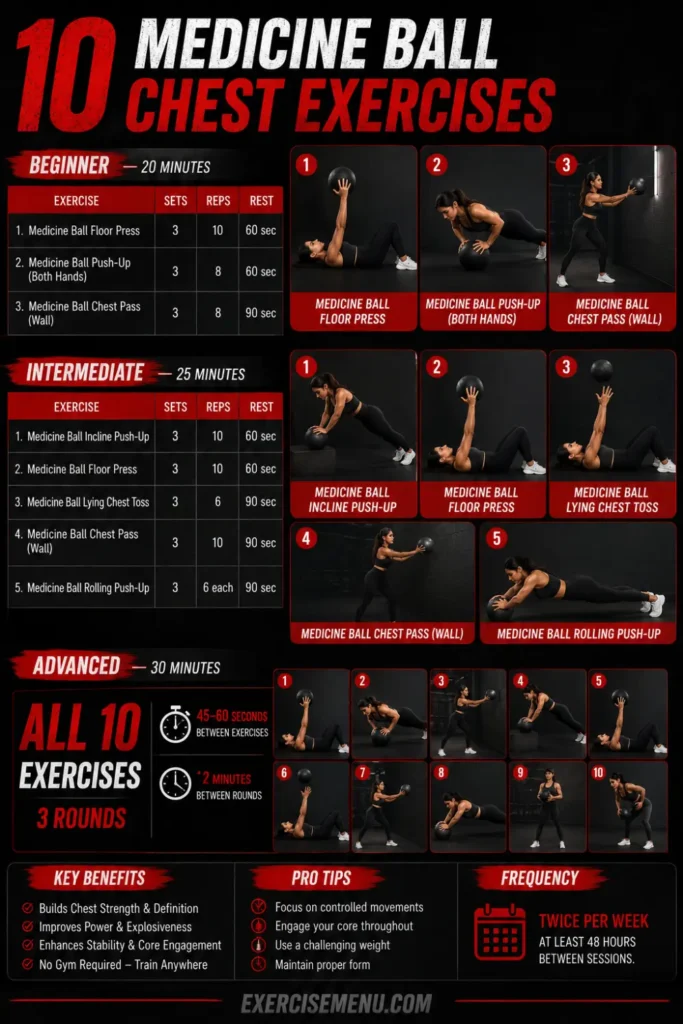
How to Structure Your Medicine Ball Chest Workout
Can Medicine Ball Chest Exercises Replace Bench Press?
For most goals, no — but they complement it well.
Medicine ball chest work is better for explosive power and athletic performance. The chest throw and lying toss train fast-twitch fibers at speeds a controlled bench press cannot reach. The neutral grip is easier on the shoulder for people with impingement history.
Where the barbell stays superior is progressive overload for hypertrophy. A barbell loads incrementally — a fixed-weight medicine ball cannot. Muscle growth needs progressive overload, and a medicine ball eventually stops providing enough resistance to drive it.
Best approach: use medicine ball exercises for power work or as a finisher after barbell pressing — not as the only chest training tool. For anyone starting out with medicine ball training at home, the beginners medicine ball guide covers the foundational movements first.
Frequently Asked Questions
What is the difference between a medicine ball chest pass and a chest throw?
A chest pass is a continuous drill — release to a wall or partner, catch the rebound, repeat. A chest throw is a single maximum-effort throw for distance, used to test power output. Pass for training volume, throw for testing.
Can I use a medicine ball for chest exercises if I have a shoulder injury?
The neutral grip reduces internal shoulder rotation — floor press and push-up variations are often more comfortable than barbell work for impingement. Avoid explosive throws and plyometric push-ups until pain-free. Start with the floor press only.
How do I know when to increase my medicine ball weight?
When every set reaches the top of the rep range with clean form and the last rep still feels hard. For throws, increase weight only when speed stays explosive through all reps — slowing down means the ball is too heavy for power work.
Can I do medicine ball chest exercises on the same day as barbell bench press?
Yes — do medicine ball work after barbell sets, not before. Explosive work like the chest pass or lying toss fits well as a finisher. Running it before bench press creates fatigue that reduces performance on your primary lift.
Are medicine ball chest exercises suitable for women?
Yes. Same exercises, same rep ranges, same progression. Women typically start at 4–6 lbs and progress at the same rate. Floor press and push-up variations are particularly effective for building chest strength without a gym.
Ready to Build Your Chest Routine?
A personalized plan takes the guesswork out of which exercises to prioritize and how to progress them.
