

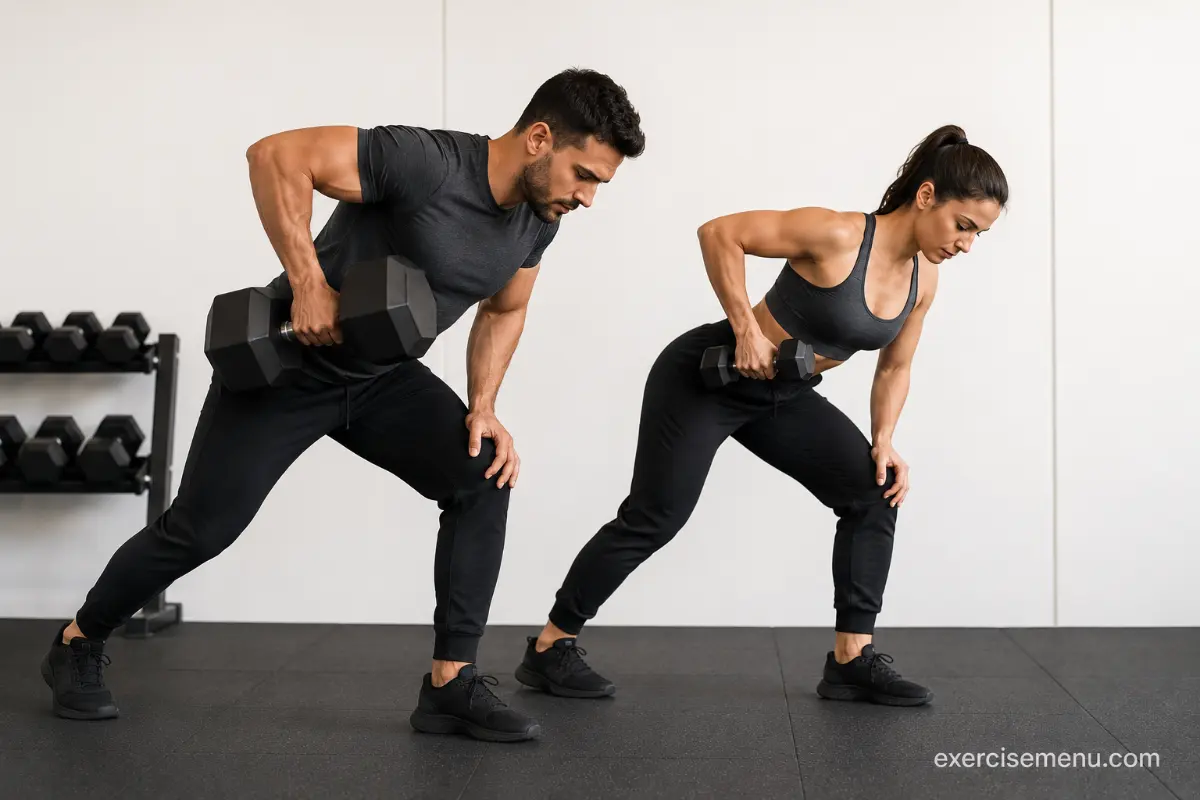
Training with your partner sounds simple until you’re both standing in front of a squat rack with completely different strength levels, different goals, and no idea how to structure a session that works for both of you.
The fix isn’t doing separate workouts on opposite sides of the gym. It’s using the same exercises with different reps, sets, and loads — matched to each person individually. Same session. Same structure. Different prescriptions.
A 1995 study published in the Journal of Sports Medicine and Physical Fitness tracked married couples who joined a fitness program together versus those who joined alone. After 12 months, couples who trained together had a 6.3% dropout rate. Those who trained alone? 43%. That’s not a marginal difference — exercising together reduced the quit rate by more than six times.
The benefit isn’t just adherence. A 2021 study by Sackett-Fox, Gere, and Updegraff in the Journal of Social and Personal Relationships found that on days participants exercised with their romantic partner, they reported better mood during and after the workout and higher relationship satisfaction compared to days they trained alone.
The research is clear. Training together works — if the programming accounts for both people.
Why the same workout with different reps works
Most couples default to one of two approaches. Either they do the exact same workout at the same weight — which bores the stronger partner and overwhelms the other. Or they do entirely separate sessions — which kills the shared experience that makes training together effective in the first place.
The third option is what actually works. Both partners follow the same exercise sequence — squat, press, row, whatever the session calls for — but each person uses a rep range, load, and rest period that matches their individual level and goal.
This is standard training programming. A beginner doing 3×12 at 60% of their capacity and an intermediate doing 3×8 at 75% are both getting an effective training stimulus from the same movement. The exercise is shared. The prescription is personal.
The “you go, I go” structure
The most practical format for couples is alternating sets. Partner A does a set, then Partner B does a set. No timers needed.
When one partner performs a set of 10 reps at a controlled tempo, that set takes roughly 30–40 seconds. The other partner rests during that time, then immediately begins their set. The result is a natural 1:1 work-to-rest ratio — which falls directly in the range that research identifies as effective for muscle growth.
No one stands around scrolling between sets. No one waits too long and loses the training stimulus. The structure self-regulates rest periods based on each person’s actual work time.
If one partner’s set takes longer (heavier weight, slower tempo), the other partner simply gets a slightly longer rest — which they likely need less because their set was shorter or lighter. The format naturally adjusts to the gap between partners without either person having to compromise.
How to set reps and sets when fitness levels are different
Here’s a shared workout where both partners do the same exercises but with programming matched to their level:
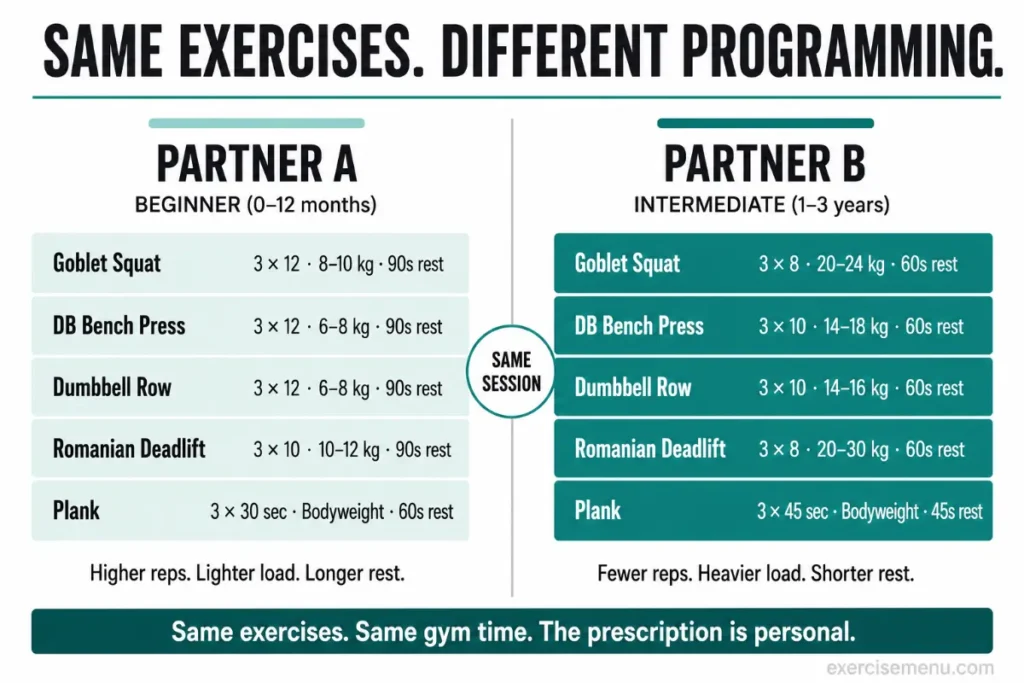
Partner A: Beginner (0–12 months training)
| Exercise | Sets × Reps | Load | Rest |
|---|---|---|---|
| Goblet squat | 3×12 | Light (8–10 kg) | 90 sec |
| Dumbbell bench press | 3×12 | Light (6–8 kg each) | 90 sec |
| Dumbbell row | 3×12 | Light (6–8 kg) | 90 sec |
| Romanian deadlift | 3×10 | Light (10–12 kg total) | 90 sec |
| Plank | 3×30 sec | Bodyweight | 60 sec |
Partner B: Intermediate (1–3 years training)
| Exercise | Sets × Reps | Load | Rest |
|---|---|---|---|
| Goblet squat | 3×8 | Moderate (20–24 kg) | 60 sec |
| Dumbbell bench press | 3×10 | Moderate (14–18 kg each) | 60 sec |
| Dumbbell row | 3×10 | Moderate (14–16 kg) | 60 sec |
| Romanian deadlift | 3×8 | Moderate (20–30 kg total) | 60 sec |
| Plank | 3×45 sec | Bodyweight | 45 sec |
Same five exercises. Same session. Same gym time. The beginner uses lighter weight with higher reps and longer rest. The intermediate uses heavier weight with fewer reps and shorter rest. Both get a training stimulus appropriate for their level.
The key: neither partner adjusts for the other. Each person follows their own prescription regardless of what the other is lifting.
Sample weekly plan for couples
Training 2–3 times per week on nonconsecutive days is enough for consistent progress without burnout. Here’s a simple structure:
| Day | Session | Format |
|---|---|---|
| Monday | Full body strength (you go, I go) | Compound lifts, alternating sets |
| Wednesday | Cardio or HIIT together | Treadmill intervals, rowing, cycling side by side |
| Friday | Full body strength (you go, I go) | Same exercises, increased load or reps from Monday |
| Weekend | Active recovery together | Walk, hike, stretch, mobility work |
Keep the strength sessions to 35–40 minutes. Five compound exercises, three sets each, alternating format. Warm up together for five minutes — jumping jacks, bodyweight squats, arm circles. Cool down together with stretching.
The shared warm-up and cool-down create the bonding time. The working sets are where each person trains at their own capacity.
Progressive overload for couples
Progress stalls when the workout stays the same week after week. Both partners need to apply progressive overload independently — not at the same rate.
The beginner will progress faster. Adding weight every session or every week is realistic in the first 6–12 months because neural adaptation drives rapid strength gains early on. The intermediate partner progresses slower — adding weight every 1–2 weeks or increasing reps before increasing load.
This means the gap between partners will narrow over time. The beginner catches up. The intermediate keeps climbing. Neither waits for the other.
Track sessions individually. A shared workout log where both partners record their own numbers for each movement makes progress visible for both people — and turns training into a shared project rather than a competition.
When training together doesn’t work
Not every couple benefits from shared sessions. Be honest about these situations:
One partner coaches the other constantly. Encouragement helps. Unsolicited technique corrections every set create tension. Research on health-related social control in couples consistently shows that persuasion and support improve adherence — but pressure and criticism backfire. If feedback turns into frustration, train the same time in the same space but follow separate programs.
The ego gap causes resentment. If one partner feels embarrassed lifting lighter weight, the format isn’t working. Reframe the goal: effort relative to your own capacity is what drives results, not the number on the dumbbell. A beginner squatting 10 kg with perfect form at genuine effort is training harder than an intermediate coasting through 40 kg.
Schedules don’t align. If forcing a shared session means one person trains at a time that disrupts their sleep, nutrition, or recovery, the cost outweighs the benefit. Train together when it works. Train separately when it doesn’t. One shared session per week is enough to maintain the accountability and bonding effect the research supports.
Common mistakes
Using the same weight for both partners. The stronger partner goes too light. The weaker partner goes too heavy. Both get a suboptimal stimulus. Individual loading is non-negotiable.
Turning rest periods into long conversations. Rest is a training variable. A 90-second rest that becomes five minutes of talking changes the entire session’s training density. Keep conversations for the warm-up, cool-down, and car ride home.
Skipping the warm-up because you’re short on time. Five minutes of light movement before the first working set protects joints and primes the nervous system. Cutting it to “save time” increases injury risk for both partners.
Competing on load instead of effort. Strength differences between partners are normal. Comparing numbers is meaningless when training age, body size, and recovery capacity are all different. Compare effort. Compare consistency. Those are the variables that matter.
Frequently asked questions
What are the best reps and sets for couples who train together?
Both partners do the same exercises but adjust reps, sets, and load individually. A beginner typically works at 3×12 with lighter weight and longer rest. An intermediate works at 3×8–10 with heavier weight and shorter rest. The shared structure keeps you training together while the individual prescription keeps both of you progressing.
Can couples with very different fitness levels train together?
What are the best reps and sets for couples who train together?
Both partners do the same exercises but adjust reps, sets, and load individually. A beginner typically works at 3×12 with lighter weight and longer rest. An intermediate works at 3×8–10 with heavier weight and shorter rest. The shared structure keeps you training together while the individual prescription keeps both of you progressing.
How many times a week should couples train together?
Two to three sessions per week is enough for consistent results. Schedule strength sessions on nonconsecutive days with at least 48 hours between sessions targeting the same muscle groups. Add one shared cardio or active recovery session on a non-lifting day for variety and quality time.
How many times a week should couples train together?
Two to three sessions per week is enough for consistent results. Schedule strength sessions on nonconsecutive days with at least 48 hours between sessions targeting the same muscle groups. Add one shared cardio or active recovery session on a non-lifting day for variety and quality time.
Does training together actually help you stay consistent?
Research says yes. A 1995 study in the Journal of Sports Medicine and Physical Fitness found that couples who joined a fitness program together had a 94% retention rate after 12 months — compared to 57% for those who joined alone. The accountability, shared routine, and emotional support make a measurable difference.
What if one partner wants to build muscle and the other wants to lose fat?
The workout structure stays the same — compound lifts, alternating sets. The difference is in load and rest. The muscle-building partner uses heavier weight with 60–90 second rest for hypertrophy. The fat-loss partner uses moderate weight with 30–60 second rest to keep heart rate elevated. Both goals are served by the same movements in the same session.
