
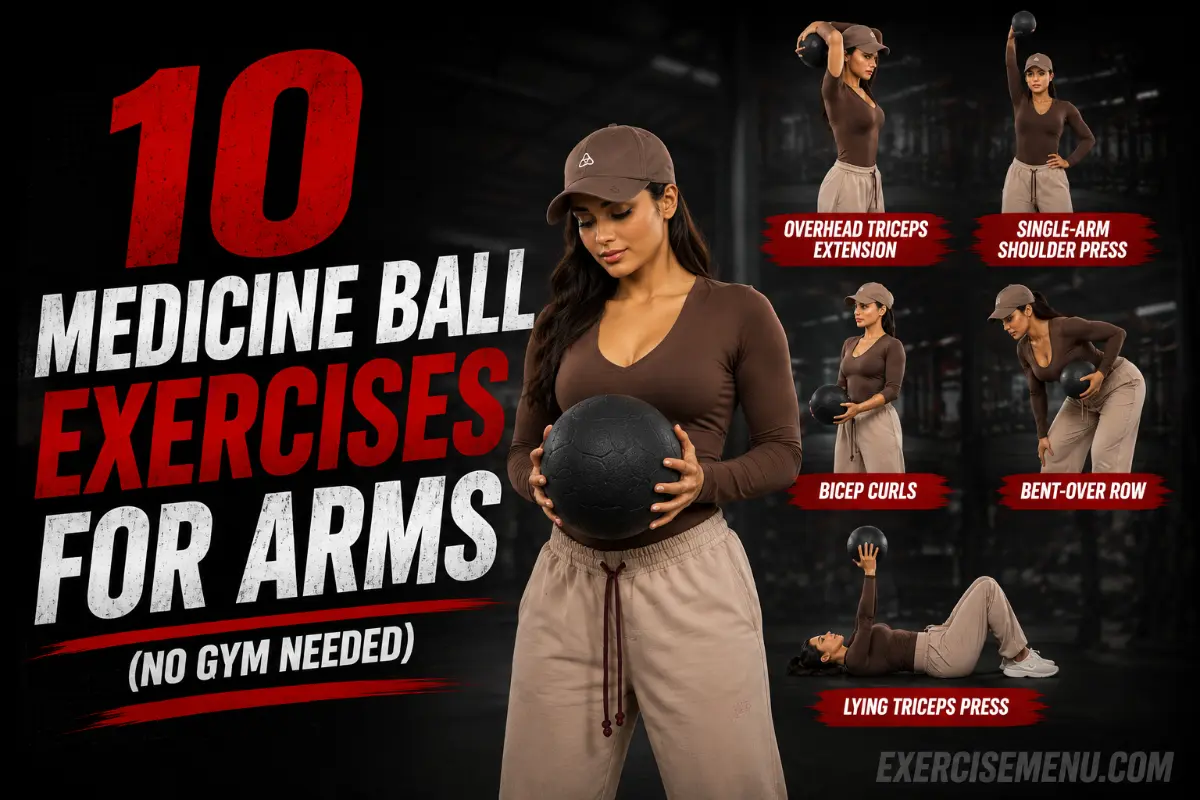
You don’t need a gym, a rack of dumbbells, or an hour of free time to build stronger arms. A medicine ball and a few feet of floor space is enough.
This guide covers 10 exercises that target your biceps, triceps, and shoulders — with clear steps, form tips, and a ready-to-use workout plan at the end.
Grab a 4–6 lb ball. Let’s get to work.
Training legs too? Here’s our guide to 10 medicine ball exercises for legs.
10 Arm exercises with a medicine ball
Ordered easiest to hardest. Each one targets a specific part of your arms.
Before you start — five rules for every rep:
- Brace your core.
- Control the speed — 2 seconds up, 3 seconds down. That slow lowering phase increases time under tension — and that’s what builds muscle.
- Exhale on effort, inhale on the return.
- Keep a neutral spine. No arching, no rounding.
- Muscle burn is fine. Joint pain means stop.
1. Overhead triceps extension
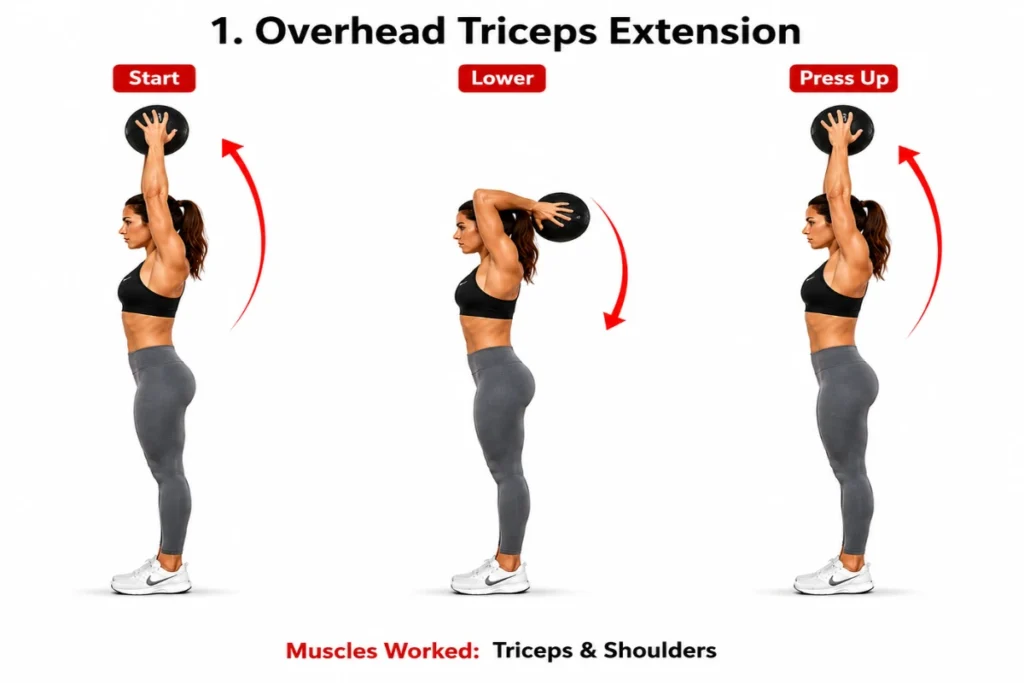
Muscles: Triceps Sets × Reps: 3 × 10–12 | Rest: 45 sec
How to do it:
- Stand with feet shoulder-width apart. Hold the ball with both hands overhead, arms straight.
- Bend your elbows and lower the ball behind your head until your elbows hit 90 degrees. Inhale.
- Squeeze your triceps and push the ball back up. Exhale.
Keep in mind: Your elbows stay close to your head — pointing forward, not sideways.
Beginner tip: Do this seated on a chair first. It removes the balance challenge so you can focus on the contraction.
Common mistake to avoid: Elbows flaring outward. Once they drift sideways, the load shifts from your triceps to your shoulders.
2. Bicep curls
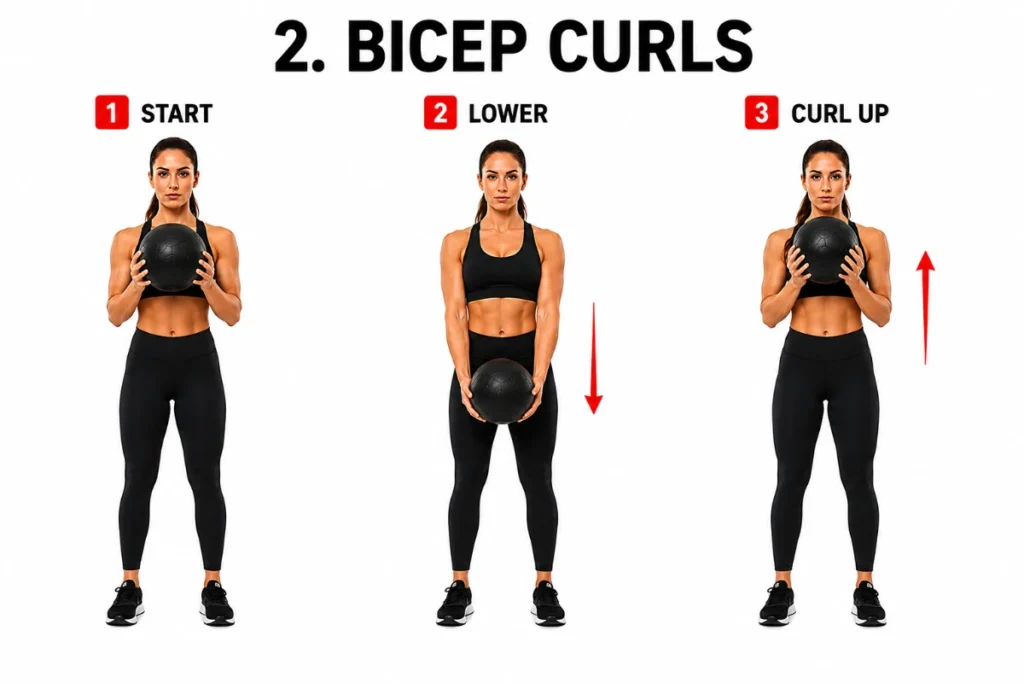
Muscles: Biceps, forearms Sets × Reps: 3 × 10–12 | Rest: 45 sec
How to do it:
- Stand with feet hip-width apart. Hold the ball at chest height with both hands, palms facing up.
- Lower the ball slowly until your arms are fully extended. Inhale.
- Curl back up to chest height. Squeeze your biceps at the top. Exhale.
Keep in mind: Your upper arms stay pinned to your sides. Only your forearms move.
Beginner tip: Sit on a chair for extra stability — it stops you from swaying.
Common mistake to avoid: Swinging the ball up with momentum. If you’re rocking your body, the ball is too heavy — drop 2 lbs.
3. Curl and press
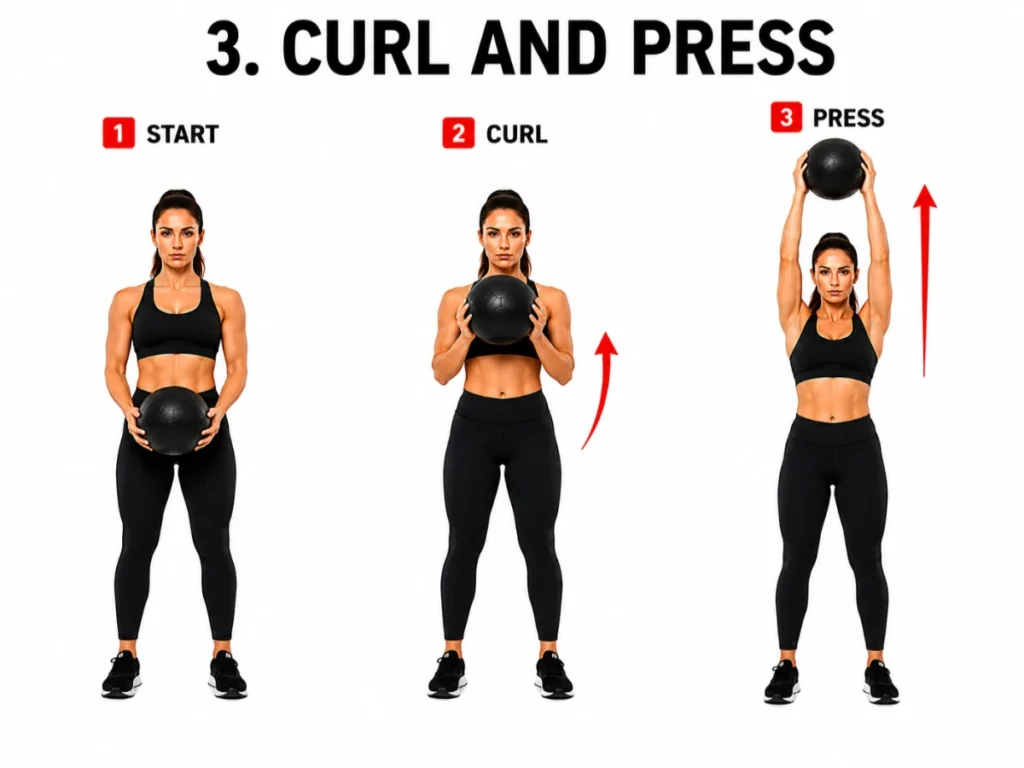
Muscles: Biceps, front shoulders, triceps Sets × Reps: 3 × 8–10 | Rest: 60 sec
How to do it:
- Stand with feet shoulder-width apart. Hold the ball at waist level.
- Curl the ball to chest height. Squeeze your biceps. Exhale.
- Press the ball straight overhead until your arms lock out. Keep exhaling.
- Lower to chest, then to waist. Inhale on the way down.
Keep in mind: Two separate movements — curl, pause at chest, then press. Don’t rush them into one motion.
Beginner tip: Do just the curl for weeks 1–2. Add the press once 12 reps feel controlled.
Common mistake to avoid: Lower back arching on the press. Brace your core and keep your ribs pulled down.
4. Overhead pass
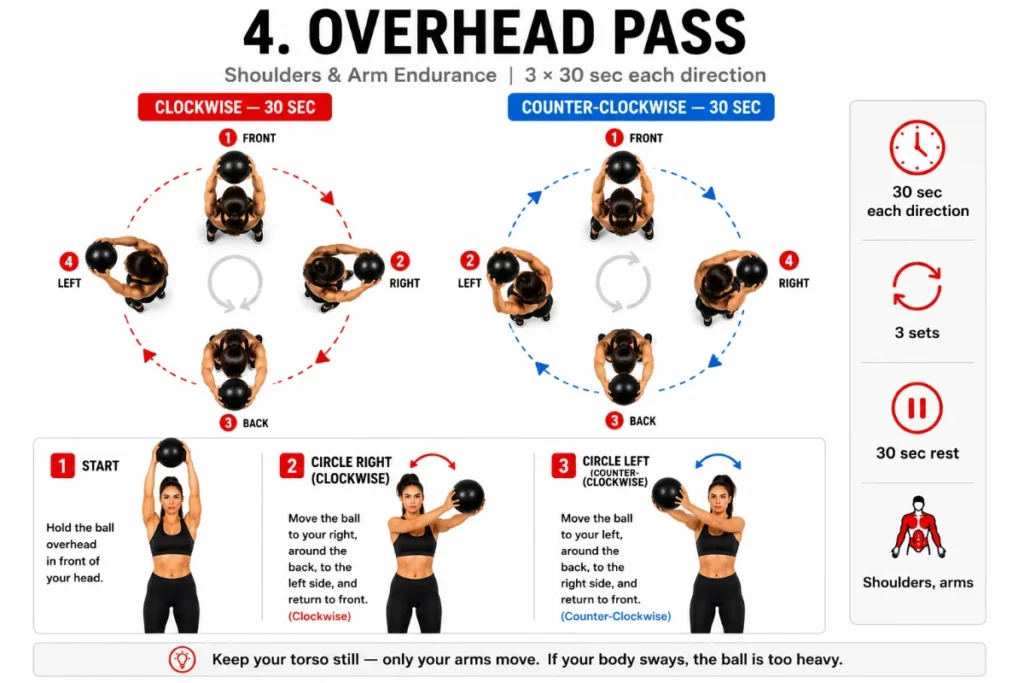
Muscles: Shoulders, arm endurance Sets × Time: 3 × 30 sec each direction | Rest: 30 sec
How to do it:
- Stand tall, core tight. Hold the ball overhead, arms slightly bent.
- Circle the ball around your head — clockwise — keeping arms extended. Breathe steadily.
- After 30 seconds, reverse direction.
Keep in mind: Your torso stays still. Only your arms move. If your body is swaying, the ball is too heavy.
Beginner tip: Great warm-up exercise. Use it first in every arm session.
Common mistake to avoid: Moving too fast. Slow circles keep constant tension on your shoulders. Fast circles just use momentum.
5. Bent-over row
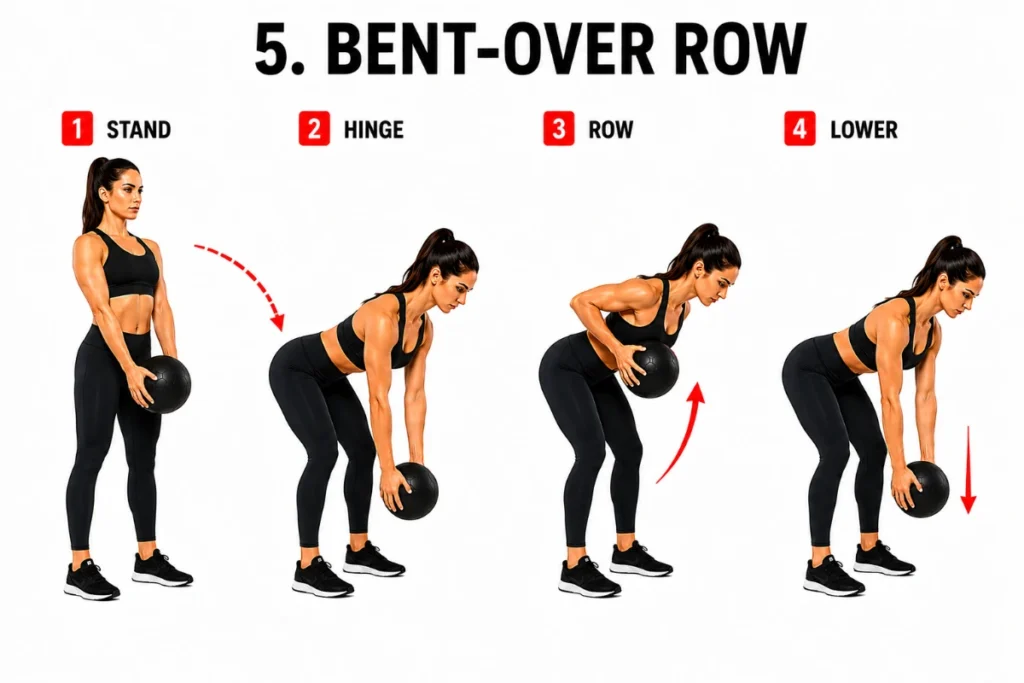
Muscles: Biceps, upper back, rear shoulders Sets × Reps: 3 × 10–12 | Rest: 60 sec
How to do it:
- Stand with feet shoulder-width apart, knees slightly bent. Hold the ball with arms hanging down.
- Hinge forward from your hips — back flat, about 45 degrees to the floor. Inhale.
- Pull the ball toward your navel, squeezing your shoulder blades together. Exhale.
- Pause 1 second at top. Lower slowly. Inhale.
Keep in mind: Squeeze your shoulder blades together at the top like you’re pinching a pencil between them. Without that squeeze, your biceps do the work and your back gets nothing. This move doubles as a back builder too — it’s one of the exercises in our medicine ball back workout.
Beginner tip: If the hinged position is tough, rest your forehead on a table for support — it removes the balance demand.
Common mistake to avoid: Rounding your upper back. When your chest drops, the load shifts to your lower back. Keep your chest up and spine neutral.
6. Controlled slam
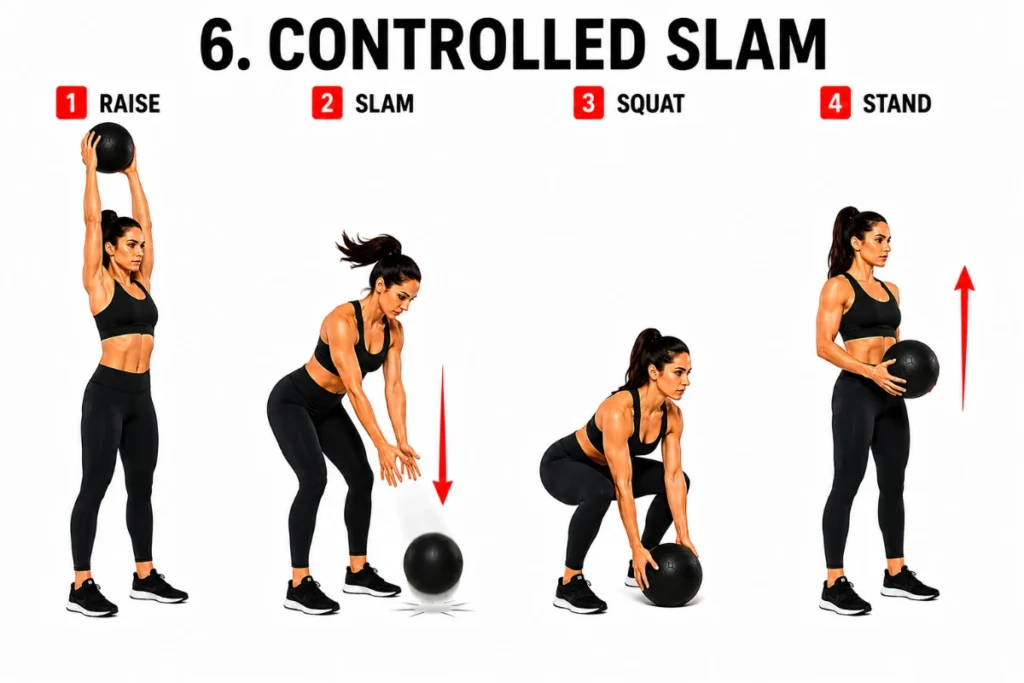
Muscles: Triceps, shoulders, core Sets × Reps: 3 × 8–10 | Rest: 60 sec
How to do it:
- Stand with feet shoulder-width apart. Hold the ball overhead, arms slightly bent.
- Slam the ball into the ground in front of your feet. Exhale hard.
- Squat down to pick it up — bend at your knees, not your waist.
- Stand back up and repeat.
Use a slam ball (dead ball) for this exercise. Rubber medicine balls bounce back unpredictably. If you only have a rubber ball, do exercise #7 instead.
Keep in mind: Fully extend overhead before each slam. The power comes from the full stretch at the top.
Beginner tip: Start with controlled, moderate slams. Focus on the overhead extension — full power comes later.
Common mistake to avoid: Bending from the waist to pick the ball up. Squat every time — knees bent, hips back, chest up.
7. Lying triceps press
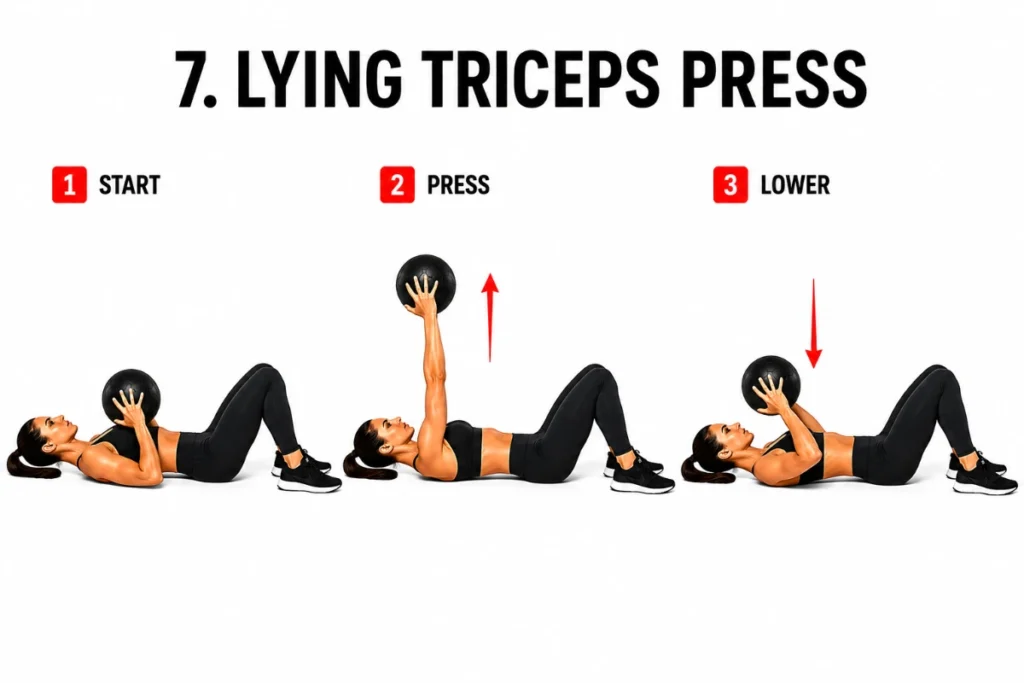
Muscles: Triceps, chest Sets × Reps: 3 × 10–12 | Rest: 45 sec
How to do it:
- Lie on your back, knees bent, feet flat on the floor. Hold the ball on your chest.
- Press the ball straight up toward the ceiling. Exhale.
- Lower slowly back to your chest. Inhale.
A soft medicine ball works best here — the ball is directly above your face. Safer if it slips.
Keep in mind: Elbows at about 45 degrees from your body. Tucking them keeps the load on your triceps. Flaring them wide turns this into a chest exercise.
Beginner tip: Most joint-friendly triceps exercise on this list. If overhead extensions bother your elbows, start here.
Common mistake to avoid: Flaring your elbows out wide. It feels easier because your chest takes over — but you’re here for triceps.
8. Single-arm shoulder press
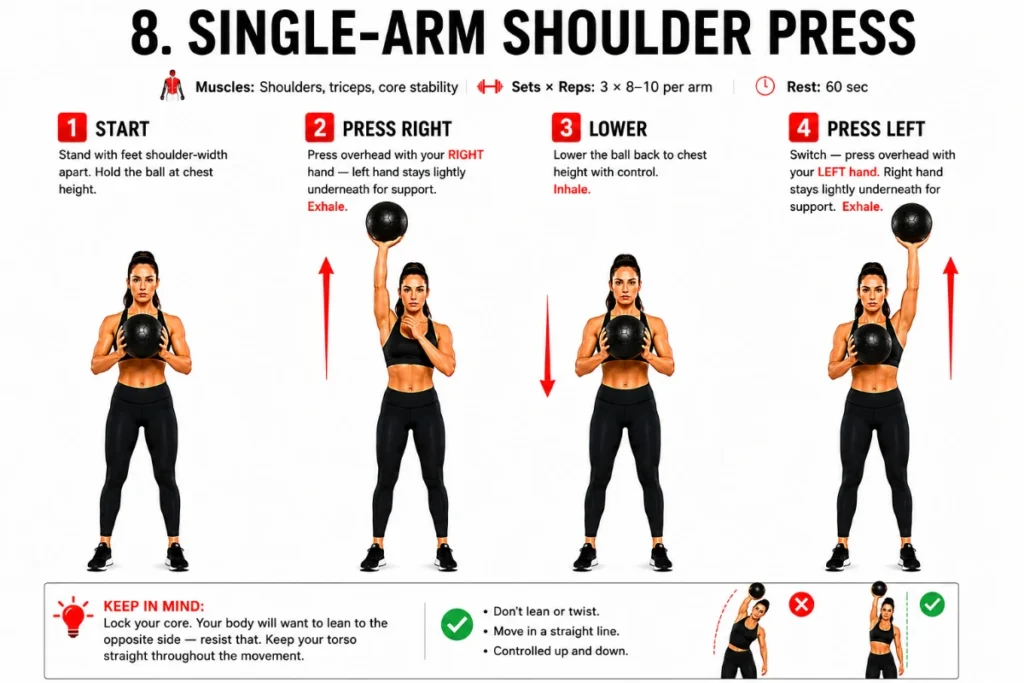
Muscles: Shoulders, triceps, core stability Sets × Reps: 3 × 8–10 per arm | Rest: 60 sec
How to do it:
- Stand with feet shoulder-width apart. Hold the ball at chest height.
- Press overhead with your right hand — left hand stays lightly underneath for support. Exhale.
- Lower to chest. Inhale.
- Switch — left hand leads the next press.
Keep in mind: Lock your core. Your body will want to lean to the opposite side — resist it.
Beginner tip: Start with both hands pressing equally. Shift to single-arm once you can handle 3 × 10 two-handed.
Common mistake to avoid: Leaning backward during the press. If you’re arching, the ball is too heavy for single-arm work.
9. Prone passes
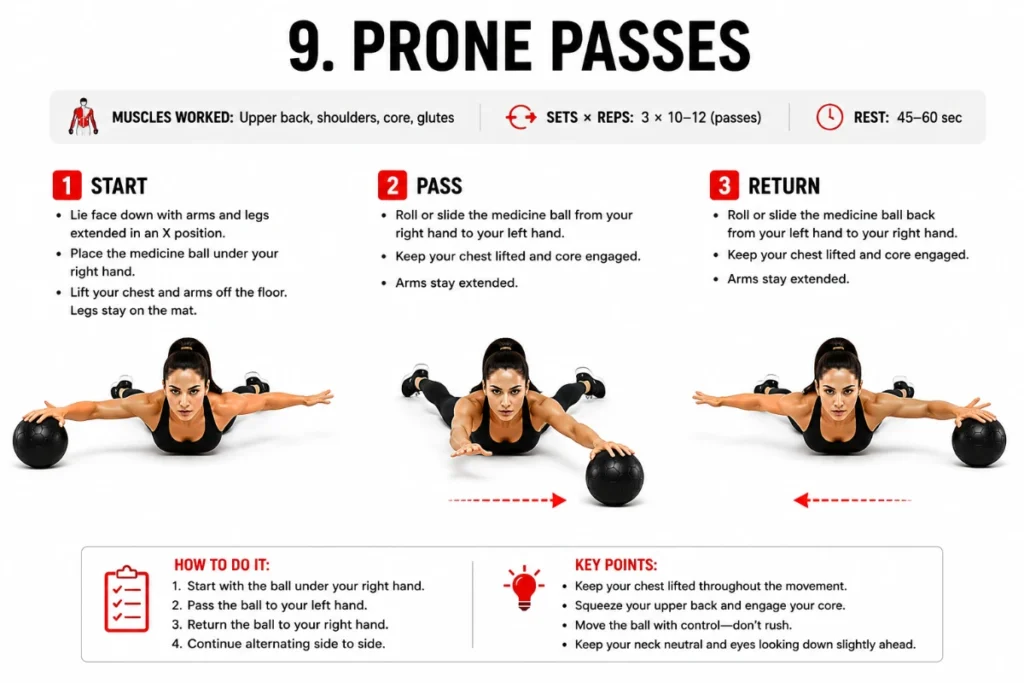
Muscles: Rear shoulders, upper back, triceps Sets × Reps: 3 × 12–15 | Rest: 45 sec
How to do it:
- Lie face down, arms and legs in an X position. Ball under your right hand.
- Lift your chest and arms off the floor. Legs stay on the mat.
- Roll the ball from your right hand to your left hand.
- Pass it back. That’s 1 rep.
Keep in mind: Keep your chest lifted the entire set. The constant hold is what works your upper back and rear shoulders.
Beginner tip: Can’t lift your chest yet? Roll the ball hand-to-hand while lying flat. Add the chest lift once you’ve built some strength.
Common mistake to avoid: Rushing. Slow, controlled passes build more muscle than fast ones.
10. Arm circles
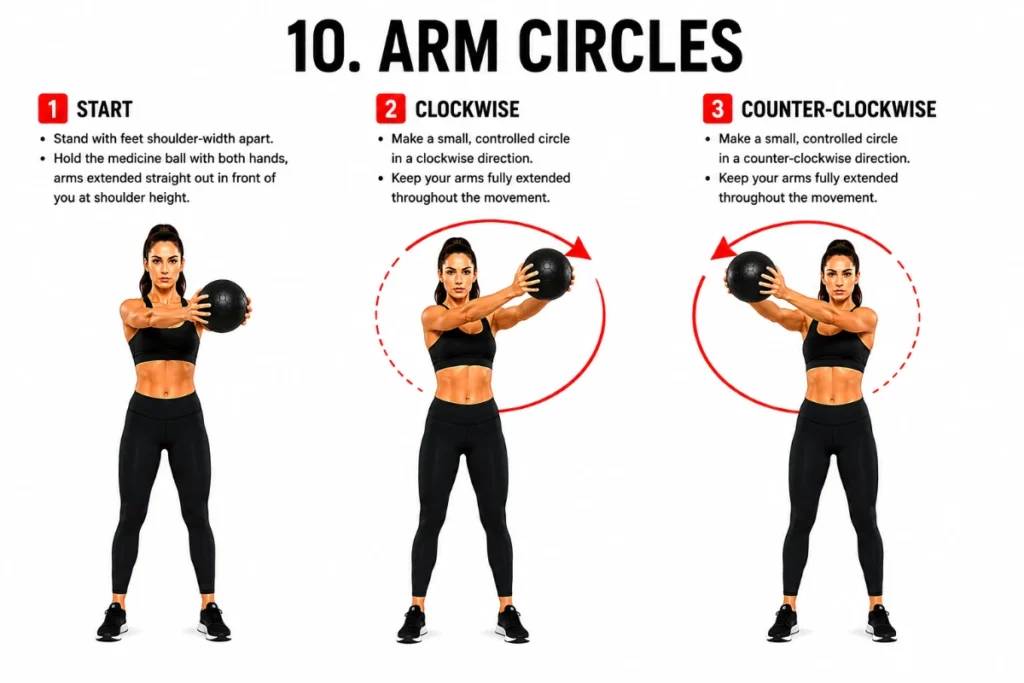
Muscles: Shoulders, forearms, arm endurance Sets × Time: 3 × 30 sec each direction | Rest: 30 sec
How to do it:
- Stand with feet shoulder-width apart. Hold the ball with arms extended straight in front at shoulder height.
- Make controlled circles — arms fully extended. Breathe steadily.
- 30 seconds clockwise, 30 seconds counterclockwise.
Keep in mind: Arms stay locked out. The moment you bend your elbows, you cut the shoulder work in half.
Beginner tip: Use this as your finisher. Your arms are already fatigued from the nine exercises before — even a 4 lb ball will burn.
Common mistake to avoid: Circles too large. Small, controlled circles maintain tension. Large circles let momentum do the work.
Which muscles each exercise works
| Exercise | Biceps | Triceps | Shoulders | Upper back | Forearms |
|---|---|---|---|---|---|
| 1. Overhead triceps extension | — | ✅ | ✅ | — | — |
| 2. Bicep curls | ✅ | — | — | — | ✅ |
| 3. Curl and press | ✅ | ✅ | ✅ | — | — |
| 4. Overhead pass | — | — | ✅ | — | ✅ |
| 5. Bent-over row | ✅ | — | ✅ | ✅ | — |
| 6. Controlled slam | — | ✅ | ✅ | — | — |
| 7. Lying triceps press | — | ✅ | — | — | — |
| 8. Single-arm shoulder press | — | ✅ | ✅ | — | — |
| 9. Prone passes | — | ✅ | ✅ | ✅ | — |
| 10. Arm circles | — | — | ✅ | — | ✅ |
Exercises 1 and 7 target triceps. Exercises 2 and 3 hit biceps. Exercises 4, 8, and 10 focus on shoulders. Exercises 5 and 9 work your upper back alongside your arms.
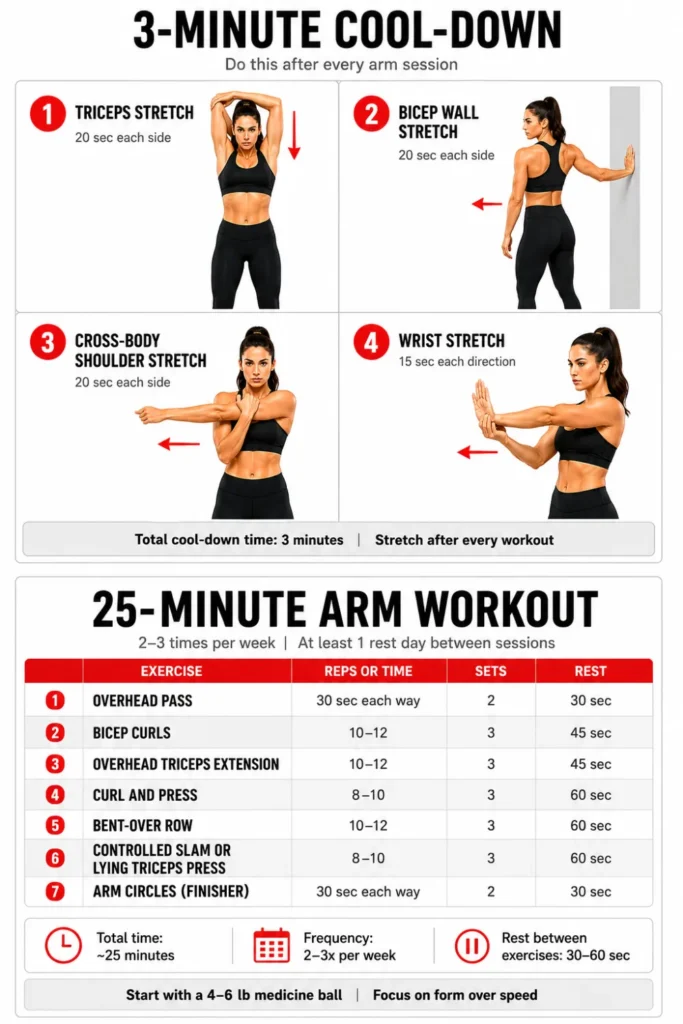
25-minute arm workout you can do today
Do this 2–3 times per week with at least one rest day between sessions.
Warm-up (3 minutes)
- Arm circles (no ball) — 30 sec each direction
- Wrist rotations — 20 sec
- Shoulder shrugs — 10 reps
- Ball passes hand-to-hand — 30 sec
Not sure what 3 × 10 means? Check our quick guide.
The 25-minute workout
| # | Exercise | Reps / Time | Sets | Rest |
|---|---|---|---|---|
| 1 | Overhead pass | 30 sec each way | 2 | 30 sec |
| 2 | Bicep curls | 10–12 | 3 | 45 sec |
| 3 | Overhead triceps extension | 10–12 | 3 | 45 sec |
| 4 | Curl and press | 8–10 | 3 | 60 sec |
| 5 | Bent-over row | 10–12 | 3 | 60 sec |
| 6 | Controlled slam or Lying triceps press | 8–10 | 3 | 60 sec |
| 7 | Arm circles (finisher) | 30 sec each way | 2 | 30 sec |
Cool-down (3 minutes)
- Triceps stretch — arm behind head, 20 sec each side
- Bicep wall stretch — hand on wall, turn away, 20 sec each side
- Cross-body shoulder stretch — 20 sec each side
- Wrist stretch — 15 sec each direction
New to reps and sets? Start there first.
Before your next session
- Don’t skip the warm-up — cold shoulders and elbows get injured. Three minutes is enough.
- Don’t train arms on back-to-back days — muscles grow during rest, not during the workout.
- Start with a 4–6 lb ball even if it feels light — total volume across 7 exercises adds up fast.
When to move up
- Weeks 1–2: Focus on form. Lower end of every rep range. 4 lb ball.
- Weeks 3–4: Push to upper rep ranges. Slow your lowering tempo to 3 seconds.
- Week 5+: Move to a 6–8 lb ball — only if all reps are clean and the last 2 feel manageable.
If your form breaks at rep 8, stay at your current weight. Never jump more than 2 lbs at a time.
The pattern I see most with beginners — too heavy, no warm-up, too frequent. Fix those three and progress comes twice as fast.
Common questions
How heavy should a medicine ball be for beginners?
4–6 lbs (2–3 kg). If you can do 12 clean reps without losing form, the weight is right. If 15+ reps feel easy, move up by 2 lbs.
A soft rubber ball is the best option — easier to grip and safer for lying exercises.
Will these exercises build bigger arms?
They’ll build strength, endurance, and visible definition — especially for beginners. Any new resistance stimulus triggers muscle growth, and a medicine ball is real resistance training.
For serious size beyond the beginner stage, you’ll eventually need heavier loads from dumbbells or barbells. For the right rep ranges, here’s our guide on reps and sets for muscle growth.
How often should I do this workout?
2–3 times per week with at least one rest day between sessions. Your arm muscles need 48 hours to recover and grow. On off days, train legs or core instead.
Do I need different medicine balls for different exercises?
Not as a beginner. One 4–6 lb soft rubber ball covers 9 out of 10 exercises here. The exception is slams — a slam ball (dead ball) doesn’t bounce and is designed for ground impact. If you plan to do slams regularly, it’s worth picking one up.
How long before I see results?
You’ll feel stronger within 2–3 weeks — grip, control, and endurance improve first. Visible definition depends on body fat and diet, but most beginners notice changes around the 6–8 week mark with consistent training.
Can kids do medicine ball exercises?
Yes — but with lighter balls and age-appropriate movements. Exercises like chest passes, squats, and overhead throws are safe for children with supervision. We’ve got a full guide to 10 medicine ball exercises for kids under 12 with the right ball weight by age and parent tips for every exercise.
Conclusion
10 exercises covering biceps, triceps, and shoulders. Grab a 4–6 lb ball, follow the workout plan above, and train 2–3 times per week with form as the priority over speed. For lower body work with the same ball, the medicine ball leg exercises guide covers quads, hamstrings, and glutes with the same sets-and-reps format. The medicine ball exercises guide covers every other muscle group — back, chest, shoulders, abs, and more — in one place.
