


Key takeaways
- A deload week is a planned 5–7 day reduction in training intensity and/or volume — typically by 30–50% — while staying active
- It’s not the same as a rest week: you keep training, just with less load and stress
- Your nervous system, tendons, and connective tissue need deloading as much as your muscles do
- Most consistent lifters benefit from deloading every 6–8 weeks; advanced athletes may need it every 4–6 weeks
- Done correctly, a deload week doesn’t cost you gains — it sets you up to hit them
You’ve been training consistently. You’re doing the work, hitting your sessions, eating enough protein. But something’s off. Your lifts feel heavy before you even warm up. Your motivation has slipped. You’re sore most of the time, and progress has stalled.
This isn’t a motivation problem. It’s a recovery problem.
I’ve coached clients for 7+ years at Exercise Menu, and I’ve seen this pattern hundreds of times. The athlete who thinks they need to push harder is almost always the one who needs to pull back. Specifically, they need a deload week.
If you’re training 3 or more times a week with a progressive overload goal, this guide is for you. Beginners can deload reactively when symptoms appear. Advanced athletes preparing for competition should time deloads with a qualified coach.
This guide covers exactly what a deload week is, what’s happening in your body during one, how to know when you need one, and how to structure it — without losing the progress you’ve worked hard to build.
- What is a deload week?
- What actually happens in your body during a deload week?
- 7 signs you actually need a deload week right now
- Deload Readiness Checker
- What happens if you never deload?
- How often should you take a deload week?
- How to do a deload week correctly (5 methods)
- Will you lose muscle or strength during a deload week?
- Deload week nutrition: should you eat differently?
- Deload weeks for different training styles: quick reference
- What happens after a deload week?
- What the research and experts say
- Frequently asked questions
- The bottom line
What is a deload week?
A deload week is a planned period — typically 5–7 days — where you intentionally reduce your training stress, either by cutting volume (fewer sets and reps), reducing intensity (lighter weights), training less frequently, or a combination of all three.
According to a 2023 International Delphi Consensus study published in Sports Medicine – Open, deloading is formally defined as a period of reduced training stress designed to mitigate physiological and psychological fatigue, promote recovery, and enhance preparedness for subsequent training. The study brought together expert strength and physique coaches to establish a shared framework — and the agreed reduction sits at 30–50% of your normal training load.
The critical distinction: you don’t stop training. You scale back purposefully while keeping your movement patterns intact.
Deload week vs. rest week — what’s the actual difference?

A rest week usually happens by necessity — illness, injury, travel, or burnout forces a full stop. A deload week is proactive and planned. You’re removing accumulated fatigue before it turns into a real problem.
Deload week vs. active recovery — not the same thing
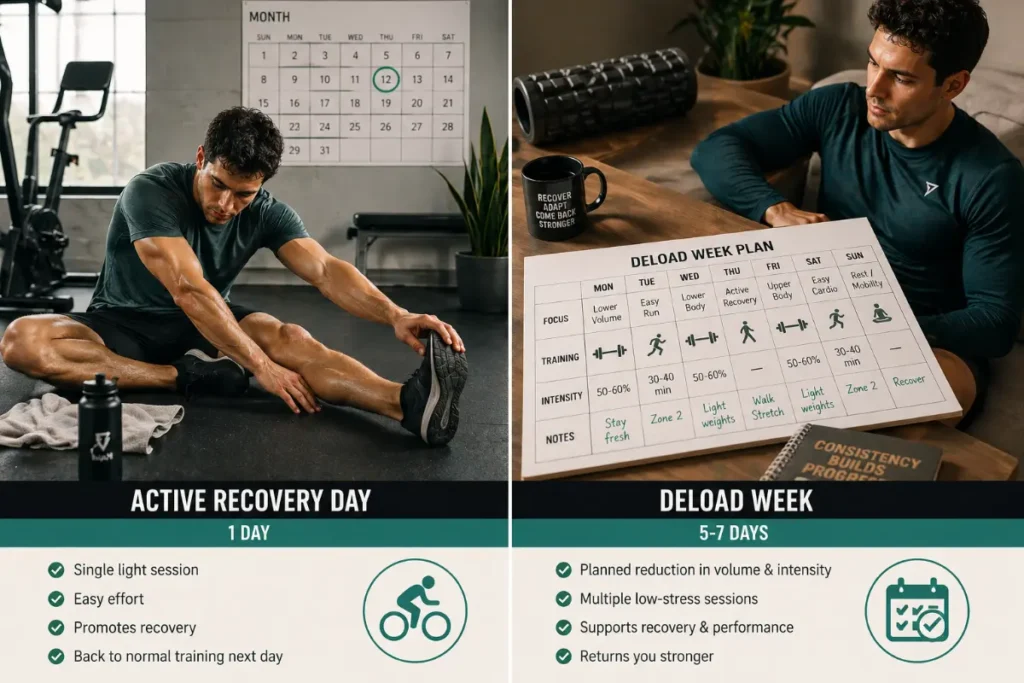
Active recovery is a single lighter day between hard sessions. A deload is a structured 5–7 day reduction block. Confusing the two is one of the most common mistakes I see — treating one lighter workout as enough to offset weeks of high-intensity training. It isn’t.
What actually happens in your body during a deload week?
Most people think a deload is just giving their muscles a break. It’s not. Several systems recover simultaneously — and that’s why a day or two doesn’t cut it.
- The central nervous system (CNS) — heavy training doesn’t just fatigue your muscles. It creates significant neural stress. When CNS fatigue builds up, you’ll notice it as a feeling of heaviness, slower bar speed, and reduced power output even when muscle soreness is gone
- Connective tissue (tendons and ligaments) — muscles recover faster than tendons. This mismatch is a major injury driver. Your muscles feel ready to train hard again, but your tendons haven’t caught up yet. Deloading lets connective tissue close that gap
- Hormonal stress markers — chronically elevated cortisol from sustained high-volume training suppresses recovery, disrupts sleep, and impairs muscle protein synthesis. A deload normalizes this
- Mental fatigue — this one is real and it’s physical. The motivation to train isn’t just psychological willpower; it’s influenced directly by systemic fatigue levels. When systemic fatigue drops, motivation returns — not because you gave yourself a pep talk, but because your body’s stress load decreased
One of my clients — a male intermediate lifter training 5 days a week — came to me having made zero strength progress for four months. He was convinced he needed more volume. He needed the opposite. After dropping to 4 sessions per week, reducing sets per muscle group, and adding a mandatory deload every 4th week, he added 25 lbs to his squat and 20 lbs to his bench within 8 weeks. The fitness was there the entire time. The fatigue was hiding it.
The supercompensation principle: why rest makes you stronger
Every adaptation follows the same cycle: apply stress → recover → adapt → repeat. Supercompensation is the phase where your body, after full recovery, comes back stronger than it was before the stress. If you never allow full recovery, you stay in the fatigue phase permanently. You accumulate stress on top of stress. Deloads are the planned release valve in that cycle — they’re when the adaptation you earned actually gets expressed.
7 signs you actually need a deload week right now
Your body communicates overreaching clearly. Most athletes just don’t listen closely enough.
1. Your strength is dropping week over week. You’re doing everything right nutritionally, sleeping reasonably well, but your working weights are going backwards. This is accumulated CNS fatigue, not weakness.
2. Persistent DOMS that never fully clears. Some soreness after hard sessions is normal. Soreness that lingers for 4–5 days and never actually resolves between sessions means you’re accumulating tissue stress faster than you’re clearing it.
3. Poor sleep or elevated resting heart rate. A resting heart rate that’s 5–7 beats per minute above your normal baseline is a documented sign of insufficient recovery. If you’re sleeping but not restoring — waking up tired — this is your nervous system telling you something.
4. Training feels heavy before the session starts. The warm-up shouldn’t feel like a working set. If it does, that session’s going to be a write-off regardless of how long you rest before it.
5. You’ve lost motivation and the gym feels like a chore. This isn’t a mindset issue. It’s a physiological signal. Chronically elevated stress hormones directly reduce motivation. When training stops feeling purposeful and starts feeling like obligation, that’s often systemic fatigue presenting as psychology.
6. Lingering joint pain or tightness. Muscle soreness fades in 48–72 hours in a well-recovered athlete. Joint discomfort that lingers beyond 3–4 days — especially in knees, shoulders, elbows, or hips — indicates connective tissue is accumulating stress faster than it can repair.
7. Coordination and technique feel off. When CNS fatigue is high, movement quality degrades before strength does. If your bar path looks worse, your technique feels unstable, or your coordination is off, your nervous system is fatigued.
Deload Readiness Checker
Answer 7 questions about how your training has felt lately. Get a specific recommendation — not a generic one.
What happens if you never deload?
Skipping deloads isn’t courageous — it’s expensive. Here’s what chronic under-recovery actually produces over time:
- Tendinopathy — tendons that never fully recover develop micro-tear accumulation that eventually becomes chronic pain. This is the injury nobody saw coming because it developed slowly over months of ignored warning signs
- CNS burnout — prolonged neural fatigue leads to performance regression, not stagnation. Athletes who skip deloads for extended periods often find themselves getting weaker despite consistent training
- Hormonal disruption — elevated cortisol sustained over weeks suppresses testosterone and growth hormone, directly impairing the muscle-building response to training
- Immune suppression — overreaching is consistently associated with increased illness in both recreational and competitive athletes
- Psychological burnout — grinding without recovery ends training careers. Structured deloads extend them
The pattern I see most often: a lifter trains hard for 6–9 months without structured recovery, hits a wall, gets an overuse injury, and is forced to take 6–8 weeks completely off. That forced rest takes far more from them than any planned deload ever would have.
How often should you take a deload week?
There’s no single answer here, and anyone who gives you one number without context isn’t being accurate. Recovery capacity is highly individual. That said, research and practical experience point to clear ranges:
| Training level | Recommended deload frequency |
|---|---|
| Beginner (0–12 months) | Only when symptoms appear; not scheduled |
| Intermediate (1–3 years) | Every 6–8 weeks |
| Advanced / high volume | Every 4–6 weeks |
| Competitive athletes | Every 4–6 weeks, or timed to competition phases |
Based on a 2024 cross-sectional survey of 246 competitive strength and physique athletes published in Sports Medicine – Open — the typical deload lasted 6.4 days and was integrated into training every 5.6 weeks on average.
Beginners don’t need scheduled deloads. Early training has built-in recovery from lower absolute loads. A beginner should deload when progress stalls, form breaks down, or training feels unusually hard — not on a fixed schedule.
When life stress should move your deload earlier
Your training recovery doesn’t happen in isolation. Poor sleep, high work stress, illness, travel, and significant life events all draw from the same recovery pool. When stress outside the gym is high, the body has fewer resources available for physical recovery.
I tell clients to think of their total recovery capacity as a budget. When life spends from that budget, training has less available. In those periods, scheduling a deload sooner — rather than grinding through — prevents the kind of accumulated fatigue that takes weeks to dig out of.
How to do a deload week correctly (5 methods)
Here are the five most effective approaches, with guidance on when each fits best:
Method 1: Reduce volume (fewer sets and reps)
Keep your exercises and roughly similar weights, but cut your total sets per session by 30–50%. If you normally do 20 working sets per week for a muscle group, drop to 10–12. This works well for lifters whose main issue is accumulated volume fatigue rather than intensity-driven CNS overload.
If you’re unsure how your sets and reps are currently structured, our guide on what reps and sets actually mean gives you the full breakdown before you start adjusting them.
Method 2: Reduce intensity (lighter weights, same movements)
Keep your exercise selection and set/rep structure, but train at 60–70% of your normal working weight. This maintains motor patterns and keeps your CNS engaged without creating meaningful fatigue. If your normal squat working weight is 100 kg, your deload squat might sit at 60–70 kg. Never approach failure on any set during a deload week.
Method 3: Reduce frequency (fewer training days)
If you normally train 5 days per week, drop to 2–3. This is especially effective when general systemic fatigue — not just muscular fatigue — is the issue. It also gives athletes who are mentally burned out a genuine break from the structure of daily training.
Method 4: Technique-focused deload
Use the week to drill movement quality on your compound lifts at sub-maximal loads. Particularly useful for intermediate and advanced lifters who want to address form breakdown that’s developed over a hard training block. Light weights, precise execution, full range of motion. No grinding, no near-failure sets.
Method 5: Active recovery deload
Step away from the weights entirely and move in ways that feel restorative — walking, hiking, cycling at low intensity, swimming, yoga, Pilates, foam rolling, or mobility work. When mental fatigue is the dominant issue, structured training is often what needs the break — not just the body.
Will you lose muscle or strength during a deload week?
This is the fear that stops most people from deloading when they should. The short answer: no.
Meaningful muscle loss doesn’t begin until approximately 2–4 weeks of completely skipped training. A single week of reduced — but not absent — training does not cause hypertrophy regression.
A 2024 study published in PeerJ tracked 39 resistance-trained men and women through a 9-week program — one group deloaded at the midpoint, one trained straight through. The result: no significant differences in muscle hypertrophy between groups. The deload group showed slightly lower strength numbers mid-study — because they were recovering, not regressing. By the end, differences were minor and the deload group reported better subjective recovery. That’s why personal bests after a deload are common — and expected.
Deload week nutrition: should you eat differently?
Most people should eat at maintenance or a slight surplus during a deload week — and no, you don’t need to slash calories just because you’re training less.
Recovery is still the primary goal. Muscle protein synthesis continues to require adequate protein intake regardless of reduced training load. Dropping calories significantly during a deload week undermines the very thing you’re trying to achieve.
Protein stays the same. Aim for your normal daily protein target — typically 0.7–0.9g per pound of bodyweight. Cutting protein during a week specifically designed for tissue repair is counterproductive.
If you’re currently cutting: you should still deload. A caloric deficit impairs recovery capacity, which means you likely need to deload more frequently, not less. You don’t need to increase calories — the protein target doesn’t change, and the training reduction alone gives your body the recovery room it needs.
Deload weeks for different training styles: quick reference
| Training style | Recommended deload method | Key adjustment |
|---|---|---|
| Strength / powerlifting | Volume or intensity reduction | Keep compound patterns, drop load to 60–70% |
| Hypertrophy / bodybuilding | Volume reduction | Cut sets per muscle by 40–50%, stay far from failure |
| Endurance / running | Frequency and distance reduction | Drop weekly mileage by 40–50%, no speed work |
| Beginners | Active recovery or frequency reduction | Light movement only, no near-failure work |
| Advanced athletes (40+) | Volume + intensity combined | Connective tissue recovery takes longer — err conservative |
A note on older athletes specifically: recovery timelines lengthen meaningfully with age, particularly for connective tissue. Lifters over 40 generally benefit from deloading more frequently than the standard 6–8 week guideline, and from being more conservative with how much they reduce. Most training guides don’t address this — but age genuinely changes the math.
What happens after a deload week?
Return to your normal program as planned. Don’t test your maxes in the first session back. Don’t pile on extra sets because you feel good. The enthusiasm you feel post-deload is the signal that the week worked — it’s not a green light to immediately undo it.
Expect the first two sessions back to feel noticeably smoother. Bar speed returns, coordination sharpens, and RPE drops on weights that felt heavy before the deload. That’s your body expressing the adaptations it couldn’t during the fatigue phase.
Give yourself 1–2 weeks to ramp back to full pre-deload intensity. Most lifters hit their stride by week two and often find they’re moving weights that were previously stuck.
The biggest mistake returning from a deload: ego lifting in session one. You feel recovered, you feel strong, so you go heavier than you should. Then you’re sore for five days and back to square one. Ease back in — your body will tell you when it’s ready to push again, and it usually takes less than two sessions to find out.
What the research and experts say
The evidence base for deloading is consistent across three independent lines of research: the 2023 Delphi consensus from Sports Medicine – Open establishing the formal definition, the 2024 athlete survey in Sports Medicine – Open confirming real-world deload frequency and methods, and the 2024 PeerJ controlled trial showing no hypertrophy loss from a structured deload week.
The National Strength and Conditioning Association (NSCA) supports planned unloading phases as part of periodized programming — the systematic variation of training stress over time to maximize long-term adaptation.
Dr. Brad Schoenfeld and Eric Helms have both pointed to fatigue management as a non-negotiable part of long-term programming — not a nice-to-have, but a requirement for continued adaptation. If two of the most cited researchers in hypertrophy science agree on this, that’s worth paying attention to.
Frequently asked questions
What is a deload week?
A deload week is a planned 5–7 day reduction in training intensity and/or volume — typically by 30–50% — while continuing to train. It allows connective tissue, the nervous system, and hormonal markers to recover simultaneously, setting you up for a stronger return to full training.
How often should I take a deload week?
Every 6–8 weeks for most consistent lifters; every 4–6 weeks for advanced or high-volume athletes. Beginners don’t need a fixed schedule — deload when progress stalls, form deteriorates, or training feels unusually hard. External stressors like poor sleep or high life stress can move the timing earlier regardless of training level.
Will I lose muscle if I take a deload week?
No. Muscle loss doesn’t begin until approximately 2–4 weeks of completely skipped training. A deload reduces load — it doesn’t remove the training stimulus entirely. A 2024 study in PeerJ confirmed no significant difference in hypertrophy between lifters who deloaded and those who didn’t over the same period.
What should I do during a deload week?
Reduce sets by 40–50%, cut weight to 60–70% of normal, train fewer days, focus on technique, or shift to active recovery — walking, yoga, Pilates, or mobility work. The right choice depends on whether your dominant fatigue is muscular, neural, or psychological.
Is a deload week the same as a rest week?
No. A rest week means stopping exercise entirely — usually forced by illness, injury, or travel. A deload is intentional: you keep moving and maintain your movement patterns, but reduce the training stress load deliberately.
Should I change my nutrition during a deload week?
Eat at maintenance or a slight surplus. Protein stays the same — typically 0.7–0.9g per pound of bodyweight. If you’re cutting, don’t reduce calories further; the training reduction alone creates the recovery conditions your body needs.
The bottom line
A deload week isn’t doing less — it’s training smart enough to recognize that recovery is part of the process, not a pause from it. The athletes who progress consistently over years aren’t the ones who never rest. They’re the ones who know when to push and when to pull back.
If your lifts are stalling, your joints are nagging, or you’re dreading sessions you used to look forward to, your body has already told you what it needs. A week of reduced load now will cost you nothing. Ignoring it for another month will.
If you want to make sure your training is structured to support consistent progress — including knowing when and how to adjust volume and intensity — our Rep Range Recommender gives you a research-backed starting point based on your specific goal.

3 Comments
Pingback: Is Muscle Confusion Real? What 3 Studies Actually Found
Pingback: How to Calculate Your 1RM (One Rep Max Calculator + Formula)
Pingback: Should You Train to Failure? What 55 Studies Say (2026)