


Quick Answer: Do 3–4 sets of 10–15 reps with light-to-moderate weight, 3–4 days per week, with 60–90 seconds rest between sets. Use a weight that genuinely challenges you in the last 2–3 reps. Keep protein at 1.6–2.2g per kg of bodyweight daily. That combination not endless cardio is what preserves muscle while fat comes off.
Most people who start training for fat loss either go too heavy chasing a burn, or grind through endless light reps thinking higher numbers automatically mean more fat gone. Neither approach is wrong — but neither is optimised either.
How many reps and sets for fat loss depends on a simple principle: the goal of resistance training in a calorie deficit is not to burn as many calories as possible during the session. It is to preserve muscle while your body pulls from fat stores. Calories are managed through diet. Training determines what you lose alongside the fat.
- What Rep Range Is Best for Fat Loss?
- How Many Sets for Fat Loss Per Week?
- Rep and Set Ranges by Training Goal
- What Actually Changes When You Train in a Calorie Deficit?
- How Long Should Rest Periods Be for Fat Loss?
- How Many Days Per Week Should You Train for Fat Loss?
- Sample Weekly Training Plans
- The Role of NEAT in Fat Loss
- Cardio During a Fat Loss Phase
- Can You Lose Fat and Build Muscle at the Same Time?
- Common Mistakes When Training for Fat Loss
- Frequently Asked Questions
What Rep Range Is Best for Fat Loss?
For most people, 10–15 reps per set with light-to-moderate weight is the most practical rep range for fat loss — but it is not the only one that works.
The 10–15 range works because it maximises time under tension. The longer your muscles work under load, the greater the metabolic demand during and after the session. A systematic review by Schoenfeld, Ogborn & Krieger, published in the Journal of Sports Sciences, found that moderate-to-higher rep ranges performed to a similar level of effort produced comparable muscle retention outcomes to heavier, lower-rep training — which matters most when muscle preservation is the priority.
That said, only training in the 10–15 range has a limitation: it does not do enough to preserve strength. For most people running a calorie deficit, a mixed approach works better:
- 50% of sets in the 8–15 rep range — muscle retention and metabolic demand
- 25% of sets in the 3–8 rep range — strength retention, particularly on compound lifts
- 25% of sets in the 15–25 rep range — higher metabolic demand, conditioning
Maintaining strength output during a cut is the clearest signal to your body that the muscle is still needed. Without that signal, a calorie deficit accelerates lean tissue loss alongside fat.
Rep number is secondary. Effort is what matters — the last 2–3 reps of every set should require genuine focus to complete with clean form.
How Many Sets for Fat Loss Per Week?
3–4 sets per exercise, across 3–4 sessions per week, is the effective range during a fat loss phase.
For weekly volume, 10–15 hard sets per muscle group per week is sufficient to maintain muscle in a calorie deficit. Going significantly above this especially while eating less creates more recovery demand than most people can manage. The result is not faster fat loss. It is declining performance, persistent soreness, and muscle loss rather than preservation.
The question of how many sets per muscle group per week shifts depending on your training level — beginners maintain muscle on lower weekly volumes than intermediates but 10–15 sets covers the productive range for most people in a cut.
Rep and Set Ranges by Training Goal
Here is where fat loss sits relative to other training goals:
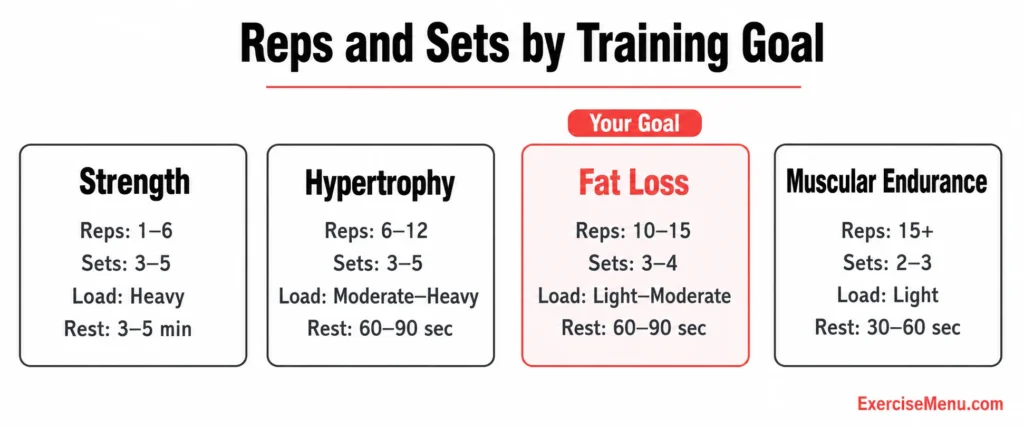
If you are unsure where to start, 3 sets of 12 reps is the practical middle ground widely used, easy to track, and effective for most people in a moderate calorie deficit.
What Actually Changes When You Train in a Calorie Deficit?
When you are eating less than you burn, your body has less energy available for both performance and recovery. Strength output drops especially on heavy compound lifts. Recovery slows. And muscle loss risk increases, particularly with aggressive deficits or high training volumes.
Three variables determine how much muscle you keep versus how much you lose:
Protein intake is the most important nutritional variable. Keeping protein at 1.6–2.2g per kg of bodyweight daily is consistent with British Nutrition Foundation guidance and is the single most effective lever for muscle retention during a cut. Most people in a deficit under-eat protein and over-reduce carbohydrates — which compounds both fatigue and muscle loss.
Resistance training sends the retention signal. When you lift, your muscles receive a clear signal that they are being used and need to stay. Without that signal, a calorie deficit accelerates lean tissue breakdown alongside fat. This is why people who rely solely on cardio or diet often end up lighter but lose more lean tissue than they should.
Insulin sensitivity improves with resistance training. Regular lifting makes your body more efficient at handling the food you eat improving how cells respond to insulin means less of what you consume gets stored as fat, even in a deficit. This mechanism is separate from the calorie burn of the session itself.
How Long Should Rest Periods Be for Fat Loss?
60–90 seconds between sets is where the research consistently points for fat loss training.
Shorter rest than strength training keeps heart rate elevated, increases caloric expenditure during the session, and sustains metabolic demand across the full workout. Cutting rest too aggressively — below 45 seconds on compound movements compromises form and reduces the quality of subsequent sets.
A practical split:
- Compound movements (squats, rows, chest press): 75–90 seconds rest
- Isolation exercises (curls, tricep extensions): 45–60 seconds rest
How Many Days Per Week Should You Train for Fat Loss?
3–4 resistance training sessions per week is the productive range during a fat loss phase.
Beginners: 3 full-body sessions per week — each session trains all major muscle groups, providing enough frequency without excessive fatigue in a deficit.
Intermediate lifters: 4-day upper/lower split more volume per muscle group per session, structured to allow adequate recovery between sessions.
Going beyond 5 sessions per week in a calorie deficit is generally counterproductive. Recovery suffers, performance declines, and the risk of losing lean tissue increases rather than fat loss accelerating.
The NHS Physical Activity Guidelines recommend muscle-strengthening activity on at least two days per week — a useful minimum, but for active fat loss, 3–4 sessions is where the evidence points. How those sessions sit alongside rest and active recovery days determines whether the week as a whole supports progress or undermines it.
Sample Weekly Training Plans
3-day full-body plan (beginner)
| Day | Session | Sets × Reps | Rest |
|---|---|---|---|
| Monday | Full-Body Resistance | 3 × 12 | 90 sec |
| Tuesday | LISS or Rest | 30–40 min walk | — |
| Wednesday | Full-Body Resistance | 3 × 12 | 90 sec |
| Thursday | Rest or Light Walk | — | — |
| Friday | Full-Body Resistance | 3 × 12 | 90 sec |
| Saturday | LISS (optional) | 30 min walk/cycle | — |
| Sunday | Full Rest | — | — |
Each session: one push (chest press or push-up), one pull (lat pulldown or dumbbell row), one lower body compound (squat or Romanian deadlift), one core movement (dead bug or plank).
4-day upper/lower split (intermediate)
| Day | Session | Sets × Reps | Rest |
|---|---|---|---|
| Monday | Upper Body | 3–4 × 10–12 | 90 sec |
| Tuesday | Lower Body | 3–4 × 10–12 | 90 sec |
| Wednesday | LISS or Rest | 30–40 min | — |
| Thursday | Upper Body | 3–4 × 10–12 | 90 sec |
| Friday | Lower Body | 3–4 × 10–12 | 90 sec |
| Saturday | LISS or Moderate Cardio | 20–30 min | — |
| Sunday | Full Rest | — | — |
Keep sessions under 60 minutes in a calorie deficit fatigue accumulates quickly when eating less, and performance drops sharply beyond that point.
The Role of NEAT in Fat Loss
The calories burned outside formal exercise — called NEAT (Non-Exercise Activity Thermogenesis) — can vary by up to 2,000 kcal per day between individuals. It covers walking, taking the stairs, fidgeting, and general daily movement.
Research from Herman Pontzer, published in Current Biology (2016), found that as formal exercise increases, the body compensates by reducing energy burned elsewhere. In practical terms: adding more gym sessions does not always create the calorie deficit you would mathematically expect.
The fix is simple but requires tracking: aim for 10,000–12,000 daily steps throughout a cut. On days with no step tracking, movement quietly drops to 6,000–7,000 without any conscious decision to sit more.
Cardio During a Fat Loss Phase
Cardio is not the driver of fat loss it is a supplement to the resistance training and nutrition that do the real work.
2–3 moderate cardio sessions per week (20–40 minutes each) alongside 3–4 resistance sessions is sufficient for most people. If you are already training 4 days per week with weights, adding 3–4 high-intensity cardio sessions on top creates a recovery load that exceeds what most people can manage in a deficit.
| Cardio Type | Best Used For | Weekly Volume |
|---|---|---|
| LISS (walking, light cycling) | Active recovery on off-days | 2–3 sessions |
| HIIT (sprint intervals) | Calorie burn — use sparingly | 1–2 sessions max |
| Steady-state moderate (jog/cycle) | General conditioning | 2–3 sessions |
If you are unsure whether cardio should come before or after weights when combining both in one session, cardio before or after weights covers the evidence on sequencing.
Can You Lose Fat and Build Muscle at the Same Time?
Yes — but with specific conditions.
Body recomposition is most effective for beginners, returning lifters, and those carrying higher body fat. For experienced, already-lean lifters, true recomposition is considerably slower and harder to achieve.
If recomposition is the goal:
- Keep the deficit modest — 200–300 kcal below maintenance
- Protein at the higher end of the fat loss range daily
- Training: 3–4 sets of 10–15 reps, 3–4 times per week
- Progressive overload must still apply — flat performance across weeks signals to the body that muscle is unnecessary
Common Mistakes When Training for Fat Loss
Too much cardio, too little lifting. Cardio burns calories during the session. Muscle raises resting metabolism around the clock. For long-term body composition, lifting produces better returns than cardio.
Slashing calories too aggressively. A deficit larger than 500–750 kcal per day consistently leads to muscle loss, performance decline, and hormonal disruption. If weight loss exceeds 0.75–1% of bodyweight per week, the deficit is too aggressive.
Letting loads drop week after week. In a cut, try to maintain or slightly increase the weight being lifted. Letting loads fall session after session signals to the body that muscle is no longer required — and it will respond accordingly.
Neglecting sleep. Poor sleep raises cortisol, suppresses testosterone, increases hunger hormones, and directly undermines both fat loss and muscle retention. Seven to nine hours per night is where the research on sleep and athletic recovery consistently points.
NEAT dropping without noticing. Many people start a cut, begin formal training, and simultaneously become more sedentary outside the gym. If daily steps drop below 7,000–8,000, NEAT is working against the calorie deficit rather than supporting it.
Frequently Asked Questions
How many reps and sets should I do for fat loss as a beginner?
Start with 3 sets of 10–12 reps on major compound exercises. Use a weight that challenges you on the final 2–3 reps with clean form.
Is it better to lift heavy or light for fat loss?
Light-to-moderate weight with 10–15 reps is better aligned with fat loss goals for most people. Heavy lifting places greater recovery demands which are already under pressure in a calorie deficit. That said, including some heavier sets (5–10 reps) on compound lifts helps preserve strength during a cut.
Should I do cardio or weights first for fat loss?
Weights first. Resistance training requires more neuromuscular precision and energy than steady-state cardio. Cardio before weights depletes glycogen and fatigues the muscles needed for quality lifting. Ideally, keep them on separate days.
How long does it take to see results from weight training for fat loss?
Most people notice meaningful body composition changes within 6–12 weeks of consistent training combined with a modest calorie deficit. The first two to four weeks often show little change on the scale neurological adaptations come first, visible changes follow.
How many days a week should I train for fat loss?
Three to four resistance training sessions per week is optimal for most people in a calorie deficit. Beginners do well with three full-body sessions intermediates with a four-day upper/lower split.
What if I’m not losing fat despite training consistently?
The most common reasons: the calorie deficit is smaller than assumed, protein intake is too low, sleep quality is poor, or NEAT has dropped to compensate for increased formal activity. Audit those four areas before adding more training volume more exercise is rarely the correct answer when the fundamentals are not in place.
