
Barbell Standing Calf Raise
A standing calf exercise with a barbell across the upper back that trains the calves from a full stretch to a full rise.
BeginnerIsolationBarbellCalvesLower Body
Last updated: November 4, 2026
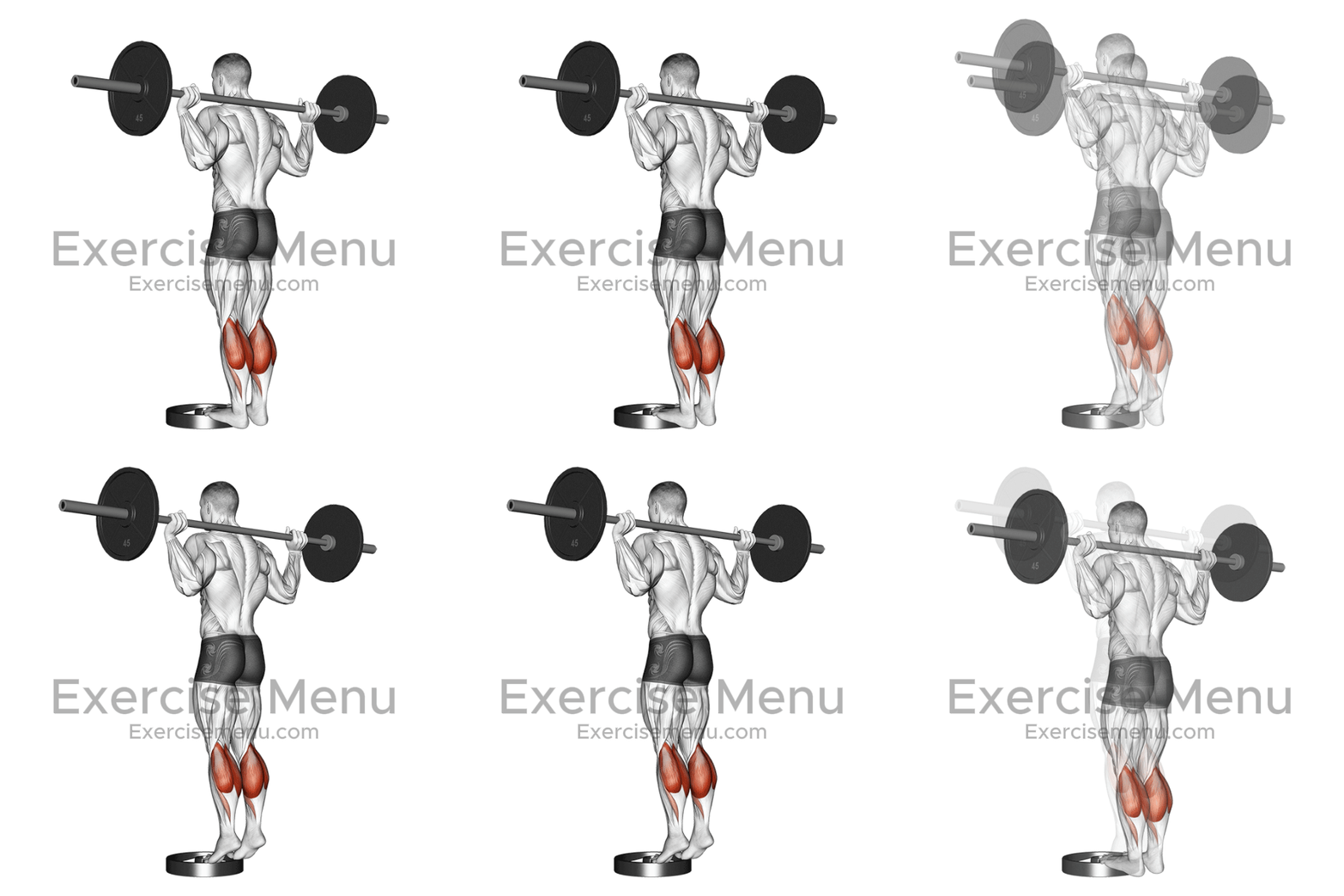
Exercise Profile
- Target Muscle
- Gastrocnemius
- Body Part
- Calves
- Equipment
- Barbell, Squat Rack, Step or Weight Plate
- Category
- Isolation
- Skill Level
- Beginner
- Movement
- Plantar Flexion
- Also Known As
- Standing Barbell Calf Raise, Barbell Calf Raise
- Est. Calories
- 2–4 kcal per setEstimate for a 70 kg person, 30–60 second set
Quick Answer
The barbell standing calf raise is a calf exercise done standing with a barbell across your upper back. Straight knees make the gastrocnemius the main mover, with the soleus assisting. Raise your heels as high as you can, then lower them for a full stretch. Use 3 to 4 sets of 10 to 15 reps.
How to Do the Barbell Standing Calf Raise
- 1
Set the bar in the rack
Set the bar at about armpit height and rest it across your upper traps, as you would for a back squat.
- 2
Stand on a platform
Unrack the bar and place the balls of your feet on a step or weight plate, heels hanging off, feet about hip-width apart.
- 3
Keep your knees nearly straight
Brace your core and keep a slight, fixed bend in your knees for the whole set.
- 4
Lower into a stretch
Lower your heels below the platform until you feel a full stretch in your calves.
- 5
Rise as high as you can
Push through the balls of your feet to lift your heels as high as possible and pause for one second.
- 6
Lower with control
Lower your heels slowly over 2–3 seconds back to the stretched position.
What Muscles Does the Barbell Standing Calf Raise Work?
Primary
- Gastrocnemiusthe two-headed upper calf muscle, raises the heels and works hardest with straight knees.
Secondary
- Soleusthe deeper calf muscle, also raises the heels in every calf raise.
- Tibialis Posteriorassists and stabilizes the ankle.
- Peroneus Longus and Brevisstabilize the ankle on the outside of the lower leg.
How Many Sets and Reps Should You Do?
| Goal | Sets | Reps | Rest |
|---|---|---|---|
| Muscle Growth | 3–4 | 10–15 | 60–90 sec |
| Strength | 3–5 | 6–8 | 2 min |
| Endurance | 2–3 | 20–25 | 30–45 sec |
| Beginner | 2–3 | 12–15 | 60–90 sec |
Common Mistakes That Reduce Results
✕
Short, Bouncing Reps
Bouncing in the middle of the range skips the stretch at the bottom and the full rise at the top. Move through the full range on every rep.
✕
Standing Flat on the Floor
A flat floor stops the heels at floor level. A step or plate lets the heels drop below the toes for a longer stretch.
✕
Bending the Knees to Help
Bending and straightening the knees turns the rep into a mini squat. Keep the knee angle fixed.
✕
Rolling onto the Outer Foot
Letting the ankles roll outward shifts pressure off the big toe. Press evenly through the ball of the foot.
✕
Going Too Heavy
If you cannot pause at the top or control the lowering, the weight is too heavy. Reduce it and restore the full range.
Tips for Better Results
✓
Pause at Both Ends
A one-second pause at the top and a short pause in the stretch remove the bounce from the Achilles tendon so the calves do the work.
✓
Spend Time in the Stretch
Kassiano and colleagues (2023) found calf raises trained in the stretched part of the range grew the medial gastrocnemius more than full-range or top-range raises.
✓
Keep the Knees Straight for the Gastrocnemius
Cresswell and colleagues (1995) found gastrocnemius activity fell as the knee bent, while soleus activity stayed the same.
✓
Use a Smith Machine if Balance Limits You
A fixed bar path lets you focus on the calves instead of balancing the bar.
Modifications and Progressions
▼ Easier
Bodyweight Standing Calf Raise
Learn the full range on a step with no load, holding a support for balance.
▼ Easier
Smith Machine Standing Calf Raise
The fixed bar path removes the balance challenge.
▲ Harder
Single-Leg Calf Raise
Working one leg at a time puts the full load on each calf. Hold a dumbbell and a support.
▲ Harder
Paused Standing Calf Raise
Hold the bottom stretch for 2 seconds and the top for 1 second on every rep.
Workout Plans With the Barbell Standing Calf Raise
Legs A Push Pull Legs Split: How It Works, And How to Start?Barbell Standing Calf Raise Alternatives
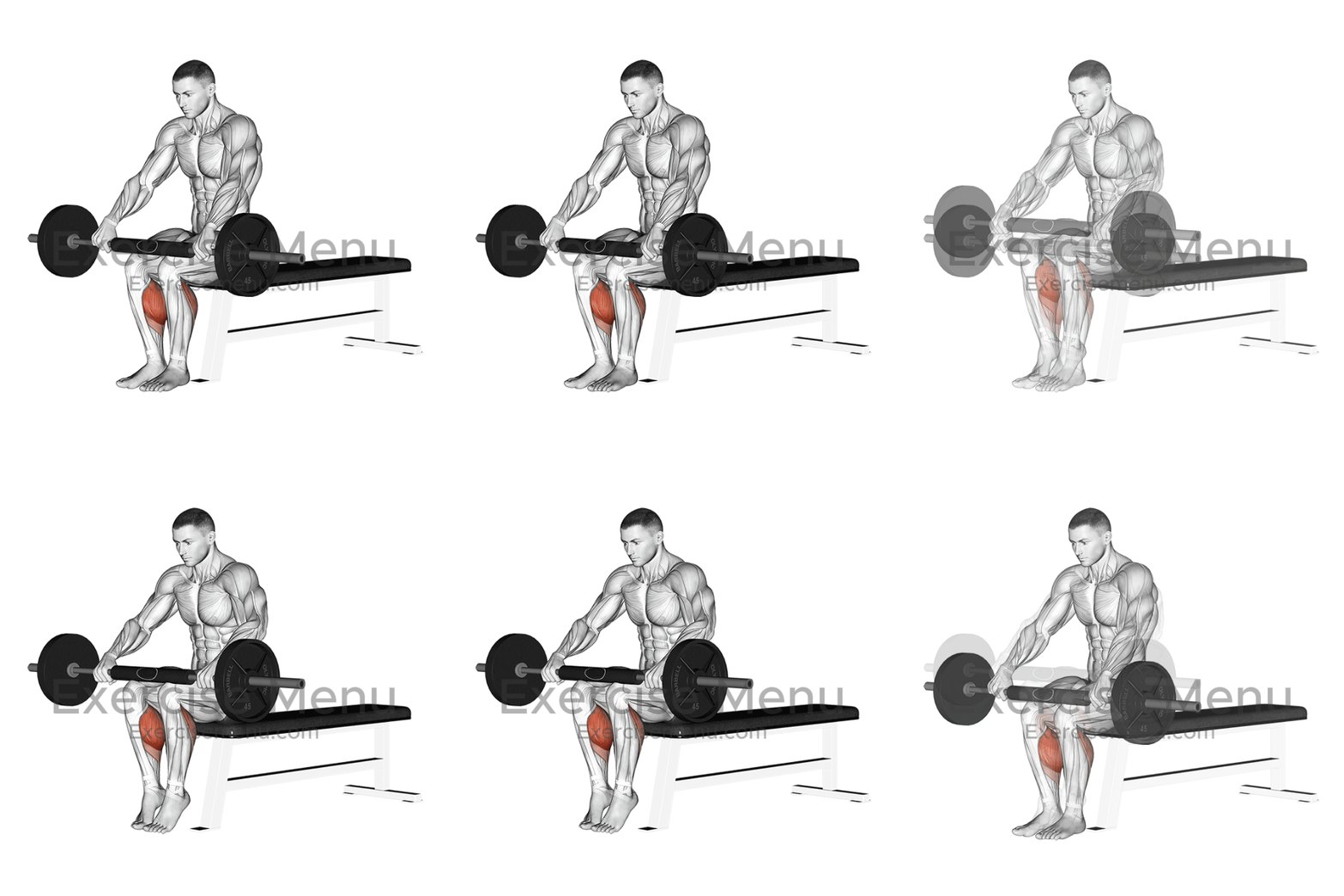 Barbell Seated Calf Raise
Soleus
Frequently Asked Questions
Do I need a platform for standing calf raises?
It is strongly recommended. Standing on a step or plate lets the heels drop below the toes, which trains the calf through a longer, stretched range.
Standing or seated calf raises — which builds bigger calves?
Standing. In a 2023 study by Kinoshita and colleagues, standing raises grew the gastrocnemius by about 9–12%, compared with about 1–2% for seated raises, while soleus growth was similar in both.
Does pointing the toes in or out change which part of the calf grows?
Slightly. In a 9-week study by Nunes and colleagues (2020), toes pointed out favored the inner (medial) head and toes pointed in favored the outer (lateral) head.
How often should I train calves?
Two to three times a week works well for most people and makes it easy to spread your weekly calf sets.
What is the difference between the gastrocnemius and the soleus?
The gastrocnemius crosses the knee and ankle, so it works best with straight knees. The soleus lies underneath, crosses only the ankle, and works in every calf raise.
Sources
- Kassiano W, et al. Greater Gastrocnemius Muscle Hypertrophy After Partial Range of Motion Training Performed at Long Muscle Lengths. J Strength Cond Res. 2023;37(9):1746–1753. https://pubmed.ncbi.nlm.nih.gov/37015016/
- Cresswell AG, Löscher WN, Thorstensson A. Influence of gastrocnemius muscle length on triceps surae torque development and electromyographic activity in man. Exp Brain Res. 1995;105(2):283–290. https://pubmed.ncbi.nlm.nih.gov/7498381/
- Kinoshita M, et al. Triceps surae muscle hypertrophy is greater after standing versus seated calf-raise training. Front Physiol. 2023;14:1272106. https://www.frontiersin.org/journals/physiology/articles/10.3389/fphys.2023.1272106/full
- Nunes JP, et al. Different Foot Positioning During Calf Training to Induce Portion-Specific Gastrocnemius Muscle Hypertrophy. J Strength Cond Res. 2020;34(8):2347–2351. https://pubmed.ncbi.nlm.nih.gov/32735428/
If you have an existing injury or medical condition, check with your doctor before adding this exercise to your training.