

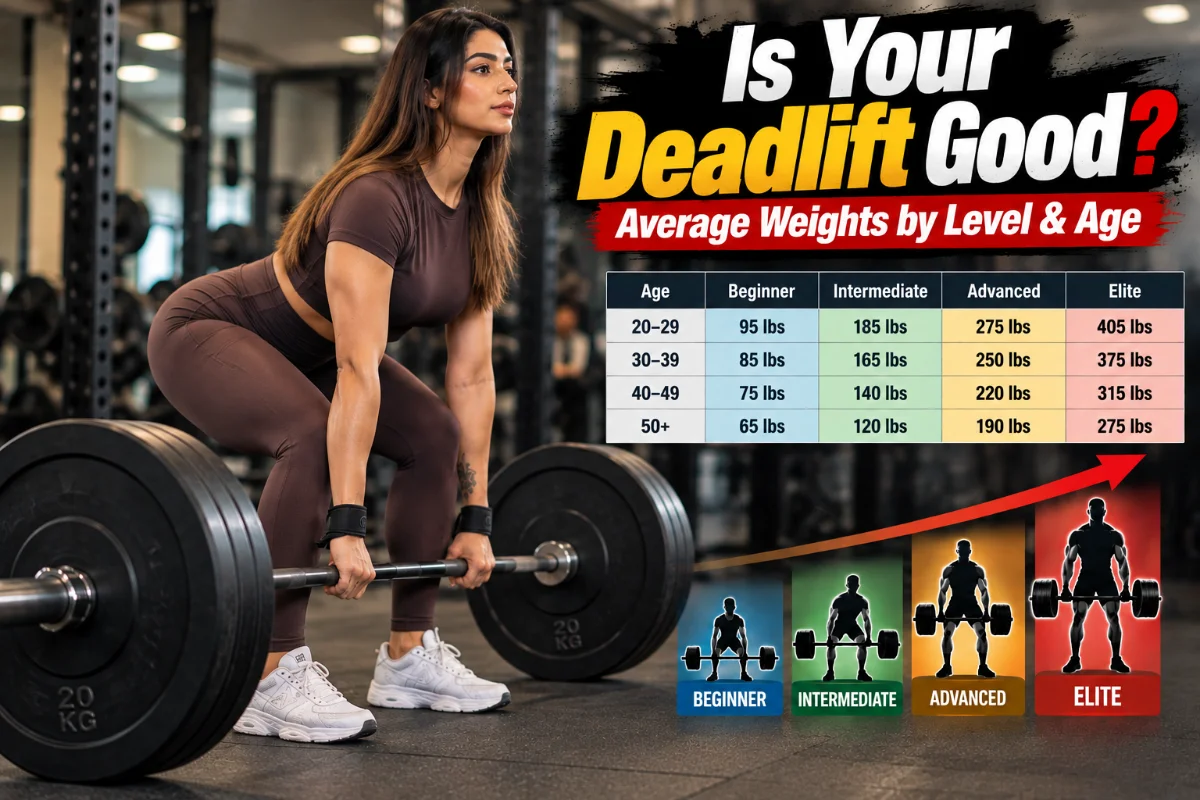
Quick Answer: The average deadlift is 340 lb (154 kg) for men and 200 lb (91 kg) for women at intermediate level, stronger than 50% of lifters. For untrained adults who have never deadlifted, expect around 135–155 lb (61–70 kg) for men and 75–90 lb (34–41 kg) for women. Data: Strength Level, 22 million+ logged lifts.
Whether you want to know where you stand, set a target, or understand why your number differs from a chart, the tables below give you a clear picture. Average deadlift weight varies more than most people expect, bodyweight, age, training history, and the variation you train all shift the standard meaningfully.
Experience-level data comes directly from Strength Level’s database of 22,978,599 logged lifts (data cutoff: March 2026). Age-adjusted standards use ExRx population norms. All tables include lb and kg.
- What Is the Average Deadlift Weight?
- Is Your Deadlift Good? Specific Numbers Answered
- Average Deadlift by Experience Level — Men
- Average Deadlift by Experience Level — Women
- Average Deadlift by Age Group
- Deadlift Bodyweight Ratio Standards
- What Affects Your Average Deadlift?
- How to Reach the Intermediate Standard?
- Frequently Asked Questions
What Is the Average Deadlift Weight?
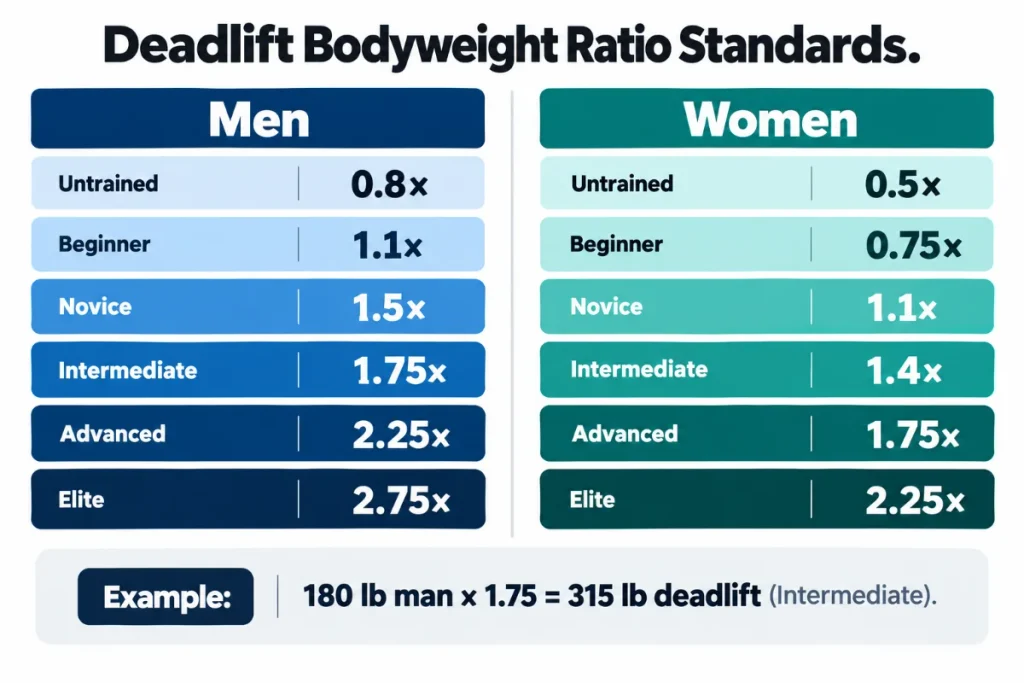
The average gym-going man deadlifts 340 lb (154 kg) for a one-rep max. The average gym-going woman deadlifts 200 lb (91 kg). Both sit at intermediate level on Strength Level’s scale — stronger than 50% of all lifters in their database.
About these numbers: Strength Level’s data comes from people who actively track workouts in fitness apps — a self-selected group who train regularly. The true baseline for an untrained adult who has never deadlifted is considerably lower (roughly 135–155 lb for men, 75–90 lb for women, based on ExRx population norms). These tables compare you to active gym-goers, not the general population.
Overall Average — Men vs Women at a Glance
| Level | Percentile | Men (lb) | Men (kg) | Women (lb) | Women (kg) |
|---|---|---|---|---|---|
| Beginner | Top 95% | 176 | 80 | 91 | 41 |
| Novice | Top 80% | 249 | 113 | 139 | 63 |
| Intermediate | Top 50% | 340 | 154 | 200 | 91 |
| Advanced | Top 20% | 445 | 202 | 273 | 124 |
| Elite | Top 5% | 558 | 253 | 352 | 160 |
Source: Strength Level (22,978,599 lifts, 2015–2026). Numbers reflect aggregated 1RM across all bodyweights.
Is Your Deadlift Good? Specific Numbers Answered
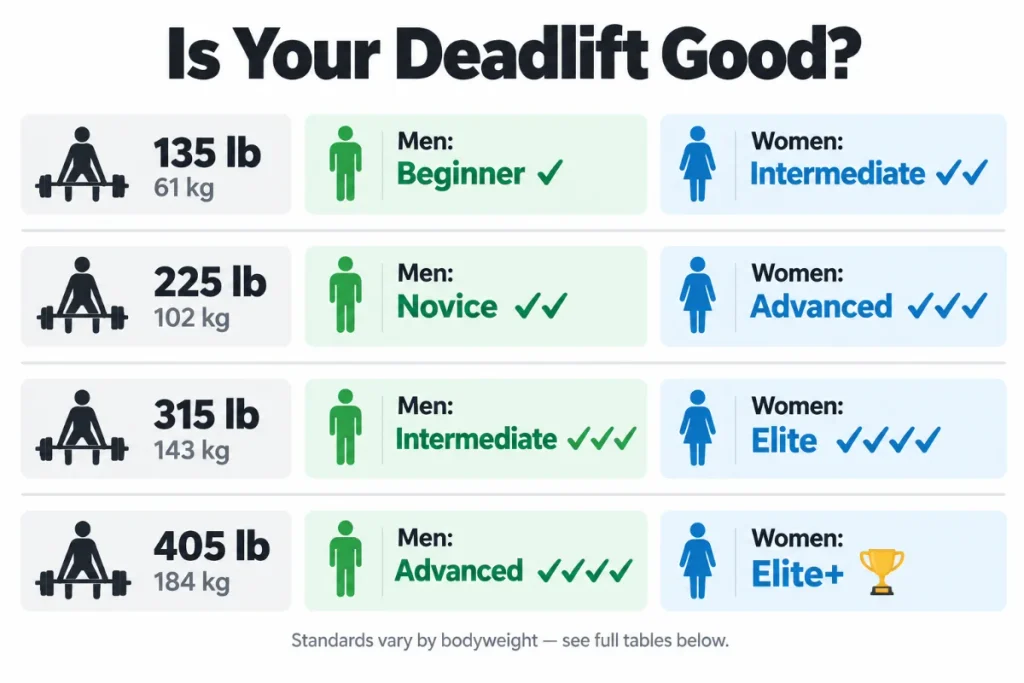
These are the most common questions people search. Context requires knowing your bodyweight, the by-bodyweight tables below cover every weight class. For most people at average gym-going weight (men ~180 lb, women ~140 lb), here is what each milestone means:
Is a 135 lb Deadlift Good?
For a man at 180 lb, 135 lb is below the beginner standard (201 lb), still in the early stages of learning the movement. For a woman at 140 lb, 135 lb sits between novice (139 lb) and intermediate (196 lb), a solid result. For anyone in their first month of training, 135 lb is a competent starting point to build from.
Is a 225 lb Deadlift Good?
For a man at 180 lb, 225 lb falls between beginner (201 lb) and novice (268 lb), a meaningful lift with clear room to progress. For a woman at 140 lb, 225 lb sits above the advanced standard (264 lb) and near elite, a strong result by any measure.
Is a 315 lb Deadlift Good?
For a man at 180 lb, 315 lb sits just below the intermediate standard (348 lb), placing you in the top 35–40% of tracked lifters. For a woman at 140 lb, 315 lb is above the elite standard (338 lb). Fewer than 30% of male gym-goers ever pull 315 lb with clean form, it is a genuine milestone.
Is a 405 lb Deadlift Good?
For a man at 180 lb, 405 lb falls between intermediate (348 lb) and advanced (438 lb), top 25–30% of tracked lifters. For any woman, 405 lb is elite regardless of bodyweight. Four plates from the floor is a meaningful strength achievement by any standard.
Average Deadlift by Experience Level — Men
What Each Level Means
- Beginner (top 95%): Has practiced the movement correctly for at least one month
- Novice (top 80%): Has trained the deadlift consistently for at least six months
- Intermediate (top 50%): Has trained consistently for at least two years
- Advanced (top 20%): Has progressed consistently for over five years
- Elite (top 5%): Dedicated five+ years toward competitive strength performance
Men’s Deadlift Standards by Bodyweight (lb)
| Bodyweight (lb) | Beginner | Novice | Intermediate | Advanced | Elite |
|---|---|---|---|---|---|
| 130 | 131 | 186 | 254 | 332 | 416 |
| 140 | 146 | 203 | 274 | 355 | 442 |
| 150 | 160 | 220 | 293 | 377 | 466 |
| 160 | 174 | 236 | 312 | 398 | 490 |
| 170 | 188 | 252 | 330 | 419 | 513 |
| 180 | 201 | 268 | 348 | 438 | 535 |
| 190 | 214 | 283 | 365 | 458 | 556 |
| 200 | 227 | 297 | 382 | 476 | 576 |
| 220 | 252 | 326 | 413 | 512 | 615 |
| 240 | 275 | 352 | 443 | 545 | 652 |
Men’s Deadlift Standards by Bodyweight (kg)
| Bodyweight (kg) | Beginner | Novice | Intermediate | Advanced | Elite |
|---|---|---|---|---|---|
| 60 | 59 | 84 | 115 | 151 | 189 |
| 65 | 66 | 93 | 126 | 163 | 203 |
| 70 | 73 | 102 | 137 | 175 | 217 |
| 75 | 80 | 111 | 148 | 189 | 233 |
| 80 | 87 | 120 | 159 | 201 | 247 |
| 85 | 94 | 128 | 169 | 213 | 260 |
| 90 | 100 | 136 | 179 | 225 | 273 |
| 100 | 112 | 152 | 198 | 247 | 298 |
| 110 | 124 | 166 | 216 | 268 | 321 |
Source: Strength Level. Kg values converted from lb at 0.453592.
Average Deadlift by Experience Level — Women
Using the same level definitions above.
Women’s Deadlift Standards by Bodyweight (lb)
| Bodyweight (lb) | Beginner | Novice | Intermediate | Advanced | Elite |
|---|---|---|---|---|---|
| 110 | 74 | 115 | 168 | 231 | 300 |
| 120 | 80 | 123 | 178 | 242 | 313 |
| 130 | 87 | 131 | 187 | 253 | 326 |
| 140 | 93 | 139 | 196 | 264 | 338 |
| 150 | 99 | 146 | 205 | 274 | 349 |
| 160 | 105 | 153 | 213 | 283 | 359 |
| 170 | 110 | 159 | 221 | 292 | 370 |
| 190 | 121 | 172 | 236 | 309 | 389 |
| 220 | 135 | 189 | 256 | 332 | 414 |
Women’s Deadlift Standards by Bodyweight (kg)
| Bodyweight (kg) | Beginner | Novice | Intermediate | Advanced | Elite |
|---|---|---|---|---|---|
| 50 | 34 | 52 | 76 | 105 | 136 |
| 55 | 37 | 57 | 83 | 114 | 147 |
| 60 | 41 | 62 | 90 | 122 | 158 |
| 65 | 44 | 67 | 96 | 131 | 168 |
| 70 | 47 | 72 | 102 | 139 | 178 |
| 75 | 50 | 77 | 108 | 146 | 187 |
| 80 | 53 | 81 | 113 | 153 | 195 |
| 90 | 59 | 89 | 123 | 166 | 211 |
| 100 | 64 | 97 | 133 | 179 | 226 |
Source: Strength Level. Kg values converted from lb at 0.453592.
Average Deadlift by Age Group
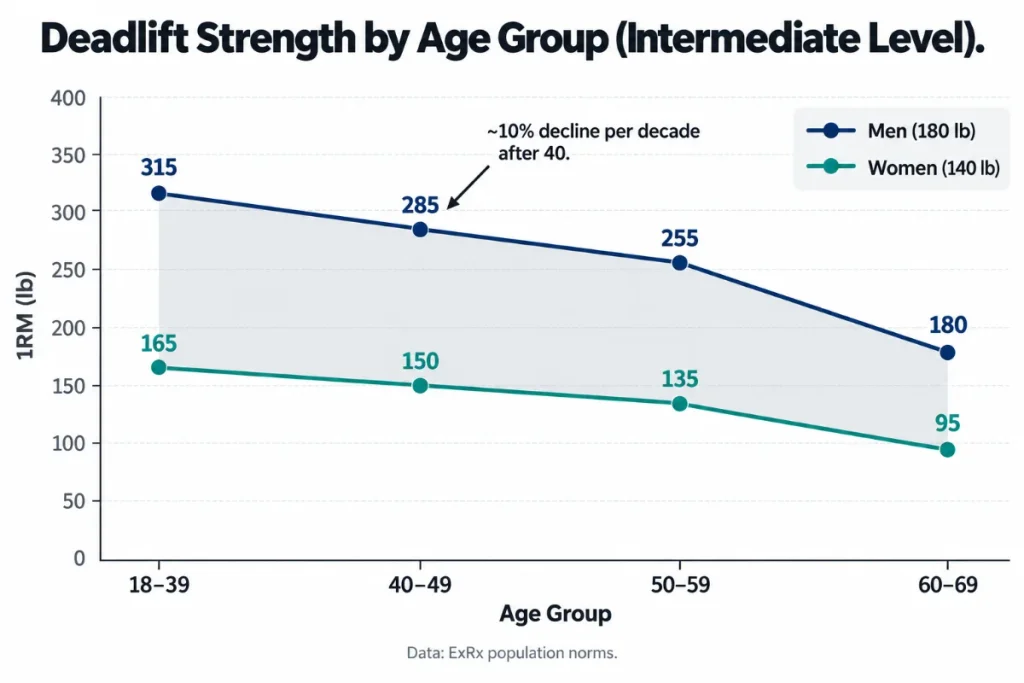
Deadlift strength peaks between ages 25–35 for most people. After 40, muscle mass decreases and recovery slows without deliberate intervention, the tables below show what this looks like in practice across each decade. Consistent strength training measurably slows this decline; these numbers are not fixed outcomes.
Data source: ExRx population norms. Numbers shown for 180 lb (82 kg) man and 140 lb (64 kg) woman. For your exact bodyweight, the full ExRx tables at exrx.net list standards at every weight class.
Men’s Average Deadlift by Age Group — at 180 lb (82 kg) bodyweight
| Age Group | Untrained | Novice | Intermediate | Advanced | Elite |
|---|---|---|---|---|---|
| 18–39 | 150 lb / 68 kg | 275 lb / 125 kg | 315 lb / 143 kg | 440 lb / 200 kg | 550 lb / 249 kg |
| 40–49 | 135 lb / 61 kg | 250 lb / 113 kg | 285 lb / 129 kg | 395 lb / 179 kg | 485 lb / 220 kg |
| 50–59 | 115 lb / 52 kg | 220 lb / 100 kg | 255 lb / 116 kg | 355 lb / 161 kg | 435 lb / 197 kg |
| 60–69 | 85 lb / 39 kg | 155 lb / 70 kg | 180 lb / 82 kg | 250 lb / 113 kg | 315 lb / 143 kg |
Women’s Average Deadlift by Age Group — at 140 lb (64 kg) bodyweight
| Age Group | Untrained | Novice | Intermediate | Advanced | Elite |
|---|---|---|---|---|---|
| 18–39 | 75 lb / 34 kg | 145 lb / 66 kg | 165 lb / 75 kg | 230 lb / 104 kg | 290 lb / 132 kg |
| 40–49 | 65 lb / 29 kg | 130 lb / 59 kg | 150 lb / 68 kg | 205 lb / 93 kg | 260 lb / 118 kg |
| 50–59 | 55 lb / 25 kg | 115 lb / 52 kg | 135 lb / 61 kg | 185 lb / 84 kg | 230 lb / 104 kg |
| 60–69 | 45 lb / 20 kg | 85 lb / 39 kg | 95 lb / 43 kg | 135 lb / 61 kg | 170 lb / 77 kg |
Source: ExRx population norms.
Deadlift Bodyweight Ratio Standards
Bodyweight ratio removes the size advantage from the comparison. Two people pulling the same absolute weight can be at very different levels if their bodyweights differ, the ratio shows where each stands relative to their own body.
Men’s Deadlift Bodyweight Ratios
| Level | Bodyweight Ratio | Example: 180 lb man |
|---|---|---|
| Beginner | ~1.1× BW | ~200 lb |
| Novice | ~1.5× BW | ~270 lb |
| Intermediate | ~1.9× BW | ~340 lb |
| Advanced | ~2.5× BW | ~450 lb |
| Elite | ~3.1× BW | ~558 lb |
Women’s Deadlift Bodyweight Ratios
| Level | Bodyweight Ratio | Example: 140 lb woman |
|---|---|---|
| Beginner | ~0.65× BW | ~91 lb |
| Novice | ~1.0× BW | ~140 lb |
| Intermediate | ~1.4× BW | ~196 lb |
| Advanced | ~1.9× BW | ~266 lb |
| Elite | ~2.5× BW | ~350 lb |
Two milestones worth noting: pulling 2× bodyweight puts a man in the advanced category — only the top 20% of tracked male lifters reach this. For women, pulling 1.5× bodyweight sits between advanced and elite, placing you in the top 10–15% of female lifters.
What Affects Your Average Deadlift?
Several factors push your number above or below these standards, none are excuses, but all are worth understanding when interpreting a chart.
Age
If you are 50 and matching the novice standard for 18–39-year-olds, you are performing above average for your age group. Use the age table as your primary benchmark, then use the experience-level table for goal-setting.
Bodyweight
Heavier lifters generally pull more absolute weight, but lighter lifters typically show better bodyweight ratios. The by-bodyweight tables above account for this directly, use your own row, not the overall average.
Sex
Men and women have different absolute strength capacities at the same bodyweight, primarily due to differences in muscle mass driven by hormonal differences. Women’s standards are set independently, not as a percentage of men’s numbers.
Body Proportions
Longer arms relative to torso length provide a mechanical advantage in the conventional deadlift — the bar travels a shorter distance to lockout. Lifters with shorter arms often find the conventional pull harder and may benefit from sumo mechanics. The full breakdown is in the sumo vs conventional deadlift guide.
Deadlift Variation
Standards above apply to conventional barbell deadlifts. The trap bar deadlift runs about 8% higher, Strength Level’s trap bar intermediate is 366 lb for men and 217 lb for women. The sumo deadlift sits close to conventional (370 lb men, 209 lb women at intermediate). Do not compare numbers across variations directly.
Training Consistency and Specificity
The experience-level definitions assume consistent, specific deadlift training. Five years of general gym attendance without deadlifting regularly will not produce intermediate deadlift numbers. The level reflects deadlift-specific training, not total time in the gym.
How to Reach the Intermediate Standard?
The intermediate standard, roughly 1.9× bodyweight for men and 1.4× for women, is achievable for most people within two to three years of consistent training. For complete beginners, a realistic 12-month target is 1.5× bodyweight for men and 1.0× for women.
Three things that move the number consistently:
- Train the deadlift specifically, at least twice per week. General gym attendance builds fitness; deadlift strength requires pulling from the floor with progressive intent on a regular schedule.
- Apply progressive overload systematically. Adding load or reps over time — as a structured plan, not randomly, is what converts sessions into measurable strength gains. The full breakdown is in the progressive overload guide.
- Track your starting point. Use a 1RM estimation method to set a baseline — it lets you identify your current level in these tables and set training weights as percentages rather than guesswork.
Frequently Asked Questions
Should I Compare My Deadlift to the Standard for My Bodyweight or My Age Group?
Use both for different purposes. The by-bodyweight table tells you where you stand among lifters of similar size right now. The age table tells you whether you’re performing above or below what’s typical for your decade of life. A 55-year-old matching the intermediate standard for 18–39-year-olds is performing well above their age group — that context matters when setting goals.
Does Deadlift Strength Transfer to Other Exercises Like Squats or Hip Thrusts?
Yes, but selectively. The deadlift builds hip hinge strength, posterior chain development, and grip, these carry over most directly to hip thrusts, Romanian deadlifts, and rows. The squat and deadlift share glute and erector involvement, but the squat requires more quad and ankle mobility, so deadlift strength does not automatically translate to squat strength. Most strong deadlifters are also decent squatters, but the correlation weakens as loads get heavier and technique specificity matters more.
How Long Does It Take to Go From Beginner to Intermediate?
For most people training the deadlift twice per week with consistent progressive overload, moving from beginner (top 95%) to intermediate (top 50%) takes 18–30 months. Lifters with good mechanics, adequate recovery, and consistent nutrition can reach it closer to 12–18 months. Frequency and progressive intent matter more than time spent in the gym.
Do Powerlifting Federation Standards Differ From These General Fitness Standards?
Yes, by a large margin. IPF powerlifting standards come from competitive lifters who have typically been training specifically for years and self-selected into competition. Their benchmarks sit considerably higher than Strength Level’s general gym-goer data. If you’re comparing yourself to IPF data, expect to appear at a lower level than you would on these tables — that is not a fair comparison for a recreational lifter.
Why Is My Deadlift Stronger Than My Squat — Is That Normal?
Yes, for most people. The deadlift starts from a mechanical advantage, the bar is on the floor and you pull from a static position. The squat requires controlling the load through a longer range of motion with full knee and hip flexion, which demands more quad strength, ankle mobility, and positional stability. Most recreational lifters deadlift 10–20% more than they squat. The gap narrows for experienced lifters with balanced programming. If your deadlift is more than 30–40% above your squat, it typically suggests your quad and front squat strength is a limiting factor worth addressing.
These standards are reference benchmarks from app user data, not population-wide targets or medical recommendations. If you have existing injuries, joint conditions, or relevant health considerations, consult a physiotherapist or qualified strength coach before loading the deadlift.
