

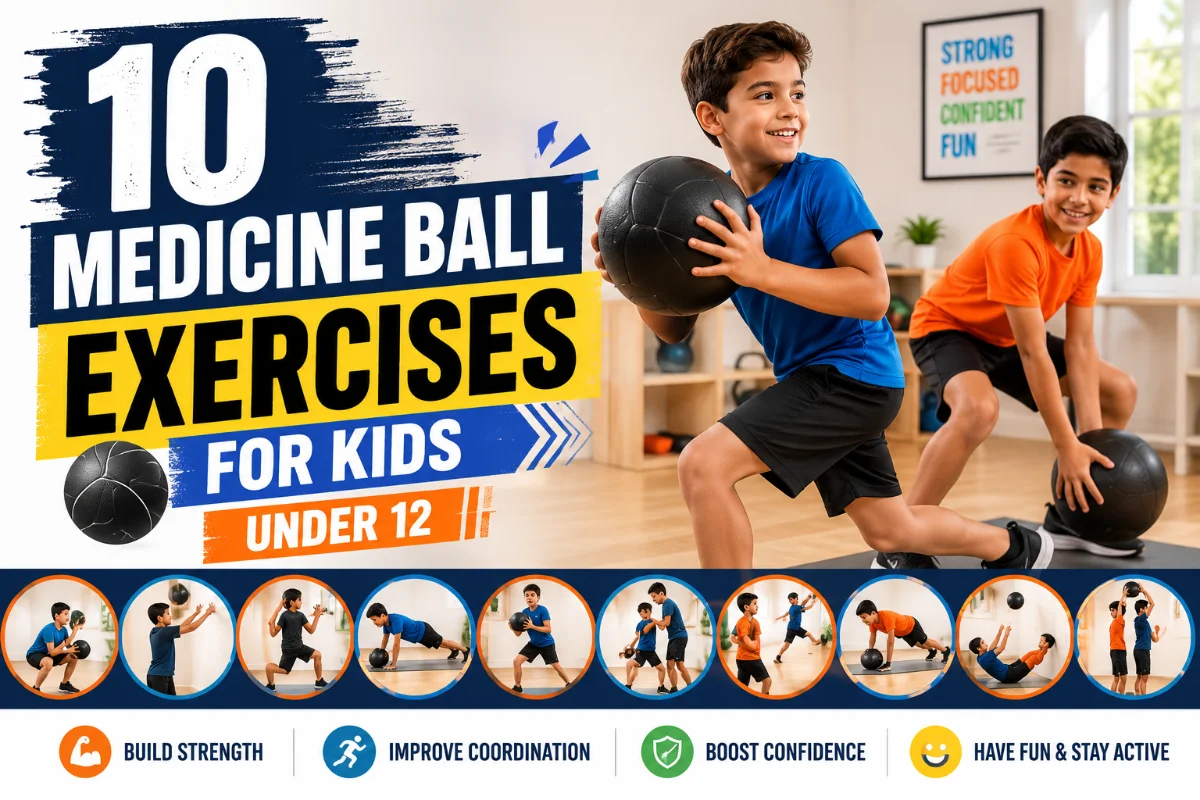
You searched this because your child needs to move more and you’re not sure where to start. Gyms don’t take kids under 12. Adult exercises are too advanced. YouTube is a mess of random routines with no structure.
A medicine ball cuts through all of that lightweight, safe, and every exercise feels like play. Throwing at walls, chasing bounces, twisting side to side. This guide gives you 10 easy exercises for kids at home the right ball weight for their age, clear steps to follow together, and a ready-to-use 15-minute workout. No guesswork. No gym.
These 10 exercises are designed for kids under 12. For adult medicine ball training across every muscle group — arms, back, legs, chest, shoulders, and abs — the medicine ball exercises guide covers all of it.
Before you start — ball weight and safety rules
Getting the ball weight wrong ruins the session. Too heavy and form breaks down. Too light and the child gets bored. Use this table:
| Age | Recommended weight | Notes |
|---|---|---|
| 6–8 years | 2 lb (1 kg) | Soft-shell only. Start here regardless of size. |
| 9–10 years | 2–4 lb (1–2 kg) | Move up only when 12 reps feel easy with perfect form. |
| 11–12 years | 4–6 lb (2–3 kg) | Max for pre-teens. Never exceed 6 lbs for under 12. |
Five rules for every session:
- An adult supervises the entire time. No exceptions.
- Technique first, weight second. If form breaks, the ball is too heavy.
- No pain. Muscle tiredness is fine. Joint pain, sharp pain, or tingling means stop.
- Keep sessions to 20–30 minutes, 2–3 times per week on nonconsecutive days.
- Warm up first — 3 minutes of jumping jacks, high knees, and arm circles before touching the ball.
The American Academy of Pediatrics and the American College of Sports Medicine both confirm that resistance training with proper supervision is safe for children. Medicine balls carry lower injury risk than free weights because they don’t require grip strength or complex bar paths.
10 medicine ball exercises for kids under 12
Ordered from simplest to most challenging. Exercises 1–5 are easy exercises for kids aged 6–8 — simple movements, low reps, no complexity. Add 6–10 as coordination and confidence improve.
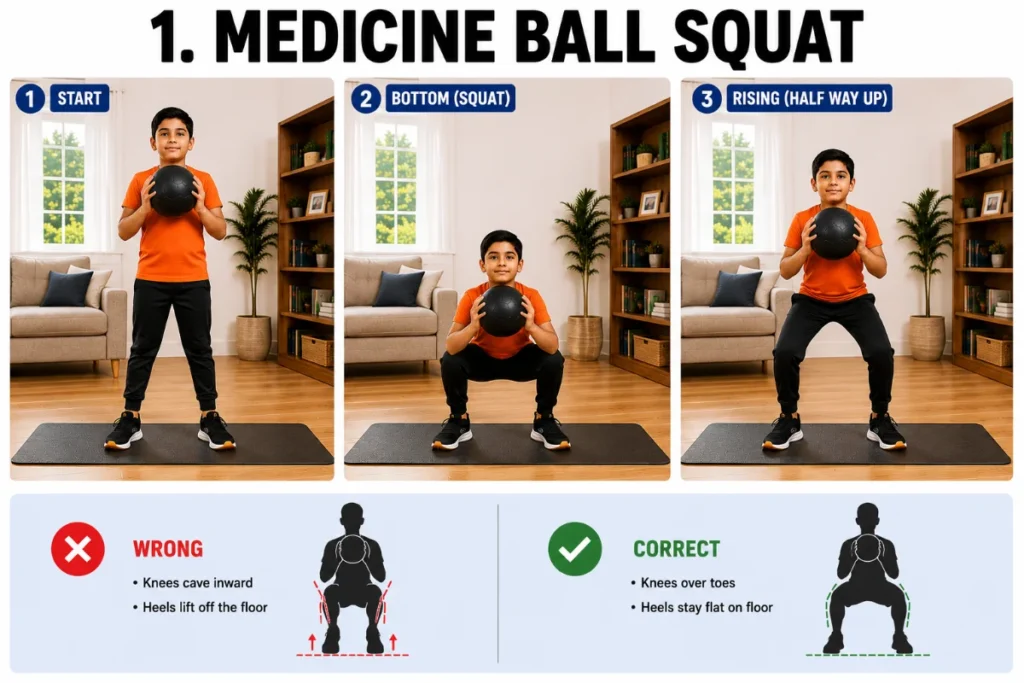
1. Medicine ball squat
Works: Legs, core, balance Sets × Reps: 2 × 8–10 | Rest: 30 sec
How to do it:
- Stand with feet shoulder-width apart. Hold the ball at chest height with both hands, elbows tucked.
- Sit the hips back and bend the knees — like sitting into a chair.
- Go down until the thighs are close to parallel with the floor (or as far as feels comfortable). Stand back up by pushing through the heels.
Parent tip: Tell the child to “sit back like there’s a chair behind you.” Keep the ball steady at the chest the entire time — no dropping the arms.
Look out for: Knees caving inward. If this happens, drop the ball weight or try the squat without a ball first.
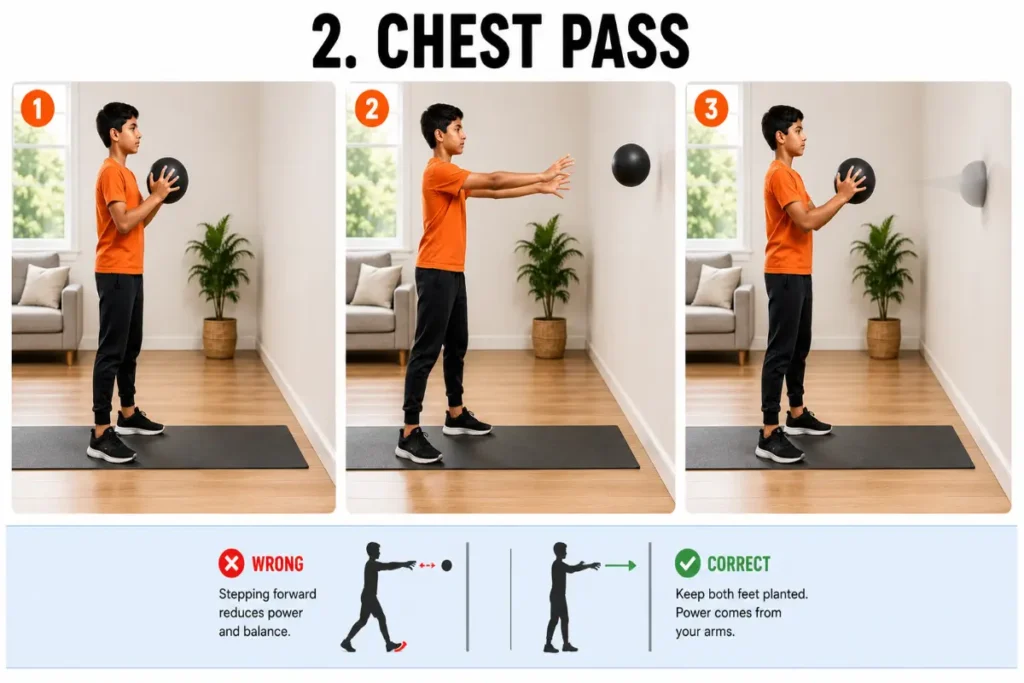
2. Chest pass (with a partner or wall)
Works: Arms, chest, hand-eye coordination Sets × Reps: 2 × 10 | Rest: 30 sec
How to do it:
- Stand 4–6 feet from a wall or a partner. Hold the ball at chest height.
- Push the ball forward with both hands — like a basketball chest pass.
- Catch it on the return (from the wall bounce or partner throw).
Parent tip: Start close to the wall and move farther back as accuracy improves. This builds coordination faster than starting far away.
Look out for: The child stepping forward on every throw. Feet stay planted — the power comes from the arms and core, not momentum.
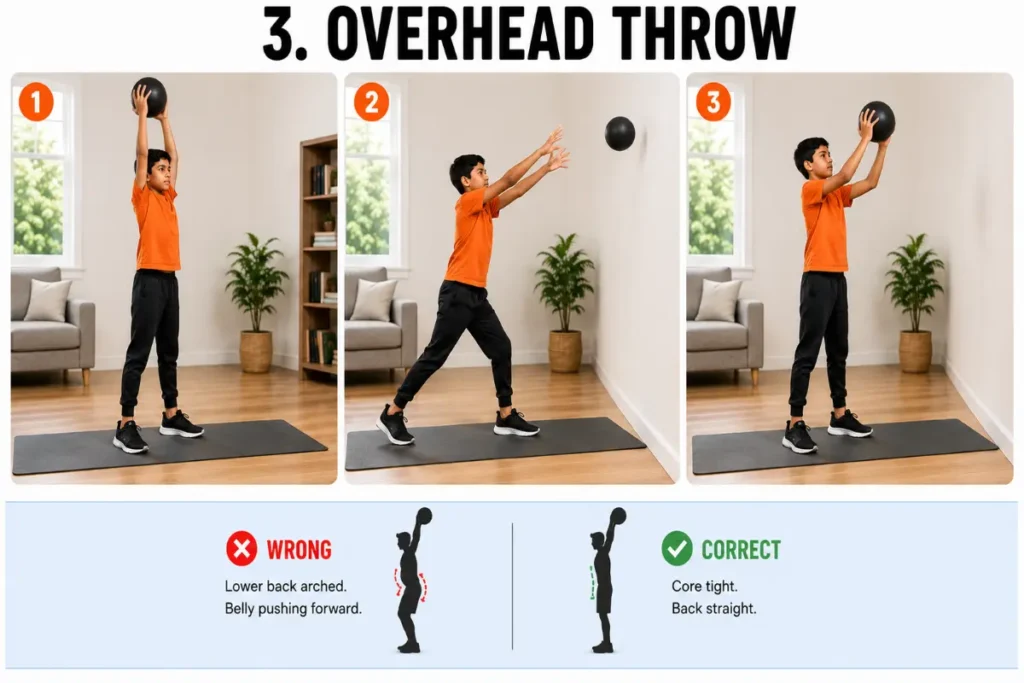
3. Overhead throw
Works: Shoulders, core, full-body coordination Sets × Reps: 2 × 8 | Rest: 30 sec
How to do it:
- Stand with feet hip-width apart. Hold the ball overhead with both arms extended.
- Step one foot forward and throw the ball at a wall or to a partner using a soccer throw-in motion.
- Catch the return and repeat.
Parent tip: This is a great exercise to do together. Stand 6–8 feet apart and throw back and forth — it turns into a game naturally.
Look out for: Arching the lower back on the throw. Cue the child to “squeeze your belly tight” before releasing.
4. Standing Russian twist
Works: Core, obliques, balance Sets × Reps: 2 × 8 each side | Rest: 30 sec
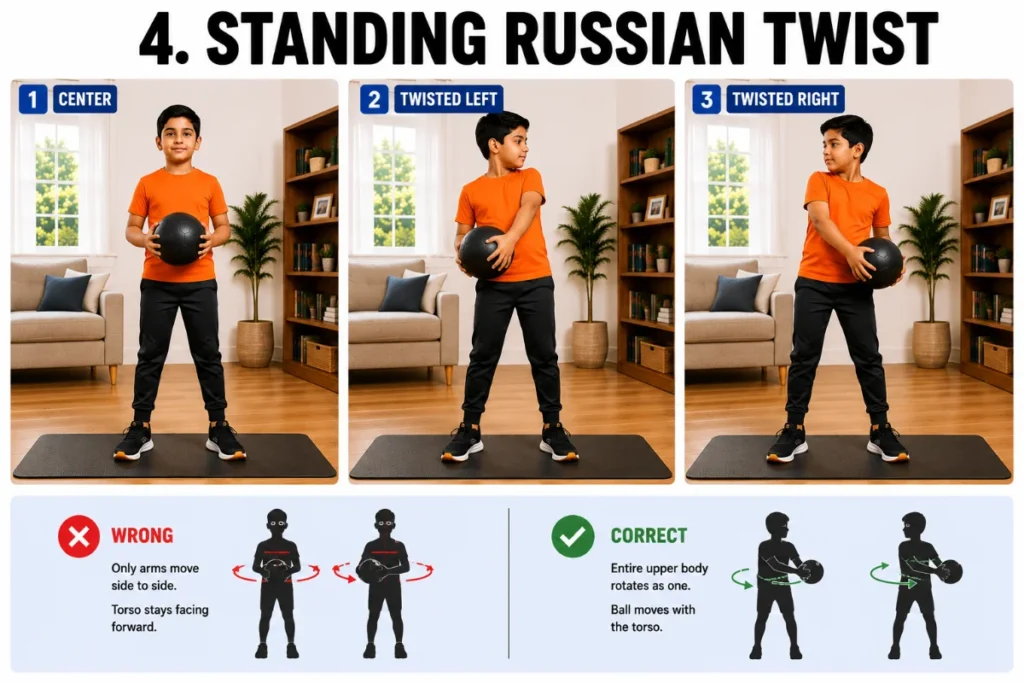
How to do it:
- Stand tall with feet directly under the shoulders. Hold the ball in front of the belly button with arms slightly bent.
- Rotate the upper body to the left — the ball moves with the torso. Feet can rotate slightly.
- Rotate back through center and to the right. That’s one rep each side.
Parent tip: Keep this standing for kids under 12 — the seated version with feet off the floor is too advanced and strains the lower back in children who haven’t developed full core stability yet.
Look out for: Only the arms moving while the torso stays still. The whole upper body should twist together.
5. Ball around the body
Works: Core stability, coordination, grip Sets × Reps: 2 × 5 each direction | Rest: 30 sec
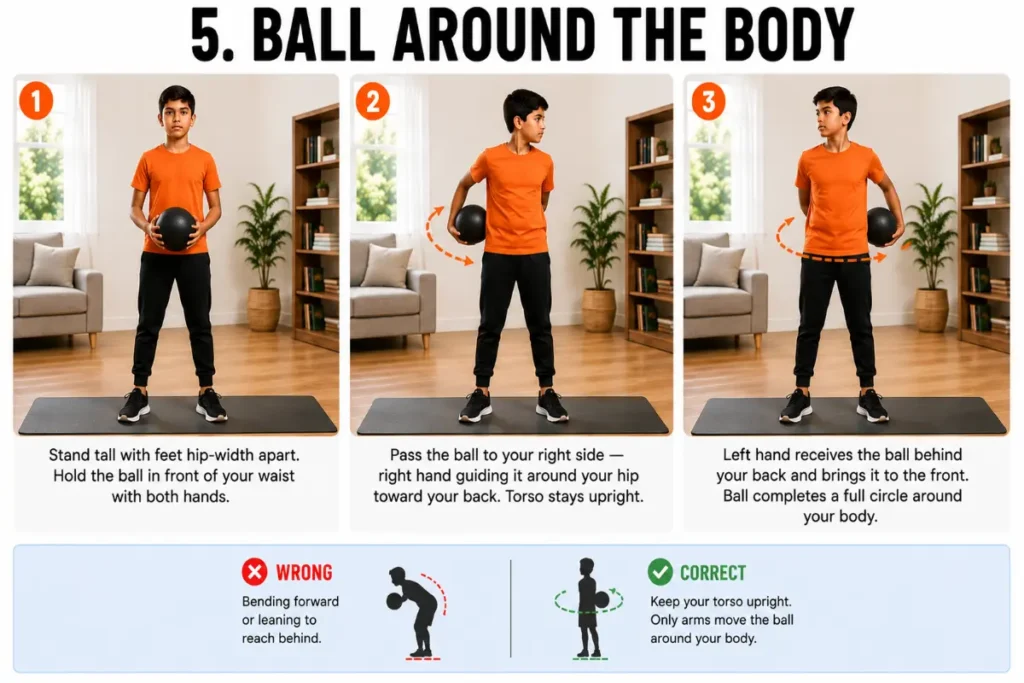
How to do it:
- Stand tall, feet hip-width apart. Hold the ball in front of the waist.
- Pass the ball around the body — right hand passes to the left hand behind the back, left hand brings it back to the front.
- Complete 5 circles one direction, then reverse.
Parent tip: Start slow. Speed up only when the child completes every pass without dropping the ball. Dropped ball = too fast.
Look out for: The child bending forward or leaning to reach behind. Torso stays upright — only the arms move around.
6. Medicine ball wood chop
Works: Core, shoulders, legs, rotational power Sets × Reps: 2 × 8 each side | Rest: 30 sec
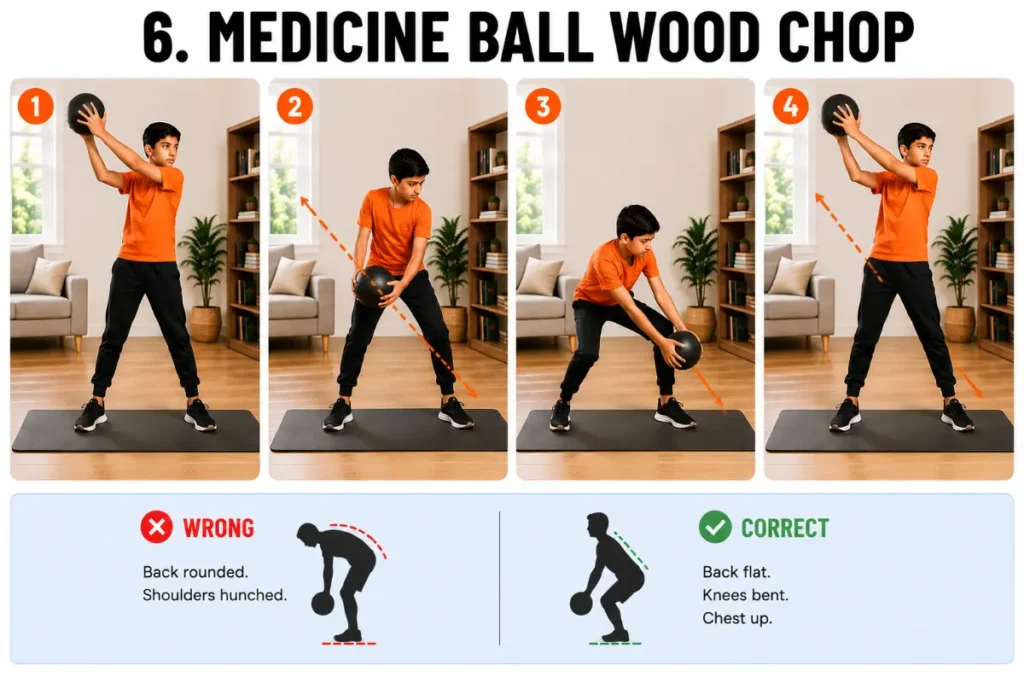
How to do it:
- Stand with feet slightly wider than shoulder-width. Hold the ball with both hands.
- Start with the ball above the left shoulder, arms extended. Rotate the torso and sweep the ball diagonally down to the outside of the right knee — bending the knees as the ball comes down.
- Reverse the path back up. Complete all reps on one side, then switch.
Parent tip: Tell the child to “chop wood” — the visual makes the diagonal path click immediately. Arms stay straight throughout.
Look out for: Rounding the back at the bottom of the chop. The knees bend, the back stays flat.
7. Squat-throw-catch
Works: Legs, shoulders, explosive power, timing Sets × Reps: 2 × 8 | Rest: 45 sec
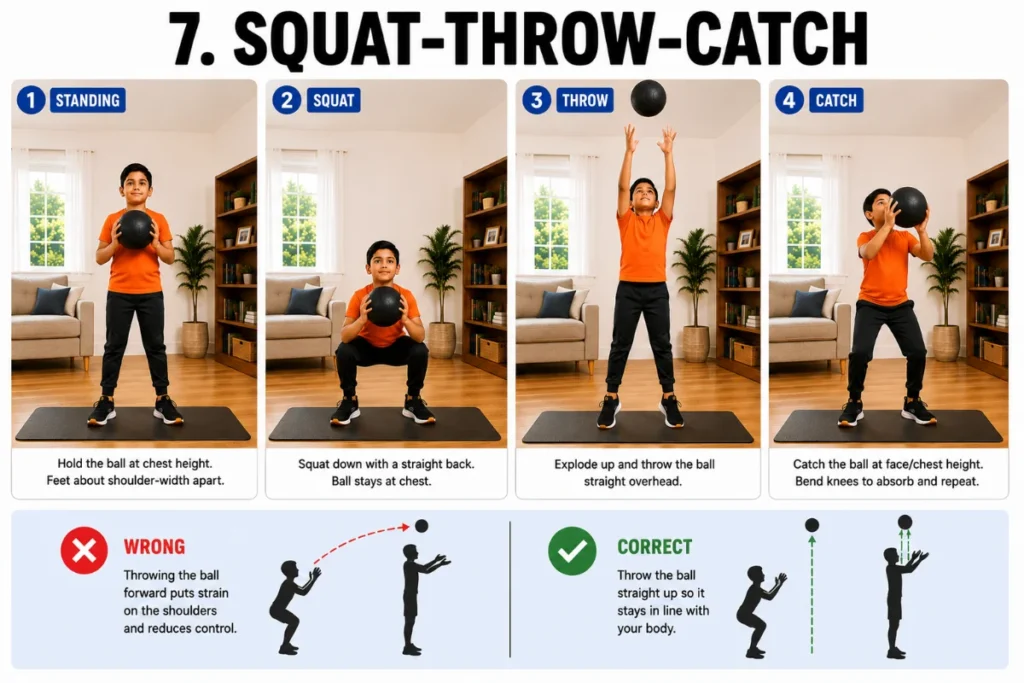
How to do it:
- Stand with feet shoulder-width apart. Hold the ball at chest height.
- Squat down. As the child stands back up, push the ball straight up overhead with both hands — letting it leave the hands at the top.
- Catch the ball as it comes back down and immediately squat into the next rep.
Parent tip: Start with a low toss — just 6 inches above the hands. The goal is rhythm and timing, not height. Increase the toss height as catching confidence builds.
Look out for: The child throwing the ball forward instead of straight up. Cue: “Throw it to the ceiling, not the wall.”
8. Medicine ball lunge
Works: Legs, glutes, balance, core Sets × Reps: 2 × 6 each leg | Rest: 45 sec
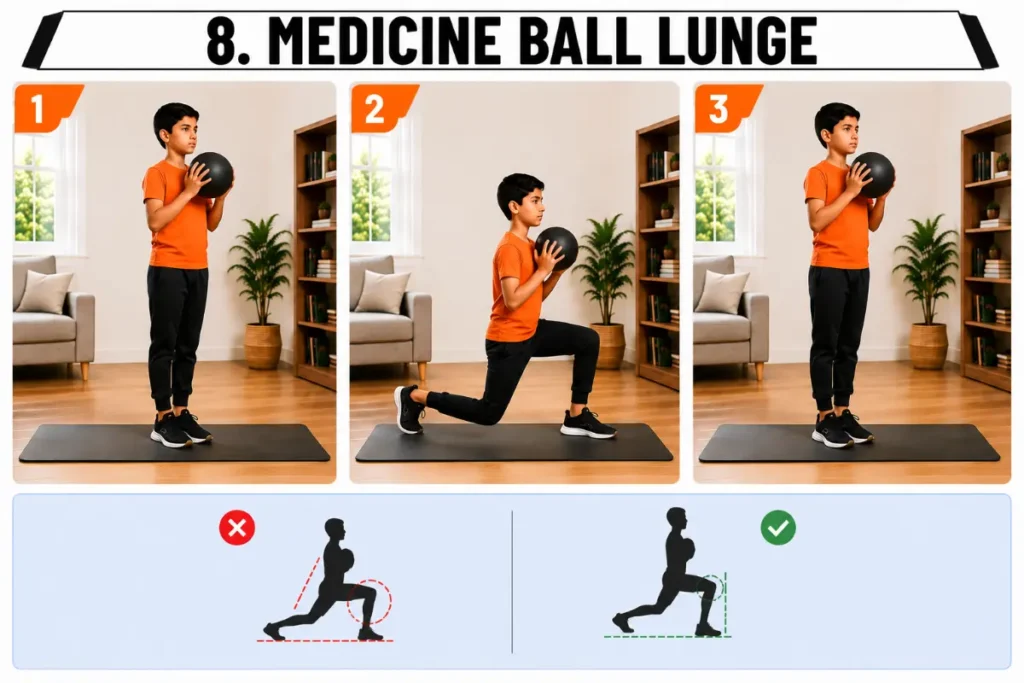
How to do it:
- Stand tall holding the ball at chest height.
- Step one foot forward and lower the back knee toward the floor — stop before it touches.
- Push through the front heel to return to standing.
Parent tip: Hold the child’s free hand for balance during the first few reps if needed. Lunges require more single-leg stability than squats, so some kids need a session or two to find their balance.
Look out for: Front knee shooting past the toes. The shin stays as vertical as possible.
9. Push and chase
Works: Arms, speed, agility, reaction time Sets × Reps: 2 × 6 | Rest: 45 sec
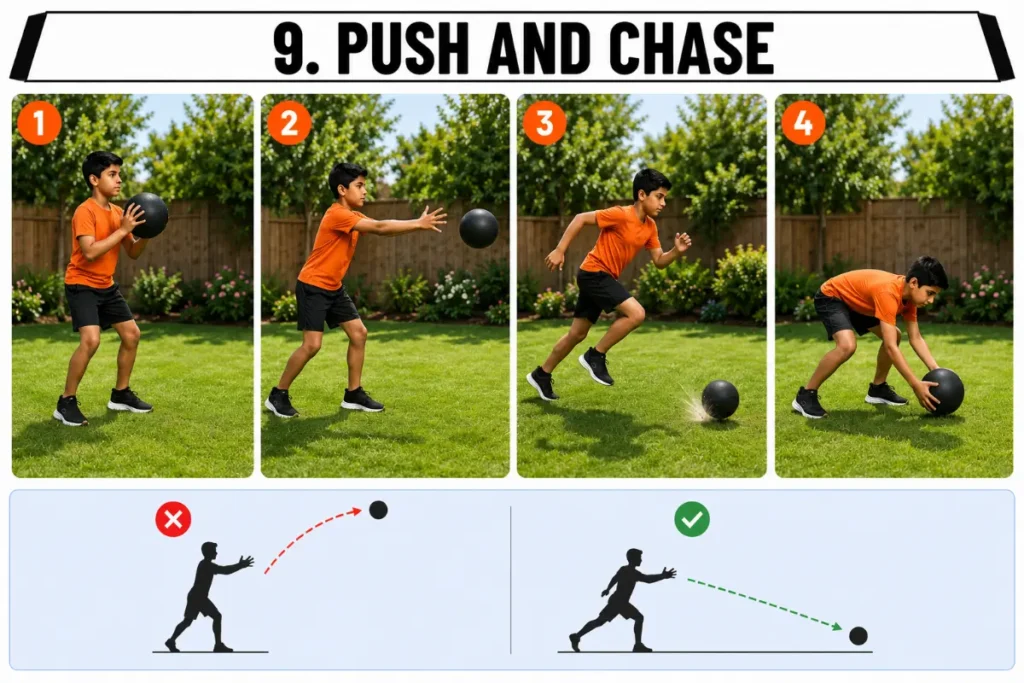
How to do it:
- Stand holding the ball at chest height.
- Push the ball forward as hard as possible from the chest (like a chest pass with no partner).
- Sprint after the ball and catch it before it bounces twice.
Parent tip: This is the exercise every kid loves. It’s a race against the ball — competitive, explosive, and self-limiting because the child controls the throw distance. Record personal bests to keep motivation high.
Look out for: Throwing the ball too high. The push goes forward and low — like bowling, not basketball.
10. Partner over-and-under
Works: Core, hamstrings, shoulders, teamwork Sets × Reps: 2 × 10 total passes | Rest: 45 sec
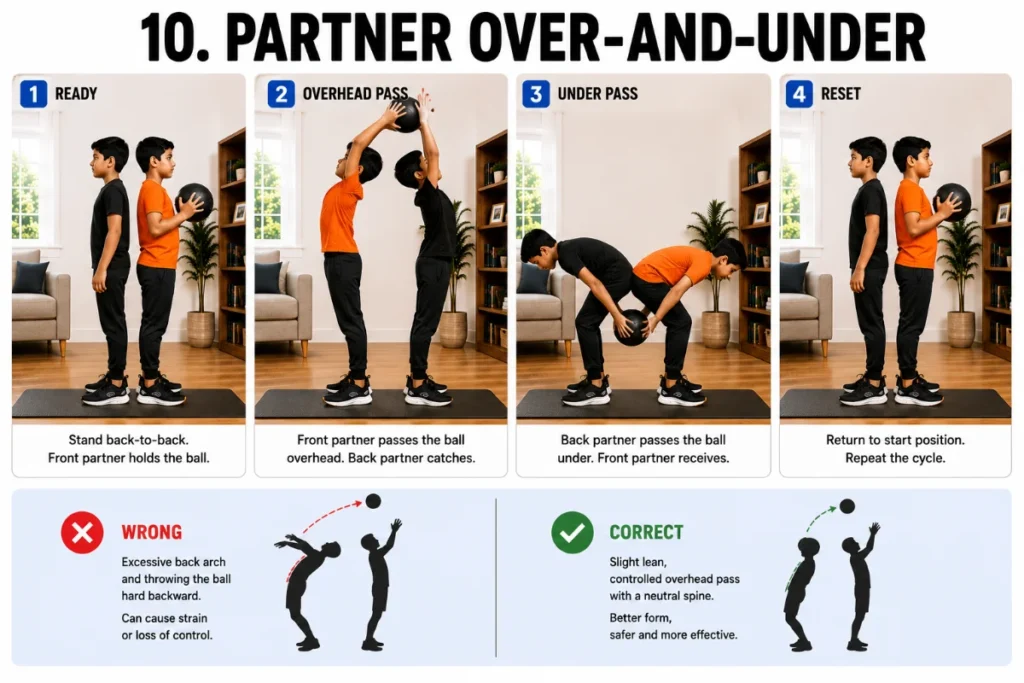
How to do it:
- Two kids (or parent and child) stand back-to-back, about one foot apart.
- First person passes the ball overhead to the partner behind. The partner receives it, bends down, and passes it back between the legs.
- First person picks it up from below and passes overhead again. That’s one cycle.
Parent tip: Alternate who starts on top each round. This exercise builds teamwork and timing — perfect for siblings or PE class pairs.
Look out for: The child reaching too far back on the overhead pass and arching the spine. Keep the pass controlled, not thrown.
Which muscles each exercise works
✔ = light, ✔✔ = moderate, ✔✔✔ = primary focus
| Exercise | Core | Legs | Arms/Shoulders | Coordination | Balance |
|---|---|---|---|---|---|
| Squat | ✔ | ✔✔✔ | – | ✔ | ✔ |
| Chest pass | ✔ | – | ✔✔✔ | ✔✔✔ | – |
| Overhead throw | ✔✔ | ✔ | ✔✔✔ | ✔✔ | ✔ |
| Standing Russian twist | ✔✔✔ | – | ✔ | ✔✔ | ✔✔ |
| Ball around body | ✔✔ | – | ✔ | ✔✔✔ | ✔ |
| Wood chop | ✔✔✔ | ✔✔ | ✔✔ | ✔✔ | ✔ |
| Squat-throw-catch | ✔✔ | ✔✔✔ | ✔✔ | ✔✔✔ | ✔ |
| Lunge | ✔ | ✔✔✔ | – | ✔ | ✔✔✔ |
| Push and chase | ✔ | ✔✔ | ✔✔✔ | ✔✔ | ✔ |
| Over-and-under | ✔✔✔ | ✔✔ | ✔✔ | ✔✔✔ | ✔ |
15-minute medicine ball workout for kids
No warm-up machines. No stopwatch apps. Just a ball and a timer.
Warm-up (3 minutes): 30 sec jumping jacks, 30 sec high knees, 30 sec arm circles forward, 30 sec arm circles backward, 60 sec jog in place
Circuit — do 2 rounds, 30 sec rest between exercises:
| Order | Exercise | Reps |
|---|---|---|
| 1 | Medicine ball squat | 8 |
| 2 | Chest pass (wall) | 10 |
| 3 | Standing Russian twist | 6 each side |
| 4 | Wood chop | 6 each side |
| 5 | Squat-throw-catch | 8 |
| 6 | Push and chase | 4 |
Cool-down (2 minutes): 30 sec standing toe touch, 30 sec butterfly stretch, 30 sec reach-to-sky stretch, 30 sec deep breaths lying down
Keep it short. Keep it fun. If the child is still smiling at the end, you did it right.
Common questions
Are medicine balls good for kids?
Yes. Medicine balls are one of the safest resistance tools for children because they don’t require grip strength or complex mechanics like barbells do. Kids under 12 should use a 2–6 lb soft-shell ball with adult supervision. Start with easy medicine ball exercises for kids — throws, squats, and passes — before progressing to rotational movements like wood chops.
Is an exercise ball good for scoliosis?
A medicine ball alone won’t treat scoliosis, but core-strengthening exercises — like the Russian twist, wood chop, and squat in this guide — can support spinal stability as part of a physical therapist-supervised program. Always consult a doctor before starting any exercise program for a child with scoliosis.
What are 5 exercises for balance for kids?
Single-leg stands, medicine ball lunges, ball around the body (from this guide), heel-to-toe walking, and standing on one foot while passing a ball with a partner. Balance improves fastest when practiced 2–3 times per week.
What is the 5 4 3 2 1 workout?
A countdown circuit: 5 squats, 4 lunges (each leg), 3 chest passes, 2 overhead throws, 1 push-and-chase sprint. Rest 30 seconds, repeat. It works because the decreasing reps keep kids mentally engaged — they can see the finish line getting closer each round.
What age can a child start using a medicine ball?
Most children aged 6 and older have the coordination and maturity to use a lightweight medicine ball (1–2 lbs) safely. The ACSM-published “Medicine Ball for All” program by Faigenbaum and Mediate includes children from kindergarten age, starting with dynamic warm-ups and simple tosses before progressing to strength exercises.
How heavy should a medicine ball be for a 10-year-old?
A 4 lb (2 kg) ball is the standard starting point for most 10-year-olds. Move to 6 lbs only when the child can complete 12 reps of every exercise with perfect form and no fatigue-related breakdown. Never exceed 6 lbs for any child under 12.
Can medicine ball exercises replace sports for kids?
No — and they shouldn’t. Medicine ball training builds the foundational motor skills (coordination, balance, agility, core stability) that make kids better at sports. Think of it as preparation, not replacement. The ACSM recommends combining resistance activities with aerobic exercise like running, swimming, or cycling for balanced fitness.
How do I make medicine ball exercises fun for kids?
Turn reps into games. The push-and-chase exercise in this guide is a race against the ball. The partner over-and-under becomes a speed challenge between siblings. Set personal bests, use countdowns like the 5-4-3-2-1 workout, and keep sessions under 20 minutes so kids finish wanting more, not less.
Looking for calorie data on your child’s workout? Try our Calorie Burn Calculator to see how different activities compare.
