


Quick answer: Time under tension (TUT) is the total seconds your muscles are under active load during a set. For muscle growth, the target is 30 to 60 seconds per set — calculated by multiplying your rep duration by your total reps. Controlling rep speed through tempo is one of the most underused tools for building muscle without adding weight.
I watched a guy in my gym do 4 sets of Romanian deadlifts last week. The bar was dropping on every single rep. He wasn’t lowering the weight, he was letting it fall and catching it at the bottom. His hamstrings were barely involved. He’d been doing this for months and couldn’t understand why his posterior chain wasn’t growing.
The problem wasn’t his programme. It wasn’t his diet. It was that he had no idea how fast he was moving the weight, and nobody had ever told him it mattered.
How fast you move that weight is one of the most overlooked variables in resistance training. The speed of each rep, the lowering, the pause, the lift — directly controls how long your muscles stay under load. And that duration is one of the most underused levers for getting better results from every single set you do.
Most people push back on this. You’ve been told to lift heavy, add weight when you can, and the results will come. That’s not wrong, but it’s incomplete. Rep speed is the variable that sits between “I’m doing the work” and “I’m actually feeling the muscle work.” Once you understand it, you can’t unfeel it.
- What Is Time Under Tension (TUT)?
- TUT per Rep vs TUT per Set — What's the Difference?
- How to Calculate Your TUT?
- How Rep Tempo Works
- Why the Eccentric Phase Matters Most?
- The Three Mechanisms of Muscle Growth TUT Drives
- Mind-Muscle Connection and TUT
- Goal-Based Tempo Recommendations
- Tempo by Experience Level
- Sample TUT Workout
- How to Start This Week — Step by Step
- Breathing During TUT Sets — What Nobody Tells You
- Common Tempo Training Mistakes
- Tempo and Recovery — The DOMS Truth
- The Bottom Line
- Frequently Asked Questions
- References
What Is Time Under Tension (TUT)?
Time under tension is the total number of seconds your muscles are under active load during a set. If you do 10 reps of Romanian deadlifts and each rep takes 4 seconds, your TUT for that set is roughly 40 seconds.
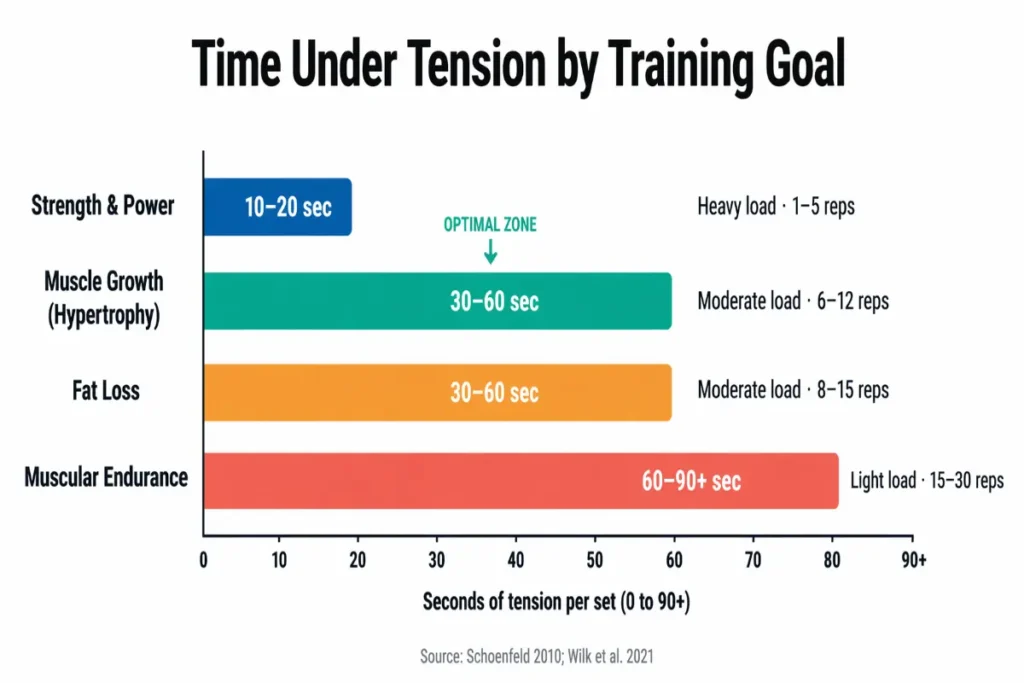
Different durations create completely different physiological responses in your muscle fibres. A set that lasts 10 seconds trains your muscles very differently from one that lasts 50 seconds — even if the weight is identical.
| Goal | TUT per set | Load | Rep range |
|---|---|---|---|
| Strength and power | 10–20 seconds | Heavy (85–95% 1RM) | 1–5 reps |
| Muscle growth (hypertrophy) | 30–60 seconds | Moderate (65–80% 1RM) | 6–12 reps |
| Muscular endurance | 60–90+ seconds | Light (40–60% 1RM) | 15–30 reps |
| Fat loss | 30–60 seconds | Moderate with controlled tempo | 8–15 reps |
Most lifters never consciously think about this. They add weight when things feel easy and wonder why progress stalls. If you’re new to how reps and sets work in a programme, my guide on what reps and sets actually mean gives you the foundation before we go deeper here.
TUT per Rep vs TUT per Set — What’s the Difference?
This is the single thing that trips nearly everyone up when they first encounter this concept.
TUT per rep is the total time your muscle is under tension for one repetition — the lowering phase, any pause at the bottom, the lift, and any pause at the top. If you squat with a 3-1-2 tempo — 3 seconds down, 1 second pause, 2 seconds up — that’s 6 seconds per rep.
TUT per set is your per-rep duration multiplied by your total reps. Six seconds per rep across 10 reps gives you 60 seconds of total time under tension for that set.
When training guidelines say “aim for 40 to 60 seconds of TUT,” they mean per set — not per rep. I’ve had clients who thought every individual rep needed to last a full minute. That’s not the target. The set is the target.
How to Calculate Your TUT?
This is the most practical piece of this whole topic, and most articles skip it entirely.
The formula:
TUT per set = (eccentric + bottom pause + concentric + top pause) × number of reps
Real example — barbell row with a 3-1-2-0 tempo for 8 reps:
- Eccentric: 3 seconds
- Bottom pause: 1 second
- Concentric: 2 seconds
- Top pause: 0 seconds
- Total per rep: 6 seconds
- TUT for the set: 6 × 8 = 48 seconds ✓ Hypertrophy range
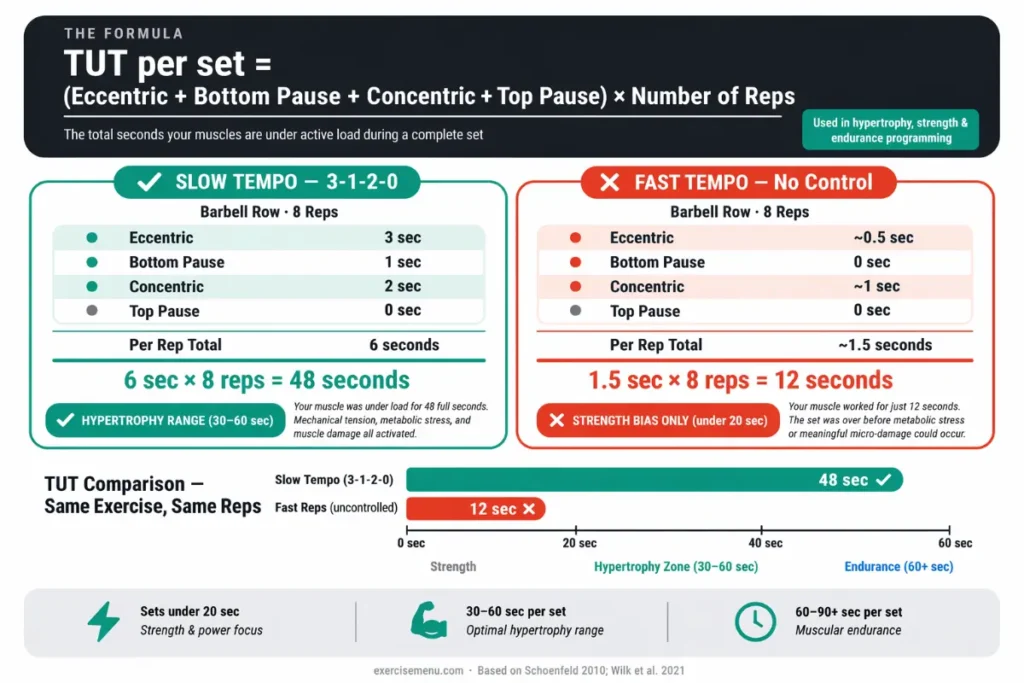
Now compare that to what most people actually do — a rep that takes about 1.5 seconds total. Eight reps gives you 12 seconds of TUT. Your muscle barely started working before the set was over.
If your sets feel over in a flash, you’re moving too fast. If you’re grinding through 30 reps on 20kg just to hit a time target, you’ve gone too far. The middle is where the muscle grows.
How Rep Tempo Works
Rep tempo is the pace at which you move through each phase of a rep. Written as a four-digit code — each number is the seconds you spend in that part of the movement.
| Digit | Phase | What it means |
|---|---|---|
| 1st | Eccentric | The lowering or lengthening phase |
| 2nd | Isometric pause (bottom) | Hold at the bottom of the movement |
| 3rd | Concentric | The lifting or shortening phase |
| 4th | Isometric pause (top) | Hold at the top of the movement |
4-0-1-0 on a back squat: 4 seconds lowering, no pause at bottom, 1 second driving up, no pause at top.
3-1-2-0 on a Romanian deadlift: 3 seconds lowering, 1 second pause at bottom, 2 seconds lifting, no pause at top.
When you see X in a tempo code — like 2-0-X-0 — it means explosive. Move that phase as fast as possible with control. Used in strength and power training where fast-twitch motor unit recruitment and concentric speed are the priority.
Use these codes for two sessions and you stop noticing them. Their real value is that they force intentionality — you stop rushing through reps and start actually training the muscle.
Why the Eccentric Phase Matters Most?
The lowering portion of a rep is where a large part of the muscle-building stimulus actually happens — and most gym content completely glosses over this.
The eccentric phase creates significantly greater mechanical tension than the concentric phase. This is why controlling the descent is more valuable for hypertrophy than how fast you drive the weight up.
Shibata et al. compared slow versus fast eccentric tempos during back squat training. The slow-eccentric group added significantly more size to their quads despite doing the exact same volume, same weight, same reps. The only variable was how they moved the weight on the way down.
A 2021 review by Wilk et al. in Sports Medicine concluded that a slower eccentric combined with a faster concentric is the most effective combination for maximising muscular development.
The rule: slow and controlled on the way down. Purposeful and powerful on the way up. Each contraction type produces a different training stimulus beyond rep speed. The eccentric vs concentric guide covers force production differences, exercises that emphasize each phase, and when to focus on one over the other.
The Three Mechanisms of Muscle Growth TUT Drives
When you slow down the eccentric, three distinct physiological mechanisms activate simultaneously. This is why tempo training produces results that simply adding more weight cannot always replicate.
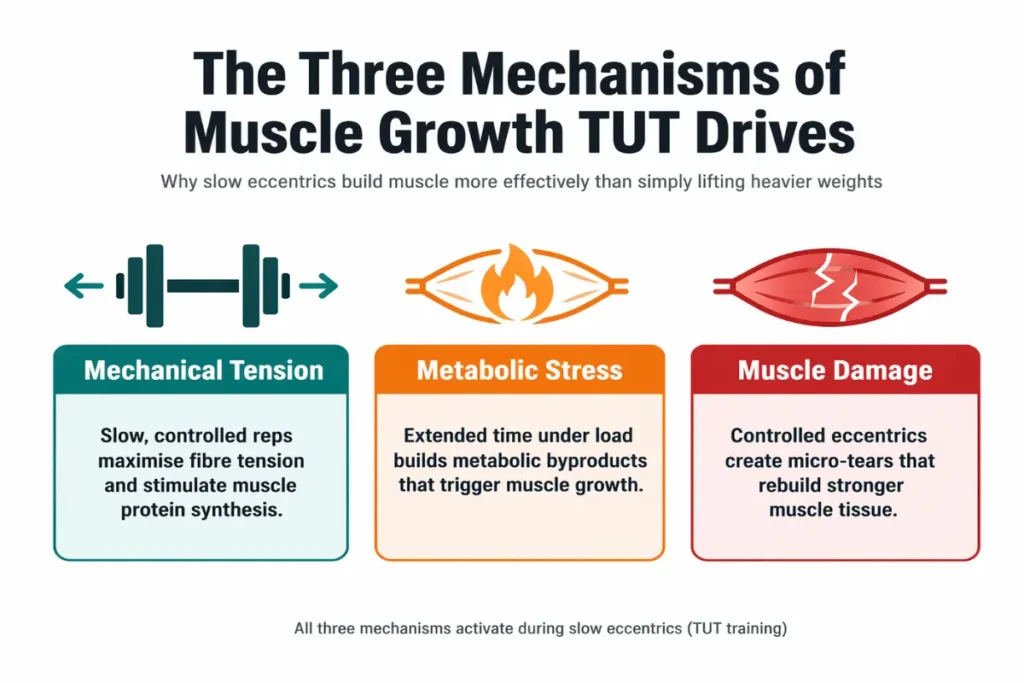
1. Mechanical tension
When a muscle resists a load through a slow, controlled range of motion, the tension placed on the muscle fibres triggers signalling pathways responsible for muscle protein synthesis. A slow eccentric maximises the time each fibre spends under this tension. This is well-documented in Schoenfeld’s landmark 2010 research on the mechanisms of muscle hypertrophy.
2. Metabolic stress
When a muscle stays under load for an extended period, metabolic byproducts accumulate — lactate, hydrogen ions, inorganic phosphate. This chemical environment signals muscle growth independent of load. It’s why a slow set with a lighter weight can produce a similar hypertrophic stimulus to a heavier, faster set. (Source: Burd et al., Journal of Physiology, 2012)
3. Muscle damage (micro-trauma)
Eccentric contractions cause more micro-damage to muscle tissue than concentric ones. That micro-damage is precisely what the body repairs and rebuilds — slightly thicker and stronger each time. A controlled eccentric maximises this stimulus without the injury risk of overloading the bar beyond your capacity.
All three mechanisms activate simultaneously during a slow, controlled eccentric. This is why tempo training produces a training stimulus that fast reps at the same weight simply cannot match.
Mind-Muscle Connection and TUT
When you rush a rep, your brain doesn’t have time to establish a clear signal to the specific muscle you’re training. Momentum takes over, surrounding muscles compensate, and the target muscle does far less work than it should. You finish the set feeling like you worked hard — but the muscle you were targeting barely contributed.
A controlled eccentric forces your nervous system to stay dialled into the muscle through its full range of motion. The extra time lets you feel the contraction, identify where tension is and isn’t building, and adjust mid-set.
When I slowed my Romanian deadlift eccentric to 3 seconds, it was the first time in two years of training that I actually felt it in my hamstrings instead of my lower back. Before that, I genuinely thought my hamstrings just didn’t respond to training. They responded immediately — the moment I stopped letting the weight drop and started controlling the descent.
That one change — 3 seconds down instead of 1 — told me more about how I’d been training than two years of adding plates did. And it’s the first thing I tell every client who comes to me with a muscle group that “won’t grow.”
Goal-Based Tempo Recommendations
For muscle growth (hypertrophy)
A 3 to 4 second lowering phase with a brief isometric pause at the bottom maximises mechanical tension and metabolic stress simultaneously. Total rep duration should fall between 4 and 8 seconds, with total set TUT between 30 and 60 seconds.
| Tempo | Breakdown | Best for |
|---|---|---|
| 3-1-1-0 | 3s down · 1s pause · 1s up · no hold | General hypertrophy — most compound lifts |
| 4-0-2-0 | 4s down · no pause · 2s up · no hold | Quad and hamstring focus |
| 3-2-1-0 | 3s down · 2s pause · 1s up · no hold | Mind-muscle connection work |
For strength
Keep your eccentric controlled at around 2 to 3 seconds but drive the concentric as fast as possible. You’re training your nervous system to produce force and recruit high-threshold motor units. The intent to accelerate matters even if the bar moves slowly under heavy load.
Prescription: 2-0-X-0 — 2 seconds down, no pause, explosive drive up.
For muscular endurance
Ultra-slow tempos like 5-5-5-0 build resilience in tendons and connective tissue alongside muscular endurance. Your muscles never get a true rest within the set — the load will feel much heavier than usual. If endurance training is your primary goal, how to structure reps and sets specifically for muscular endurance walks through the full approach alongside these tempo guidelines.
For fat loss
Slower reps extend set duration and increase metabolic demand. More time under tension means more total work done — and that work has an energy cost. Combining a controlled tempo with the right rep range preserves muscle while raising caloric expenditure per session. I’ve covered the full approach to structuring reps and sets for fat loss separately — tempo is one important piece of that.
For injury recovery
When you cannot add load, slowing the eccentric or adding isometric holds — holding a position with the muscle under tension, without movement — maintains meaningful muscle stimulus without increasing bar weight.
An isometric hold at the bottom of a squat or at the stretched position of a curl keeps the muscle firing without excessive joint stress. Work within a pain-free range and get clearance from a physiotherapist before programming this during an active injury.
Tempo by Experience Level
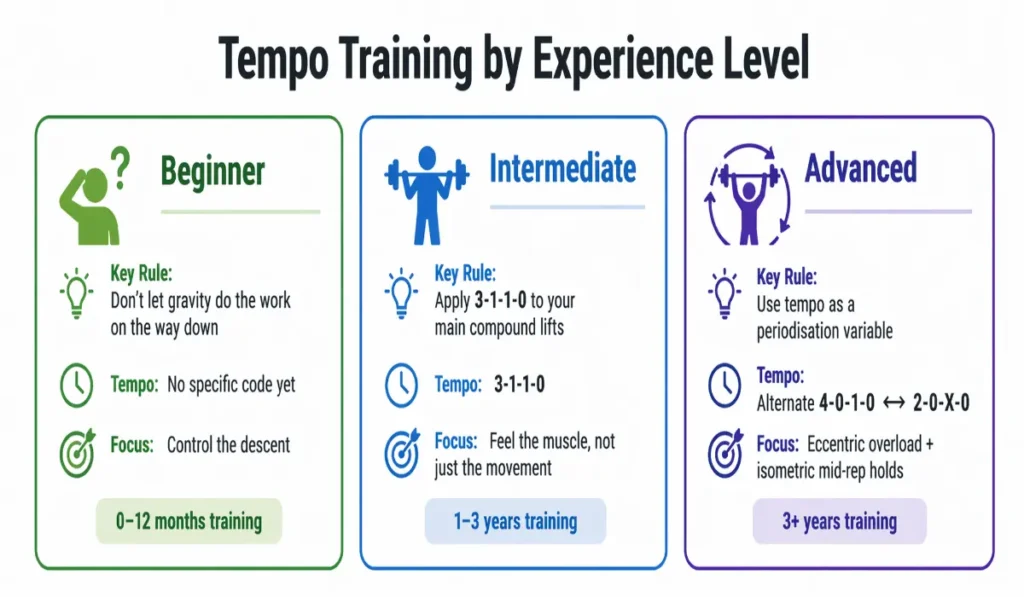
Beginners — one rule, not a tempo code
Don’t obsess over specific tempo codes yet. Before you can control a 5-second lowering phase, you need solid movement patterns. A beginner counting seconds during a squat while still learning the squat itself will almost certainly compromise form — and that’s where injury comes from.
One instruction: don’t let gravity do the work on the way down. That single rule captures 80 percent of the benefit without requiring you to count seconds. Once your movement mechanics are solid, controlled tempo becomes your next tool.
Intermediate lifters — apply it to your main lifts
This is where tempo training starts paying real dividends. You have enough body awareness to feel the difference between a muscle working and a muscle along for the ride. You’re also hitting the plateau where adding more weight alone isn’t solving the problem.
Apply a 3-1-1-0 tempo to your main compound lifts — squats, deadlifts, rows, presses. Drop the weight 10 to 15 percent first. Three seconds down on your Romanian deadlift, one second pause at the bottom, drive it back up. That’s the moment you’ll feel what the exercise is actually supposed to do.
One practical question at this stage: should you use tempo on warm-up sets? No. Warm-up sets and working sets serve completely different purposes — applying strict tempo to warm-up sets changes their function in a counterproductive way. Controlled tempo is for working sets only.
Advanced lifters — use tempo as a periodisation tool
Alternate between hypertrophy blocks with slow eccentrics and strength blocks with explosive concentrics. You can also use isometric holds mid-rep to target specific weaknesses in a range of motion — a 3-second pause at parallel in a squat builds the kind of positional strength that translates directly to heavier working weights.
Sample TUT Workout
These are the exact tempo prescriptions I use with intermediate clients in their first tempo block. Use these sessions as a starting point.
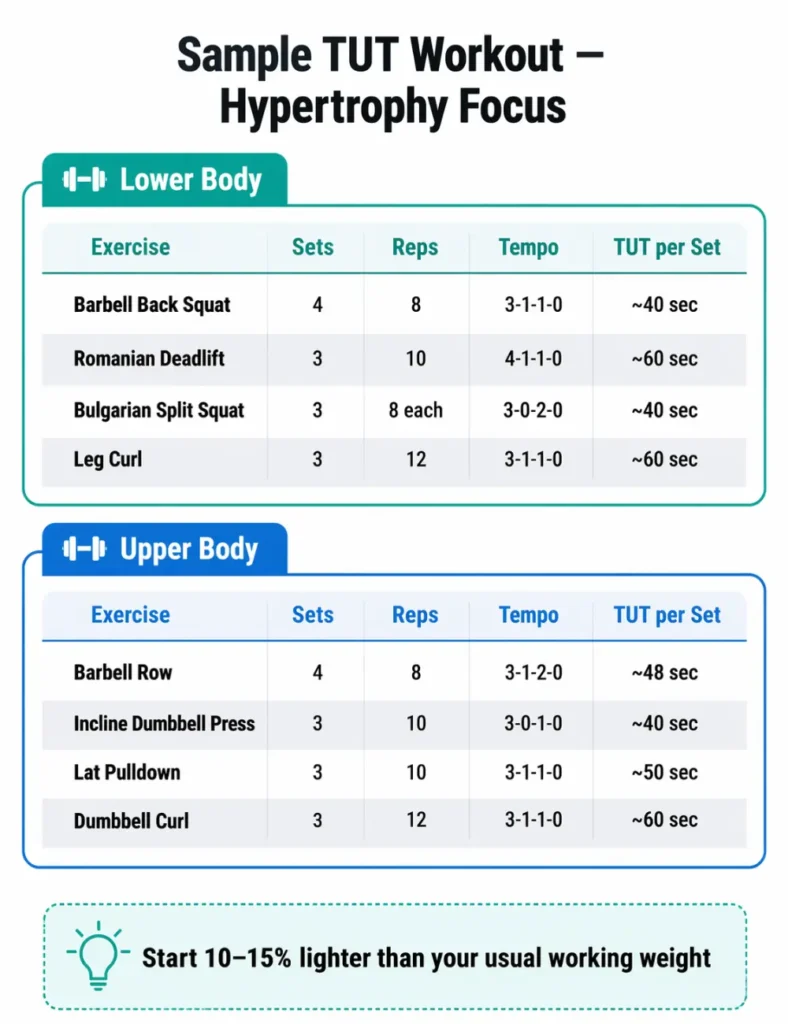
Lower Body TUT Session
| Exercise | Sets | Reps | Tempo | TUT per set |
|---|---|---|---|---|
| Barbell back squat | 4 | 8 | 3-1-1-0 | ~40 sec |
| Romanian deadlift | 3 | 10 | 4-1-1-0 | ~60 sec |
| Bulgarian split squat | 3 | 8 each | 3-0-2-0 | ~40 sec |
| Leg curl | 3 | 12 | 3-1-1-0 | ~60 sec |
Upper Body TUT Session
| Exercise | Sets | Reps | Tempo | TUT per set |
|---|---|---|---|---|
| Barbell row | 4 | 8 | 3-1-2-0 | ~48 sec |
| Incline dumbbell press | 3 | 10 | 3-0-1-0 | ~40 sec |
| Lat pulldown | 3 | 10 | 3-1-1-0 | ~50 sec |
| Dumbbell curl | 3 | 12 | 3-1-1-0 | ~60 sec |
Load note: Start 10 to 15 percent lighter than your usual working weight. The slow eccentric makes these sets significantly harder than the numbers suggest.
How to Start This Week — Step by Step
Step 1: Pick one lower body and one upper body compound lift from your current routine.
Step 2: Drop the load 10 to 15 percent.
Step 3: Assign a tempo of 3-1-1-0 to each. Log the tempo alongside your sets, reps, and weight every session.
Step 4: In week 2, either add one second to the eccentric or keep the same tempo and nudge the weight slightly upward. That is progressive overload through tempo — a legitimate form of progression.
Step 5: After 4 weeks, ask yourself one question: are you feeling the target muscle working more consistently than before? If yes, the tempo is working.
I remember asking myself this four weeks into slowing my squat eccentric. My quads were sore in a way they hadn’t been in over a year of training. My weights were slightly lighter than before — but what was happening inside the muscle was completely different. That quality of soreness, in exactly the right place, told me more than any number on the bar ever had.
Breathing During TUT Sets — What Nobody Tells You
This is missing from almost every TUT article, and it genuinely matters.
When a set lasts 40 to 60 seconds, your breathing can’t be the same as a 10-second set.
During the eccentric: Take a full breath before the descent. You can hold it briefly through a 2 to 3 second lowering phase to maintain core tension — or exhale slowly and controlled through a longer 4 to 5 second descent. The goal is stable core pressure throughout.
At the bottom pause: Reset your breath if needed before driving back up.
During the concentric: Exhale as you drive the weight up. Same pattern as standard training — breathe out on exertion.
For sets beyond 40 seconds: Breathe rhythmically between reps. Do not hold your breath through an entire slow set. The goal is controlled breathing that doesn’t cause you to rush the tempo to get air in.
The first time most clients try a 4-second eccentric, they forget to breathe entirely and are gasping by rep 6. Practice the breathing pattern on your first set before worrying about hitting the exact tempo count.
Common Tempo Training Mistakes
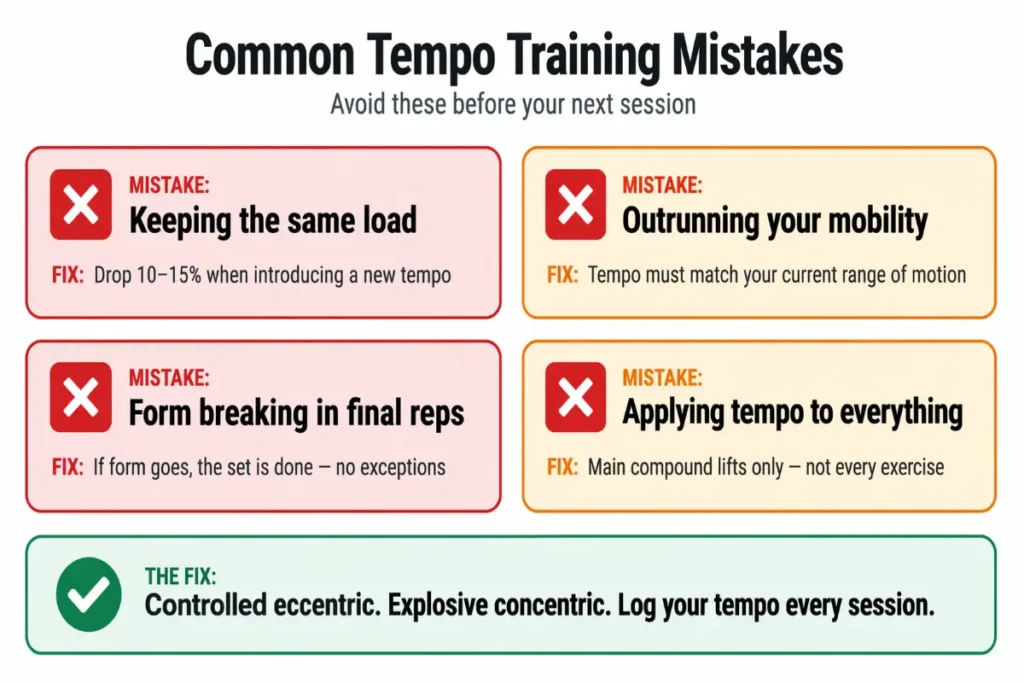
Keeping the same load
A 4-second eccentric is a harder stimulus than a fast rep at the same weight. Most people keep the load identical, lose reps, then grind through with broken form. Drop the weight when you introduce a new tempo. Build back up.
Outrunning your mobility
A 6-second lowering phase on a back squat is useless if your mobility breaks down at the bottom. You end up training compensation patterns, not the target muscle. Tempo must match your current capability — not your aspirational one.
Letting form break down in final reps
Slow-tempo sets are fatiguing in a way standard training isn’t. Most technique failures happen in the last rep or two. If your form breaks, the set is done — non-negotiable.
Applying tempo to every exercise
Tempo codes belong on your main compound lifts. Accessory and isolation work can run at a natural, controlled pace. Turning every exercise into a counting exercise kills training quality and enjoyment.
Tempo and Recovery — The DOMS Truth
Slower eccentrics cause significantly more muscle soreness than fast reps. More micro-damage in the tissue means more repair required — and more recovery time needed between sessions.
The first time I programmed a full slow-tempo deadlift session for a client, she texted me the next morning unable to walk properly. We had used exactly the same weight she always trained with. The only change was a 4-second eccentric on every rep. That’s what a controlled descent does to muscle tissue that isn’t prepared for it.
When introducing tempo training for the first time: reduce working weight by 10 to 20 percent and lower your total session volume. Expect significant soreness for 48 to 72 hours after the first two or three sessions. Add one second to your eccentric over several weeks rather than jumping straight to ultra-slow sets — your tendons and connective tissue adapt more slowly than muscle and need time to catch up. The soreness settles within two to three weeks of consistent tempo work.
The Bottom Line
Most lifters leave results on the table not because they’re lazy, but because they’re rushing. The weight moves, the reps get done, and it all looks fine from the outside — but the muscle barely had time to do its job.
Slow one phase down this week. Pick one lift, try a 3-second eccentric, and pay attention to what you actually feel. Four weeks in, when you’re finally feeling Romanian deadlifts where you’re supposed to — in your hamstrings, not your lower back — you’ll understand exactly why this matters.
Frequently Asked Questions
What is time under tension and why does it matter?
Time under tension is the total seconds your muscles are under active load during a set. Shorter durations favour strength, 30 to 60 seconds per set favours muscle growth, and longer durations build endurance. Controlling rep speed is one of the simplest ways to get more from a set without changing the weight.
What is the formula to calculate TUT?
TUT per set = (eccentric + bottom pause + concentric + top pause) × number of reps. A 3-1-2-0 tempo for 10 reps gives 60 seconds of TUT — solidly in the hypertrophy range.
What’s the difference between TUT per rep and TUT per set?
TUT per rep is how long one repetition takes. TUT per set is per-rep duration multiplied by your total reps. When guidelines say “aim for 40 to 60 seconds of TUT,” they mean per set — not per rep.
What tempo should I use to build muscle?
Use a 3 to 4 second eccentric with a brief isometric pause at the bottom and a purposeful concentric drive. A 3-1-1-0 or 4-0-2-0 tempo on compound lifts keeps total set TUT between 30 and 60 seconds — the optimal range for hypertrophy.
Is slower always better for building muscle?
No. A slow eccentric is beneficial. A slow concentric is not — unless training for endurance or rehabilitation. The sweet spot is a controlled descent combined with a purposeful, driven lift. Slowing everything reduces power development and undermines your mind-muscle connection under fatigue.
What does X mean in a tempo code?
X means explosive — move that phase as fast as possible with control. A 2-0-X-0 tempo means 2 seconds lowering, no pause, then drive up as explosively as possible. Used in strength training where fast-twitch motor unit recruitment and concentric power are the priority.
How should I breathe during a slow TUT set?
Inhale before the eccentric, maintain core tension through the descent, then exhale on the concentric drive. For sets longer than 40 seconds, breathe rhythmically between reps without holding your breath through the entire set.
Can I use tempo training without gym equipment?
Yes. A slow eccentric on a push-up, a 3-second lowering phase on a bodyweight squat, or a controlled descent on a pull-up all increase time under tension without adding load. Isometric holds at the bottom of any bodyweight movement add extra stimulus. Tempo is one of the most practical progressive overload tools for home training.
Does tempo training cause more soreness?
Yes, particularly in the first few weeks. Slower eccentrics cause more micro-damage, leading to greater DOMS. Reduce working weight by 10 to 20 percent and lower session volume when first introducing tempo. Soreness typically settles within two to three weeks.
Is tempo training useful during injury recovery?
Yes. Slowing the eccentric or adding isometric holds maintains muscle stimulus without increasing joint load. Stay within a pain-free range and get clearance from a physiotherapist before using this during an active injury.
Should I use tempo on warm-up sets?
No. Warm-up sets prime the nervous system and joints — they are not meant to build muscle. Applying strict tempo to warm-up sets changes their purpose in a counterproductive way. Save controlled tempo for working sets only.
References
- Schoenfeld, B.J. (2010). The mechanisms of muscle hypertrophy and their application to resistance training. Journal of Strength and Conditioning Research. Read study →
- Wilk, M. et al. (2021). The influence of movement tempo during resistance training on muscular strength and hypertrophy responses. Sports Medicine. Read study →
- Burd, N.A. et al. (2012). Muscle time under tension during resistance exercise stimulates differential muscle protein sub-fractional synthetic responses in men. The Journal of Physiology. Read study →
- Martins-Costa, H.C. et al. (2016). Longer repetition duration increases muscle activation and blood lactate response. Motriz: Revista de Educação Física. Read study →
- Tanimoto, M. & Ishii, N. (2006). Effects of low-intensity resistance exercise with slow movement on muscular function in young men. Journal of Applied Physiology. Read study →

2 Comments
Pingback: Eccentric vs Concentric: Difference and When to Use Each
Pingback: Mind-Muscle Connection: Does It Work? Science + Cues