Close Menu
  • Home
  • About Us
  • Services
    • Home Workout
    • Gym Workout
    • Nutrition & Diet
  • Tools
    • Calorie Burn Calculator
    • Water Intake Tool
    • Protein Calculator
    • BMI Calculator
  • Areas We Serve
    • Miami Dade
    • Broward
    • Palm Beach
    • Hillsborough
  • Blog
  • Contact Us
What's Hot

What Does 3×10, 4×12, or 5×5 Mean in a Workout? (Complete Guide)

April 10, 2026

How Many Reps and Sets for Muscular Endurance? Beginner to Advanced Guide

April 9, 2026

How Many Reps & Sets for Fat Loss? My 12-Week Experience

April 8, 2026
Facebook X (Twitter) Instagram
Facebook Instagram TikTok
Exercisemenu
Login
  • Home
  • About Us
  • Services
    • Home Workout
    • Gym Workout
    • Nutrition & Diet
  • Tools
    • Calorie Burn Calculator
    • Water Intake Tool
    • Protein Calculator
    • BMI Calculator
  • Areas We Serve
    • Miami Dade
    • Broward
    • Palm Beach
    • Hillsborough
  • Blog
  • Contact Us
Exercisemenu
Home»Workout»What Does 3×10, 4×12, or 5×5 Mean in a Workout? (Complete Guide)
Workout

What Does 3×10, 4×12, or 5×5 Mean in a Workout? (Complete Guide)

Sadia BalochBy Sadia BalochApril 10, 2026No Comments20 Mins Read
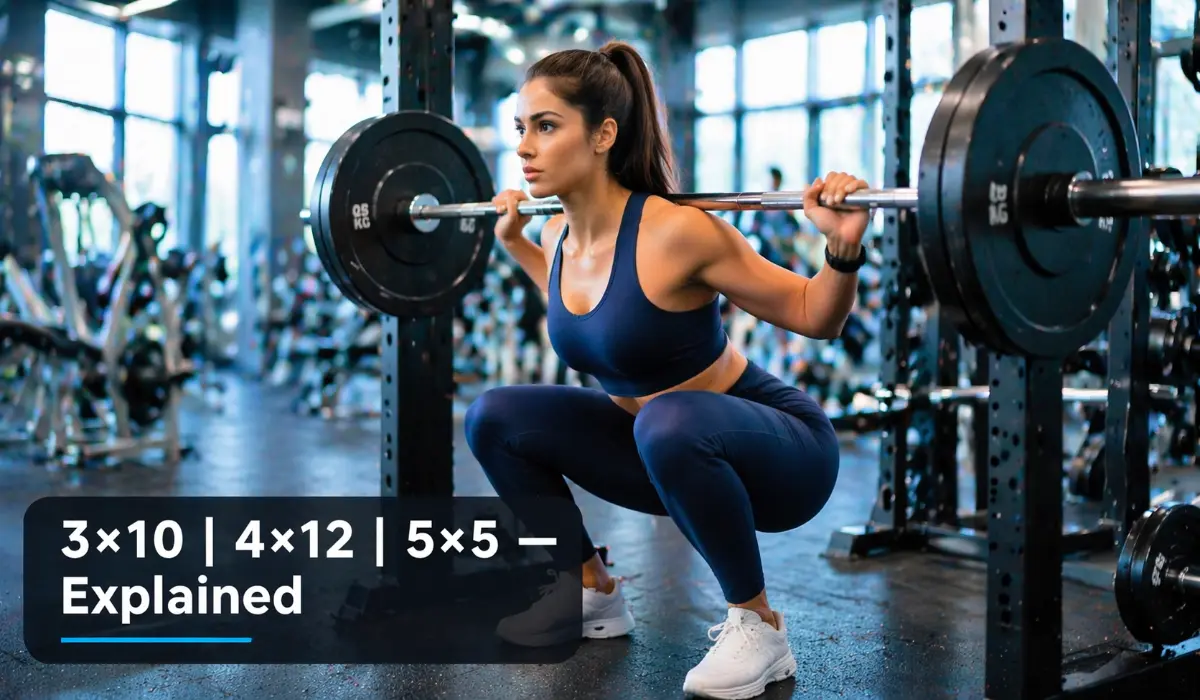
Athlete performing barbell back squat in gym — understanding workout notation 3x10 4x12 5x5

You’re staring at your programme. It says “Back Squat 5×5” or “Bicep Curls 3×12.” You have no idea what those numbers mean — and nobody in the gym is explaining it.

Here’s the answer: the first number is your sets, the second is your reps. But knowing which combination to use, and why, is what actually moves the needle. Pick the wrong scheme for your goal and you’ll spend months working hard with almost nothing to show for it.

This guide breaks it all down — simply, practically, and with zero fluff.

What Do Sets and Reps Actually Mean?

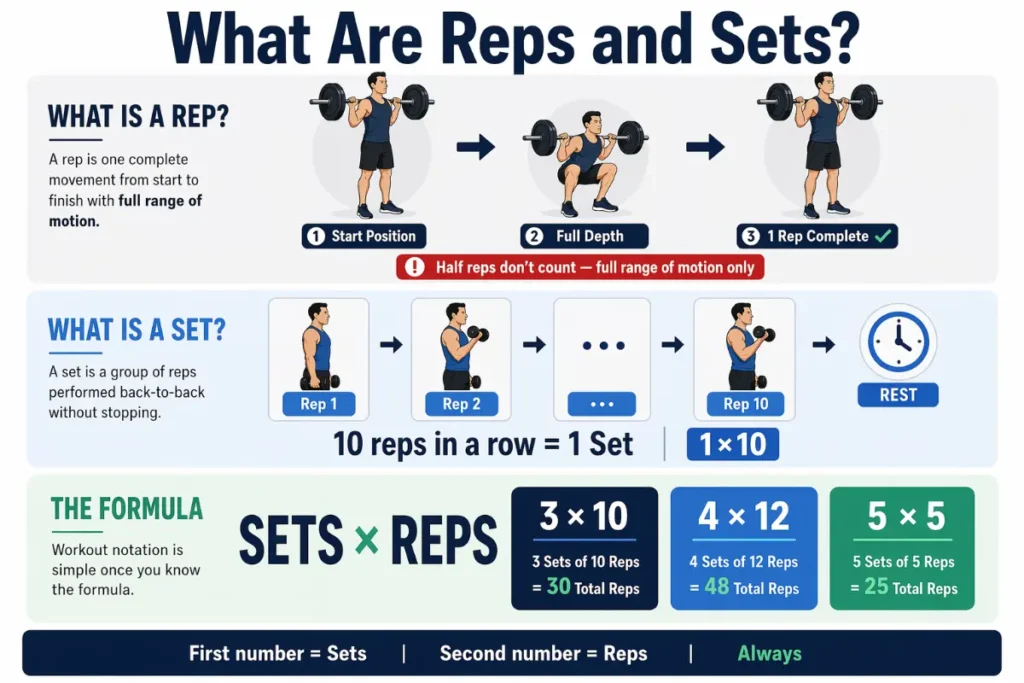
Infographic explaining what are reps and sets — 
Section 1 shows a 3-step barbell squat illustration 
demonstrating one complete rep from start position 
to full depth and back up. Section 2 shows a dumbbell 
curl sequence from rep 1 to rep 10 followed by rest, 
explaining one set. Section 3 shows the Sets x Reps 
formula with examples 3x10 equals 30 total reps, 
4x12 equals 48 total reps, and 5x5 equals 25 total reps

A rep (repetition) is one complete movement. Squat down and stand back up — that’s one rep. Curl a dumbbell up and lower it back down — one rep. The key word is complete. Half reps don’t count, and they don’t build muscle either.

A set is a group of reps done back-to-back before you rest. Ten squats, then rest — that’s one set of 10, written as 1×10.

The formula is always: Sets × Reps

NotationWhat It MeansTotal Reps
3×10³ sets of 10 reps30
4×124 sets of 12 reps48
5×55 sets of 5 reps25

Simple once you see it. What makes each scheme different is the goal it’s built around — and that’s where things get interesting.

If you want a deeper understanding of how reps and sets work together across all training goals — from movement phases to weekly volume targets — our complete beginner’s guide to reps and sets covers all of it.

What Does 3×10 Mean in a Workout?

Three sets of ten reps is the most common notation in general fitness. It sits in what coaches call the hypertrophy range — the rep zone most associated with building muscle size.

At 3×10, you’re typically working at 65–75% of your maximum for a given exercise. Heavy enough to create real tension in the muscle, light enough to maintain solid form across all three sets. That balance between load and volume is what drives muscle growth.

3×10 works particularly well for:

  • Isolation exercises — bicep curls, leg extensions, triceps pushdowns
  • Accessory compound movements — Romanian deadlifts, dumbbell rows
  • Beginners who are still building movement patterns before adding serious load

What Does 4×12 Mean in a Workout?

4×12 takes everything 3×10 does and turns the volume dial up. One more set, two more reps, slightly lighter load — around 60–70% of your max — producing more time under tension and a harder metabolic hit.

This scheme is popular in bodybuilding-style training because it generates a strong muscle pump and builds high training volume. It works especially well as a finishing scheme — used after heavier compound work when the goal is driving accumulated fatigue into a specific muscle group.

Use 4×12 when:

  • You want more total volume for a muscle group in a single session
  • You’re doing isolation or accessory work later in a workout
  • You’re in a dedicated hypertrophy training block

What Does 5×5 Mean in a Workout?

Five sets of five reps is a classic strength protocol that has proven itself over decades. Straightforward, demanding, and consistently effective.

At 5×5, you’re lifting heavy — typically 80–85% of your 1 rep max (1RM). The low rep count lets you move significant weight, while five sets provide enough volume to force genuine adaptation. This is the sweet spot for building raw strength without wrecking your recovery.

What makes 5×5 work is neurological adaptation. Repeated exposure to heavy loads teaches your central nervous system to recruit more muscle fibres more efficiently. You get stronger not just because muscles grow — but because your nervous system learns to use what you already have, better.

Popular 5×5 programmes worth knowing:

  • StrongLifts 5×5 — five barbell movements (Squat, Bench Press, Deadlift, Overhead Press, Barbell Row) trained three times per week. Hundreds of thousands of lifters have used this to build their first real strength base.
  • Starting Strength — also built around 5×5 on core barbell lifts, with a stronger emphasis on coaching technique before adding load.
  • Texas Method — a slightly more advanced take that cycles volume, recovery, and intensity days across the week.

5×5 is best suited to:

  • Compound barbell lifts — Squat, Deadlift, Bench Press, Overhead Press, Barbell Row
  • Beginners and intermediates building a foundational strength base
  • Anyone whose primary goal is to get stronger, not just bigger

One thing most people underestimate: rest periods matter here. Give yourself 3 to 5 minutes between sets. 5×5 is neurologically demanding — cutting rest short compromises every set that follows.

Warm-Up Sets vs Working Sets — What’s the Difference?

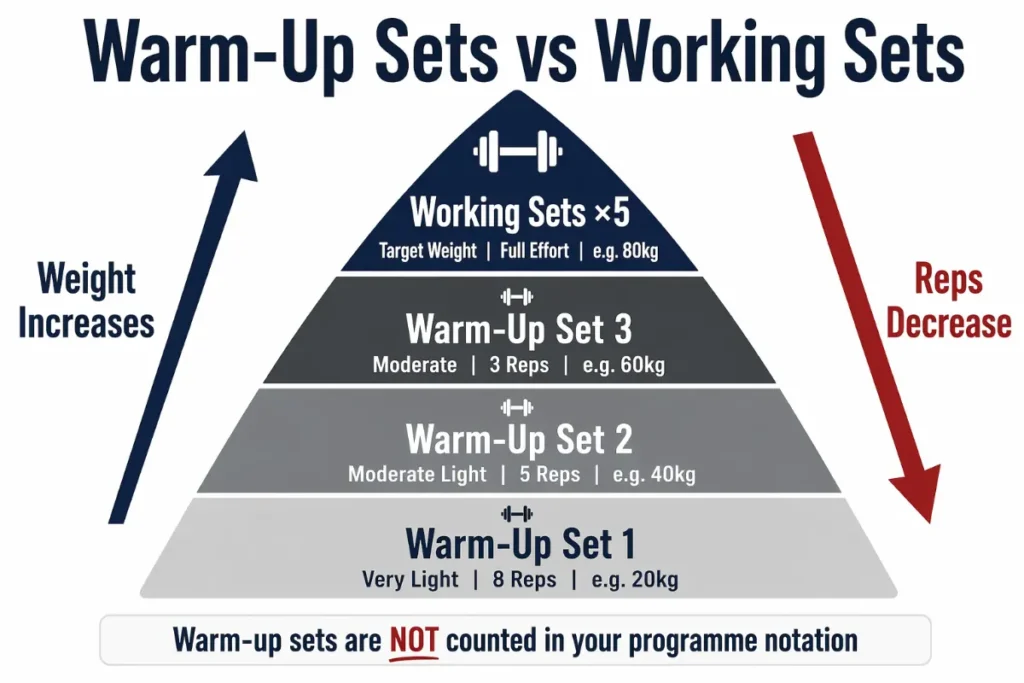
This trips up a lot of beginners. When your programme says 5×5, it does not mean five all-out sets from your very first rep.

Working sets are your actual training sets — the ones that count toward your programme notation, done at your target weight and effort level.

Warm-up sets are the sets you do before your working sets to prepare your joints, muscles, and nervous system. They use lighter weight and are not counted in your programme notation.

A practical example for Back Squat 5×5 at 80 kg:

  • Set 1 (warm-up): 20 kg × 8 reps
  • Set 2 (warm-up): 40 kg × 5 reps
  • Set 3 (warm-up): 60 kg × 3 reps
  • Sets 4–8 (working): 80 kg × 5 reps — this is your 5×5

Skipping warm-up sets on heavy compound lifts is one of the fastest ways to pick up an injury. Two to three progressively heavier warm-up sets is enough for most people.

Other Notation You’ll See in Workout Programmes

Once you know sets and reps, real programmes throw a few more symbols at you. Here’s what they mean:

A1 / A2 (Supersets) Letters next to exercises mean you do them back-to-back with no rest between them, only resting after both are done.

Example: A1. Bench Press 3×10 / A2. Barbell Row 3×10

This means: do a set of bench press, go straight into a set of rows, then rest. Repeat 3 times. It saves time and keeps intensity high by working opposing muscle groups together.

DS (Drop Set) After completing your working set, you immediately reduce the weight by 20–30% and keep going until near failure — no rest in between. Drop sets are an advanced technique for squeezing extra volume out of a single exercise, typically used on the last set only.

Example: Bicep Curl 3×12 + DS on the last set

AMRAP (As Many Reps As Possible) When a programme says AMRAP for a set, push that set close to failure while keeping good form. There’s no fixed rep target — you go until you can’t.

Example: Squat 3×8, last set AMRAP

This is commonly used on the final set to measure progress — if you hit 12 reps when the target was 8, you’re ready to add weight next session.

These aren’t things to overthink. You’ll encounter them as you progress, and now you know exactly what to do when you do.

How Each Scheme Compares — At a Glance

SchemePrimary GoalTypical Load (% 1RM)Rest Period
5×5Strength80–85%3–5 minutes
3×10Muscle growth65–75%60–90 seconds
4×12Muscle growth / volume60–70%60–90 seconds
3×20+Muscular endurance50–60%30–60 seconds

One point most programmes skip: the crossover between these ranges is larger than most people expect. A landmark 2017 meta-analysis by Schoenfeld et al., published in the Journal of Strength and Conditioning Research, found that meaningful muscle growth can occur across a rep range of roughly 5 to 30 — provided sets are taken close to muscular failure.

Strength gains, however, were significantly greater with heavier loading — which is exactly why 5×5 remains the go-to for raw strength. 5×5 builds some muscle. 3×10 builds some strength. The difference is emphasis, not exclusivity.

Which Scheme Is Right for Your Goal?

Strength: 5×5. Heavy compound lifts, low reps, long rest, consistent progressive loading.

Muscle size: 3×10 or 4×12. Moderate loads, moderate-to-high volume, shorter rest periods. Hypertrophy responds well to accumulated tension and metabolic stress. For a full breakdown of optimal volume and frequency for muscle growth, see our guide on how many reps and sets for muscle growth.

Fat loss: “Toning” is not a special training method — it means building muscle while reducing body fat. The same hypertrophy principles apply. 3×10 or 4×12 are strong choices. The diet does the fat loss work. For the full picture, our guide on reps and sets for fat loss covers exactly how to structure this.

Endurance: 15 to 20+ reps with lighter loads build muscular stamina. Useful for any sport that demands repeated muscular efforts. If this is your focus, our muscular endurance reps and sets guide goes much deeper.

Can you run both schemes together? Yes — and often you should. Opening a session with a compound movement at 5×5 for strength, then following with accessory work at 3×10 or 4×12 for hypertrophy, is called concurrent training. It develops strength and size in the same session without meaningfully compromising either.

How Many Sets Per Week Should You Do Per Muscle Group?

Knowing your rep scheme is one thing. Knowing how much total work to do per week is what actually determines whether you progress or plateau.

Research and the NSCA’s resistance training guidelines point to 10 to 20 sets per muscle group per week as the productive range for most people. Below 10, you’re likely leaving gains on the table. Above 20, recovery starts to suffer.

Practical starting points:

Experience LevelSets Per Muscle Group Per Week
Beginner10–12
Intermediate12–16
Advanced16–20

These numbers include all sets across all exercises that target that muscle group. If you do 3×10 on bench press and 3×10 on dumbbell flyes in the same session, that’s 6 sets for chest — count them all.

A Sample 3-Day Programme Using All Three Schemes

This is what concurrent training actually looks like in practice:

Sample 3-day training week using 5x5 strength focus on day 1, 3x10 hypertrophy on day 2, and 4x12 volume training on day 3

Day 1 — Strength Focus (5×5)

  • Back Squat: 5×5 @ 80–85% 1RM
  • Bench Press: 5×5 @ 80–85% 1RM
  • Barbell Row: 5×5 @ 80–85% 1RM
  • Rest: 3–5 minutes between sets

Day 2 — Hypertrophy Focus (3×10)

  • Romanian Deadlift: 3×10
  • Dumbbell Shoulder Press: 3×10
  • Lat Pulldown: 3×10
  • Dumbbell Bicep Curl: 3×10
  • Tricep Pushdown: 3×10
  • Rest: 60–90 seconds between sets

Day 3 — Volume Focus (4×12)

  • Leg Press: 4×12
  • Incline Dumbbell Press: 4×12
  • Cable Row: 4×12
  • Lateral Raise: 4×12
  • Rest: 60–90 seconds between sets

This isn’t a finished programme — it’s a structure that shows you how to combine all three schemes in one training week. Adjust exercises to match your gym setup and current ability.

How to Choose the Right Weight — RPE and RIR Explained

This is where most beginners go wrong. Either the weight is so light the last rep feels effortless, or it’s so heavy form collapses by set two.

The most practical loading tool is RPE — Rate of Perceived Exertion. On a 1–10 scale where 10 is absolute maximum effort:

  • 5×5: RPE 8–9. The final rep of your last set should be genuinely hard — form solid throughout, but a real fight.
  • 3×10 / 4×12: RPE 7–8. Last few reps require real effort — not a struggle, not comfortable.

A related tool is RIR — Reps in Reserve — simply the inverse: how many reps could you have done after stopping? For hypertrophy, finishing with 1 to 3 in reserve is the target.

Practical example: You’re doing 3×10 bicep curls. You finish set one feeling like you could easily do 6 more reps. That weight is too light — add 2.5 kg next set. If you finish set three and could only have done 1 more, that’s exactly where you want to be.

The American College of Sports Medicine’s Position Stand on Resistance Training recommends loads of 8–12 RM for novice hypertrophy training and 1–6 RM (80–85% 1RM) for strength — directly mapping to how 3×10 and 5×5 are loaded in practice.

How to Track Your Sets and Reps — and Why It Matters

Progressive overload only works when you remember what you lifted last time. Memory is not reliable enough — not across multiple exercises, multiple sets, over weeks of training.

The fix is simple: log every working set, every session. Write down the exercise, weight, and reps you actually completed. Before your next session, check what you did last time and know exactly what you’re trying to beat.

What to track at minimum:

  • Exercise name
  • Weight used
  • Reps completed per set
  • How it felt (RPE or a quick note like “felt easy” / “last set was a grind”)

A basic notepad works fine. So does your phone’s notes app. If you want something purpose-built, apps like Strong, Hevy, or RepCount are free, simple, and designed exactly for this — they store your history, show your previous weights automatically, and flag when you’re ready to progress.

Tracking isn’t just record-keeping. It’s how progressive overload actually happens in practice. Without it, you’re training by feel — and training by feel is how progress quietly stalls for months without you noticing.

When to Switch Rep Schemes — Periodization Basics

Most people find something that works and run it into the ground until progress stops. That’s not a strategy — that’s stagnation waiting to happen.

Periodization simply means intentionally cycling your training emphasis over time so your body keeps adapting.

A simple approach:

  • Weeks 1–4: Strength focus — 5×5 on compound lifts
  • Weeks 5–8: Hypertrophy focus — 3×10 or 4×12
  • Week 9: Deload — drop volume by 40–50%, keep movement quality sharp
  • Repeat — return to strength phase with slightly heavier loads

This kind of structured cycling produces better long-term results than staying in one rep range indefinitely. Your strength gains from weeks 1–4 give you a heavier base to use in your hypertrophy phase. Your hypertrophy gains give you more muscle to express strength through. The two phases feed each other.

How to Break a Plateau with Rep Range Manipulation

You’ve been doing 3×10 bench press for six weeks. The weight hasn’t moved. You’re not getting weaker — you’re just stuck.

Here’s a simple fix: change the stimulus, not the exercise.

  • Drop to 5×5 for 3–4 weeks. The heavier loading builds new strength. When you return to 3×10, you’ll be doing it with a weight that previously felt impossible.
  • Or go the other direction — try 4×15 with a lighter load. The higher volume creates a different kind of fatigue that can break a growth plateau even without adding weight.

Plateaus mean your body has fully adapted to its current stimulus. The rep scheme is one of the easiest variables to change — and often the most overlooked.

Can You Use These Schemes at Home with Dumbbells?

Yes — completely. All three notations apply directly to dumbbell and bodyweight training.

5×5 at home works well with goblet squats, dumbbell Romanian deadlifts, single-arm rows, and dumbbell floor press. One honest limitation: once you’re completing 5×5 with your heaviest dumbbells comfortably, you’ve outgrown the equipment, not the programme. At that point, a set of adjustable dumbbells or a barbell becomes a worthwhile investment.

3×10 and 4×12 at home are arguably better suited to dumbbells. Unilateral exercises — working one side at a time — add a balance and stability demand that compounds the training effect. A 3×10 of single-arm rows or Bulgarian split squats is demanding work even at moderate loads.

Rep Range Guidance for Women

Women are routinely handed the same rep scheme recommendations as men, with no acknowledgement that the physiology differs meaningfully.

Research consistently shows women recover faster between sets and sessions than men and tend to have greater muscular endurance relative to their maximum strength. Programmes favouring the upper end of the hypertrophy range — 4×12 up to 4×15 — often align particularly well with female physiology.

This doesn’t mean women shouldn’t train with 5×5. Many do with excellent results. But if you’re designing your own programme, don’t assume that what works optimally for a male lifter at 3×8 automatically applies to you. Higher rep ranges with moderate loads are a legitimate — and often superior — starting point.

Rep Range Guidance for Lifters Over 40

Strength training is one of the most well-evidenced investments you can make in long-term health, bone density, and functional independence as you age. But how you apply these schemes warrants more thought.

Near-maximal loading at high frequency places cumulative demand on joints, tendons, and the central nervous system — and the margin for error narrows with age. The NSCA’s Position Statement on Resistance Training for Older Adults specifically highlights that while heavy resistance training remains beneficial and safe for older adults, intensity and recovery must be managed more carefully than in younger populations. Their guidance supports moderate loads in the 8–15 rep range as the primary training zone, with heavy loading introduced progressively.

This doesn’t mean avoiding 5×5 entirely. It means managing it — sensible frequency, planned deload weeks, and a willingness to train at RPE 7 rather than pushing to RPE 9 every session. You can build meaningful, lasting strength at 3×12. You don’t need to chase a 5×5 personal record every week to make consistent progress.

What to Do When You Can’t Complete All Your Reps

This happens to everyone. You’re on set three of a 3×10, you hit 7 reps, form starts to break down, you stop. Here’s exactly what to do:

  • Consistently 2–3 reps short across most sets: Weight is too heavy. Drop 5–10% and rebuild from there.
  • Occasionally 1–2 reps short on the final set only: Rest slightly longer next session. Keep the weight.
  • All reps completed with energy clearly left over: Time to increase the load.

Progressive overload is the engine behind all of it — consistently giving your body a slightly harder challenge so it has a reason to keep adapting. For 5×5, add weight once all sets are completed cleanly — typically 2.5–5 kg per session early on. For 3×10 or 4×12, that can mean more weight, an extra rep, a shorter rest period, or an additional set.

The notation gives you the structure. Progressive overload gives that structure momentum.

Common Mistakes That Undermine Any Scheme

Ignoring rest periods. Rest is programming — it’s not optional. Cutting rest short on a 5×5 session directly undermines the strength adaptation you’re working toward. Use a timer.

Staying in one rep range indefinitely. Your body adapts to consistent stimulus. Cycling between strength-focused and hypertrophy-focused phases keeps adaptation happening and progress honest.

Loading based on ego, not effort. The number on the bar is irrelevant. A 5×5 at 60 kg with full intent and clean progression beats a sloppy 5×5 at 80 kg every single time.

Assuming more sets means more progress. Volume matters only up to the point your recovery can absorb it. More work produces results only when your body can actually recover from it.

Skipping warm-up sets on heavy lifts. Two to three progressively loaded warm-up sets before your working sets is non-negotiable for anything heavy. This alone prevents the majority of training injuries beginners pick up in their first few months.

Not tracking your sessions. If you don’t know what you lifted last week, you can’t beat it this week. No log means no reliable progressive overload — and no reliable progress.

Frequently Asked Questions

What does 3×10 mean in a workout?

Three sets of ten repetitions — perform the exercise 10 times, rest, then repeat twice more for 30 total reps. The first number is always sets, the second is always reps. It’s the most common notation in general fitness and the foundation of most hypertrophy programmes.

What does 4×12 mean in a workout?

Four sets of twelve repetitions — 48 total reps at around 60–70% of your maximum. A higher-volume hypertrophy scheme producing significant metabolic stress and muscle pump. Works best for isolation and accessory exercises later in a session.

What does 5×5 mean in a workout?

Five sets of five repetitions with heavy compound lifts at 80–85% of your 1 rep max. A classic strength protocol driving neurological adaptation and foundational muscle development. Rest periods of 3 to 5 minutes between sets are essential.

Is 3 sets of 10 enough to build muscle?

Yes — if you’re training close to failure and progressively increasing the challenge over time. 3×10 sits in the optimal hypertrophy range and is more than sufficient for most people, especially beginners and intermediates. The key is effort and consistency, not complexity.

Which is better — 5×5 or 3×10 for building muscle?

Both build muscle when sets are taken close to failure — confirmed by the Schoenfeld et al. 2017 meta-analysis. 5×5 prioritises strength and neural efficiency; 3×10 prioritises volume and metabolic stress. Cycling between both over time produces the best long-term results.

How long should I rest between sets?

For 5×5 (strength): 3–5 minutes. For 3×10 and 4×12 (hypertrophy): 60–90 seconds. Rest periods are not optional — they directly determine the quality of your next set.

Can I do 5×5 every day?

No — and you shouldn’t try. 5×5 on heavy compound lifts is neurologically and physically demanding. Most effective 5×5 programmes run three days per week with rest days between sessions. Daily heavy training without adequate recovery leads to stalled progress and increased injury risk.

What should I do if I can’t finish all my reps?

If you’re consistently 2–3 reps short across most sets, reduce the load by 5–10% and rebuild. If it’s only the final set by one or two reps, rest slightly longer and keep the weight. Consistent failure across all sets means the load needs adjusting — occasional short sets on the final set are completely normal.

What does AMRAP mean in a workout?

AMRAP stands for As Many Reps As Possible. When a programme says AMRAP on the last set, push it close to failure while keeping good form. No fixed rep target — you go until you genuinely can’t continue with clean technique. It’s often used to measure readiness to increase weight.

What does a superset (A1/A2) mean?

Letters like A1 and A2 next to exercises mean you perform them back-to-back with no rest between them, only resting after both are done. It saves time and keeps intensity high. A1/A2/A3 is a triset — three exercises done consecutively before resting.

What is progressive overload and why does it matter?

Progressive overload means consistently giving your body a slightly harder challenge so it keeps adapting. Without it, any scheme eventually stops producing results. For 5×5, add weight once all sets are completed cleanly. For 3×10 or 4×12, increase weight, reps, sets, or reduce rest time.

Conclusion

You now know what the numbers mean and what to do with them. Pick the scheme that matches your current goal, load it with honest effort, respect the rest periods, and give your body a consistent reason to keep adapting.

The rep notation is your structure. The sample programme above gives you a starting point. Tracking your sessions turns intention into actual progress. Progressive overload gives it all momentum.

What actually determines your results is how seriously you apply it — session after session, week after week.

Sources: Schoenfeld BJ et al. (2017). Strength and Hypertrophy Adaptations Between Low- vs. High-Load Resistance Training. Journal of Strength and Conditioning Research. PubMed American College of Sports Medicine Position Stand on Resistance Training. ACSM NSCA Position Statement on Resistance Training for Older Adults. NSCA

Beginner Workout Rep Ranges Reps and Sets Weight Training Workout Guide
Share. Facebook Twitter Pinterest LinkedIn Reddit Email
Previous ArticleHow Many Reps and Sets for Muscular Endurance? Beginner to Advanced Guide
Sadia Baloch
  • Instagram

Sadia Baloch is a passionate fitness trainer and gym enthusiast with years of personal experience in the gym. She has honed her skills in strength training, weight loss, and muscle building, using her knowledge to guide others in their fitness journeys. Sadia is dedicated to helping people achieve their goals through practical, effective workout routines that combine functional training, cardio, and weight lifting.

Related Posts

How Many Reps and Sets for Muscular Endurance? Beginner to Advanced Guide

April 9, 2026

How Many Reps & Sets for Fat Loss? My 12-Week Experience

April 8, 2026

How Many Reps and Sets for Muscle Growth? Complete Hypertrophy Guide

April 6, 2026

Warm-Up Sets vs Working Sets – What’s the Difference? Complete Guide

April 5, 2026
Add A Comment
Leave A Reply Cancel Reply

Don't Miss

What Does 3×10, 4×12, or 5×5 Mean in a Workout? (Complete Guide)

April 10, 2026

How Many Reps and Sets for Muscular Endurance? Beginner to Advanced Guide

April 9, 2026

How Many Reps & Sets for Fat Loss? My 12-Week Experience

April 8, 2026

Subscribe to Updates

Get the latest creative news from SmartMag about art & design.

Facebook Instagram TikTok
  • Contact Us
  • About Us
  • Authors
  • Disclaimer
  • Privacy Policy
© 2026 Exercise Menu. Designed by Rank It Globally.

Type above and press Enter to search. Press Esc to cancel.

Sign In or Register

Welcome Back!

Login to your account below.

Lost password?