


Walk into any gym and you’ll see it: someone loads the bar, does one or two half-hearted light sets, then grinds through what feels like a brutally heavy first rep. They’re not weak — they just skipped their warm-up sets, or did them wrong.
If your first working set consistently feels harder than it should, this is likely why.
- Quick Answer
- What Is a Warm-Up Set?
- What About the Empty Bar?
- Why Heavier Warm-Ups Work Better
- What Is a Working Set?
- General Warm-Up vs Specific Warm-Up
- How Many Warm-Up Sets Do You Need?
- How to Structure Warm-Up Sets
- Over-Warming Up
- The Implied Sets Problem
- What If You Don't Know Your Working Weight?
- Autoregulation
- Log Working Sets Only
- Frequently Asked Questions
Quick Answer
- A warm-up set is a lighter, submaximal set done before your working weight. Its job is to prepare your body — joints, muscles, nervous system — for the load ahead. It doesn’t count toward training volume.
- A working set is done at your actual training weight. This is where strength and muscle growth are built, and it’s what you track.
- Any set at or above roughly 85–90% of your session’s top weight counts as a working set.
What Is a Warm-Up Set?
A warm-up set is preparation, not training. The weight is lighter, the reps are deliberate, and the effort stays well below what your working sets will demand.
When you ramp up with progressively heavier sets before your working weight, you’re greasing the groove — reinforcing the movement pattern under load, raising your core temperature, and priming the motor pathways your nervous system relies on when the weight gets heavy.
Cold muscle tissue and an unactivated nervous system don’t produce force efficiently. That’s the real reason your first set feels terrible when you skip warm-ups.
A simple ramp-up structure for a compound lift:
| Set | Load | Reps |
|---|---|---|
| 1 | ~50% of working weight | 5 |
| 2 | ~70% of working weight | 3–4 |
| 3 | ~85% of working weight | 2 |
| — | Working sets begin | — |
If any of these sets leaves you winded or your muscles feel genuinely worked, you’re spending energy that belongs to your working sets.
What About the Empty Bar?
Starting with an empty barbell is useful for checking your mechanics, but it’s not real preparation. For anyone lifting meaningful weight, 20 kg is under 25% of a typical working load — not enough to prepare connective tissue, synovial fluid, or the nervous system for what’s coming.
Use the empty bar as a movement check if you want one. Your first loaded warm-up set starts at 50% of your working weight.
Why Heavier Warm-Ups Work Better
Not all warm-up approaches produce the same result.
A study comparing warm-up intensities of 40%, 60%, and 80% of 10-rep max found the 80% protocol produced significantly greater total training volume on subsequent working sets than both lighter conditions — across bench press, incline leg press, and lat pulldown.
The reason is post-activation potentiation (PAP): a heavy submaximal set temporarily increases neuromuscular force output, priming your motor units for the work ahead. A warm-up set close to your working load does far more for your first working set than one that barely resembles the effort to come.
What Is a Working Set?
A working set is performed at your target weight and effort level — heavy enough that your body has a real reason to adapt.
By training goal:
- Strength: 1–5 reps, RPE 7–9 (1–3 reps in reserve)
- Hypertrophy: 6–12 reps, RPE 7–8
- General fitness: 5–10 challenging reps
The dividing line between a warm-up set and a working set isn’t just a percentage. It’s whether the set is hard enough to force adaptation. Anything below roughly 85% of your session’s heaviest weight, taken well short of failure, is still preparation — not training.
Working sets are what you track and apply progressive overload to. If you’re still figuring out how reps and sets drive results, that’s the foundation to understand first.
General Warm-Up vs Specific Warm-Up
Most people do one of these and think they’ve done both.
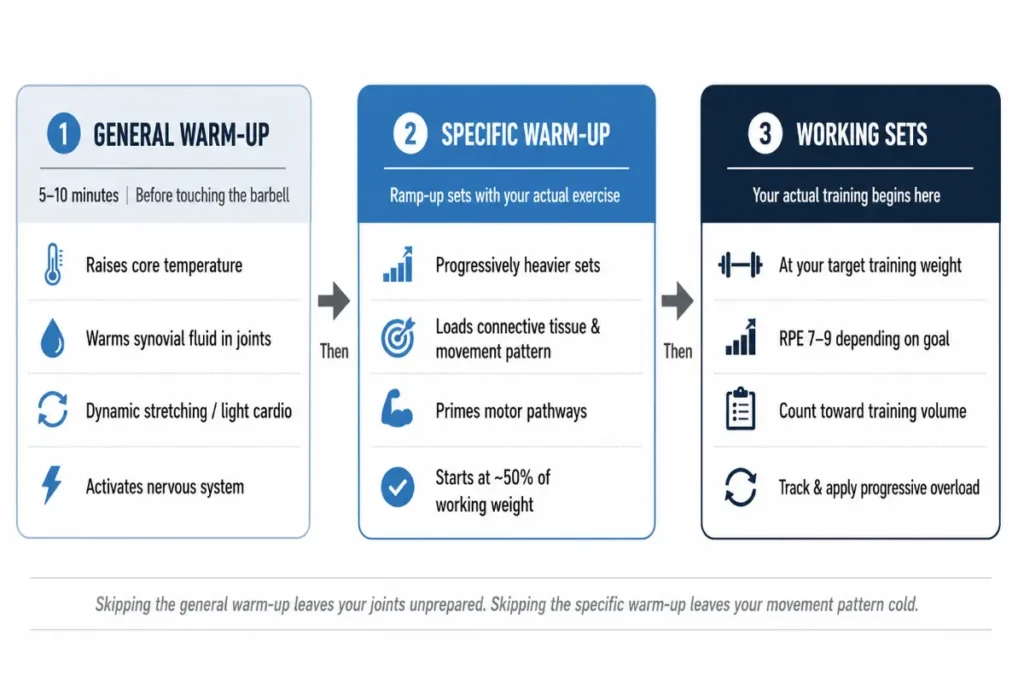
General warm-up happens before you touch a barbell — 5 to 10 minutes of light cardio, dynamic stretching, or mobility work. It raises core temperature, improves muscle elasticity, warms the synovial fluid that lubricates your joints, and gets your nervous system ready. This comes first.
Specific warm-up is your ramp-up sets with the actual exercise you’re training — the progressively heavier sets that load your muscles, connective tissue, and movement pattern specifically for what’s coming. This comes second.
Then your working sets begin.
Skipping the general warm-up leaves your joints unprepared. Skipping the specific warm-up leaves your movement pattern cold.
How Many Warm-Up Sets Do You Need?
Your working weight, rep range, and where the exercise falls in your session all affect the answer.
By training goal:
| Goal | Rep Range | Warm-Up Sets |
|---|---|---|
| Strength | 1–5 | 3–5 |
| Hypertrophy | 6–12 | 2–3 |
| Higher reps | 12+ | 0–1 |
| Isolation exercises (later in session) | Any | Usually none |
By exercise order:
Your first compound lift of the session needs the most preparation. Exercises that follow — especially those using the same muscle group — need little to none. Your body is already warm, progressive fiber recruitment has already begun, and the movement patterns are already active.
If the second exercise targets a completely different muscle group, one or two light sets make sense. Squats followed by bench press is a clear example — different muscles, different pattern, brief ramp-up is worth it.
Cold environment: Training in a cold garage or unheated gym requires extra preparation time. Cold tissue takes longer to respond, and your joints will confirm this on the first set if you skip it.
How to Structure Warm-Up Sets
Reduce reps as weight increases. The goal is reaching your working weight without accumulated fatigue — sets get shorter as they get heavier.
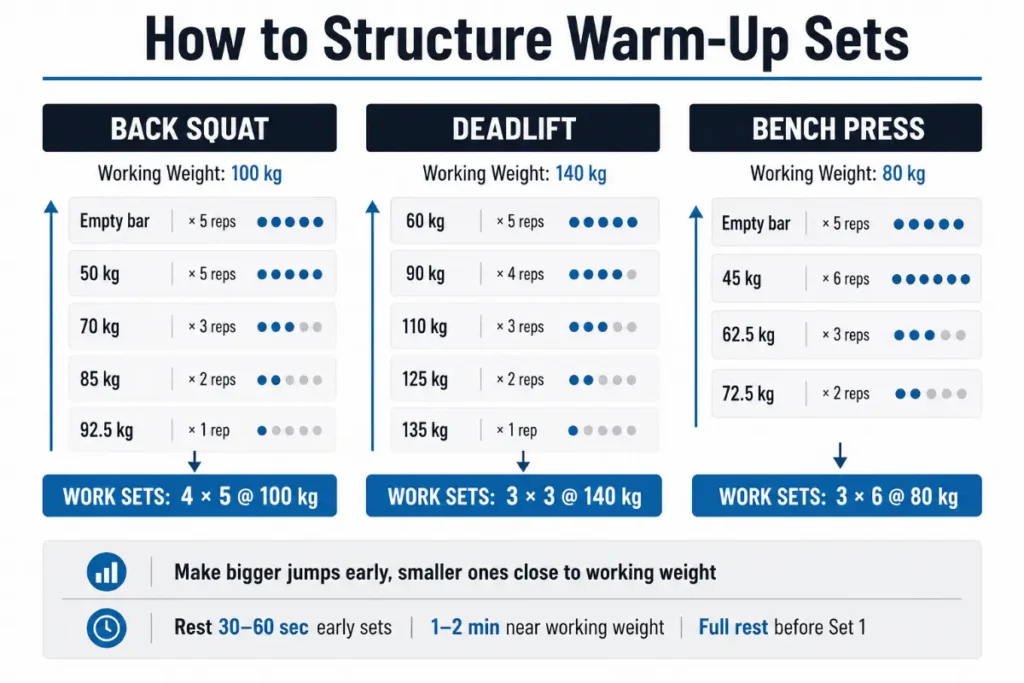
Back Squat — Working Weight: 100 kg
- Empty bar × 5
- 50 kg × 5
- 70 kg × 3
- 85 kg × 2
- 92.5 kg × 1
- Work sets: 4 × 5 @ 100 kg
Deadlift — Working Weight: 140 kg
- 60 kg × 5
- 90 kg × 4
- 110 kg × 3
- 125 kg × 2
- 135 kg × 1
- Work sets: 3 × 3
Bench Press — Working Weight: 80 kg
- Empty bar × 5
- 45 kg × 6
- 62.5 kg × 3
- 72.5 kg × 2
- Work sets: 3 × 6
On weight jumps: make larger jumps early, smaller ones as you close in on your working weight. The final warm-up set should feel close — not equal — to what’s coming.
On rest: 30–60 seconds between early sets is enough. Extend to 1–2 minutes as the weight climbs. Before your first working set, take a full rest.
Over-Warming Up
Every article covers skipping warm-ups. Almost none address doing too many.
If your first working set feels heavier than expected, bar speed is already slow, and your muscles feel worked before real training even begins — the warm-up is the problem, not your strength.
The signs: RPE on your first working set is higher than your target, you feel muscular fatigue before working sets, performance drops faster than usual across the session.
The fix: fewer sets, smaller jumps to working weight, and make sure reps are coming down as weight goes up.
The Implied Sets Problem
Most programs are written like this:
Back Squat: 3 × 5
Bench Press: 3 × 5
Deadlift: 1 × 5
That means 3 working sets of 5. Warm-up sets are implied but never written out — they depend on your working weight and how your body responds that day, which no program can specify in advance.
The most common beginner mistake is treating the first set as the working set. It isn’t. The program tells you what counts toward your training. Your warm-up is what gets you ready to do that.
A rough formula: subtract the bar weight from your working weight, divide by four. That gives you your approximate jump increment per warm-up set.
What If You Don’t Know Your Working Weight?
Use the warm-up sets to find it. Start around 50% of what you think you can handle and work up honestly. The weight where reps feel demanding but form stays solid — where you’re working but not grinding — is your working weight for that session.
Autoregulation
Autoregulation means using what your warm-up sets show you to decide your working weight, rather than following a number you wrote down regardless of how you’re actually feeling.
Some sessions the bar moves fast. Others, 70% feels like 90%. If warm-ups feel heavier than usual, drop the working weight 5–10% and train from there. If everything moves well, push slightly above your plan.
Sleep, nutrition, accumulated fatigue, and recovery all shift your capacity from session to session. Your warm-up sets surface that before you’re committed to a weight. Ignoring it and grinding through anyway doesn’t make you tougher — it just produces worse sessions and slower progress.
Log Working Sets Only
Warm-up sets don’t count toward training volume. Only working sets do.
If your log shows 6 bench press sets and 3 were warm-ups, you did 3 working sets — not 6. Logging warm-ups inflates your volume numbers and makes it impossible to accurately track whether you’re progressing week to week.
Frequently Asked Questions
What is the difference between a warm-up set and a working set?
A warm-up set prepares your body using lighter weight. A working set uses your actual training load and drives muscle and strength gains.
Do warm-up sets count toward training volume?
No. Volume is calculated from working sets only.
How many warm-up sets do I need?
Between 2 and 5. Heavier loads and lower rep ranges need more. Isolation exercises done later in a session usually need none.
Should I do warm-up sets for every exercise?
Mainly just the first compound lift. Later exercises that use the same muscle groups usually don’t need them.
What RPE should warm-up sets be?
RPE 4–6. Well below failure.
Can I skip warm-up sets?
On lighter or high-rep work, yes. Before heavy compound lifts, skipping them consistently degrades performance and stresses your joints unnecessarily
What is autoregulation?
Using how your warm-up sets feel to decide your working weight for that session, rather than following a fixed number regardless of your readiness that day.
Are warm-up set percentages fixed?
No — they’re starting points. Your working weight, experience, the specific lift, and how you’re responding that day all affect what’s right for you.

2 Comments
Pingback: Time Under Tension: Rep Tempo Guide for Muscle Growth
Pingback: How to Warm Up Before a Workout: 3 Phase Guide