


| Quick Answer: For muscle growth, aim for 6–12 reps per set, 10–20 sets per muscle per week, training each muscle 2–3 times per week, with 60–120 seconds rest between sets. This combination is consistently supported by peer-reviewed research and produces the best hypertrophy results for most people. |
Most people who train consistently but don’t see muscle growth are not failing because of a lack of effort. They’re failing because they don’t understand how to structure their training. The right number of reps and sets determines how much stimulus your muscles receive — and whether that stimulus is enough to cause growth.
This guide gives you clear, research-backed numbers and practical guidance so you can finally make consistent, visible progress.
- Who Is This Guide For?
- What Actually Causes Muscle Growth?
- What Is the Best Rep Range for Muscle Growth?
- Rep Range Comparison: A Visual Breakdown
- How Many Sets Per Muscle for Maximum Growth?
- Weekly Volume Guide by Muscle Group
- How Often Should You Train Each Muscle?
- Progressive Overload: The Non-Negotiable Rule
- How Long Should You Rest Between Sets?
- How to Structure Your Training Program?
- Nutrition: What You Eat Is Just as Important
- Recovery: Where Muscle Growth Actually Happens
- Common Hypertrophy Mistakes to Avoid
- My Personal Experience
- How to Break Through a Plateau?
- How Long Does It Take to See Results?
- Frequently Asked Questions
- Summary: Your Action Plan
Who Is This Guide For?
This guide is designed for:
- Beginners who don’t know where to start
- Intermediate lifters stuck at the same weights for months
- Anyone training regularly but not seeing visible muscle growth
What Actually Causes Muscle Growth?
Muscle growth — or hypertrophy — happens when your training creates enough stress that your body is forced to adapt by building bigger, stronger muscle fibers. Three main factors drive this:
1. Mechanical Tension
This is the most important driver. When you lift a weight through a full range of motion with control, your muscle fibers generate force against resistance. This tension signals your body to grow. Higher loads and slower, controlled reps increase mechanical tension significantly.
2. Metabolic Stress
The burning sensation during high-rep sets is metabolic stress — a buildup of metabolic byproducts like lactate. Research suggests this also triggers growth-promoting hormones and cellular signals that contribute to hypertrophy.
3. Muscle Damage
Resistance training creates micro-tears in muscle fibers — particularly during the lowering (eccentric) phase. Your body repairs these tears and makes the fibers thicker and stronger during recovery.
| Key Insight: All three drivers matter, but mechanical tension is considered primary. A 2010 review by Brad Schoenfeld, published in the Journal of Strength and Conditioning Research, identified these three mechanisms as the foundation of hypertrophy training. |
What Is the Best Rep Range for Muscle Growth?
The 6–12 rep range is widely considered the hypertrophy sweet spot. This corresponds to lifting about 65–80% of your one-rep maximum (1RM). At this load and rep range, you create significant mechanical tension while also accumulating enough metabolic stress to drive growth.
That said, muscle can be built across a broader range. A 2017 study by Schoenfeld et al. found that both low-rep (3 sets of 2–4 reps) and high-rep (3 sets of 20–25 reps) training produced similar muscle growth — as long as sets were taken close to failure. The key variable is effort, not just rep count.
Practical rep range guide:
- Best for building pure strength. Some muscle growth, but not optimal.
- Best balance of tension and volume for hypertrophy.
- Can build muscle effectively when taken close to failure. Good for variety or joint-friendly options.
To get the most out of this table, you first need to understand What Are Reps and Sets? A Complete Beginner’s Guide — and how they work together to drive muscle growth.
Rep Range Comparison: A Visual Breakdown
Use this table to match your training goal with the right rep range, load, and rest period:
| Rep Range | Load (% 1RM) | Primary Goal | Sets/Week | Rest Time |
| 1–5 reps | 85–100% 1RM | Pure Strength | Low (3–5 sets) | 3–5 min |
| 6–12 reps | 65–80% 1RM | Muscle Growth | Moderate (3–5 sets) | 60–120 sec |
| 13–20 reps | 50–65% 1RM | Endurance + Size | Moderate-High | 30–60 sec |
| 20–30 reps | 40–50% 1RM | Endurance | High (4–6 sets) | 30 sec |
Note: 1RM = one-rep maximum. These are general guidelines — individual response may vary.
How Many Sets Per Muscle for Maximum Growth?
Volume — the total number of sets you perform per muscle per week — is one of the most studied variables in hypertrophy research.
The effective volume range
Most people need at least 10 sets per muscle per week to see meaningful growth. Research supports a range of 10–20 sets per week for most muscle groups. Beyond 20 sets, recovery becomes difficult and gains start to diminish.
- Around 10 sets per week — enough to trigger growth in most people.
- 12–16 sets per week for most muscle groups.
- Around 20+ sets per week — only suitable for advanced lifters with excellent recovery.
Start lower, build up
A common mistake is jumping straight to high volume. If your muscles are not used to 15–20 sets per week, you’ll just be sore and fatigued — not growing. Start at the lower end (8–10 sets per week) and add volume gradually every 3–4 weeks.
Weekly Volume Guide by Muscle Group
| Muscle Group | General Range | Beginner | Advanced |
| Chest | 10–20 sets | 8–12 sets | 15–20 sets |
| Back | 10–20 sets | 10–14 sets | 16–22 sets |
| Shoulders | 8–16 sets | 6–10 sets | 12–20 sets |
| Biceps | 8–14 sets | 6–8 sets | 10–16 sets |
| Triceps | 8–14 sets | 6–8 sets | 10–18 sets |
| Quads / Hamstrings | 12–20 sets | 10–14 sets | 16–22 sets |
| Glutes | 10–16 sets | 8–12 sets | 14–20 sets |
| Calves | 8–16 sets | 6–8 sets | 12–18 sets |
These ranges are based on current hypertrophy research. Adjust based on your recovery, training age, and how your body responds.
How Often Should You Train Each Muscle?
Frequency refers to how many times per week you train a specific muscle group. Research consistently shows that training each muscle 2–3 times per week produces better growth than once-weekly training — because muscle protein synthesis (the repair and growth process) typically peaks and returns to baseline within 48–72 hours after training.
Frequency options:
- Best for beginners. Each muscle is hit three times per week with moderate volume each session.
- A good intermediate option. Upper body and lower body alternate.
- Best for intermediate to advanced lifters. Each muscle group is trained twice per week.
- Each muscle once per week — the least effective for hypertrophy according to research.
Progressive Overload: The Non-Negotiable Rule
No matter how many sets and reps you do, if you’re not progressively overloading your muscles over time, you will stop growing. Progressive overload means gradually increasing the demand on your muscles — so they keep being forced to adapt.
How to apply progressive overload:
- When you can complete all reps with good form, increase the load by 2.5–5 kg.
- If you can’t add weight, add 1–2 reps to your sets.
- Increase weekly volume by one set per muscle every 1–2 weeks.
- Better range of motion and control increases mechanical tension even at the same weight.
| Why This Matters: Many people stop seeing progress not because their program is wrong — but because they’ve been doing the same weights and reps for weeks without tracking progress. Write down every session. If you aren’t beating last week’s numbers in some way, you aren’t overloading your muscles. |
How Long Should You Rest Between Sets?
Rest time affects how much you recover before the next set — which directly influences your ability to maintain quality reps throughout a workout.
- Best for metabolic stress and pump. Common in circuit-style training.
- The hypertrophy sweet spot. Enough recovery to maintain performance while keeping metabolic stress elevated.
- Best for heavy compound lifts where full recovery is needed to maintain strength.
A 2016 study by Schoenfeld et al. in the Journal of Strength and Conditioning Research found that longer rest periods (3 minutes vs. 1 minute) produced significantly greater muscle and strength gains — largely because lifters could maintain performance across all sets.
How to Structure Your Training Program?
For beginners (0–1 year of training)
Full body training, 3 days per week:
- 2–3 sets per exercise
- 6–8 exercises per session
- 8–12 reps per set
- Focus on compound movements: squat, deadlift, bench press, overhead press, rows
- Rest: 90–120 seconds between sets
For a complete breakdown of beginner-specific training, read our detailed guide on How Many Reps and Sets Should a Beginner Do?
For intermediate lifters (1–3 years of training)
Upper/Lower split or Push/Pull/Legs, 4–5 days per week:
- 3–4 sets per exercise
- Mix of compound and isolation exercises
- Rep range varies: 6–8 on compounds, 10–15 on isolations
- Aim for 12–16 sets per muscle per week
Best exercises for hypertrophy
Compound movements (hit multiple muscles, allow heavier loads):
- Chest: Bench press, incline dumbbell press
- Back: Pull-ups, barbell rows, cable rows
- Legs: Squat, Romanian deadlift, leg press
- Shoulders: Overhead press, Arnold press
Isolation movements (target specific muscles):
- Biceps: Barbell curl, incline dumbbell curl
- Triceps: Skull crushers, cable pushdowns
- Shoulders: Lateral raises, face pulls
- Legs: Leg extensions, hamstring curls
Nutrition: What You Eat Is Just as Important
Training without proper nutrition is like building a house without materials. Your muscles need both the signal (training) and the resources (food) to grow.
Protein intake
Protein is the most critical macronutrient for muscle growth. Research supports a daily intake of 1.6–2.2 grams per kilogram of body weight. For a 75 kg person, that’s roughly 120–165 grams of protein per day. Spreading this across 3–4 meals helps maximize muscle protein synthesis throughout the day.
Calories
You need to be in a slight caloric surplus to build muscle efficiently — roughly 200–300 calories above your maintenance level. This gives your body the energy to support growth without excessive fat gain. If you’re a beginner, you can build muscle even at maintenance calories (body recomposition).
Supplements
Most supplements are unnecessary if your diet is in order. Two have strong evidence:
- The most studied supplement in sports science. 3–5 grams daily consistently improves strength and muscle growth.
- A convenient way to hit your daily protein target — not magic, just food.
Recovery: Where Muscle Growth Actually Happens
Muscle does not grow during training — it grows during recovery. Training creates the stimulus; rest, sleep, and nutrition create the response.
- Aim for 7–9 hours per night. Growth hormone secretion peaks during deep sleep, and sleep deprivation has been shown to significantly reduce muscle protein synthesis.
- Every 4–8 weeks, reduce your training volume by 40–50% for one week. This allows accumulated fatigue to clear and often results in a strength jump the following week.
- Light walking, stretching, or mobility work on rest days promotes blood flow and reduces soreness without adding stress.
Common Hypertrophy Mistakes to Avoid

Not tracking workouts
If you’re not writing down your sets, reps, and weights, progressive overload becomes guesswork. Use a notebook or an app — it takes 30 seconds per set and makes a significant difference in long-term progress.
Changing programs too often
Every new program looks better than the one you’re currently on. But results come from consistent execution over 6–12 weeks, not program-hopping. Stick with a program long enough to actually see results.
Ignoring compound movements
Isolation exercises have their place, but if your program is built primarily around curls and lateral raises, you’re leaving a lot of growth potential on the table. Compound lifts allow heavier loads and stimulate more total muscle mass per movement.
Skipping warm-ups
A proper warm-up — 5–10 minutes of light cardio followed by 2–3 warm-up sets at reduced weight — improves performance, activates target muscles, and reduces injury risk.
Understanding the difference between Warm-Up Sets vs Working Sets is essential before you start counting your weekly volume — because warm-up sets are NOT counted in your 10–20 sets per week.
Poor sleep and nutrition
Many lifters focus entirely on the training side and ignore recovery. You can have the perfect program, but if you’re sleeping 5 hours and eating too little protein, results will be minimal.
My Personal Experience
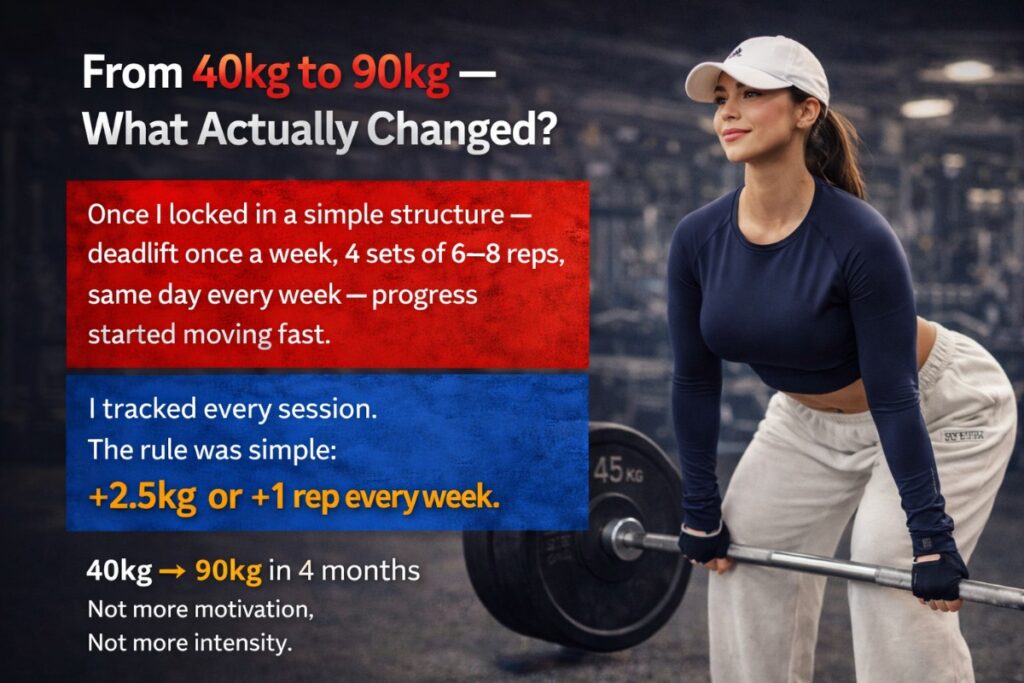
Once I actually locked in a structure — deadlift once a week, 4 sets of 6 to 8 reps, same day every week — things started moving fast. I tracked every single session. The rule was simple: add 2.5kg or one extra rep compared to last week. That’s it.
Within the first couple of months I hit 60kg. Felt like a big deal at the time. Then I kept going — same structure, same rule — and four months in I pulled 90kg.
40kg to 90kg in four months. Not because I trained harder. Because I finally trained with a plan. That one lesson — structure beats effort — is the reason I became so obsessed with understanding how reps, sets, and volume actually work. Everything in this guide comes from that experience.
How to Break Through a Plateau?
Progress will slow or stall at some point — this is normal. Before blaming your program, check these four factors:
- Review your training logs. Many people feel like they’re working hard but have been lifting the same weights for months.
- If you’ve been doing 10 sets per week for months, try increasing to 14–16 sets.
- If you’re training each muscle once per week, switch to twice per week.
- Poor sleep or undereating will stall muscle growth regardless of how well-designed your program is.
How Long Does It Take to See Results?
Beginners typically notice strength improvements within 2–4 weeks and visible muscle changes within 6–8 weeks of consistent training. These early gains are partly neurological (your nervous system learning to use your muscles more efficiently) and partly actual muscle tissue growth.
Progress slows as you become more advanced. A beginner might gain 1–2 kg of muscle per month, while an intermediate lifter might gain 0.5 kg per month. This is normal — it reflects how close you are to your genetic potential.
Frequently Asked Questions
What is the best rep range for muscle growth?
The 6–12 rep range is the most effective for hypertrophy in most people, because it combines high mechanical tension with moderate metabolic stress. However, research by Schoenfeld et al. (2017) confirms that rep ranges from 5 to 30 can build muscle effectively when sets are taken close to failure.
How many sets per muscle per week should I do?
For most people, 10–20 sets per muscle per week is the effective range. Beginners should start at 8–10 sets and add volume gradually over several weeks. Doing too much too soon leads to excessive soreness and impaired recovery rather than faster growth.
Should I train to failure?
Not on every set. Training to failure is useful occasionally — particularly on the last set of an exercise — but doing it every set increases injury risk and impairs recovery. A better approach is to stop 1–2 reps before failure (called RIR — reps in reserve) on most sets.
How much protein do I need to build muscle?
Current research supports 1.6–2.2 grams of protein per kilogram of body weight per day. Consuming more than this provides no additional muscle-building benefit.
Can women follow the same program as men?
Yes. The fundamental principles of hypertrophy — rep ranges, volume, progressive overload, recovery — are the same for men and women. Women may recover faster between sessions and can often handle slightly higher volume. Hormonal differences affect the rate of muscle gain, but not the training principles themselves.
What is the difference between strength training and hypertrophy training?
Strength training uses heavier loads (85–100% 1RM), lower reps (1–5), longer rest periods (3–5 min), and fewer total sets. Hypertrophy training uses moderate loads (65–80% 1RM), moderate reps (6–12), moderate rest (60–120 sec), and higher weekly volume. The two can and should be combined in a well-designed program.
Is cardio bad for muscle growth?
Moderate cardio (2–3 sessions per week of 20–30 minutes) does not significantly interfere with muscle growth. Excessive cardio — particularly long-distance running or cycling — can compete with recovery resources. If muscle growth is your primary goal, keep cardio moderate and ensure your calorie intake accounts for the additional energy expenditure.
Summary: Your Action Plan
Here is what to focus on starting from today:
- Train each muscle 2–3 times per week.
- Keep most of your sets in the 6–12 rep range, and vary occasionally with heavier or lighter work.
- Aim for 10–20 sets per muscle per week. Start at the lower end and build gradually.
- Apply progressive overload every week — add weight, reps, or sets.
- Rest 60–120 seconds between hypertrophy sets.
- Eat 1.6–2.2 g protein/kg/day and maintain a slight caloric surplus.
- Sleep 7–9 hours per night.
- Track every session. If you can’t see progress, you can’t manage it.
Follow these principles consistently for 8–12 weeks, and you will see results. Muscle growth is not complicated — but it does require patience and consistency.
