
Key Takeaways
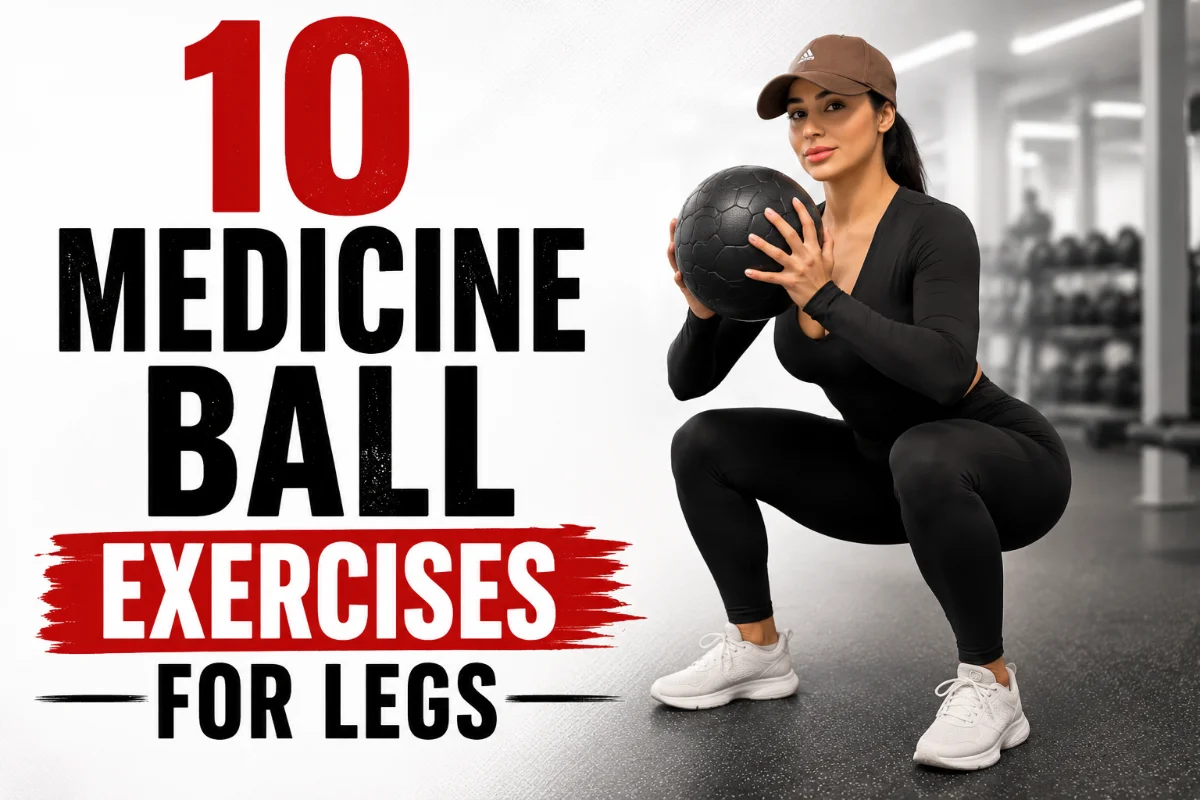
- These 10 exercises target every major leg muscle — quads, hamstrings, glutes, calves, adductors, and abductors.
- Each exercise includes step-by-step instructions, the most common mistake, and sets and reps by goal.
- Beginners: start with 4–6 kg. Intermediate: 6–10 kg. If form breaks, the ball is too heavy.
- A ready-to-use 30-minute leg workout is at the bottom — warm-up to cool-down, structured and timed.
- These exercises work at home or in the gym. All you need is the ball.
Below are 10 exercises that work every major muscle in the lower body — quads, hamstrings, glutes, and calves. Each one has step-by-step instructions, the mistake most people make, and sets and reps by goal. For the complete medicine ball training cluster covering every muscle group, the medicine ball exercises guide covers arms, back, chest, shoulders, abs, and more.”
Pick the right ball weight first
Wrong weight = broken form = no results.
| Level | Weight | How to check |
|---|---|---|
| Beginner | 4–6 kg (8–13 lb) | 12 squats with a straight back and no wobble |
| Intermediate | 6–10 kg (13–22 lb) | 10 reverse lunges with a neutral spine throughout |
| Advanced | 10–14 kg (22–31 lb) | Jump squat landing with bent knees and zero knee cave |
New to medicine ball training? Start with the medicine ball exercises for beginners guide first.
One rule: if the lower back rounds on the first rep of a deadlift, drop the weight. No exceptions.
Medicine ball vs slam ball: Medicine balls bounce. Slam balls do not. Wall ball and jump squats in this list need a standard medicine ball. A slam ball works for squats, lunges, glute bridges, and hip thrusts.
10 Medicine Ball Exercises for Legs
1. Medicine Ball Squat
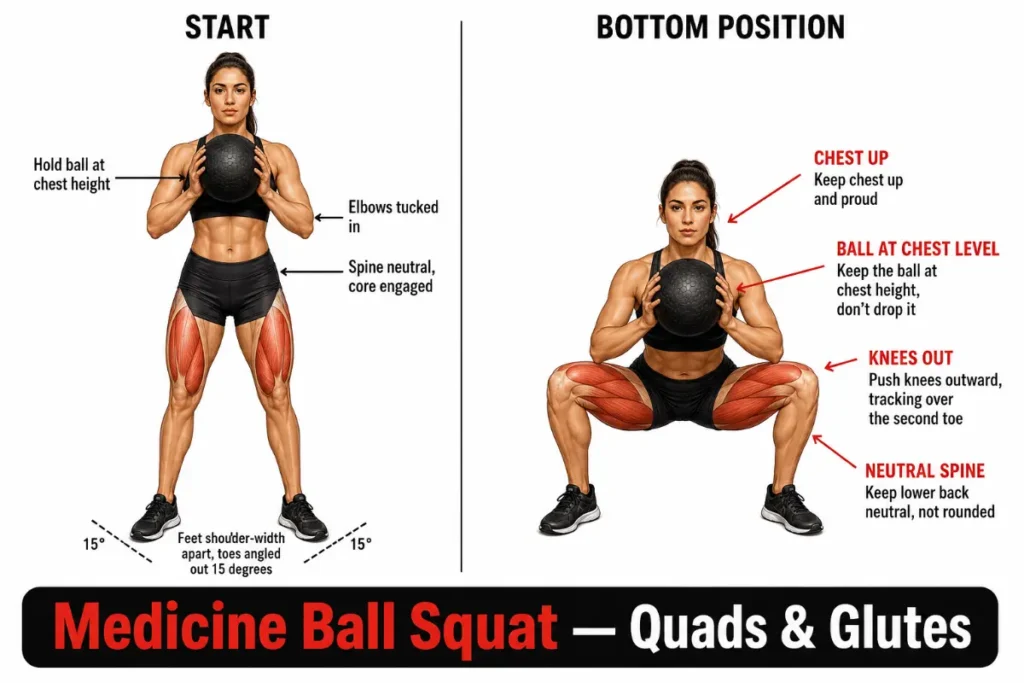
Targets: Quadriceps, Glutes | Also works: Hamstrings, Core, Calves | Pattern: Squat
Stand with feet shoulder-width apart, toes turned out 15–20 degrees. Hold the ball at chest height, elbows tucked. Push hips back, bend knees, lower until thighs are parallel. Press through heels to stand. Chest up, ball steady throughout.
Sets and reps:
| Goal | Sets | Reps |
|---|---|---|
| Strength | 4 | 5–6 |
| Muscle | 3–4 | 8–12 |
| Endurance | 3 | 15–20 |
Most common mistake: Knees caving inward. Check ball weight first — nine times out of ten, dropping the weight fixes the tracking. Push knees outward to line up with the second toe, every rep.
Why this works: Holding the ball at chest level shifts weight slightly forward, putting more load directly on the quads compared to a barbell back squat. More quad work, zero spinal compression.
2. Medicine Ball Reverse Lunge
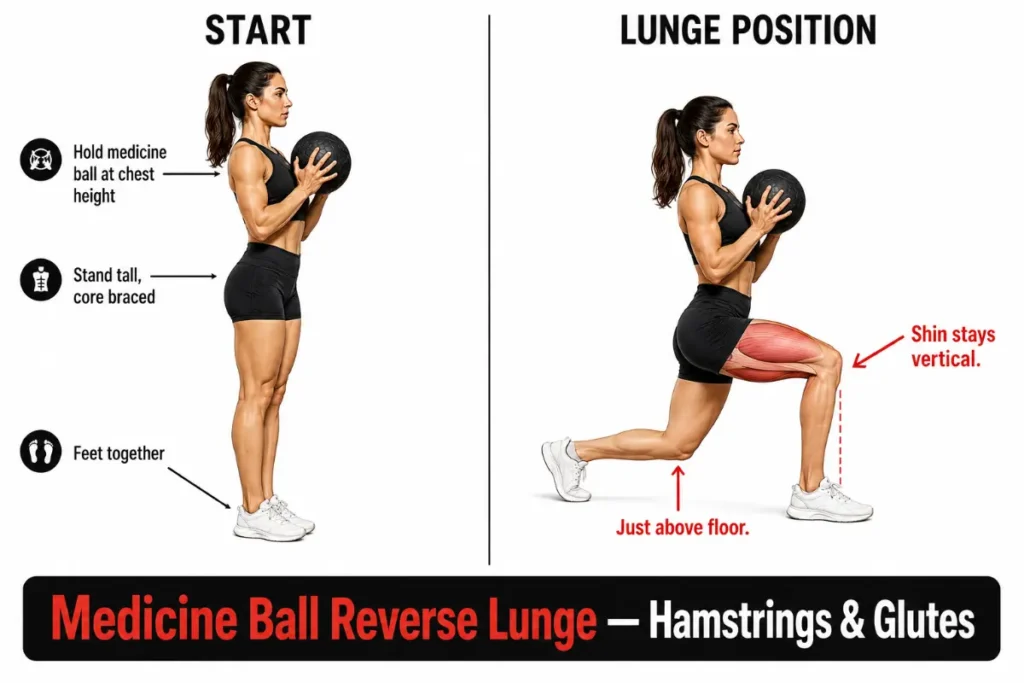
Targets: Hamstrings, Glutes | Also works: Quadriceps, Core | Pattern: Lunge
Stand tall, ball held in front of the chest. Step one foot directly backward and lower the rear knee toward the floor — stop just before it touches. Front shin stays vertical. Knee above the ankle, not forward of the toes. Drive through the front heel to return. Complete all reps on one side then switch, or alternate.
Sets and reps:
| Goal | Sets | Reps (each leg) |
|---|---|---|
| Strength | 4 | 5 |
| Muscle | 3 | 10–12 |
| Endurance | 3 | 15 |
Most common mistake: Too short a step. When the step is short, the front knee shoots forward past the toes and the glutes stop working. Step far enough back that the front shin stays vertical. If the knee travels forward, step back further.
Why this works: Stepping backward shifts load onto the hamstrings and glutes instead of the quads — better for posterior chain development than a forward lunge.
3. Wall Ball
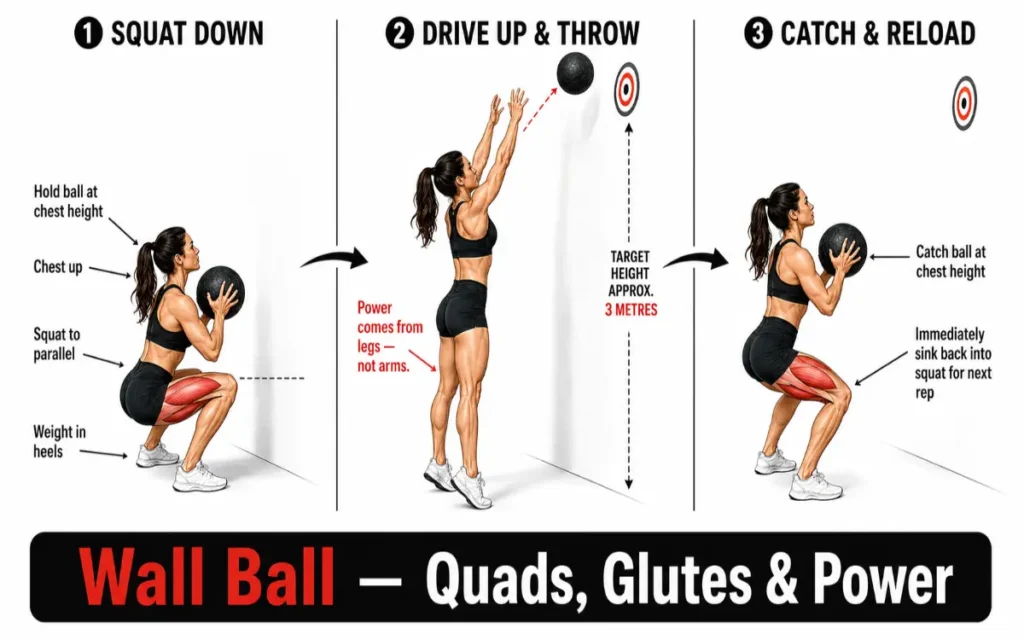
Targets: Quadriceps, Glutes | Also works: Shoulders, Core, Calves | Pattern: Squat + Power
Stand facing the wall, 1–1.5 metres away. Ball at chest height. Squat to parallel, drive upward and throw the ball at a target around 3 metres up the wall. Catch on return and immediately descend into the next squat. No catch-and-pause — one continuous rhythm.
Sets and reps:
| Goal | Sets | Reps / Time |
|---|---|---|
| Power | 4 | 8–10 reps |
| Conditioning | 3 | 15–20 reps |
| AMRAP | 3 | 60–90 seconds |
Most common mistake: Throwing with the arms instead of driving with the legs. The power in wall ball comes from the squat — the arms just guide the ball. If shoulders are burning before the legs, the mechanics are wrong. Legs launch, arms steer.
Why this works: The continuous squat-throw-catch rhythm keeps the quads and glutes under sustained tension across the entire set — longer than a standard squat set where there’s a pause at the top.
4. Medicine Ball Jump Squat
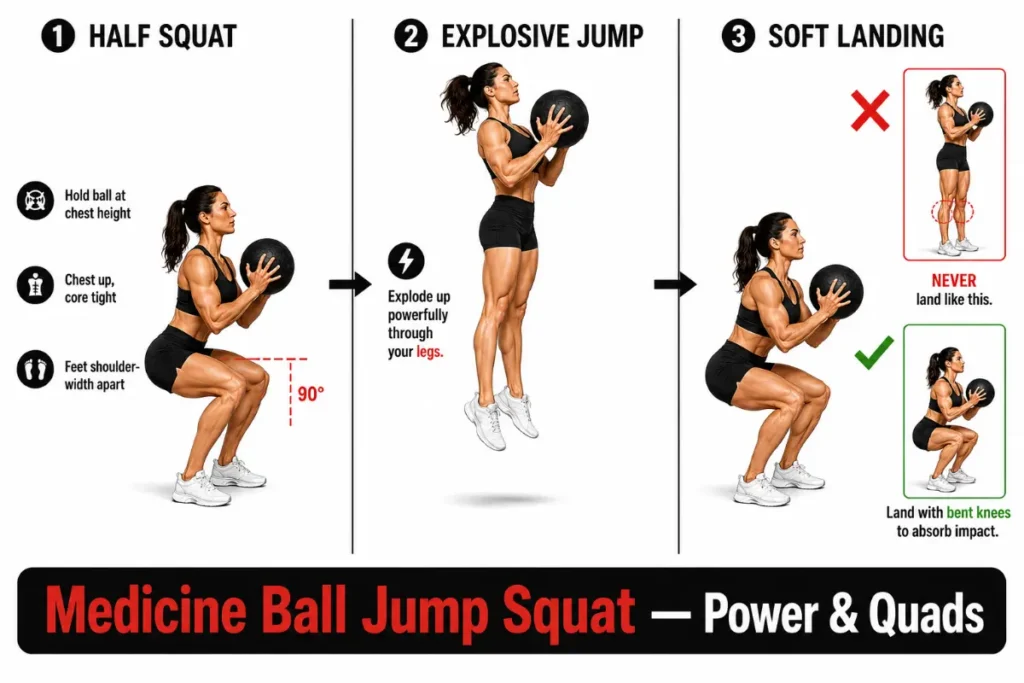
Targets: Quadriceps, Glutes | Also works: Calves, Hamstrings, Core | Pattern: Plyometric
Hold the ball against the chest. Feet shoulder-width apart. Descend to 90 degrees — not full depth. Explode upward, leave the ground completely. The moment the feet land, bend knees immediately to absorb impact. Never land with locked legs. Reset posture before the next rep.
Sets and reps:
| Goal | Sets | Reps | Rest |
|---|---|---|---|
| Power | 4–5 | 4–6 | 2–3 minutes |
| Conditioning | 3 | 10 | 60 seconds |
Most common mistake: Landing with straight legs. A locked-knee landing sends all the impact force straight through the joint. Bend the moment feet touch the floor — every rep without exception.
Record the first set from the side — most people lock their knees on landing without realizing it. Fix the landing before adding reps or weight.
Why this works: Jump squats train the fast-twitch muscle fibers that slow squats don’t reach. These fibers have the highest potential for strength and size — but only explosive training activates them.
5. Single-Leg Romanian Deadlift
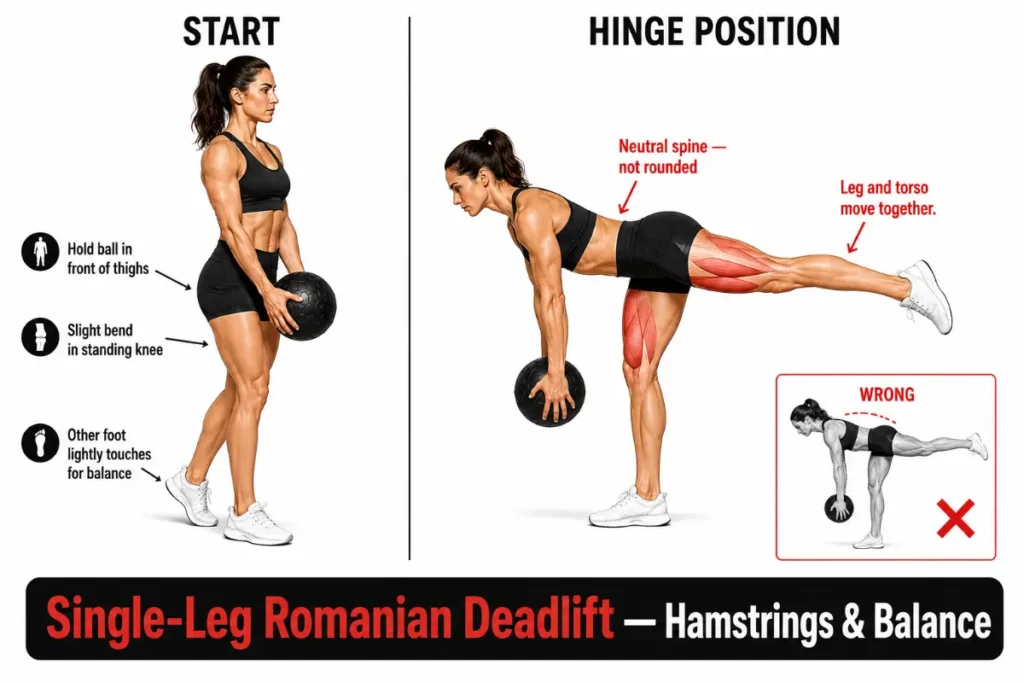
Targets: Hamstrings, Glutes | Also works: Lower back, Core, Calves | Pattern: Hip Hinge
Stand on the right leg with a slight knee bend. Hold the ball in front of the thighs. Hinge forward at the hip — not the waist — extending the left leg straight behind. Lower the ball close to the standing leg. Stop when the torso is parallel or the hamstring reaches its limit. Press through the heel to return. All reps one side, then switch.
Sets and reps:
| Goal | Sets | Reps (each side) |
|---|---|---|
| Strength | 3–4 | 6–8 |
| Muscle | 3 | 10–12 |
| Endurance | 3 | 15 |
Most common mistake: Rounding the lower back to get the ball closer to the floor. The moment the spine curves, the load shifts to the lumbar discs — not the hamstrings. Keep chest up. Think “long spine,” not “get lower.” Depth means nothing if the back is compromised.
Why this works: Most people have one dominant leg that compensates during every bilateral squat and deadlift. This exercise forces each side to work independently. The imbalance shows up within the first two reps — and fixing it makes every other leg exercise stronger.
Try five reps each side — if one side feels harder to balance, that’s the weaker leg that’s been compensating unnoticed.
6. Medicine Ball Side Lunge
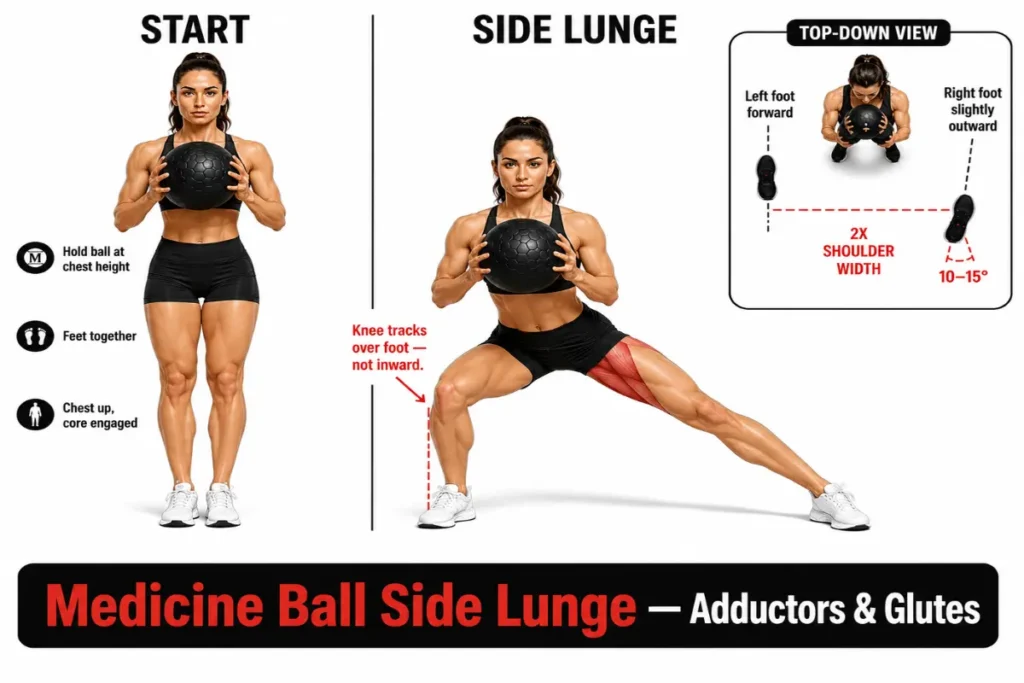
Targets: Adductors (inner thigh), Glutes | Also works: Quadriceps, Core | Pattern: Frontal Plane Lunge
Stand with feet together, ball at chest height. Step the right foot wide to the side — roughly double shoulder-width. Push the right hip back, bend the right knee, and lower into the lateral position. Left leg stays completely straight. Right knee tracks directly over the right foot. Ball stays steady. Push through the right heel to return. Alternate sides or complete one side fully.
Sets and reps:
| Goal | Sets | Reps (each side) |
|---|---|---|
| Muscle | 3–4 | 10–12 |
| Endurance | 3 | 15 |
Most common mistake: The bent knee caving inward. When the knee caves, the ligaments take the load instead of the adductors. Push the knee outward deliberately as you descend — it should feel harder, which means it’s working.
Why this works: Most lower body training happens in the sagittal plane — forward and back. The side lunge trains the frontal plane that every other exercise on this list ignores. Weak adductors are one of the most common reasons knees take extra stress during heavy squats.
7. Medicine Ball Glute Bridge
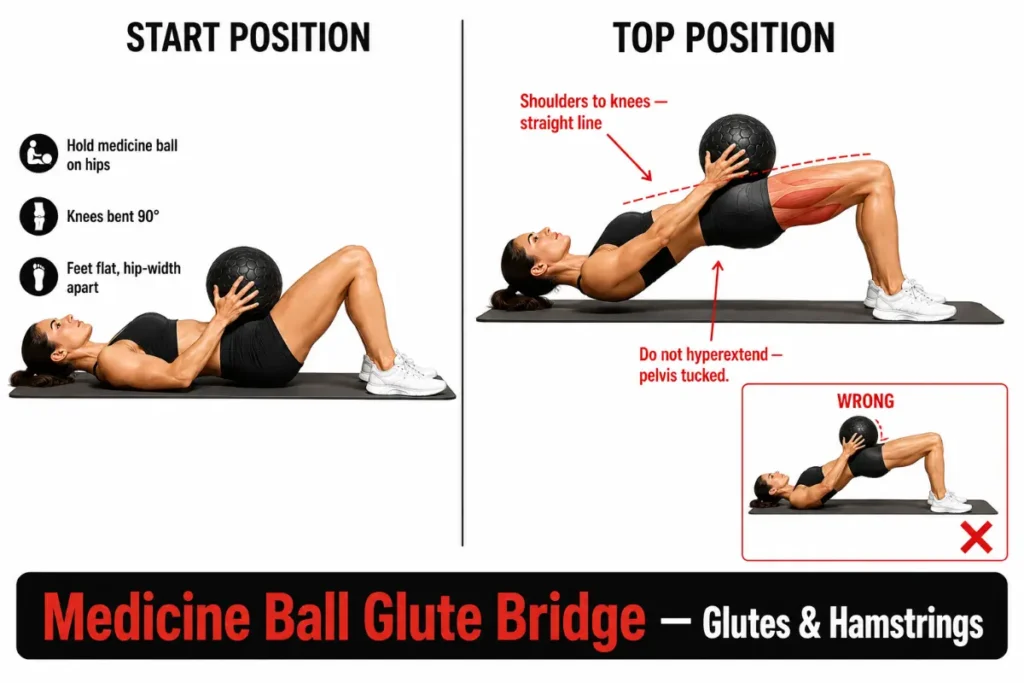
Targets: Glutes, Hamstrings | Also works: Core, Lower back | Pattern: Bridge
Lie on the back, knees bent at 90 degrees, feet flat hip-width apart. Place the ball on the hips. Brace the core. Press through heels, drive hips up until the body forms a straight line from shoulders to knees. Squeeze glutes hard at the top — hold one to two seconds. Lower slowly. Don’t let hips touch the floor between reps.
Sets and reps:
| Goal | Sets | Reps |
|---|---|---|
| Muscle | 4 | 10–15 |
| Endurance | 3 | 20–25 |
| Activation / Warm-up | 2 | 12 |
Most common mistake: Hyperextending the lower back at the top. When the lumbar spine arches too much, the lower back does the work — not the glutes. Tuck the pelvis slightly at the top. Think “ribs down, glutes squeezed” — not “hips as high as possible.”
Why this works: Squats load glutes hardest at the bottom. The glute bridge loads them hardest at the top — full hip extension. Two different stimulus points. Only squatting misses half the picture.
8. Overhead Walking Lunge
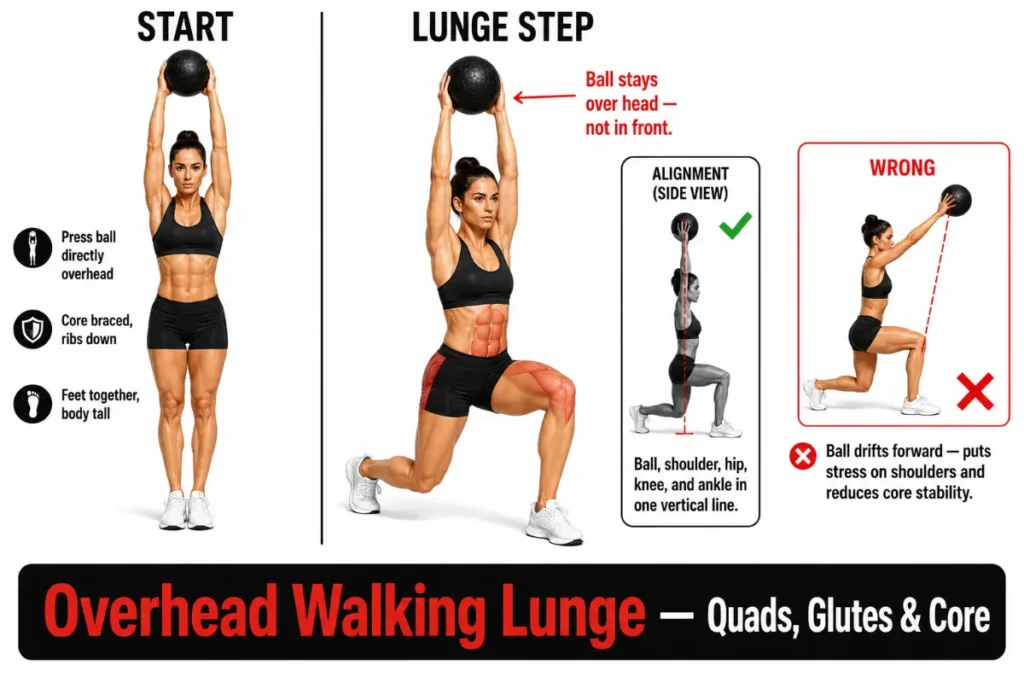
Targets: Quadriceps, Glutes | Also works: Core, Shoulders, Hip flexors | Pattern: Lunge + Overhead Stability
Press the ball directly overhead, arms locked out. Brace the core. Step forward into a lunge — front thigh parallel, rear knee just above the ground. Drive through the front heel, bring feet together. Next step with the opposite foot. Walk continuously. Ball stays directly above the head — no forward drift.
Sets and reps:
| Goal | Sets | Reps / Distance |
|---|---|---|
| Muscle | 3–4 | 10–12 steps each leg |
| Conditioning | 3 | 20 metres |
Most common mistake: The ball drifting forward as fatigue sets in. The second it moves in front of the head, the core stops working and the shoulders take over. If the ball drifts, the weight is too heavy. Drop down and keep it directly overhead.
Why this works: The overhead position forces the core to resist tipping forward every step. Quads and glutes do the leg work while the core works harder than it would in any standard lunge variation.
9. Forward Lunge with Twist
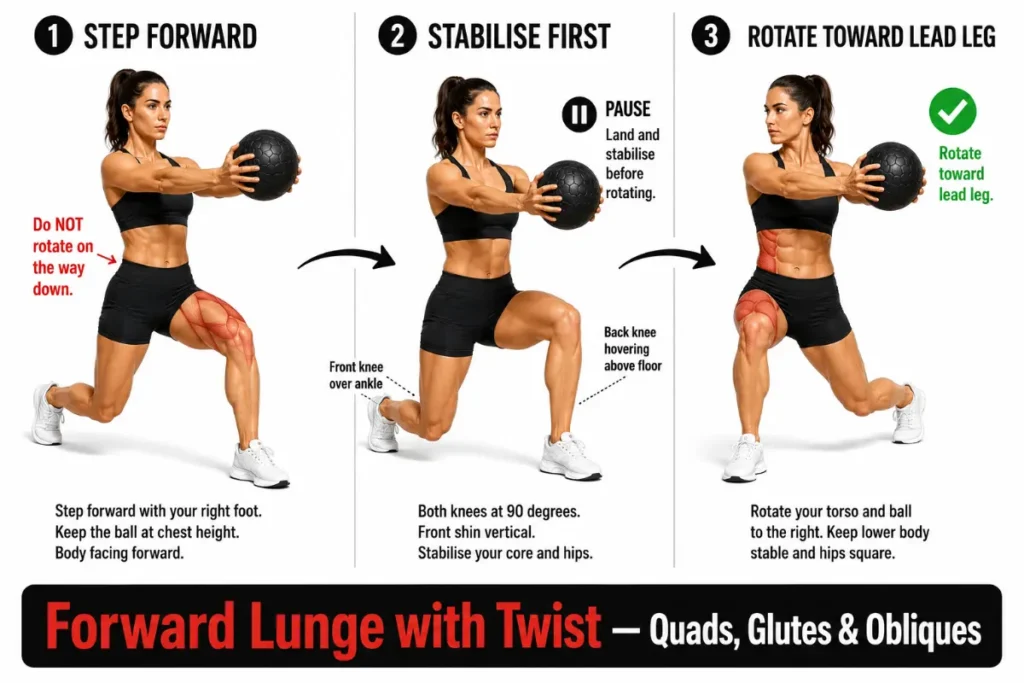
Targets: Quadriceps, Glutes, Obliques | Also works: Hamstrings, Core | Pattern: Lunge + Rotation (Transverse Plane)
Hold the ball in front of the chest, arms straight. Step forward with the right foot into a lunge. At the bottom — both knees at 90 degrees — rotate the torso and the ball toward the right leg. Pause one second. Rotate back to centre. Push through the front heel to stand. Alternate legs each rep.
Sets and reps:
| Goal | Sets | Reps (each leg) |
|---|---|---|
| Muscle | 3–4 | 10–12 |
| Conditioning | 3 | 15 |
Most common mistake: Rotating on the way down before the lunge is stable. Rotating before the foot is planted creates hip instability and throws off knee tracking. Land first. Stabilize. Then rotate. The sequence is not optional.
First set: slow it down — land, pause, rotate, hold, return. Once the pattern is clean, add speed.
Why this works: The rotation adds direct oblique work and extends how long the quads and glutes are under tension — longer than a standard lunge because of the pause and rotation at the bottom. Same movement, more stimulus.
10. Medicine Ball Hip Thrust
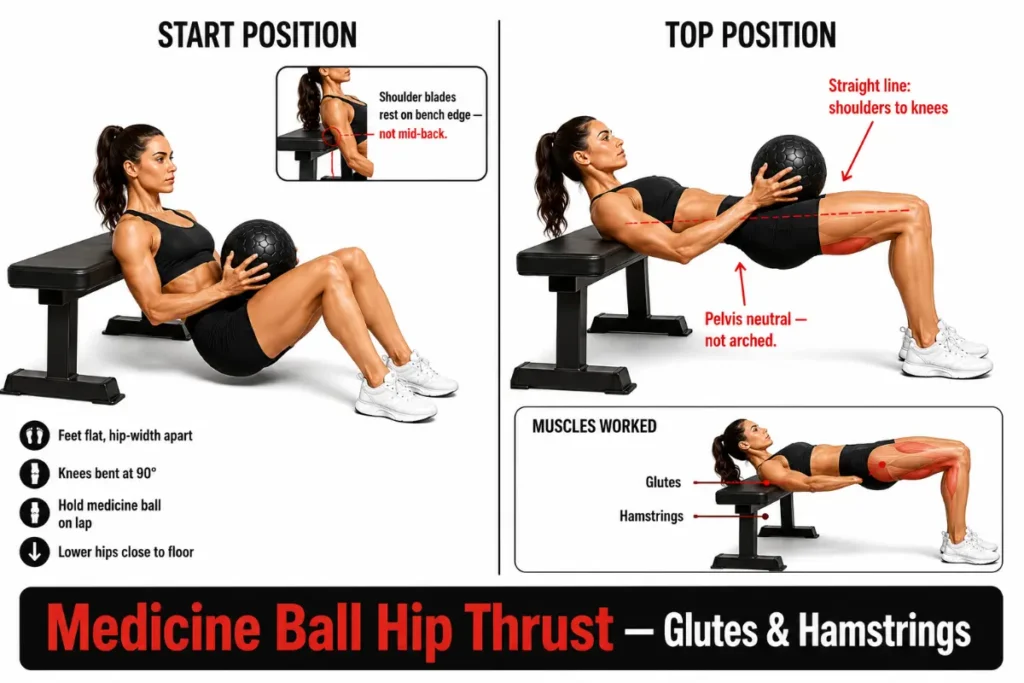
Targets: Glutes, Hamstrings | Also works: Core, Lower back | Pattern: Thrust
Sit on the floor, upper back against a stable bench or box. Place the ball on the lap. Feet flat, hip-width apart, knees at 90 degrees. Drive hips upward through heels. At the top — straight line from shoulders to knees. Squeeze glutes one to two seconds. Lower with control.
Sets and reps:
| Goal | Sets | Reps |
|---|---|---|
| Strength | 4 | 6–8 |
| Muscle | 3–4 | 10–15 |
| Endurance | 3 | 20 |
Most common mistake: Bench placed too far behind. When the bench is too far back, the upper back slides down during the rep instead of pivoting on the edge. Position it so the shoulder blades sit across the bench edge when hips are at the bottom — not the mid-back. Get the setup right before adding load.
Why this works: Squats and deadlifts don’t fully load hip extension — that’s where the hip thrust fills the gap. It loads the glutes at peak contraction. If glutes are a weak point, this exercise isn’t optional.
Exercise-to-muscle map
Every exercise in this list and what it actually hits — primary targets in bold.
● = primary target | ○ = secondary | blank = minimal
| Exercise | Quads | Hams | Glutes | Calves | Adductors | Core | Pattern |
|---|---|---|---|---|---|---|---|
| Squat | ● | ○ | ● | ○ | ○ | Squat | |
| Reverse Lunge | ○ | ● | ● | ○ | Lunge | ||
| Wall Ball | ● | ● | ○ | ○ | Squat + Power | ||
| Jump Squat | ● | ○ | ● | ● | ○ | Plyometric | |
| Single-Leg RDL | ● | ● | ○ | Hinge | |||
| Side Lunge | ○ | ○ | ● | ○ | Frontal Lunge | ||
| Glute Bridge | ○ | ● | ○ | Bridge | |||
| Overhead Lunge | ● | ● | ● | Lunge + Stability | |||
| Lunge with Twist | ● | ○ | ● | ● | Lunge + Rotation | ||
| Hip Thrust | ○ | ● | ○ | Thrust |
All six major leg muscle groups. All three movement planes. No muscle left out.
Sets and reps quick reference
| Goal | Sets | Reps | Rest | Ball Weight |
|---|---|---|---|---|
| Strength | 4–5 | 3–6 | 2–3 minutes | Heavy |
| Muscle (Hypertrophy) | 3–4 | 8–12 | 60–90 seconds | Moderate |
| Endurance | 2–3 | 15–25 | 30–45 seconds | Light-moderate |
| Fat Loss / Conditioning | 3–4 | 12–20 or timed | 30–60 seconds | Light-moderate |
| Power | 4–5 | 3–5 | 2–3 minutes | Light (speed is the load) |
Matching reps and sets to the right goal changes the outcome of every exercise on this list.
30-minute medicine ball leg workout
All 10 exercises above, structured into one complete session.
Warm-up — 5 minutes
- Hip Circle with Ball — 60 seconds
- Single-Leg Hinge, Slow Tempo — 10 reps each side
- Squat to Press, Light — 8 reps
Block 1 — Compound strength — 12 minutes
- Medicine Ball Squat — 4 × 8–10 | Rest 75 seconds
- Medicine Ball Reverse Lunge — 3 × 10 each leg | Rest 60 seconds
Block 2 — Posterior chain and single-leg — 10 minutes
- Single-Leg Romanian Deadlift — 3 × 10 each side | Rest 60 seconds
- Medicine Ball Glute Bridge — 3 × 12–15 | Rest 45 seconds
- Medicine Ball Side Lunge — 2 × 12 each side | Rest 45 seconds
Block 3 — Power finisher — 5 minutes
- Wall Ball — 3 × 10 | Rest 45 seconds
- Medicine Ball Jump Squat — 3 × 6 | Rest 60 seconds
Cool-down — 3–5 minutes
- Standing quad stretch — 30 seconds each side
- Supine hamstring stretch — 30 seconds each side
- Hip flexor kneeling stretch — 30 seconds each side
How to progress week by week
Week 1–2 — Form first. Pick a weight where every rep is clean. If form breaks at rep 8, the weight is wrong.
Week 3–4 — Add reps. Move from 3 × 10 to 3 × 11, then 3 × 12.
Week 5–6 — Add weight. Increase by 1–2 kg. Drop reps back to the lower end and build up again.
Week 7–8 — Progress the variation. Replace the glute bridge with the single-leg version. Swap the squat for the overhead version. Same muscles, harder pattern.
Move up when all sets are complete at the top of the rep range with two reps still in the tank.
Frequently Asked Questions
Can you build leg muscle with just a medicine ball?
Yes — if the weight challenges you and you’re progressing over time. Squats, lunges, RDLs, and hip thrusts create enough stimulus for muscle growth. The ceiling is around 12–15 kg — beyond that, barbell work becomes necessary.
How heavy should my medicine ball be for leg exercises?
Start at 4–6 kg if new to it. Intermediate trainees land between 6–10 kg. For explosive moves like wall ball and jump squats, go one level lighter than strength work — speed matters more than load. If a neutral spine can’t hold for 10 reps, the ball is too heavy.
Which muscles do medicine ball leg exercises work?
All six major lower body groups: quads (squats, wall ball, jump squats), hamstrings (reverse lunge, RDL, hip thrust), glutes (glute bridge, hip thrust, side lunge), calves (jump squat, wall ball), adductors (side lunge), abductors (side lunge, forward lunge with twist). No single exercise covers all six — working through all 10 matters.
How often should I train legs with a medicine ball?
Twice a week with 48 hours between sessions. Two sessions with real effort and progression beats three done carelessly.
Are medicine ball exercises safe for kids?
Yes — children as young as 6 can use a lightweight medicine ball (2–4 lb) with adult supervision. Stick to simple movements like squats, chest passes, and overhead throws. For a complete age-appropriate routine, check out our 10 medicine ball exercises for kids under 12 with ball weight guidance by age and parent tips per exercise.
Is a medicine ball good for glutes?
The glute bridge and hip thrust are two of the most direct glute exercises possible without a barbell. The hip thrust loads glutes at full hip extension — the point where squats are at their weakest for glute activation. If glutes are the priority, these two aren’t optional.
Final Word
You have the ball. You have 10 exercises. You have a 30-minute workout ready to go.
Pick up the ball. Start with the squat. Get that right before anything else.
