


Start with a 4–8 lb medicine ball and these 12 exercises — grouped by upper body, core, and lower body. Each includes step-by-step form cues, starting weight, and sets and reps. A ready-to-use 2-day workout plan and 6-week progression guide are included below.
If you’ve picked up a medicine ball at the gym and weren’t sure what to do with it, this is the right place to start. Below are 12 exercises that cover your full body using one piece of equipment — no machines, no cables, no gym membership required.
Each exercise has step-by-step instructions, the correct starting weight, and sets and reps you can follow from day one. A 2-day workout plan and a 6-week progression guide are built in so you’re not guessing what to do next. You may have seen this called a “weighted ball” in some places — it’s the same thing.
About the Author: This article is written by Sadia Baloch — FISAF-certified fitness coach with 7+ years of coaching experience, 257+ clients trained, and a 95% client satisfaction rate.
- What Is a Medicine Ball and Why Should Beginners Use One?
- How Heavy Should Your Medicine Ball Be?
- 12 Medicine Ball Exercises for Beginners
- Medicine ball exercises for core and abs (4 Exercises)
- Medicine ball exercises for lower body (4 Exercises)
- Which Medicine Ball Exercises Replace Dumbbells?
- What Does a Beginner Workout Plan Look Like?
- How Do You Progress Week by Week?
- What Mistakes Should Beginners Avoid?
- Frequently asked questions
- Final Word
What Is a Medicine Ball and Why Should Beginners Use One?
A medicine ball is a weighted exercise ball used for strength, power, and core stability training. They range from 2 to 25 lbs and come in rubber, leather, or vinyl shells filled with sand, gel, or air. Unlike dumbbells, a medicine ball can be thrown, slammed, and rotated — which makes it one of the most versatile functional training tools available.
There are three types you’ll see at the gym, and the difference matters:
- Medicine ball — bounces when dropped. Used for presses, squats, rotations, and wall throws.
- Slam ball — sand-filled, zero bounce. Built for floor slams and high-impact throws.
- Wall ball — larger, leather-covered. Designed for wall throws in CrossFit-style training.
For every exercise in this guide, a standard medicine ball works. The only exception is the ball slam (exercise 1), which requires a slam ball.
Why beginners benefit from medicine ball training specifically:
Medicine balls build coordination, core stability, and explosive power through compound movements that train multiple muscle groups at once. They’re easier to learn than barbells, safer than heavy dumbbells for beginners, and effective enough to build real strength at home or in the gym. A 12-week study published in the Journal of Strength and Conditioning Research (Ignjatovic et al., 2012) found that medicine ball training improved muscular power and functional performance compared to standard resistance training alone.
How Heavy Should Your Medicine Ball Be?
Pick the wrong weight and every exercise becomes either too easy or impossible to do with correct form.
| Fitness Level | Recommended Weight | What This Weight Does |
|---|---|---|
| Complete beginner | 4–6 lbs | Lets you learn the movement without form breaking down |
| Beginner with gym experience | 6–10 lbs | Adds enough resistance to build strength and power |
| Intermediate | 10–15 lbs | Increases load on strength movements |
| Advanced | 15–20 lbs | Drives maximal power output |
The ball should make the movement harder — not impossible. If you can’t complete a full rep with good form, drop down a size. For core exercises like Russian twists and wood chops, stay at the lower end of your range. Control matters more than load. For strength movements like squats and deadlifts, you can go slightly heavier.
According to the National Strength and Conditioning Association (NSCA), ball weight for power-based movements like slams and throws should not exceed 10% of your body weight.
12 Medicine Ball Exercises for Beginners
Medicine Ball Exercises for Upper Body (4 Exercises)
1. Medicine Ball Slam
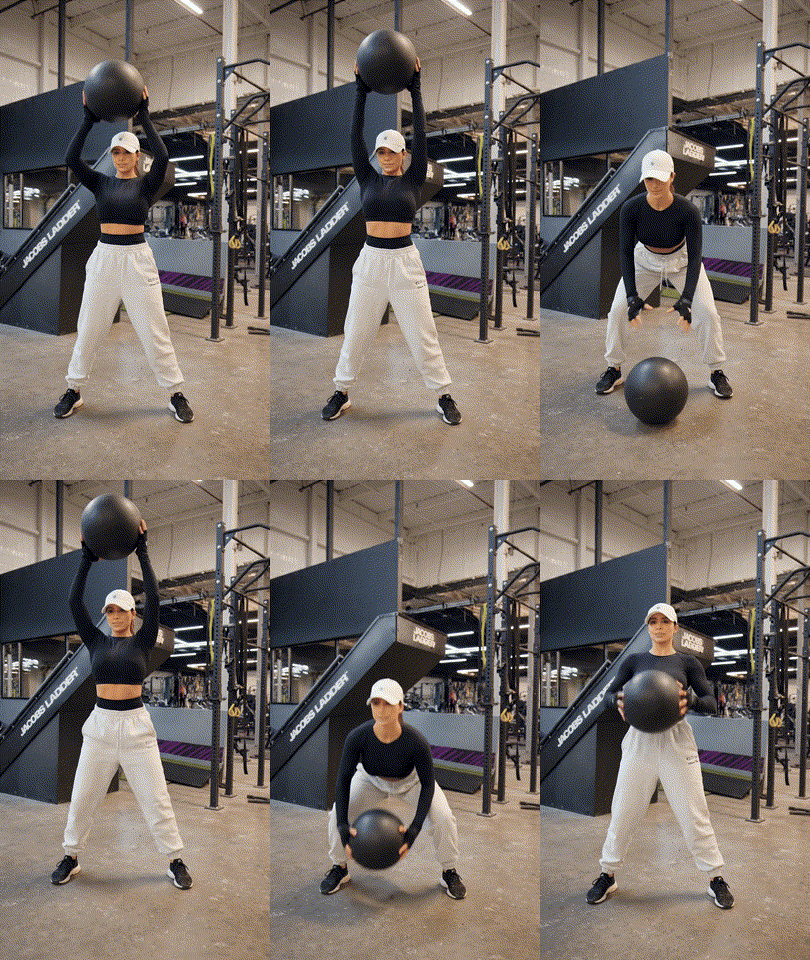
Muscles worked: Shoulders, lats, triceps, core, glutes, quads Starting weight: 10 lbs
Equipment note: Use a slam ball for this exercise — not a standard medicine ball. Standard balls bounce, and a hard slam can send one straight back at you. A slam ball is sand-filled with zero bounce and built specifically for this movement.
The slam is the best power exercise you can do with a medicine ball. It also works as a warm-up primer before a strength session — 2–3 sets of explosive slams activate your nervous system before heavier work.
How to do it:
- Stand with feet shoulder-width apart, knees slightly bent.
- Hold the ball with both hands and raise it directly overhead, arms fully extended.
- Brace your core, drive your hips back, and slam the ball into the floor as hard as you can.
- Squat — do not bend at the lower back — to pick it up. Repeat.
Sets and reps: 3 sets of 8 reps. Rest 60–90 seconds between sets.
Watch for this: The power comes from your hips driving down, not your arms pulling. Most beginners use arms only on the first few reps. Focus on the hip drive first and let your arms follow.
2. Medicine Ball Overhead Press
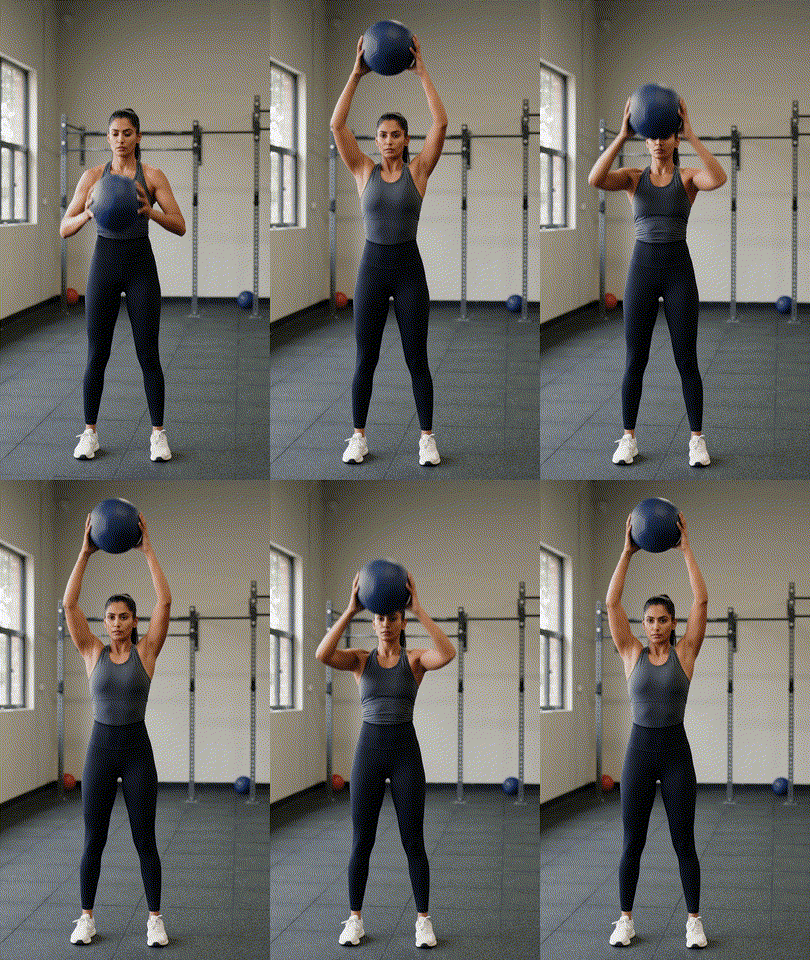
Muscles worked: Shoulders, triceps, upper traps, core Starting weight: 6–8 lbs
This covers the same movement pattern as a dumbbell overhead press — same muscles, same stimulus. If you’re training at home without dumbbells, this replaces it entirely.
How to do it:
- Stand with feet hip-width apart, ball at chest height with both hands.
- Press the ball directly overhead until your arms are fully extended.
- Lower back to chest height with control. That’s one rep.
Sets and reps: 3 sets of 10–12 reps.
Watch for this: Don’t let your lower back arch as you press overhead. Keep your core braced and your ribs pulled down throughout the movement.
3. Medicine Ball Push-Up
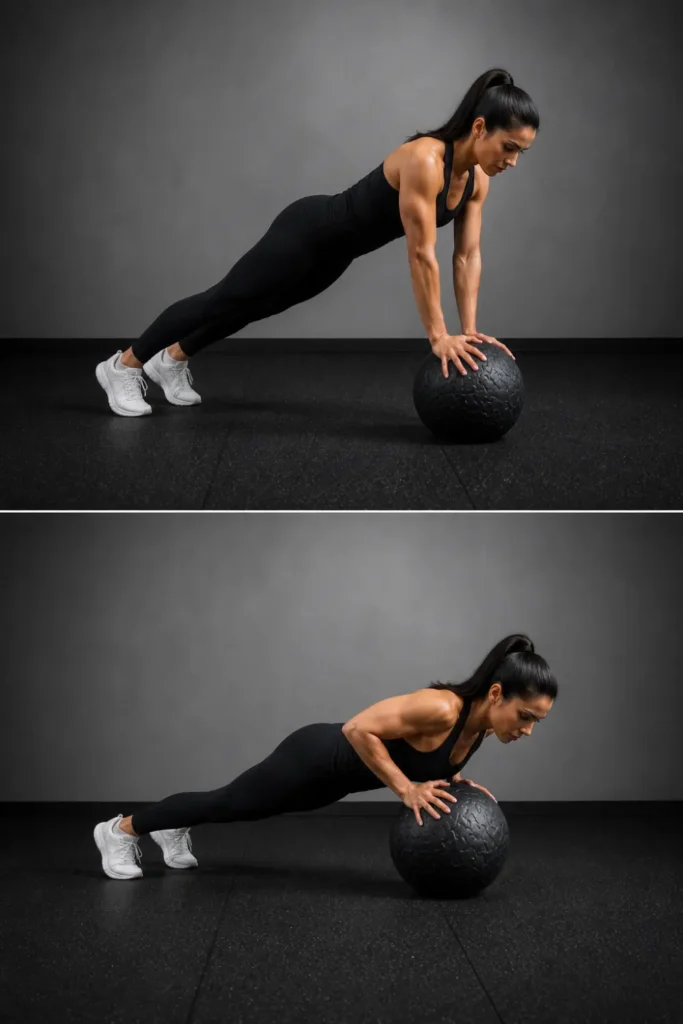
Muscles worked: Chest, shoulders, triceps, rotator cuff, core Starting weight: N/A — the ball is the surface
How to do it:
- Place both hands on the ball, directly under your shoulders.
- Walk your feet back into a plank — body in a straight line, core tight.
- Lower your chest toward the ball, elbows at roughly 45 degrees.
- Press back to the start.
Sets and reps: 3 sets of 6–10 reps. Drop to your knees if the full version is too difficult — prioritize form over full reps.
Watch for this: The unstable surface forces your shoulder stabilizers to work harder than on a flat floor. If it feels easy, your core probably isn’t fully engaged. Brace harder and slow the movement down.
4. Chest Pass Against a Wall
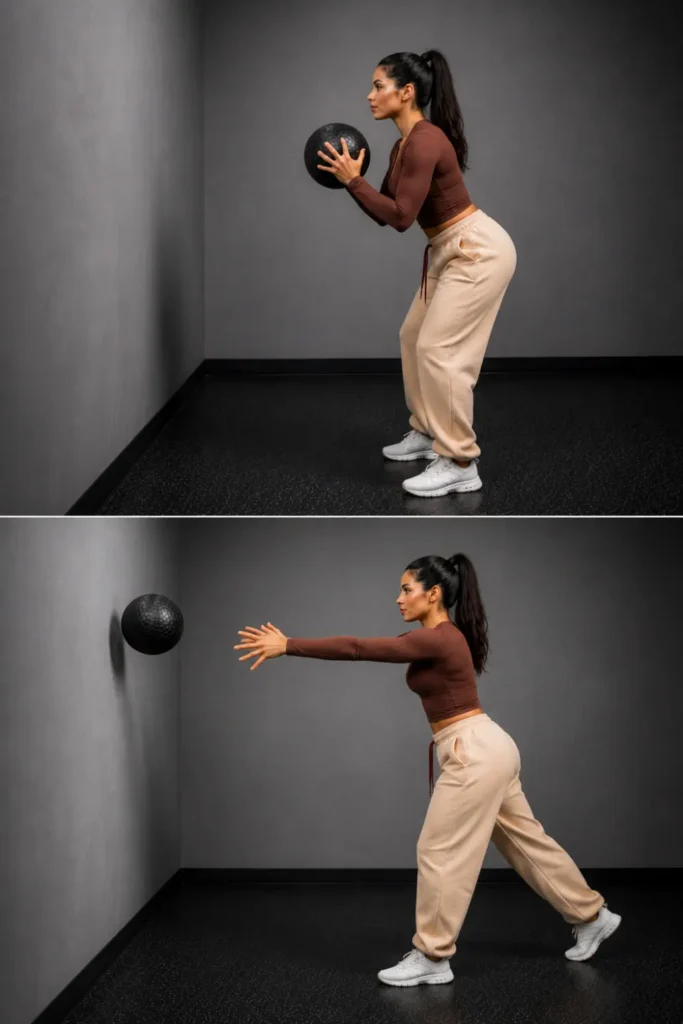
Muscles worked: Chest, shoulders, triceps, core Starting weight: 8–10 lbs
How to do it:
- Stand 3–4 feet from a solid wall, ball at chest height.
- Explosively push the ball into the wall from both hands.
- Catch the rebound and immediately repeat.
Sets and reps: 3 sets of 10 reps.
Watch for this: Keep your feet planted and your core braced throughout. This is a chest and shoulder movement — your lower body stays still.
Medicine Ball Exercises for Core and Abs (4 Exercises)
For a deeper dive into core-specific training with a medicine ball, the medicine ball ab exercises guide covers all four abdominal regions with dedicated circuits.
Medicine ball exercises for core and abs (4 Exercises)
5. Russian twist
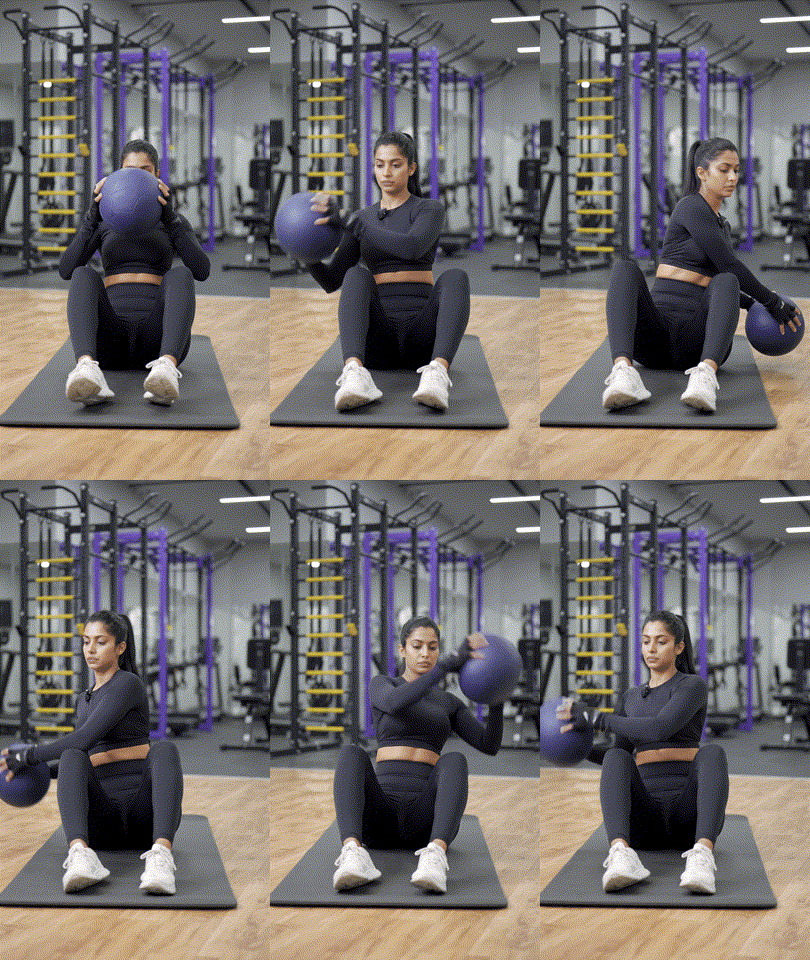
Muscles worked: Obliques, rectus abdominis, transversus abdominis, hip flexors Starting weight: 6–8 lbs
How to do it:
- Sit with your knees bent at 45 degrees, heels slightly off the floor.
- Hold the ball with both hands at chest height.
- Lean your torso back slightly until your abs engage.
- Rotate your entire torso to the right, bringing the ball close to the floor beside you.
- Return to center, then rotate left. That’s one rep.
Sets and reps: 3 sets of 20 reps — 10 each side. Keep heels on the floor if the full version is too challenging to start.
Watch for this: Rotate your entire torso — not just your arms. The ball follows your shoulders. If your shoulders stay still and only your arms move, you’re not working your obliques.
6. Wood chop
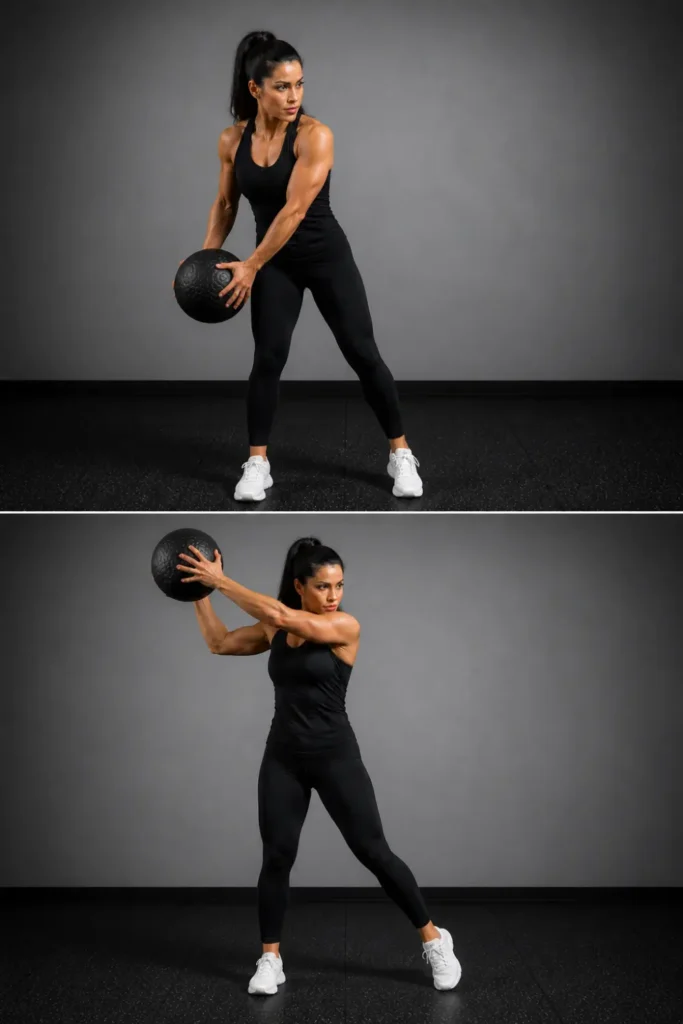
Muscles worked: Obliques, lats, shoulders, glutes Starting weight: 6–8 lbs
The wood chop trains diagonal movement — the pattern your body uses constantly in daily life and sport. Most gym exercises only train forward and back, or up and down. This one covers what they miss and trains across the transverse plane of motion.
How to do it:
- Stand with feet shoulder-width apart, ball at your right hip with both hands.
- Rotate your torso and lift the ball diagonally up to your left shoulder in one smooth movement.
- Lower it back to your right hip with control. That’s one rep.
- Complete all reps on one side, then switch.
Sets and reps: 3 sets of 10 reps each side.
Watch for this: Keep your feet planted. The rotation happens at your torso — not by pivoting your feet or shifting your hips sideways.
7. Plank ball pass
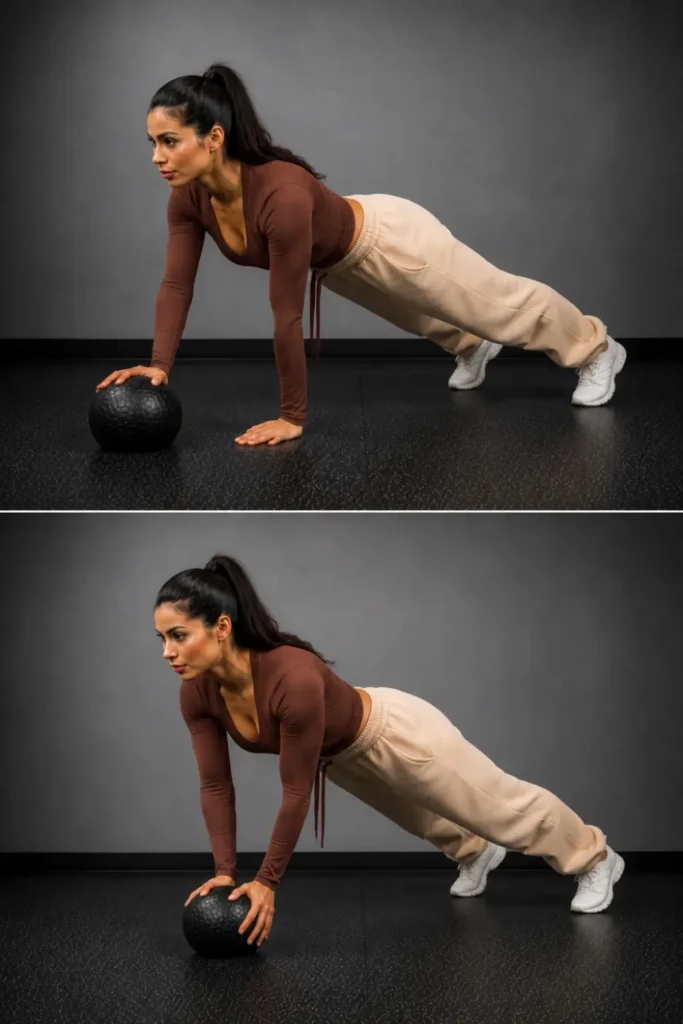
Muscles worked: Transversus abdominis, obliques, shoulder stabilizers Starting weight: 6 lbs
How to do it:
- Start in a plank — hands under shoulders, body in a straight line.
- Place the ball under your right hand.
- Roll it across to your left hand while keeping your hips completely still.
- Roll it back. That’s one rep.
Sets and reps: 3 sets of 8 reps.
Watch for this: The moment your hips rotate or dip, the core work stops. This exercise only does its job when your hips stay perfectly level the entire time. Slow the pass down if needed.
8. V-Up With Medicine Ball
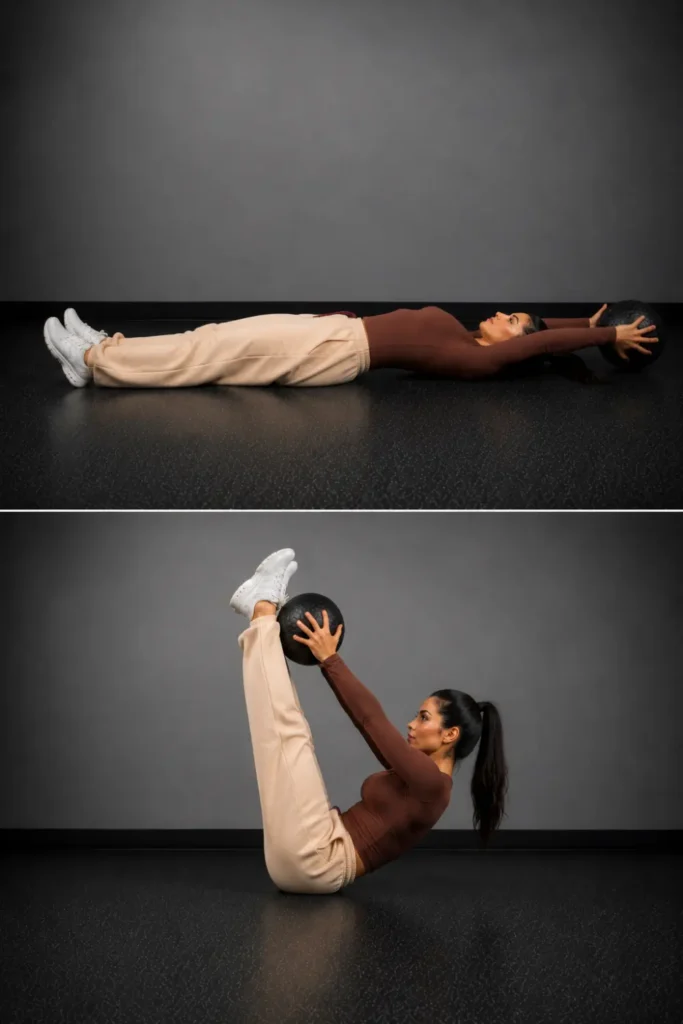
Muscles worked: Rectus abdominis, hip flexors, shoulders Starting weight: 4–6 lbs
How to do it:
- Lie flat on your back, legs straight, arms extended overhead holding the ball.
- Simultaneously raise your legs and your upper body, reaching the ball toward your feet.
- Lower back to the start under control.
Sets and reps: 3 sets of 8–10 reps.
Watch for this: Don’t swing yourself up using momentum. The movement should be controlled on the way up and slow on the way down — the lowering phase is where most of the ab work happens.
Medicine Ball Exercises for Lower Body (4 Exercises)
Medicine ball exercises for lower body (4 Exercises)
9. Squat and press
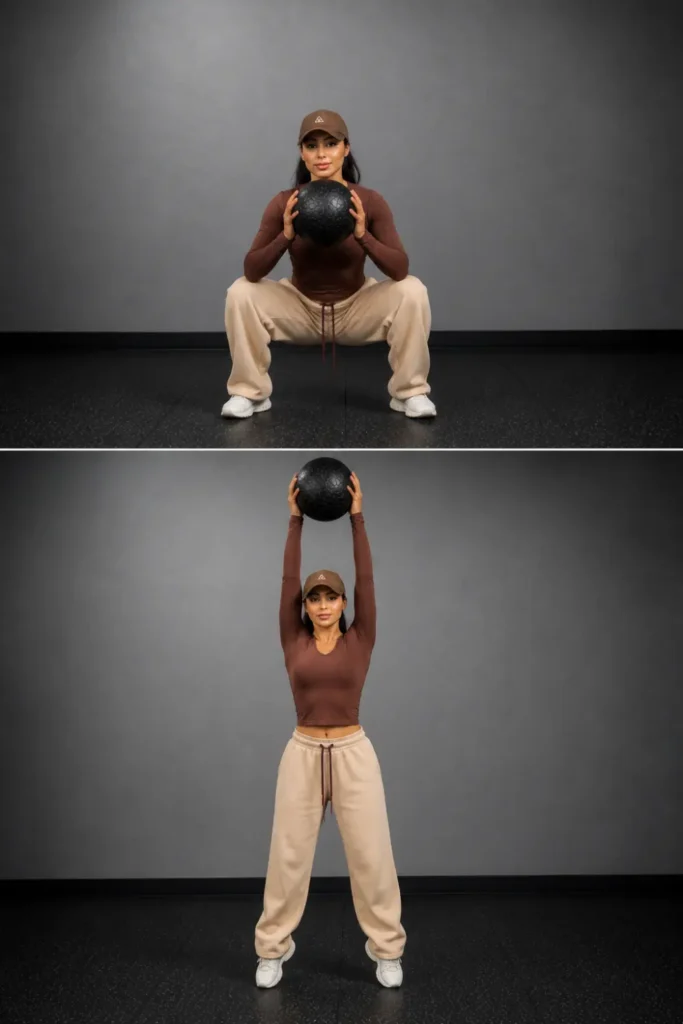
Muscles worked: Quads, glutes, hamstrings, calves, shoulders, core Starting weight: 8–10 lbs
This is the best single exercise for a beginner. It works your entire body in one compound movement. If you only have time for one exercise, make it this one.
How to do it:
- Stand with feet shoulder-width apart, ball at chest height.
- Squat down — thighs parallel to the floor, chest up, knees tracking over your toes.
- Drive up out of the squat and press the ball overhead as you stand.
- Catch it at chest height as you lower into the next squat.
Sets and reps: 3 sets of 10 reps.
Watch for this: The press and the stand happen together — not one after the other. Drive out of the squat and press at the same time. If you’re standing fully upright before you start pressing, slow down and connect the two movements.
10. Forward lunge with twist
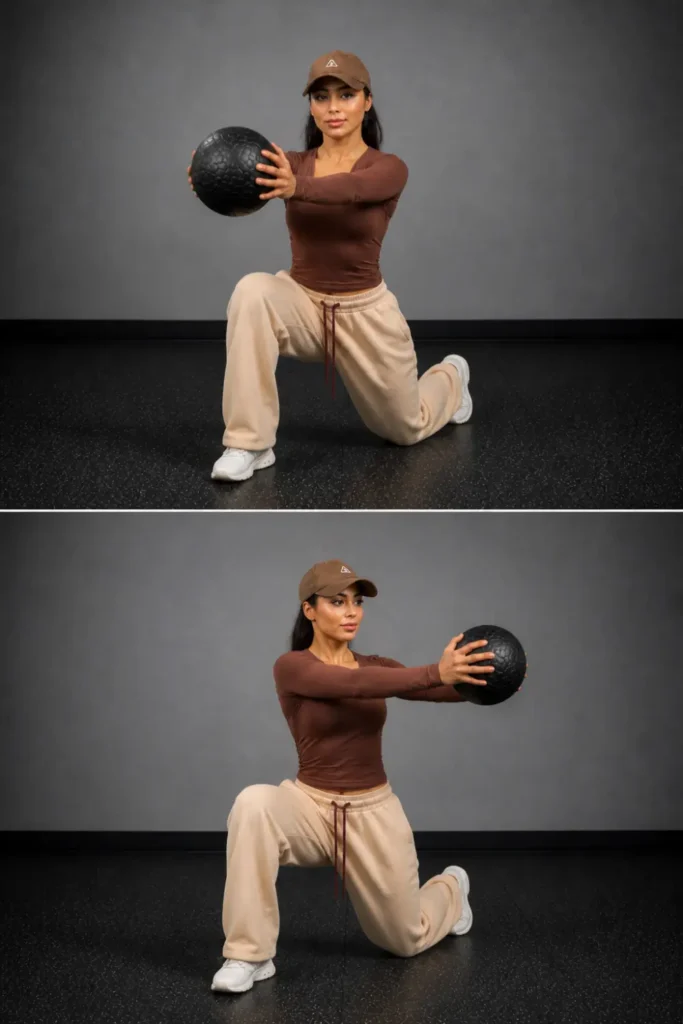
Muscles worked: Quads, glutes, hamstrings, obliques, core Starting weight: 6–8 lbs
How to do it:
- Hold the ball at chest height, arms extended.
- Step forward into a lunge with your right foot.
- At the bottom of the lunge, rotate your torso to the right — the ball follows your shoulders.
- Rotate back to center, push off your front foot, and return to standing.
- Alternate legs each rep.
Sets and reps: 3 sets of 8 reps per leg.
Watch for this: Get into the full lunge position first, then rotate. Twisting on the way down before you’re stable creates instability at the knee and hip. Land, pause, then rotate.
11. Medicine ball Romanian deadlift
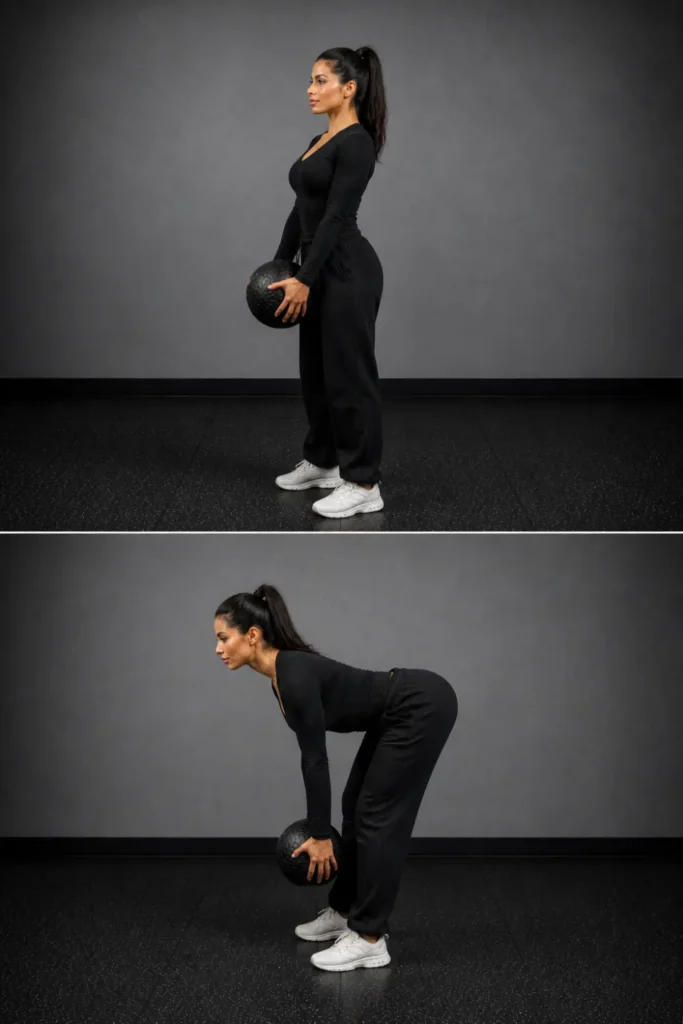
Muscles worked: Hamstrings, glutes, lower back, core Starting weight: 8–12 lbs
This covers the same posterior chain muscles as a dumbbell Romanian deadlift — same movement pattern, same stimulus.
How to do it:
- Stand with feet hip-width apart, ball held in front of your thighs with both hands.
- Push your hips back and lower the ball toward the floor, keeping your back flat and the ball close to your legs throughout.
- Once you feel a strong stretch in your hamstrings, drive your hips forward to return to standing.
Sets and reps: 3 sets of 10–12 reps.
Watch for this: Your back stays flat the entire time. If it rounds before the ball reaches mid-shin level, stop there — depth means nothing if your spine is compromised. The stretch in your hamstrings tells you when you’ve gone far enough.
12. Glute bridge with ball squeeze
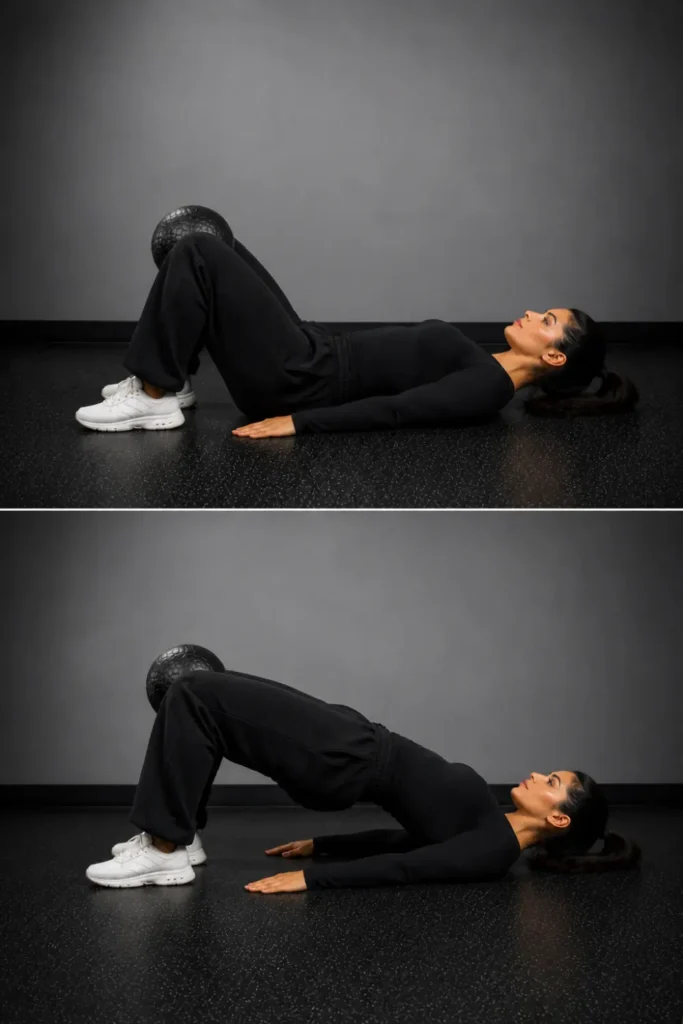
Muscles worked: Glutes, hamstrings, inner thighs, core Starting weight: 6–8 lbs
How to do it:
- Lie on your back, knees bent, feet flat on the floor hip-width apart.
- Place the ball between your knees and squeeze it firmly — hold that squeeze throughout every rep.
- Drive your hips up toward the ceiling, squeezing your glutes at the top.
- Hold for one second, then lower with control.
Sets and reps: 3 sets of 12–15 reps.
Watch for this: Don’t let your lower back arch at the top. Think “glutes squeeze” not “hips as high as possible.” Squeezing the ball activates your inner thighs at the same time — something a standard glute bridge doesn’t do.
If legs are your main focus, the 10 medicine ball exercises for legs guide goes deeper — squats, hip thrusts, lateral lunges, and single-leg variations with sets and reps by goal.
Which Medicine Ball Exercises Replace Dumbbells?
If you’re training at home without a full weight set, a medicine ball covers more ground than most people expect. This table shows which exercises in this guide map directly to standard dumbbell movements.
| Medicine Ball Exercise | Dumbbell Equivalent | What the Med Ball Adds |
|---|---|---|
| Overhead Press | Dumbbell Overhead Press | Neutral grip reduces shoulder strain |
| Push-Up (on ball) | Dumbbell Floor Press | Unstable surface increases rotator cuff and core demand |
| Romanian Deadlift | Dumbbell RDL | Identical posterior chain stimulus |
| Squat and Press | Dumbbell Thruster | Same compound movement pattern |
| Chest Pass (wall) | Dumbbell Bench Press (partial) | Adds explosive horizontal pressing — dumbbells can’t replicate the release |
| Russian Twist | Dumbbell Russian Twist | Sphere grip forces continuous forearm engagement |
| Glute Bridge (squeeze) | Dumbbell Glute Bridge | Ball squeeze adds inner thigh (adductor) activation |
| Ball Slam | No dumbbell equivalent | Explosive full-body power — can’t be done safely with a dumbbell |
| Wood Chop | Cable Wood Chop | Trains rotational power without a cable machine |
Exercises like the ball slam, chest pass, and wood chop have no direct dumbbell equivalent — they use throwing, catching, or rotational patterns that fixed weights can’t safely replicate. That’s where a medicine ball earns its place even if you already own dumbbells.
What Does a Beginner Workout Plan Look Like?
Train two to three days per week with at least 48 hours between sessions. Your muscles recover and grow during rest — not during the workout itself.
Day 1 — Upper Body and Core
Perform as a circuit. Complete all five exercises back-to-back, rest 90 seconds, then repeat. Do 3 rounds total.
| Exercise | Reps |
|---|---|
| Medicine Ball Slam | 8 |
| Overhead Press | 10 |
| Russian Twist | 20 (10 each side) |
| Medicine Ball Push-Up | 8 |
| Plank Ball Pass | 8 |
Day 2 — Lower Body and Core
| Exercise | Reps |
|---|---|
| Squat and Press | 10 |
| Forward Lunge With Twist | 8 per leg |
| Medicine Ball Romanian Deadlift | 12 |
| Glute Bridge With Ball Squeeze | 15 |
| Wood Chop | 10 per side |
How Do You Progress Week by Week?
Weeks 1–2: Focus on form only. Use the starting weights listed above. Rest as long as you need between exercises. Getting the movement right now saves you from injuries and wasted effort later.
Weeks 3–4: Reduce rest between exercises by 15 seconds. Same weights, same reps — less rest. This is progressive overload without changing anything else.
Week 5: Add a fourth round to each circuit.
Week 6: Increase ball weight by 2 lbs on strength exercises — squat and press, Romanian deadlift, lunge. Keep the same weight on power and core movements for now.
If fat loss is a goal alongside this plan, the Exercise Menu Calorie Burn Calculator estimates how many calories each session burns based on your bodyweight and workout duration.
What Mistakes Should Beginners Avoid?
These show up most often in the first few weeks. Knowing them now saves you from learning them the hard way.
Using a standard medicine ball for floor slams. Standard balls bounce. A hard slam can send one straight back at your face. Use a slam ball for slams — it absorbs impact without bouncing back.
Picking up the ball by rounding your lower back. After every slam, the ball is on the floor. Bending at the spine to retrieve it repeatedly strains the lower back. Squat to pick it up every single time.
Going too heavy on power movements. Speed is the point of explosive training. A heavier ball slows the movement and removes the stimulus entirely. If you can’t throw or slam with full force, drop down a size.
Training the same way every week. Your body adapts to whatever you give it and stops responding. Follow the progression plan above — reduce rest, add rounds, increase weight. The same medicine ball workout routine every week produces the same result indefinitely.
Skipping the warm-up. Explosive movements on cold muscles cause strains. Five minutes of light movement — bodyweight squats, arm circles, leg swings — is the minimum before any medicine ball session.
Frequently asked questions
Can you build muscle with a medicine ball?
Yes. Medicine ball training recruits large muscle groups through compound movements and activates fast-twitch muscle fibers through explosive loading — the fibers with the highest growth potential. For beginners and intermediates, it builds meaningful muscle. Advanced trainees get the best results pairing it with heavier barbell and dumbbell work.
Is a medicine ball good for losing belly fat?
Spot reduction — losing fat from one specific area — isn’t possible. What medicine ball training does is burn a significant number of calories through full-body explosive movements that elevate your heart rate. Combine it with a calorie deficit and you’ll lose fat from your whole body, including your abdomen. For reps-and-sets guidance matched to fat loss, see our guide on how many reps and sets for fat loss.
How many times a week should I train with a Medicine ball?
Two to three sessions per week for beginners. This gives your muscles and connective tissue 48–72 hours to recover between sessions. More frequent training without adequate recovery creates fatigue — not better results.
Can I use a Medicine ball every day?
Not for explosive or high-intensity training. Daily explosive work overloads fast-twitch muscle fibers and connective tissue before they’ve had time to repair, leading to diminishing returns and eventually overuse injury. Light rehab movements or low-intensity practice are fine daily.
What is the best Medicine ball exercise for a beginner?
The squat and press. It works the lower body, upper body, and core in one movement, it’s easy to learn with proper form, and it scales naturally as you get stronger. Start with 8 lbs and add weight when the movement becomes comfortable.
Final Word
Twelve exercises. Two days a week. One medicine ball. Start with the squat and press. Get the form right on every exercise before you add weight or reps. Follow the six-week progression plan and you will not plateau. Once these exercises feel comfortable, the medicine ball exercises guide covers every muscle group chest, back, arms, shoulders, abs, and partner training.
