


I remember my first few months of training — lifting heavy, resting long, and wondering why I kept gassing out by the third set. My numbers looked fine on paper, but my form was falling apart under fatigue and I had no idea why. A trainer eventually told me something simple that changed everything: “You’re training strength, not endurance. Those are two completely different things.”
That one shift changed how I trained. And if you’ve ever felt strong in set one but completely finished by set three — this guide is for you.
Most people train too heavy and rest too long. They build strength in isolation but never teach their muscles to sustain effort over time. The fix isn’t more cardio. It’s muscular endurance training done correctly — with the right reps and sets, the right rest, and a real progression system.
This guide covers everything: the exact numbers, the science behind them, exercises, a full weekly plan, and advanced techniques most people never hear about. Every recommendation is grounded in guidelines from the NSCA and ACSM.
Quick Answer
If you just need the numbers right now — here they are:
| Beginner | Intermediate | Advanced | |
|---|---|---|---|
| Reps per set | 15 | 20 | 25 |
| Sets | 2 | 3 | 4 |
| Weight | 50% of max | 60% of max | 70% of max |
| Rest | 60 sec | 45 sec | 30 sec |
| Frequency | 2x per week | 2–3x per week | 3x per week |
Not sure where you fit? If you can do fewer than 10 push-ups in one go — start at Beginner. Scroll down for the complete breakdown.
What Is Muscular Endurance — And Why Does It Actually Matter?
Muscular endurance is your muscles’ ability to perform repeated contractions over time without breaking down in form or performance.
In real life, it’s what lets you:
- Complete 20 push-ups without collapsing at rep 12
- Maintain proper squat form in your 4th set
- Stay physically controlled in the last 10 minutes of a game
- Carry groceries up stairs, move furniture, or stand for hours without your body giving out
But here’s something most fitness articles don’t tell you: muscular endurance is one of the most important injury prevention tools you have.
Research across soccer, rugby, and high school sports consistently shows that injuries happen more frequently in the later stages of events — not because athletes are suddenly weaker, but because fatigue breaks down movement control.
A soccer player who loses hip stability in the 75th minute puts enormous strain on the ACL. A runner whose core gives out at mile 8 shifts load directly onto the knees. A gym-goer whose lower back fatigues mid-set compensates with their spine instead of their glutes.
📌 Key Point: Muscular endurance delays the point at which technique breaks down. That delay is what protects your joints.
A 2017 review found that higher levels of muscular endurance were directly associated with a lower risk of musculoskeletal injuries. And a 2014 study linked greater muscular endurance to reduced cardiovascular disease risk, lower triglycerides, and better blood sugar control — benefits that go well beyond the gym.
Worth knowing: Muscular endurance is what most people actually mean when they say “toning.” It improves muscle definition and stamina without significantly increasing size — which is why runners, cyclists, and swimmers rely on it heavily.
The rep ranges and exercises in this guide work equally well for women — the physiology is the same. Women typically see definition and endurance improvements faster in the early weeks due to higher baseline slow-twitch fiber composition.
Exact Reps and Sets for Muscular Endurance
Here is the evidence-based guideline from the National Strength and Conditioning Association (NSCA):
| Variable | Muscular Endurance | Strength Training | Key Difference |
|---|---|---|---|
| Reps per set | 15–25 | 1–6 | Higher reps = more time under tension |
| Sets per exercise | 2–4 | 3–5 | Endurance uses fewer sets |
| Weight | 50–70% of max | 80–90% of max | Lighter load = more reps possible |
| Rest between sets | 30–60 seconds | 2–5 minutes | Short rest keeps metabolic stress high |
| Frequency | 2–3x per week | 2–4x per week | Recovery still essential |
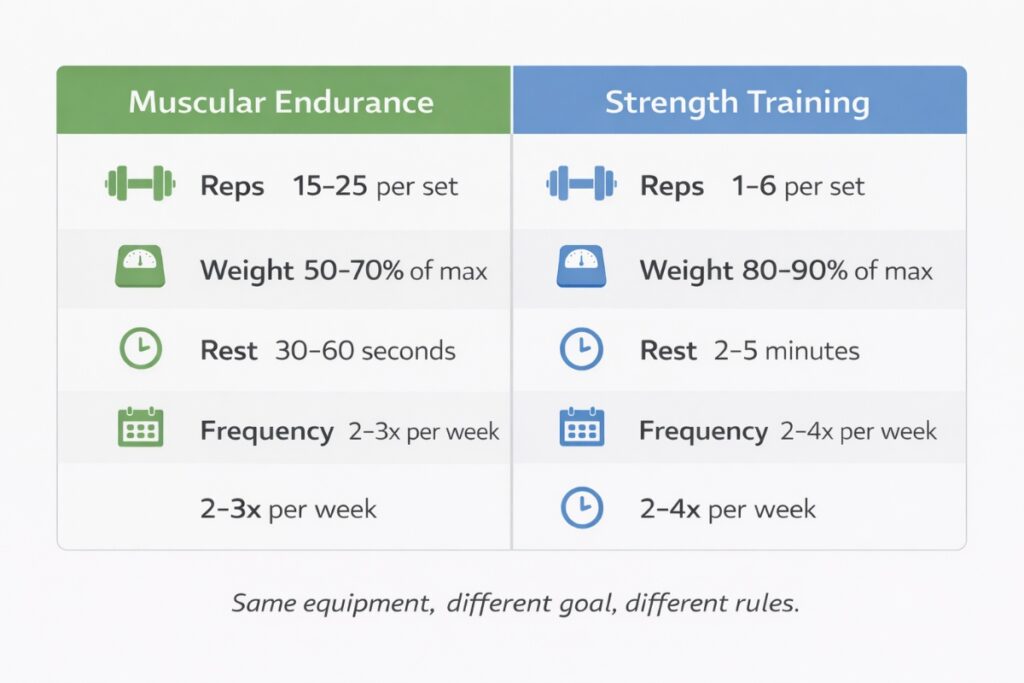
The numbers above are starting points — here’s how to adjust them based on what you’re actually experiencing:
| Situation | What to Do |
|---|---|
| Completing 25 reps easily | Increase weight by 5–10% |
| Struggling before rep 12 | Reduce the load |
| Rest feels too long | Cut it by 10 seconds each week |
| Form breaks down mid-set | Weight is too heavy — drop it |
Don’t know your 1-rep max? Start with a weight where you can complete 15 reps but rep 14 and 15 feel genuinely difficult. That’s your starting point.
Why This Rep Range Works — The Science, Simply Explained
The 15–25 rep range with short rest triggers four specific changes inside your muscles — and understanding them changes how seriously you take the rest timer.
1. Metabolic Stress Your muscles accumulate lactate and hydrogen ions during sustained effort. This buildup signals the body to adapt — building greater tolerance for sustained output. Shorter rest keeps this stress elevated across the entire session, which is what drives the adaptation.
2. Mitochondrial Density Mitochondria are your muscle cells’ energy factories. Endurance training increases both their number and efficiency through a built-in cellular sensor for sustained energy demand — when that demand stays high long enough, your body responds by building more energy-producing infrastructure inside the muscle. The result: muscles that produce energy longer before failing.
Here’s what most people don’t realize: In a traditional set of 20 bodyweight reps, the first 12–15 reps often fall below the intensity threshold needed to trigger this adaptation. Only the final few reps actually create the metabolic stress your muscles need to improve. This is why drop sets and tempo work are so effective — they extend the time your muscles spend in that effective zone.
3. Capillary Growth More capillaries means more oxygen delivered to working muscles. Endurance training stimulates angiogenesis — the growth of new blood vessels — allowing muscles to stay aerobically fueled longer before fatigue sets in.
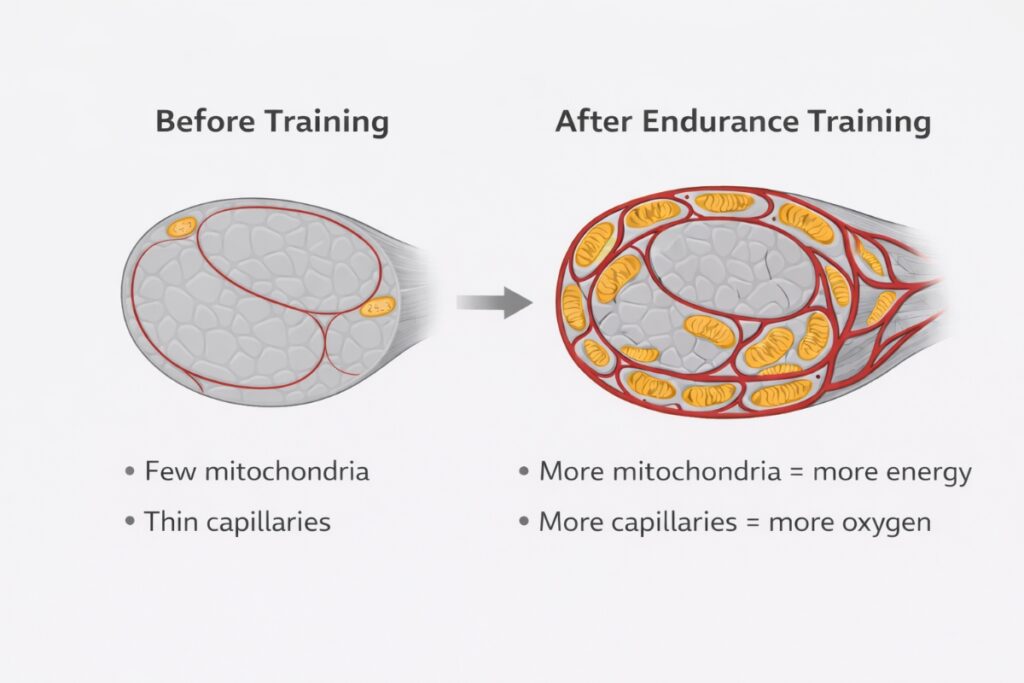
4. Slow-Twitch Fiber Development The 15–25 rep range primarily targets Type I (slow-twitch) muscle fibers — the ones built for sustained, repeated effort. Strength training targets Type II (fast-twitch) fibers built for short explosive bursts. Both matter, but for endurance, Type I fibers are the priority.
These adaptations are supported by the American College of Sports Medicine (ACSM) and a 2015 review linking endurance training to improved mitochondrial function and muscle blood circulation.
Best Exercises for Muscular Endurance
From personal experience, the best endurance exercises are ones you can perform with consistent form even as fatigue builds — not exercises that require perfect conditions to execute correctly.
📌 New to training? Start with Day 1 of the weekly plan at the bottom of this page. Do 2 sets instead of 3, rest 60 seconds between sets, and focus on form before chasing reps. Get comfortable with the movements first — the numbers will follow.
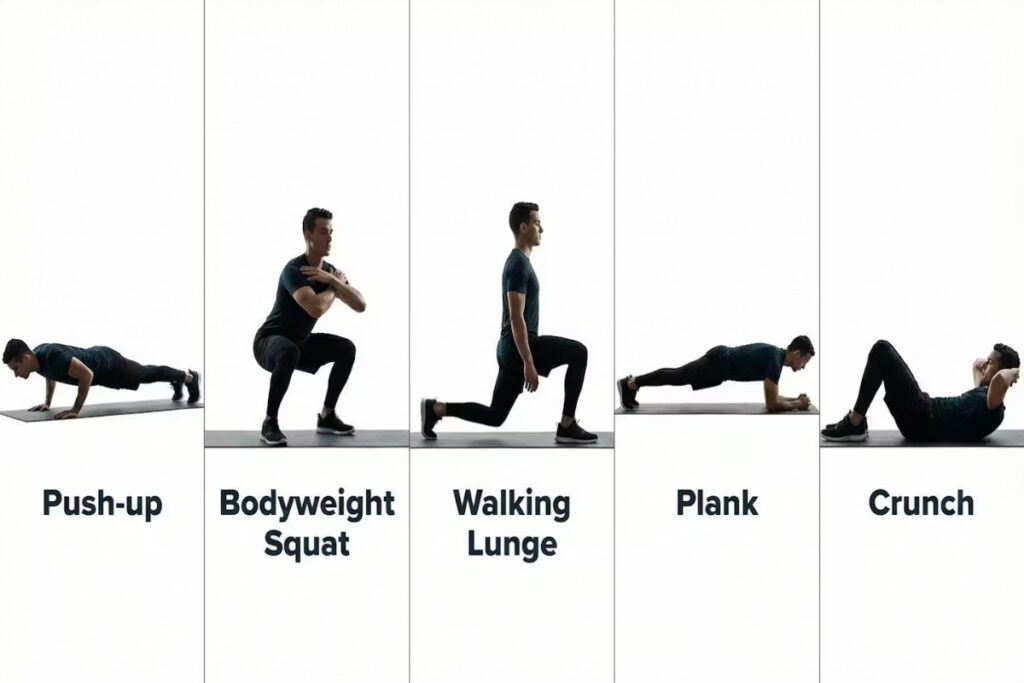
Bodyweight Exercises (No Equipment Needed)
| Exercise | Target Muscles | Endurance Sets x Reps |
|---|---|---|
| Push-ups | Chest, shoulders, triceps | 3 x 15–20 |
| Bodyweight squats | Quads, glutes, hamstrings | 3–4 x 20–25 |
| Walking lunges | Quads, glutes, calves | 3 x 20 (each leg) |
| Plank hold | Core, lower back | 3 x 30–45 sec |
| Crunches / Leg raises | Abs | 3 x 25 |
| Calf raises | Calves, lower leg | 3 x 25–30 |
Gym-Based Exercises
| Exercise | Target Muscles | Endurance Sets x Reps |
|---|---|---|
| Dumbbell chest press | Chest, shoulders, triceps | 3 x 15 |
| Dumbbell rows | Back, biceps | 3 x 15 (each arm) |
| Dumbbell overhead press | Shoulders, triceps, core | 3 x 15 |
| Cable face pulls | Rear delts, upper back | 3 x 20 |
| Light barbell squats | Full lower body | 4 x 20 |
| Resistance band circuits | Full body | 3 rounds |
Dynamic exercises build endurance through movement. But there’s a second category most people skip entirely — and it works differently.
Isometric Training — The Underused Endurance Tool
Most people skip this entirely. That’s a mistake — especially if you’re recovering from an injury or want to build endurance without loading joints.
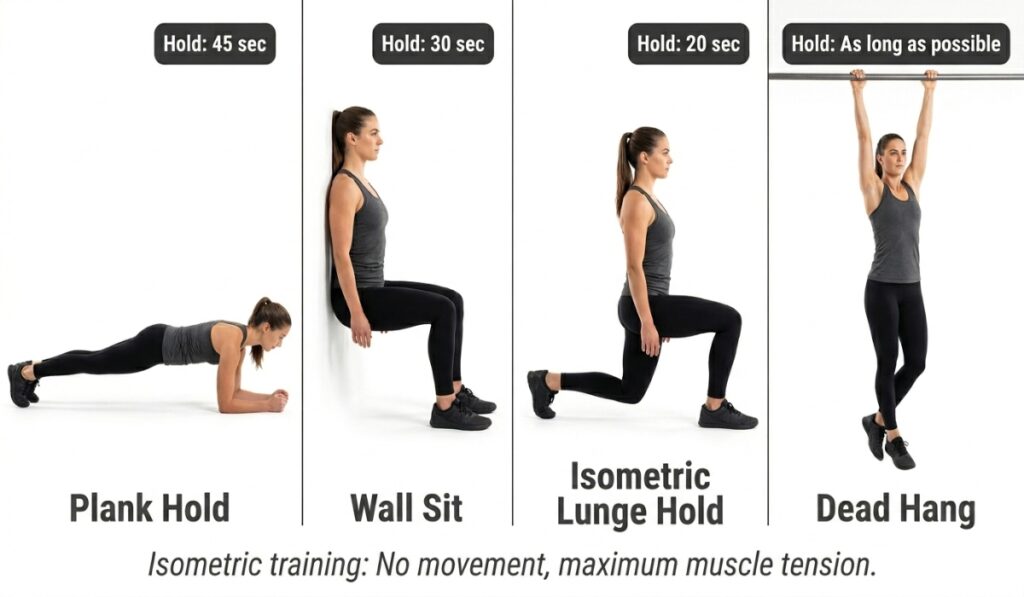
Isometric contractions are holds — you contract the muscle and maintain that position without movement. The plank is the most common example, but the method extends to wall sits, isometric lunges, and dead hangs.
A 2014 study found maximum improvements in abdominal endurance when holding a plank to failure five or more times per week. That’s a significant result from one simple exercise done consistently.
Why isometrics work for endurance:
- They keep muscles under continuous tension — maximizing time under metabolic stress
- They load the muscle without moving the joint — which is why physios use them in rehab before returning patients to full movement
- They’re easy to progress: simply extend the hold time week over week
| Exercise | Hold Target | Sets | Rest |
|---|---|---|---|
| Plank | 30–60 sec (build to failure) | 3–5 | 30 sec |
| Wall sit | 30–45 sec | 3 | 30 sec |
| Isometric lunge hold | 20–30 sec each leg | 3 | 30 sec |
| Dead hang | As long as possible | 3 | 45 sec |
Injury recovery note: If you’re coming back from a knee, shoulder, or lower back issue, isometric training is often the safest way to rebuild endurance in the affected muscles before returning to full movement. Always check with a physiotherapist first.
How to Progress Your Endurance Training?
This is where most people stall — they do the same workout every week and wonder why nothing changes. Progression is what separates improvement from maintenance.
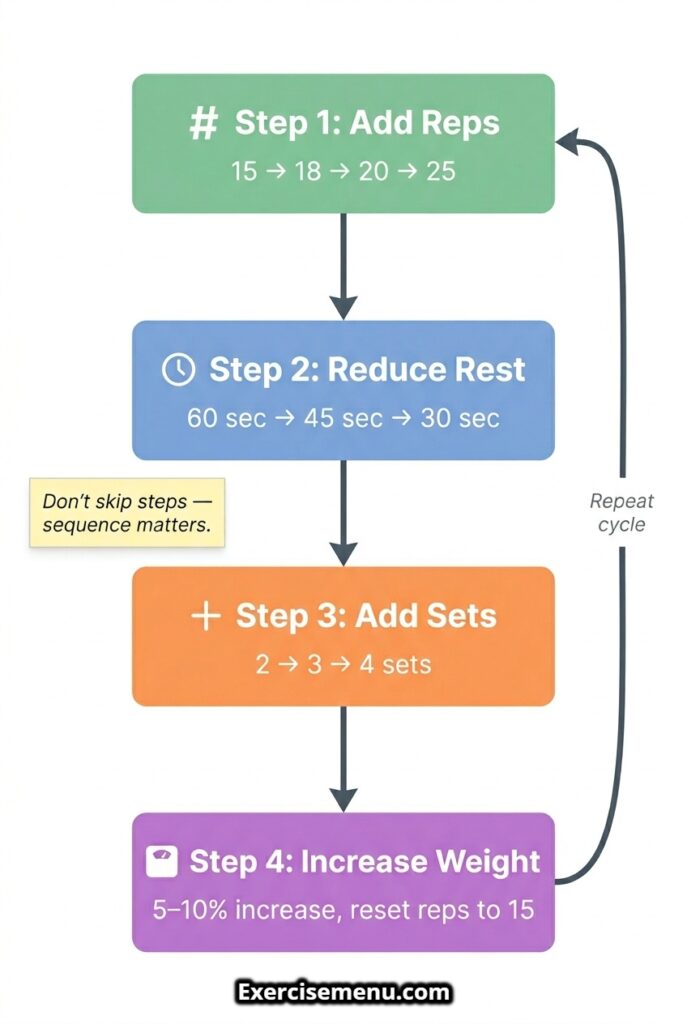
Here’s a simple system I’ve found works well. Follow these steps in order — don’t jump ahead:
Step 1 — Build Your Rep Base Start at 15 reps. When 15 feels manageable for 2 consecutive workouts, move to 18, then 20, then 25.
Step 2 — Reduce Rest Time Once you’re hitting 20+ reps comfortably, reduce rest from 60 seconds → 45 seconds → 30 seconds over 2–3 weeks. This is often more effective than adding weight for building endurance.
Step 3 — Add a Set Move from 2 sets → 3 → 4 before considering a weight increase.
Step 4 — Increase Weight Only after you can complete 25 reps with 30-second rest consistently. Then reset reps back to 15 with the new weight and repeat the cycle.
Most people notice improved endurance within 2–3 weeks — sets that used to destroy you start feeling manageable. Measurable benchmark improvements typically show up around the 4–6 week mark.
One simple self-check: track your Set 1 reps vs your Set 3 reps. If the gap is shrinking over weeks — Set 1: 20 reps, Set 3: 17 reps becoming Set 1: 20, Set 3: 19 — your endurance is building. If the gap is growing, reduce the load or add a rest day.
Should You Train to Failure?
Occasionally — not every set.
Training to failure does stimulate adaptation. But doing it on every set leads to accumulated fatigue, form breakdown, and slower recovery that compromises your next session.
A smarter approach that I’ve found works better for consistent progress:
- Stop 1–2 reps before failure on most sets
- Use failure on the last set only of each exercise
- Limit true failure training to once every 1–2 weeks per exercise
Isometric holds are the exception — for planks and timed holds, training to form failure (not muscular failure) is safe and effective.
Advanced Methods — When Basic Progression Slows
After 8–12 weeks of consistent training, your body stops responding to the same stimulus. These methods fix that — they’re not just harder, they’re structurally different from what you’ve been doing.
Drop Sets Complete your target reps, immediately reduce weight by 20–30%, and continue without rest. This pushes muscles past normal fatigue and creates a significantly longer period of effective metabolic stress. Compare 24 bodyweight calf raises (maybe 4–5 reps that actually trigger adaptation) vs 8 weighted reps + 2 drop sets of 8 — potentially 20+ effective reps for the same duration.
Supersets Pair two exercises back-to-back with no rest between them. Example: Push-ups → Dumbbell Rows. One muscle group recovers while the other works, which allows higher total volume with less wasted time.
Circuit Training 4–6 exercises performed in sequence with only 15–30 seconds rest between rounds. The accumulated fatigue across muscle groups is the point — it’s harder than it sounds and exactly what full-body endurance demands.
Pulse Reps After completing a full set to failure, continue with small, controlled contractions at the shortened range of the movement. These extend the set well past the point of normal failure by keeping the muscle under continuous tension.
Example: After completing 15 dumbbell curls to failure, continue with small partial curls in the shortened (contracted) position — keeping the weight at the top half of the movement only — for 8–10 additional reps. The muscle stays under tension the entire time without getting a chance to fully recover.
Blood Flow Restriction (BFR) Training BFR training uses a cuff around the limb to partially restrict blood returning from the muscle — not blood going in. The result is significant metabolic stress using loads as light as 20–30% of your max, making it ideal when joints can’t handle heavier loading. When the cuff is deflated between sets, the reperfusion effect creates a strong stimulus for capillary growth.
⚠️ Warning: BFR training should only be performed under professional supervision. Incorrect cuff placement or pressure can cause nerve damage or restrict blood flow dangerously.
| Method | Best For | When to Add It |
|---|---|---|
| Drop sets | Extending effective reps | After 8 weeks of base training |
| Supersets | Volume efficiency | After 6–8 weeks |
| Circuits | Full-body endurance | Any time |
| Pulse reps | Pushing past failure safely | After 10–12 weeks |
| BFR | Joint-friendly endurance stimulus | With professional guidance only |
How to Measure Your Muscular Endurance Progress
Progress in endurance is easy to miss if you’re not tracking it. Run these tests every 3–4 weeks — before your workout, not after:
| Test | How to Perform It | What Improvement Looks Like |
|---|---|---|
| Push-up test | Max reps in one set, no stopping, full range | Number increases over weeks |
| Plank hold | Time until form breaks (hips sag or rise) | Duration increases |
| Squat reps | Max bodyweight squats in 60 seconds | Count increases |
Record the numbers and compare every 3–4 weeks. Seeing those numbers move is one of the most motivating things in training.
Muscular Endurance vs Cardio Endurance — They’re Not the Same
Running more won’t fix your muscular endurance — I learned that the hard way. That’s because these are two distinct systems with completely different training requirements.
| Muscular Endurance | Cardio Endurance | |
|---|---|---|
| What it trains | Muscles | Heart and lungs |
| Example activity | 25 push-ups, sustained squats | 30-minute run, cycling |
| Primary system | Muscular + metabolic | Cardiovascular |
| Fatigue point | Muscle failure | Breathlessness |
| Training method | Resistance training, high reps | Aerobic exercise |
Both matter for complete fitness. NHS physical activity guidelines recommend combining strength and endurance training for overall health. Add 1–2 cardio sessions on top of your endurance work, not instead of it.
Common Mistakes That Kill Your Endurance Progress
In my experience, most people make the same handful of mistakes repeatedly. Fixing even one of these can immediately improve results.
| Mistake | Why It Hurts | The Fix |
|---|---|---|
| Weight too heavy | You’re training strength, not endurance — can’t reach 15 clean reps | Drop the load until you can complete 15 with good form |
| Resting too long | Anything longer than 60 seconds and you’re training a different system | Keep rest between 30–60 seconds |
| Form breaks under fatigue | Sloppy reps don’t build endurance — they build injury risk | Stop the set when form goes, not when you want to stop |
| No progression plan | Doing the same workout every week = no improvement | Follow the 4-step progression system above |
| Skipping recovery | Muscles adapt during rest, not training | Minimum 1 rest day between sessions, 7–8 hours sleep |
| Ignoring weaker muscle groups | Imbalances become injuries under endurance load | Include unilateral exercises (single-leg, single-arm) |
One More Thing — Nutrition Matters
Training is only half the equation. Muscles recover and adapt during rest — and they need adequate protein to do it. Aim for 0.7–1g of protein per pound of bodyweight daily. Without it, your endurance gains will be slower than they should be.
Complete Weekly Training Plan
Already training for strength or hypertrophy? Before each session: 5 minutes of light movement — jumping jacks, arm circles, leg swings, or a brisk walk. Cold muscles fatigue faster and are more injury-prone.
Before each session: 5 minutes of light movement — jumping jacks, arm circles, leg swings, or a brisk walk. Cold muscles fatigue faster and are more injury-prone.
This plan is built around the exact rep, set, and rest guidelines above. Adjust the exercises based on available equipment.
Day 1 — Full Body Endurance
| Exercise | Sets | Reps | Rest |
|---|---|---|---|
| Bodyweight squats | 3 | 20 | 45 sec |
| Push-ups | 3 | 15–20 | 45 sec |
| Walking lunges | 3 | 20 each leg | 45 sec |
| Plank hold | 3 | 40 sec | 30 sec |
| Calf raises | 3 | 25 | 30 sec |
Day 2 — Upper Body + Core
| Exercise | Sets | Reps | Rest |
|---|---|---|---|
| Dumbbell chest press | 3 | 15 | 45 sec |
| Dumbbell rows | 3 | 15 each arm | 45 sec |
| Dumbbell overhead press | 3 | 15 | 45 sec |
| Leg raises | 3 | 20 | 30 sec |
| Crunches | 3 | 25 | 30 sec |
Day 3 — Lower Body Focus
| Exercise | Sets | Reps | Rest |
|---|---|---|---|
| Squats | 4 | 20 | 45 sec |
| Step-ups | 3 | 15 each leg | 45 sec |
| Calf raises | 3 | 25 | 30 sec |
| Wall sit (isometric) | 3 | 45 sec | 30 sec |
Follow this plan for 4 weeks before making any changes. Consistency matters more than perfection in the first month.
Rest days between sessions are essential. Sample weekly layout: Day 1 Monday, Day 2 Wednesday, Day 3 Friday — rest or light activity on other days.
Conclusion
Muscular endurance isn’t built by accident. It’s built by consistently training your muscles to sustain effort — with the right rep range, short rest periods, and a clear progression system.
The formula is simple: 15–25 reps, 30–60 second rest, 2–4 sets, 2–3x per week. Progress systematically, track your benchmarks every few weeks, and don’t skip recovery.
When I made this switch, the difference showed up within weeks — not just in training, but in everything physical I did. Carrying things felt easier. Sports felt more controlled. Fatigue stopped hitting as early or as hard. Give it 8 weeks of consistent effort. You’ll feel exactly what I mean.
The goal isn’t just to lift more. It’s to last longer, move better, and stay injury-free while doing it.
FAQs
What rep range builds muscular endurance?
15–25 reps per set using 50–70% of your maximum weight. This range creates the metabolic and fiber-level adaptations needed for sustained performance without crossing into pure strength training territory.
How many sets should I do for endurance?
2–4 sets per exercise. Beginners should start with 2 and build to 4 as conditioning improves. Chasing volume too early leads to form breakdown before adaptation can occur.
How long should I rest between sets for endurance?
30–60 seconds. Shorter rest keeps metabolic stress elevated — which is the primary driver of endurance adaptation. Resting longer than 90 seconds shifts the training effect toward strength.
How often should I train for muscular endurance?
2–3 times per week with at least one rest day between sessions. More frequent training without adequate recovery produces fatigue accumulation, not adaptation.
Can endurance training build muscle too?
Yes, but less effectively than dedicated hypertrophy training. Beginners typically see some muscle growth in the early weeks. As training age increases, endurance programming is optimized for performance and sustained output — not size.
What exercises are best for muscular endurance?
Push-ups, squats, lunges, planks, rows, and calf raises are excellent starting points. Full-body circuits combining multiple exercises are particularly effective because they train different muscle groups to manage fatigue simultaneously.
Is muscular endurance the same as cardio fitness?
No. Cardio endurance involves the heart and lungs supplying oxygen. Muscular endurance is specific to the muscles’ ability to keep contracting under fatigue. Both should be trained — but they require different methods and they improve through different physiological mechanisms.
Should I train to failure for endurance?
Occasionally — on your last set only. Training to failure every set accumulates fatigue faster than the body can adapt, which slows progress and increases injury risk. Stop 1–2 reps before failure on most sets and use full failure sparingly.
What is the difference between muscular endurance and muscular strength?
Strength is about how much force a muscle can produce in one effort. Endurance is about how many times it can produce force repeatedly. They require different rep ranges, rest periods, and weights — and training one doesn’t automatically improve the other.
How do I know if my muscular endurance is improving?
Track simple benchmarks every 3–4 weeks: max push-ups in one set, plank hold duration, squat reps in 60 seconds. Also compare your reps in Set 1 vs Set 3 — a narrowing gap between early and late sets is a clear sign endurance is building.
