


The first time I walked into a gym, my trainer handed me a sheet that said “3×10 squats.” I stared at it for a good 30 seconds. Three what? Ten what? Nobody explained it. I just copied the person next to me and hoped for the best.
If you have ever stood in a gym feeling that same confusion, you are in the right place. By the end of this guide, you will not just know what reps and sets mean — you will understand exactly why they work, and how to use them for your specific goal.
What Is a Rep?
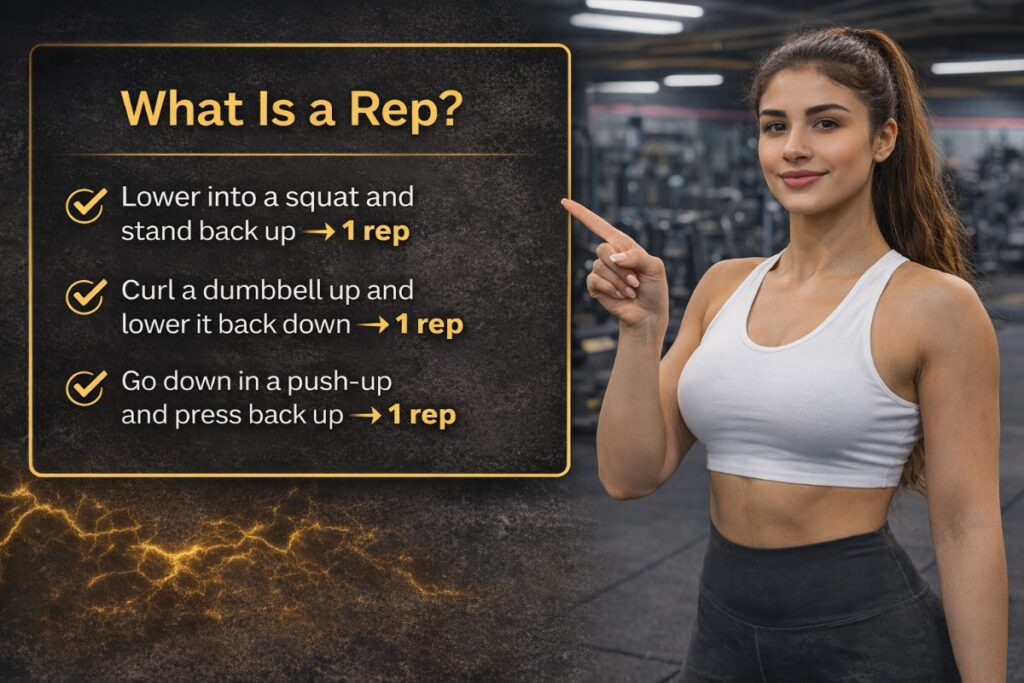
A rep — short for repetition — is one complete movement of an exercise, from start to finish and back again.
- Lower into a squat and stand back up → 1 rep
- Curl a dumbbell up and lower it back down → 1 rep
- Go down in a push-up and press back up → 1 rep
The critical word is complete. A half-squat is not a rep. A partial push-up is not a rep. Each rep must travel through the full range of motion — because cutting it short reduces muscle activation and quietly builds poor movement habits that become harder to fix the longer you leave them.
What Is a Set?
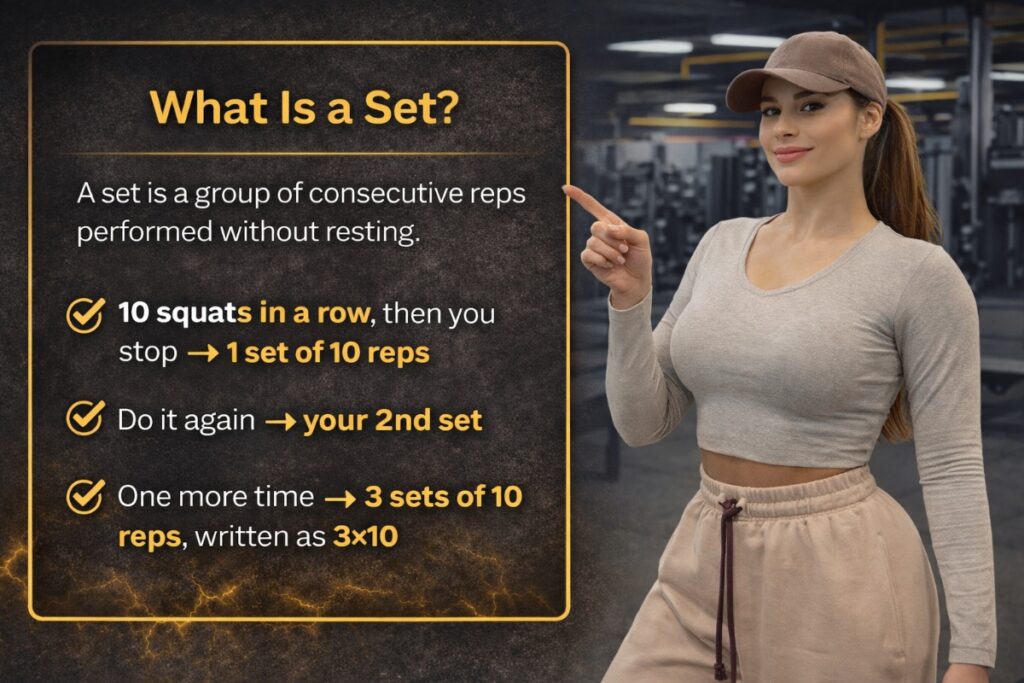
A set is a group of consecutive reps performed without resting.
- 10 squats in a row, then you stop → 1 set of 10 reps
- Do it again → your 2nd set
- One more time → 3 sets of 10 reps, written as 3×10
That notation — sets × reps — is the universal shorthand used in every gym and every workout program on earth. Once you crack that code, everything else clicks.
The 3 Phases Inside Every Single Rep
Before we go further, here is something most beginner guides completely skip — and it costs people real results.
A rep is not one action. It has three distinct phases, and how you handle each one determines how much work your muscles actually do.
Concentric phase (lifting): The muscle shortens under load. Curling the dumbbell up. Standing up from a squat. Pressing the bar away from your chest. This is the part most people think of as “the rep.”
Isometric phase (pause): A brief hold at the top of the movement. Most beginners skip this entirely, which is what makes reps look bouncy and rushed.
Eccentric phase (lowering): The muscle lengthens under tension as you return to the start position. Lowering the dumbbell back down. Sitting into the squat. This phase actually produces the strongest muscle-building signal — yet it is the one most beginners rush through the fastest. A controlled 2–3 second lowering tempo on any exercise will immediately make your training more effective.
Own all three phases. That is what a quality rep looks like.
Why Rep Ranges Are Not Arbitrary Numbers?
Here is something most beginner articles gloss over: rep ranges are not random. Each range creates a different physiological response in your muscles. Change the reps, and you change the outcome of your training.
According to the American College of Sports Medicine, resistance training variables — including rep ranges, load, and rest — should be deliberately matched to a person’s specific goal. This is the foundation of intelligent training.
The 3 Rep Ranges and What Each One Does
Low reps (1–5): Maximum strength
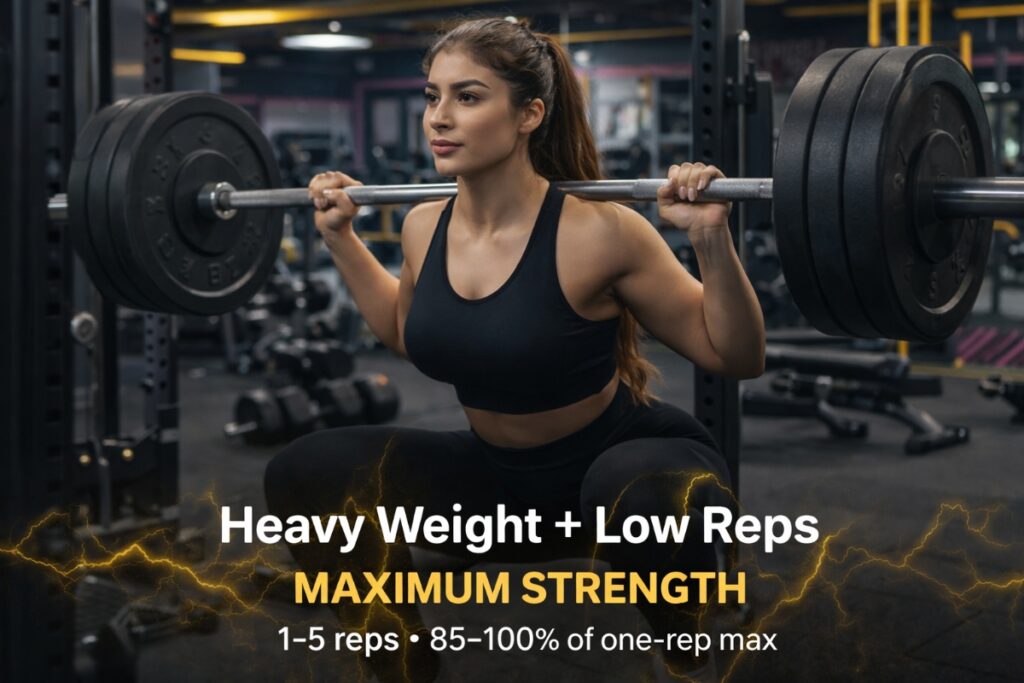
Heavy weight for few reps trains your nervous system more than it visibly changes your muscles. Your brain gets better at firing more muscle fibers at once, generating greater force output.
This is best for raw strength, athletic performance, and building the foundation that makes everything else more effective. The NSCA recommends training at 85–100% of your one-rep maximum for maximal strength — which lands in this rep range.
Moderate reps (6–12): Muscle growth (hypertrophy)
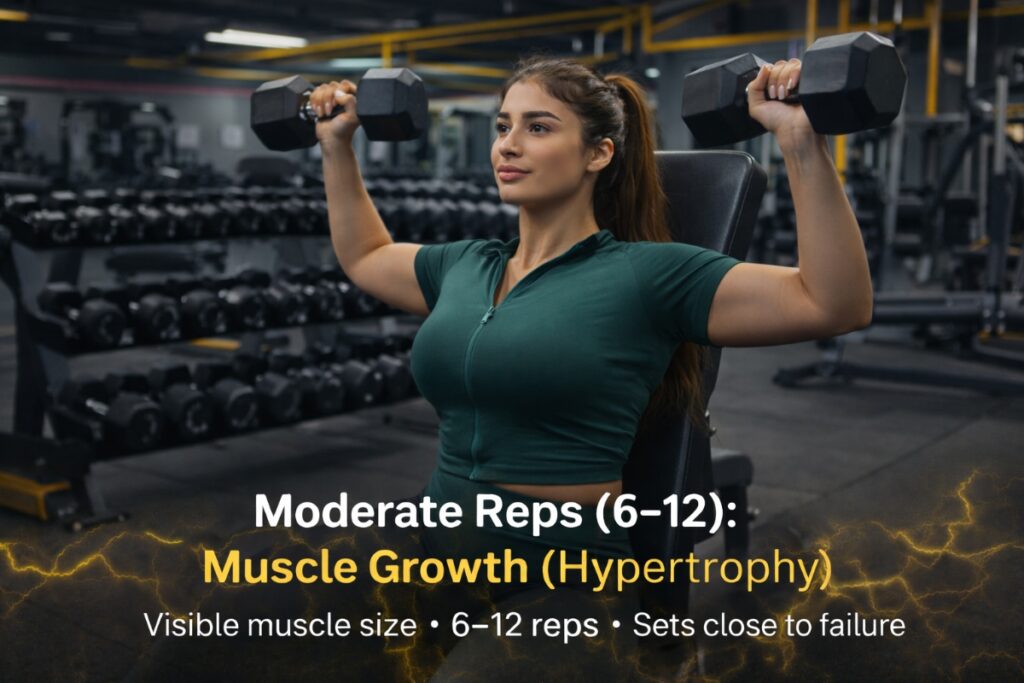
This is the most productive range for building visible muscle size. Moderate weight with enough volume creates two key drivers of muscle growth: mechanical tension and metabolic stress.
A landmark meta-analysis published on PubMed by Schoenfeld et al. (2017) confirmed that muscle growth can occur across a wide range of rep schemes — but 6–12 remains the most efficient zone for most people, particularly when sets are taken close to muscular failure.
High reps (12–20+): Muscular endurance
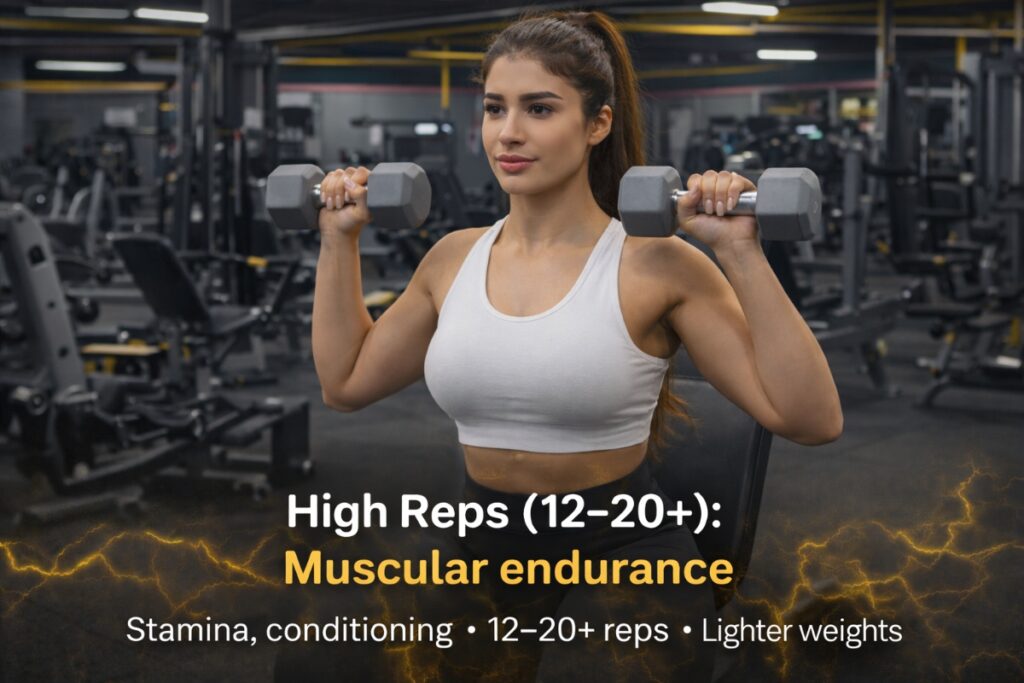
Lighter weight for higher reps trains your muscles to sustain effort over time. Your cardiovascular system and slow-twitch muscle fibers carry most of the load here.
This range suits sports and activities that demand stamina over peak force — hiking, cycling, swimming, football, cricket. It can still build meaningful muscle in beginners when effort is genuinely high.
Quick Reference: Rep Ranges at a Glance
| Goal | Rep Range | Sets | Rest Between Sets |
|---|---|---|---|
| Maximum Strength | 1–5 | 3–5 | 2–5 minutes |
| Muscle Growth (Hypertrophy) | 6–12 | 3–4 | 60–90 seconds |
| Muscular Endurance | 12–20+ | 2–3 | 30–60 seconds |
| General Fitness (Beginner) | 8–15 | 2–3 | 60–90 seconds |
How Many Reps and Sets Should a Beginner Actually Do?
For your first 4–6 weeks, keep it genuinely simple:
- 2–3 sets per exercise
- 10–12 reps per set
- Train 2–3 times per week, full-body sessions
- Rest 60–90 seconds between sets
- Weight is secondary — movement quality is everything
Choose a weight where the last 2 reps feel hard but your form stays clean. That is your working weight. Do not chase numbers you cannot control yet.
Sample beginner full-body workout (2–3x per week):
| Exercise | Sets | Reps |
|---|---|---|
| Goblet Squat or Bodyweight Squat | 3 | 10–12 |
| Push-Up (or Incline Push-Up) | 3 | 8–10 |
| Dumbbell Row | 3 | 10–12 |
| Glute Bridge | 3 | 12–15 |
| Plank Hold | 3 | 20–30 sec |
Warm up for 5–10 minutes before you start. Stretch for 5 minutes after. Do this consistently and it works.
Progressive Overload: The Only Principle That Actually Drives Progress
Your muscles adapt to whatever you consistently ask of them. Once they adapt, they stop changing — unless you give them a new reason to grow.
Progressive overload means gradually increasing the challenge on your muscles over time. The simplest way to apply it is called double progression:
- Work within a rep range — say 8–12 reps.
- Once you can complete all sets at 12 reps with clean form for two consecutive workouts, increase the weight by 5–10%.
- Drop back to 8 reps with the new weight and repeat the cycle.
You add reps first, then weight. This cycle can repeat for months and it is the closest thing to a guaranteed result that training has to offer.
Training to Failure and Reps in Reserve?
Training to failure means doing reps until you physically cannot complete another one with correct form.
You do not need to hit failure on every set — that is a fast route to burnout. But you need to get close to it. If you finish your last rep feeling like you had five more in you, the stimulus was not strong enough to force change.
A useful tool here is Reps in Reserve (RIR) — a simple self-rating of how many reps you could still do at the end of a set:
| RIR | What It Means | What to Do |
|---|---|---|
| RIR 0 | True failure — nothing left | Fine occasionally, not every set |
| RIR 1–2 | Could do 1–2 more reps | Ideal training zone |
| RIR 3–4 | Feeling comfortable | Push harder or add weight |
| RIR 5+ | Too easy | Increase load immediately |
Most of your working sets should land at RIR 1–3. That is where adaptation happens.
How Long to Rest Between Sets?
Rest is not wasted time — it is when your muscles partially recover so the next set is worth doing. Skip it and you are effectively turning three sets into one long, mediocre set.
- Heavy strength work: 2–5 minutes
- Hypertrophy training: 60–90 seconds
- Endurance and circuit training: 30–60 seconds
One practical trick I use with almost every client: pair a push exercise with a pull exercise during rest. Bench press, then immediately dumbbell row while your pressing muscles recover. By the time the row is finished, you are ready to press again. Total workout time drops by 30–40% with zero loss in quality. This is called active rest or a superset.
DOMS: The Soreness That Shows Up the Next Day
If you are new to training — or returning after a long break — expect DOMS (Delayed Onset Muscle Soreness) to arrive 24–48 hours after your first few sessions. It is a dull, heavy ache in the muscles you trained.
This is not injury. It is your body rebuilding muscle tissue in response to a new demand. It fades significantly within a few days, and the more consistent you become with training, the less intense it gets over time.
When DOMS hits hard after your first workout, that is not a reason to stop. It is confirmation that something real happened.
The One Mistake That Kills Most Beginners’ Progress
After years of training and coaching, one mistake shows up more than any other: choosing weight so light that the muscles are never genuinely challenged.
People complete their 3 sets of 12, feel fine walking out, and genuinely wonder why nothing has changed after two months. The answer is always the same — the last 2–3 reps of your working set need to require real effort. Your form must hold — but it should not be comfortable.
If it feels easy, it is not working.
Frequently Asked Questions
What are sets and reps for beginners?
A rep is one complete movement of an exercise. A set is a group of reps done back-to-back before resting. Beginners should start with 2–3 sets of 10–12 reps, 2–3 times a week, with the focus on learning correct form before increasing weight.
What is the 3-3-3 rule at the gym?
It is not an officially standardized protocol, but the 3-3-3 rule is widely understood to mean 3 exercises, 3 sets each, done 3 times per week. It is a practical and sustainable framework for beginners who want a minimal but effective starting point.
What is the 3-3-3 workout rule for beginners?
In a beginner context, it typically means selecting 3 compound movements — like a squat, a push, and a pull — performing 3 sets of each, and training 3 days per week. It keeps volume manageable for recovery while still providing enough stimulus to see early progress.
What is the 5-3-1 rule in the gym?
The 5-3-1 is a structured strength program created by powerlifter Jim Wendler. It runs in four-week cycles: week one focuses on sets of 5 reps, week two on sets of 3, week three on a final heavy set of 1+ reps at near-maximal effort, and week four is a planned deload.
It is built around the squat, deadlift, bench press, and overhead press. It is designed for intermediate lifters — not ideal as a first program, but worth understanding as you progress.
As a beginner, does the exact number of sets and reps matter?
Less than most people think. Within a sensible range — 2–4 sets of 6–15 reps — almost any combination will produce results for someone new to training, as long as the weight is genuinely challenging and sessions happen consistently.
What matters most in the beginning is showing up regularly, maintaining good form, and making things progressively harder over time. Precise programming becomes more important once the beginner stage is behind you.
