


Weight loss is one of the most searched topics on the internet — yet also one of the most misunderstood.
Millions of people diet every year.
Most of them lose weight.
And most of them gain it back.
This isn’t because people are lazy, weak, or undisciplined. It’s because the dominant weight-loss narrative is biologically wrong. For decades, we’ve been told that weight loss is simple:
But if it were that simple, obesity wouldn’t be a global crisis.
Instead of repeating surface-level advice, this article explains how fat loss actually works inside the human body — using hormonal science, metabolic regulation, and nutritional signaling, backed by the ideas found in The Obesity Code, Why We Get Fat, and Eat to Beat Disease.
This is not a quick-fix diet. This is a biological framework for sustainable fat loss.
Why Most Weight Loss Methods Fail (And Why People Regain Weight)
Most people don’t fail at weight loss.Weight loss systems fail people.
To understand why, we need to look beyond motivation and willpower — and examine how the body responds to dieting.
The Calorie Myth – Why “Eat Less, Move More” Is Not Enough
Calories matter — but they are not the primary driver of fat storage or fat loss.The calorie model assumes the human body works like a simple machine:
- Consume fewer calories → lose weight
- Consume more calories → gain weight
But the human body is not a calculator.It’s a self-regulating biological system.
Two people can eat the same number of calories and experience completely different outcomes:
- One loses fat
- One stores fat
- One feels energetic
- One feels exhausted and hungry
Why?
Because hormones control how calories are used.
Calories don’t tell your body what to do. Hormones do.When calories are reduced aggressively:
- Hunger hormones increase
- Metabolism slows down
- Energy expenditure drops
- Fat burning decreases
The body doesn’t see a “diet.”It sees a threat to survival.
The Real Reason Behind Weight Regain
Weight regain is not a mistake — it’s a predictable biological response.When you lose weight through calorie restriction:
- Your body lowers resting metabolic rate
- Hunger hormones like ghrelin rise
- Satiety hormones like leptin fall
This creates a powerful internal pressure to:
- Eat more
- Move less
- Restore lost weight
This is why:
- Biggest Loser contestants regained weight
- Yo-yo dieting is common
- Each diet attempt becomes harder than the last
The body always tries to return to its previous weight set-point.Until the hormonal environment changes, weight regain is almost inevitable.
Dieting Stress, Hunger, and Hormonal Damage
Chronic dieting doesn’t just affect weight — it affects the entire hormonal system.
Prolonged calorie restriction leads to:
- Elevated cortisol (stress hormone)
- Increased fat storage, especially around the abdomen
- Loss of muscle mass
- Increased cravings for sugar and refined carbs
This creates a vicious cycle:
- Diet harder
- Get hungrier
- Lose metabolic efficiency
- Regain more fat
This is why “discipline” fails long-term.You cannot out-willpower biology.
Why This Matters for Long-Term Fat Loss
From a biological perspective, fat gain is not a moral failure — it’s a hormonal signal problem.
Any system that ignores:
- Insulin regulation
- Metabolic adaptation
- Hormonal signaling
…will eventually fail.
Sustainable weight loss does not come from eating less.
It comes from changing the hormonal instructions your body receives.
Understanding Weight Gain – The Hormonal Perspective
If calories were the real cause of obesity, then eating less would permanently solve the problem.
But it doesn’t.
That’s because weight gain is not a calorie problem — it’s a hormonal regulation problem. Your body does not decide to store fat because you “overate.”
It stores fat because specific hormonal signals told it to do so. To understand weight loss, you must first understand why the body gains weight in the first place.
What Is Insulin and Why It Controls Fat Storage
Insulin is the most important hormone in weight gain and weight loss.
Its primary role is simple:
- Move glucose from the bloodstream into cells
- Decide whether energy should be used now or stored for later
When insulin levels are high:
- Fat burning is turned off
- Fat storage is turned on
When insulin levels are low:
- Fat burning is turned on
- Stored fat can finally be accessed
This is not theory — this is human physiology. Insulin is often misunderstood as a “blood sugar hormone,” but its real role is energy partitioning:
- Do we burn energy?
- Or do we store it as fat?
As long as insulin remains elevated, fat loss is biologically impossible, regardless of calorie intake.
How Modern Diets Keep Insulin Chronically High
The problem isn’t food quantity — it’s food signaling.
Modern diets are dominated by:
- Refined carbohydrates
- Added sugars
- Ultra-processed foods
- Frequent snacking
Each of these keeps insulin constantly elevated.
Instead of rising and falling naturally, insulin stays high all day:
- Breakfast spikes insulin
- Snacks prevent it from dropping
- Lunch spikes it again
- Evening snacks keep it elevated overnight
The body never enters a fat-burning state.
This explains a crucial paradox:
People can eat “normal” calories and still gain fat.
Because the timing and hormonal impact of food matters more than the raw number of calories.
How Carbs and Sugar Trigger Fat Gain
Not all calories create the same hormonal response.
Carbohydrates — especially refined ones — trigger the largest insulin release.
Sugar is uniquely dangerous because it:
- Spikes insulin rapidly
- Bypasses normal satiety signals
- Promotes insulin resistance over time
Fructose, a major component of sugar:
- Is processed in the liver
- Increases fat production
- Drives fatty liver and metabolic dysfunction
This is why populations didn’t become obese when calories increased —
they became obese when refined sugar and processed carbs became dietary staples.
Fat didn’t change.
Protein didn’t change much.
Sugar did.
Why Fat Does NOT Make You Fat
One of the biggest nutritional myths is that dietary fat causes body fat.
From a hormonal standpoint, this makes no sense.
Dietary fat:
- Has minimal impact on insulin
- Promotes satiety
- Slows digestion
- Reduces blood sugar spikes
This is why people can lose fat on:
- Low-carb diets
- Ketogenic diets
- Whole-food, higher-fat diets
The body stores fat only when insulin tells it to.
Fat is not the enemy.
Insulin mismanagement is.
Insulin Resistance – The Silent Weight Loss Killer
Over time, constant insulin spikes lead to insulin resistance.
This means:
- Cells stop responding properly to insulin
- The body produces even more insulin to compensate
- Fat storage accelerates
This creates a dangerous feedback loop:
- High insulin → fat storage
- Fat storage → insulin resistance
- Insulin resistance → higher insulin
At this stage:
- Hunger increases
- Energy drops
- Fat loss becomes extremely difficult
Insulin resistance is not just about diabetes —
it is one of the primary drivers of stubborn weight gain.
Inflammation, Hormones, and Weight Gain
Here’s where Eat to Beat Disease strengthens the framework.
Chronic inflammation:
- Disrupts insulin signaling
- Damages metabolic flexibility
- Promotes fat storage
Ultra-processed foods:
- Increase inflammatory markers
- Damage gut health
- Interfere with hunger hormones
Weight gain is not just about fat cells expanding —
it’s about a dysfunctional internal environment.
A body under constant inflammatory stress will always choose fat storage over fat burning.
Why Hormones Explain Every “Weight Loss Mystery”
Hormonal regulation explains:
- Why two people react differently to the same diet
- Why weight loss slows over time
- Why hunger increases during dieting
- Why exercise alone rarely causes fat loss
Calories describe energy quantity.
Hormones control energy destiny.
Once you understand this, weight loss stops being confusing —
and starts becoming predictable.
The Obesity Code – How the Body Really Loses Fat
Once you understand that hormones control fat storage, the next logical question is:
How does the body actually lose fat?
Fat loss is not triggered by eating less.
It is triggered when the body is finally allowed to access stored energy.
This is the central insight of The Obesity Code.
Why Fat Loss Is a Hormonal Process, Not a Math Equation
The calorie model assumes that fat loss happens when you create a calorie deficit.
The hormonal model explains why that deficit often fails.
Here’s the difference:
- Calorie model:
Eat less → lose weight - Hormonal model:
Lower insulin → access fat → lose weight
If insulin remains high:
- Fat is locked inside fat cells
- The body cannot access stored energy
- Hunger increases
- Metabolism slows
The body is forced to:
- Reduce energy output
- Increase appetite
This is why people feel tired, cold, and hungry on low-calorie diets.
They are not “burning fat.”
They are conserving energy.
The Body’s Energy Priority System
The human body follows a strict energy hierarchy:
- Burn glucose in the bloodstream
- Burn glycogen (stored carbs)
- Burn fat
Insulin determines which fuel source is used.
High insulin:
- Keeps the body stuck in glucose-burning mode
- Blocks fat access
Low insulin:
- Depletes glycogen
- Signals the body to switch to fat burning
Fat loss only begins after insulin drops.
This is why eating small meals all day — even “healthy” ones — can completely block fat loss.
Metabolism Explained in Simple Words
Metabolism is not “how fast you burn calories.”
Metabolism is how much energy your body feels safe spending.
When insulin is high and fat is inaccessible:
- The body perceives energy scarcity
- Metabolism slows
- Muscle breakdown increases
- Fat burning decreases
When insulin is low and fat is accessible:
- The body perceives energy abundance
- Metabolism remains stable
- Fat is used freely
- Hunger decreases
This explains why people on low-insulin approaches often report:
- Less hunger
- More stable energy
- Easier fat loss
The body is no longer fighting them.
Why Eating Less Can Make You Gain More Weight
This sounds counterintuitive — but it happens all the time.
Severe calorie restriction:
- Lowers metabolic rate
- Increases hunger hormones
- Raises cortisol
- Encourages fat regain
When the diet ends (and it always does):
- Metabolism stays low
- Appetite stays high
- Fat regain accelerates
This is why repeated dieting leads to:
- Higher body fat percentage
- Lower metabolic rate
- Increased insulin resistance
The problem wasn’t eating too much.
The problem was eating in a way that damaged hormonal balance.
The Set-Point Theory – Why the Body Fights Weight Loss
The body has a natural weight set-point — a range it tries to defend.
This set-point is influenced by:
- Insulin levels
- Inflammation
- Diet history
- Sleep and stress
Crash dieting lowers weight temporarily —
but it does not lower the set-point.
As long as the set-point remains high:
- Hunger increases
- Fat regain is aggressive
- Weight loss feels impossible
Lowering the set-point requires:
- Long-term insulin control
- Reduced inflammation
- Metabolic stability
Fat loss becomes easier only after the set-point shifts downward.
Why Exercise Alone Rarely Causes Weight Loss
Exercise is healthy — but it is a poor fat-loss tool on its own.
From a hormonal perspective:
- Exercise increases hunger
- The body compensates by reducing energy elsewhere
- Fat loss remains minimal if insulin is high
This is why:
- People can exercise daily and not lose fat
- Weight loss from exercise often plateaus
Exercise supports weight loss —
but diet controls hormonal access to fat.
Fat Loss Happens When the Body Feels Safe
The body only releases fat when it believes:
- Energy access is reliable
- Hormonal signals are stable
- Stress is manageable
Fat loss is not forced.
It is allowed.
This is the core message missing from most weight loss advice.
Intermittent Fasting – A Natural Fat Loss Tool
Intermittent fasting is often misunderstood as “not eating.”
In reality, it is strategic timing of eating designed to restore a natural hormonal rhythm that modern diets have destroyed.
Fasting is not new.
It is not extreme.
It is biologically normal.
For most of human history, food was not available 24/7 — and the human body evolved to function optimally under cycles of eating and not eating.
What Is Intermittent Fasting and How It Works
Intermittent fasting works by doing one simple thing:
Lowering insulin long enough for the body to access stored fat.
When you stop eating:
- Insulin levels fall
- Glycogen stores deplete
- Fat burning activates
- Growth hormone increases
- Metabolic rate stays stable
Unlike calorie restriction, fasting does not signal starvation.
Why?
Because during fasting:
- The body uses stored fat for energy
- Hunger hormones eventually decrease
- Energy availability remains high
The body is not deprived — it is switching fuel sources.
Fasting vs Starvation – The Critical Difference
Starvation is:
- Chronic calorie deficiency
- Continuous hormonal stress
- Muscle loss and metabolic slowdown
Fasting is:
- Time-limited
- Hormone-regulated
- Fat-driven energy usage
In fasting:
- Insulin decreases
- Growth hormone increases
- Muscle is preserved
- Fat is prioritized
This distinction is essential — and often ignored.
Different Types of Intermittent Fasting
There is no single “best” fasting method.
The goal is to create insulin-free windows, not to suffer.
16:8 Method
- 16 hours fasting
- 8-hour eating window
- Best for beginners
Benefits:
- Easy to maintain
- Minimal lifestyle disruption
- Strong insulin control
18:6 Method
- Longer fasting window
- Faster insulin reduction
- Improved fat access
Best for:
- People with insulin resistance
- Stubborn fat
24-Hour Fasting (Once or Twice Weekly)
- Powerful insulin reset
- Accelerated fat loss
- Enhanced metabolic flexibility
Best for:
- Metabolically healthy individuals
- Those experienced with fasting
Fasting duration should increase gradually, not aggressively.
Why Fasting Preserves Metabolism
One of the biggest fears around fasting is metabolic slowdown.
The opposite happens.
Studies consistently show:
- Growth hormone increases during fasting
- Noradrenaline rises
- Fat oxidation increases
This keeps metabolism stable or slightly elevated.
Why?
Because the body has access to stored energy.
When fat is available, there is no reason to slow down.
Who Should and Should NOT Do Intermittent Fasting
Fasting is powerful — but not universal.
Generally Suitable For:
- Overweight individuals
- Insulin-resistant people
- Those with frequent hunger
- People struggling with calorie control
Caution or Medical Supervision Needed For:
- Pregnant or breastfeeding women
- People with eating disorders
- Underweight individuals
- Certain medical conditions
Fasting should support health, not replace common sense.
Fasting and Inflammation Control
Here’s where Eat to Beat Disease strengthens the fasting model.
Fasting:
- Reduces inflammatory markers
- Improves cellular repair (autophagy)
- Enhances immune regulation
Lower inflammation means:
- Better insulin sensitivity
- Easier fat loss
- Improved metabolic health
Weight loss becomes a side effect of healing, not punishment.
Fasting Restores Metabolic Flexibility
Metabolic flexibility means:
- The ability to switch between glucose and fat efficiently
Modern diets destroy this ability.
Fasting restores it.
Once the body regains metabolic flexibility:
- Hunger normalizes
- Energy stabilizes
- Fat loss becomes easier
Fasting doesn’t force fat loss —
it removes the barriers that prevent it.
Why We Get Fat – The Truth About Food Choices
If fat gain were simply about overeating, then food quality wouldn’t matter.
But it does — more than most people realize.
Certain foods don’t just provide energy.
They change hormonal behavior, appetite regulation, and fat storage patterns.
This is the core argument behind Why We Get Fat — and it perfectly complements The Obesity Code.
Carbohydrates vs Fats – What Really Causes Weight Gain
The idea that fat makes you fat is one of the most damaging nutritional myths ever created.
From a hormonal standpoint:
- Fat causes minimal insulin release
- Carbohydrates cause significant insulin spikes
Since insulin is the primary fat-storage hormone, this alone explains why:
- High-carb diets promote fat storage
- Low-carb approaches often reduce hunger and weight
This doesn’t mean carbohydrates are inherently bad —
but refined carbohydrates are metabolically disruptive.
Refined Carbohydrates and Appetite Dysregulation
Refined carbs:
- Are rapidly digested
- Spike blood sugar
- Trigger insulin release
- Cause blood sugar crashes
This leads to:
- Increased hunger
- Cravings shortly after eating
- Overconsumption without satisfaction
The problem is not lack of discipline —
it’s biological appetite manipulation.
Whole foods rarely cause overeating.
Refined foods are engineered to.
Sugar – The Most Powerful Fat-Promoting Ingredient
Sugar deserves special attention.
Unlike starch:
- Sugar contains fructose
- Fructose is processed primarily in the liver
Excess fructose:
- Increases fat production
- Promotes fatty liver
- Drives insulin resistance
This explains why:
- Sugary beverages are strongly linked to obesity
- Liquid calories are uniquely harmful
Sugar does not trigger normal satiety signals.
It bypasses them.
Why Traditional Low-Fat Diets Fail
Low-fat diets reduce fat intake —
but replace it with carbohydrates and sugars.
This creates:
- Higher insulin levels
- Increased hunger
- Poor long-term adherence
People don’t fail low-fat diets because they’re weak.
They fail because the diet increases the very hormones that cause fat gain.
Protein – The Missing Piece in Most Diets
Protein behaves differently from both carbs and fats.
Protein:
- Increases satiety
- Preserves muscle mass
- Has minimal impact on insulin
- Requires more energy to digest
Higher-protein diets naturally reduce:
- Calorie intake
- Hunger
- Fat regain
This is why protein intake correlates strongly with:
- Successful weight loss
- Weight maintenance
Ultra-Processed Foods and Metabolic Damage
Ultra-processed foods:
- Disrupt gut bacteria
- Increase inflammation
- Alter hunger hormones
- Promote insulin resistance
These foods are not just “empty calories.”
They are metabolic disruptors.
The rise in obesity closely mirrors the rise in ultra-processed food consumption — not fat consumption.
Food Is Hormonal Information
Food is not just fuel.
It is biological instruction.
Each food tells the body:
- Store energy
- Burn energy
- Increase hunger
- Reduce hunger
Weight loss becomes easier when food choices:
- Lower insulin
- Improve satiety
- Reduce inflammation
This is why food quality matters more than calorie quantity.
Nutrition That Supports Weight Loss (Not Fights It)
Most diets focus on restriction.
But the body doesn’t heal through restriction —
it heals through proper nutritional signaling.
Weight loss becomes sustainable only when nutrition:
- Lowers inflammation
- Improves insulin sensitivity
- Restores metabolic balance
This is where Eat to Beat Disease adds critical depth to the fat-loss conversation.
Because a sick metabolism cannot lose weight efficiently.
The Link Between Inflammation and Weight Gain
Chronic inflammation quietly sabotages fat loss.
Inflammation:
- Interferes with insulin signaling
- Increases cortisol
- Promotes fat storage
- Disrupts hunger hormones
An inflamed body behaves like a stressed body —
and stressed bodies store fat for survival.
Many people don’t struggle with weight because they eat too much —
they struggle because their internal environment is inflamed.
Anti-Inflammatory Foods and Metabolic Repair
Certain foods actively reduce inflammation and improve metabolic function.
These foods:
- Improve insulin sensitivity
- Support mitochondrial health
- Enhance fat oxidation
Key anti-inflammatory food categories include:
- Leafy greens
- Cruciferous vegetables
- Berries
- Nuts and seeds
- Fatty fish
- Extra virgin olive oil
These foods don’t just “fit into a diet.”
They change how the body processes energy.
The Role of the Immune System in Fat Loss
Here’s a connection most weight-loss content ignores:
The immune system and metabolism are deeply linked.
When the immune system is constantly activated:
- Energy is diverted away from fat loss
- Inflammatory chemicals impair insulin
- The body prioritizes defense over repair
Nutrition that supports immune balance:
- Lowers chronic inflammation
- Frees metabolic resources
- Makes fat loss easier
Weight loss is not just metabolic —
it is immunological.
Foods That Naturally Improve Insulin Sensitivity
Some foods actively help the body respond better to insulin.
These include:
- Vinegar and fermented foods
- High-fiber vegetables
- Polyphenol-rich foods (berries, green tea)
- Omega-3 fatty acids
Improved insulin sensitivity means:
- Lower insulin levels
- Easier fat access
- Reduced hunger
This is why two people eating the same calories can experience different fat-loss results —
their insulin sensitivity is different.
Fiber, Gut Health, and Appetite Control
Fiber is not about digestion alone.
Fiber:
- Feeds beneficial gut bacteria
- Improves blood sugar control
- Enhances satiety
- Reduces inflammation
A healthy gut:
- Produces appetite-regulating compounds
- Improves insulin response
- Reduces cravings
Poor gut health often shows up as:
- Constant hunger
- Sugar cravings
- Weight regain
Fix the gut —
and appetite often fixes itself.
Micronutrients and Metabolic Efficiency
Many people are overfed but undernourished.
Micronutrient deficiencies:
- Reduce metabolic efficiency
- Increase fatigue
- Promote cravings
Key micronutrients for fat loss include:
- Magnesium
- Zinc
- Vitamin D
- B-vitamins
These nutrients don’t burn fat directly —
they allow fat-burning systems to function properly.
Healing First, Fat Loss Second
The body does not lose fat when it feels under threat.
It loses fat when:
- Inflammation is controlled
- Insulin signaling is efficient
- Nutrient needs are met
Weight loss becomes a side effect of metabolic repair.
This is why aggressive dieting fails —
and supportive nutrition succeeds.
Best Foods for Sustainable Weight Loss
Sustainable weight loss is not about eating less food.
It’s about eating foods that naturally regulate appetite, insulin, and inflammation.
When food works with the body, fat loss stops feeling like a battle.
Protein-Rich Foods for Fat Burning and Satiety
Protein plays a central role in fat loss — not because it burns fat directly, but because it changes eating behavior automatically.
Protein:
- Reduces hunger hormones
- Increases satiety
- Preserves lean muscle
- Supports metabolic rate
People who eat adequate protein naturally:
- Eat fewer calories
- Snack less
- Maintain weight loss longer
High-quality protein sources include:
- Eggs
- Fish
- Poultry
- Lean meats
- Greek yogurt
- Legumes and lentils
Protein intake is one of the strongest predictors of successful weight loss — regardless of diet style.
Fiber-Rich Foods That Control Hunger Naturally
Fiber works quietly but powerfully.
Fiber:
- Slows digestion
- Improves blood sugar control
- Feeds gut bacteria
- Enhances fullness
Unlike processed foods, fiber-rich foods are difficult to overeat.
Top fiber sources include:
- Vegetables (especially leafy greens)
- Beans and lentils
- Berries
- Seeds (chia, flax)
Fiber creates mechanical and hormonal satiety — meaning you feel full and stay full.
Healthy Fats That Help You Lose Weight
Healthy fats are often misunderstood.
When consumed with whole foods, fats:
- Reduce insulin spikes
- Increase satiety
- Stabilize energy levels
Beneficial fat sources include:
- Olive oil
- Avocados
- Nuts and seeds
- Fatty fish
Fat does not cause fat gain unless insulin is high.
In fact, healthy fats often make portion control effortless.
Low-Glycemic Carbohydrates and Metabolic Stability
Carbohydrates are not inherently harmful —
but their glycemic impact matters.
Low-glycemic carbs:
- Digest slowly
- Cause smaller insulin spikes
- Provide steady energy
Examples include:
- Whole vegetables
- Legumes
- Intact whole grains (in moderation)
These foods support weight loss without triggering fat storage.
Foods to Limit for Easier Weight Loss
Some foods make weight loss harder — not because they are “bad,” but because they disrupt hormonal balance.
These include:
- Sugary beverages
- Refined grains
- Ultra-processed snacks
- Industrial seed oils in excess
Reducing these foods often leads to:
- Lower hunger
- Better energy
- Easier fat loss
Notice the language: reduce, not eliminate.
Food Choice Simplifies Willpower
When food improves satiety and insulin control:
- Hunger decreases
- Cravings fade
- Consistency improves
Weight loss becomes behaviorally easier, not harder.
This is the hallmark of a sustainable approach.
Weight Loss for Everyone – Men & Women
Most weight loss advice fails because it assumes all bodies respond the same way.
They don’t.
Biology, hormones, age, and metabolic history all influence how fat is gained and lost.
Ignoring these differences leads to frustration — not results.
Weight Loss Differences Between Men and Women
Men and women store fat differently — and for biological reasons.
Men tend to:
- Store fat viscerally (around organs)
- Lose weight faster initially
- Respond quickly to insulin reduction
Women tend to:
- Store fat subcutaneously (hips, thighs)
- Be more sensitive to stress and cortisol
- Experience hormonal fluctuations (estrogen, progesterone)
This means:
- Women may lose weight more slowly
- Aggressive calorie restriction affects women more negatively
- Stress management is especially critical for women
Weight loss resistance in women is often hormonal — not behavioral.
The Role of Cortisol and Stress (Especially for Women)
Cortisol is a powerful fat-storage hormone.
Chronic stress:
- Raises cortisol
- Increases insulin resistance
- Promotes abdominal fat storage
This is why:
- Over-dieting backfires
- Excessive cardio stalls fat loss
- Sleep deprivation leads to weight gain
Weight loss improves when:
- Sleep improves
- Stress is managed
- Diet becomes supportive instead of restrictive
Weight Loss for Beginners – Where to Start
Beginners don’t need complexity.
They need hormonal alignment.
The most effective starting points:
- Reduce sugar and refined carbs
- Increase protein intake
- Eat whole, unprocessed foods
- Stop constant snacking
These steps alone often lead to:
- Reduced hunger
- Better energy
- Natural calorie reduction
Consistency matters more than perfection.
Why Advanced Dieters Struggle More
People who have dieted repeatedly often face:
- Slower metabolism
- Higher insulin resistance
- Increased cortisol
Their bodies have learned to defend fat aggressively.
For them:
- Fasting may need to be gentler
- Recovery periods are essential
- Nutrient sufficiency matters more
This is not failure —
it is adaptive biology.
Age, Hormones, and Metabolic Flexibility
As people age:
- Muscle mass decreases
- Insulin sensitivity often declines
- Recovery slows
This makes:
- Protein intake more important
- Resistance training more valuable
- Sleep more critical
Weight loss remains possible —
but it requires respecting biological context.
Personalization Is Biological, Not Optional
Successful weight loss adapts to:
- Sex
- Stress levels
- Diet history
- Metabolic health
The more personalized the approach,
the less resistance the body creates.
Common Weight Loss Myths That Are Destroying Your Progress
The weight loss industry is built on simple slogans.
But simple slogans often create complex damage.
Most people don’t struggle because they lack information.
They struggle because they believe information that is partially true and dangerously incomplete.
Let’s dismantle the most common myths — using biology, not opinions.
Myth #1: Eating Fat Makes You Fat
This myth came from outdated dietary ideology, not human physiology.
Dietary fat does not automatically become body fat.
Here’s the hormonal truth:
- Dietary fat produces minimal insulin response
- Insulin is the hormone that signals fat storage
If insulin stays low:
- Fat can be used as energy
- Hunger decreases
- Satiety increases
Healthy fats also slow digestion, helping stabilize blood sugar.
What actually makes you fat is not fat — it’s the hormonal environment created by refined carbohydrates and sugar.
That doesn’t mean unlimited fat is good, but it means:
Fat is not the enemy.
Insulin mismanagement is.
Myth #2: Skipping Meals Slows Your Metabolism
This myth keeps people trapped in constant eating.
In reality, short-term fasting does not slow metabolism — it often increases it.
When you skip a meal:
- Insulin drops
- Noradrenaline rises
- Fat oxidation increases
Your body is designed to function without food for several hours.
The idea that you must eat every 2–3 hours is a modern myth created by:
- Snack culture
- Processed food marketing
- Misinterpretation of metabolic science
True metabolic slowdown happens from:
- Chronic calorie restriction
- Nutrient deficiency
- Muscle loss
Not from occasional meal skipping.
Myth #3: You Must Eat Breakfast to Lose Weight
Breakfast is not mandatory.
The “breakfast is the most important meal” slogan became popular through marketing, not science.
If you wake up hungry and feel good eating breakfast, that’s fine.
But forcing breakfast when you’re not hungry:
- Raises insulin early
- Prevents fat burning
- Trains the body to expect constant food
For many people, skipping breakfast naturally creates:
- A fasting window
- Better insulin control
- Reduced daily calorie intake
The correct approach is:
Eat when hungry, not when socially programmed.
Myth #4: Exercise Alone Will Make You Lose Weight
Exercise is excellent for:
- Cardiovascular health
- Mental health
- Muscle maintenance
- Longevity
But exercise is not the primary driver of fat loss.
If insulin is high, fat is locked away.
Exercise often triggers:
- Increased hunger
- Compensatory eating
- Reduced activity later in the day
This is why many people say:
“I started exercising but didn’t lose weight.”
They’re not lying.
They’re experiencing biological compensation.
Exercise supports weight loss best when combined with:
- Insulin control
- Proper protein intake
- Sleep optimization
Myth #5: Weight Loss Is Only About Willpower
Willpower is limited. Biology is not.
If your hormones are dysregulated:
- Hunger will increase
- Cravings will intensify
- Energy will decline
- Mood will worsen
Eventually, discipline collapses — not because you’re weak, but because your body is defending its energy reserves.
Weight loss becomes sustainable only when:
- Hunger decreases
- Satiety improves
- Metabolism stabilizes
That happens through hormonal alignment, not motivational quotes.
Myth #6: “Calories In, Calories Out” Explains Everything
Calories exist, but the CICO model is incomplete.
It ignores:
- Insulin response
- Gut microbiome effects
- Inflammation
- Metabolic adaptation
- Appetite regulation
Calories are not independent variables.
The body decides:
- How many calories are absorbed
- How many are burned
- How many are stored
And hormones influence all of it.
A more accurate framework is:
Hormones control energy behavior,
calories measure energy quantity.
Myth #7: Losing Weight Fast Is Always Bad
Fast weight loss can be harmful if it comes from:
- starvation dieting
- muscle loss
- dehydration
But fast fat loss can also happen naturally when:
- insulin drops quickly
- water retention decreases
- inflammation reduces
The real question is not speed.
The real question is:
Is the method sustainable and biologically supportive?
If yes, weight loss speed is not the enemy.
Rebound weight gain is.
Myths Create Behavioral Traps
Weight loss myths are dangerous because they create cycles like:
- Eat low-fat → get hungry → binge carbs
- Exercise more → hunger rises → overeating
- Eat less daily → metabolism slows → regain weight
When myths are removed, weight loss becomes logical.
This is why myth-busting is not entertainment —
it is a corrective educational layer essential for long-term success.
A Simple, Science-Backed Weight Loss Plan
Most people don’t need a complex meal plan.
They need a framework that:
- controls insulin
- reduces inflammation
- improves satiety
- preserves metabolism
- supports long-term consistency
A good weight loss plan should feel like a system upgrade, not punishment.
Below is a structured approach based on the combined logic of:
- The Obesity Code (hormones + fasting)
- Why We Get Fat (carbs + insulin)
- Eat to Beat Disease (inflammation + metabolic repair)
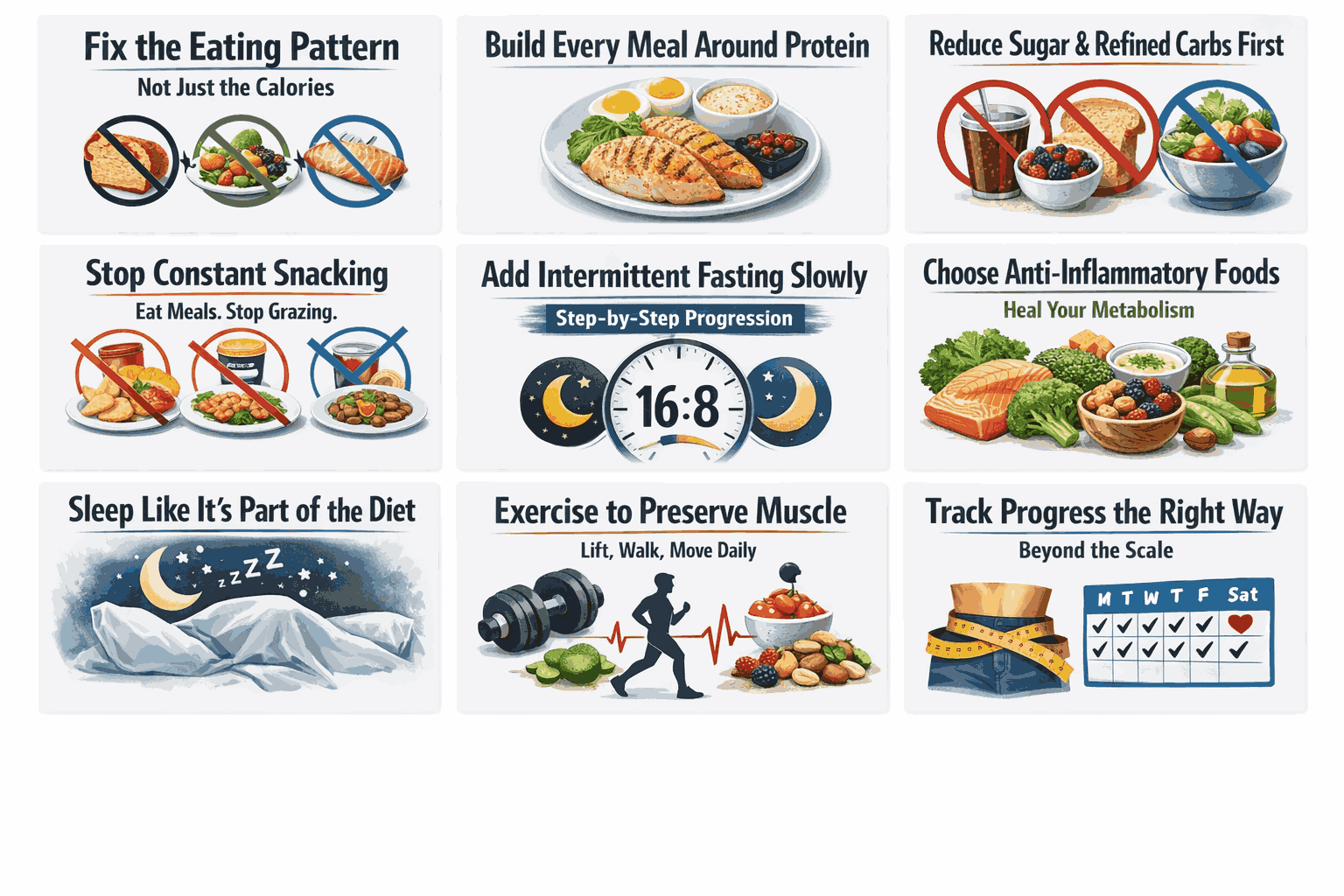
Step 1: Fix the Eating Pattern Before Fixing the Calories
Most people start with portion control.
But portion control becomes easy only after appetite is stabilized.
Instead of counting calories first, focus on:
- removing insulin-triggering foods
- increasing nutrient density
- creating longer breaks between meals
A better question than “How many calories?” is:
“What is this meal doing to my insulin and hunger?”
When hunger becomes manageable, calorie control becomes automatic.
Step 2: Build Every Meal Around Protein
Protein is the anchor of sustainable fat loss.
A good protein-focused meal:
- reduces cravings
- prevents muscle loss
- stabilizes energy
Aim to include protein in every main meal, such as:
- eggs
- chicken
- fish
- Greek yogurt
- lentils and beans
Protein is not just for gym people.
It’s for anyone who wants stable appetite and metabolism.
Step 3: Reduce Sugar and Refined Carbohydrates First
If insulin is high, fat is locked.
The fastest way to reduce insulin spikes is to reduce:
- sugar
- white bread
- pastries
- sweetened drinks
- refined flour products
You do not have to eliminate all carbohydrates.
But you should prioritize carbohydrates that come with fiber:
- vegetables
- legumes
- berries
Refined carbs are not “energy.”
They are hormonal disruption.
Step 4: Stop Constant Snacking (This Is Bigger Than People Think)
Snacking is often framed as “keeping metabolism active.”
But metabolically, snacking often means:
- insulin never drops
- fat burning never begins
- hunger becomes trained behavior
When insulin stays elevated, the body never switches into fat-burning mode.
A simple rule:
Eat meals. Stop grazing.
If you eat 3 meals per day with no snacks, most people already see improvements in:
- appetite control
- energy stability
- belly fat reduction
Step 5: Add Intermittent Fasting Slowly
Fasting is a tool, not a religion.
The best approach is gradual.
Week 1–2:
- stop eating after dinner
- avoid late-night snacks
Week 3–4:
- start a 12–14 hour fasting window
Week 5+:
- transition into 16:8 if comfortable
This progression reduces stress and improves adherence.
Fasting works best when you’re not forcing it —
when it becomes part of your routine.
Step 6: Choose Foods That Reduce Inflammation
If your metabolism is inflamed, it resists fat loss.
Focus on foods that heal the metabolic environment:
- leafy greens
- cruciferous vegetables (broccoli, cabbage)
- olive oil
- berries
- nuts and seeds
- turmeric and ginger
- fatty fish
These foods improve insulin sensitivity indirectly by reducing chronic inflammation.
This is why some people lose weight by “eating healthier” even without strict dieting.
They’re not eating less —
they’re eating in a way that improves metabolic function.
Step 7: Sleep Like It’s Part of the Diet (Because It Is)
Sleep deprivation increases:
- cortisol
- insulin resistance
- hunger hormones
Even if diet is perfect, poor sleep can stall fat loss.
Poor sleep creates:
- higher appetite
- cravings for sugar
- fatigue that reduces daily movement
Aim for:
- 7–9 hours sleep
- consistent bedtime
- reduced screen exposure at night
In fat loss, sleep is not optional.
It is a metabolic lever.
Step 8: Use Exercise to Preserve Muscle, Not “Burn Calories”
Exercise is most effective when it protects metabolism.
The best fat-loss exercise strategy is:
- strength training (2–4 times/week)
- walking daily
- light cardio for heart health
Muscle is metabolically protective.
More muscle means:
- better insulin sensitivity
- higher energy usage
- easier long-term weight maintenance
Exercise should be treated as metabolic support —
not punishment for eating.
Step 9: Track Progress the Right Way
Most people track weight and panic.
But weight is affected by:
- water retention
- glycogen storage
- hormonal cycles
- inflammation
Better indicators:
- waist measurement
- energy levels
- hunger reduction
- clothing fit
- body composition changes
Fat loss is often happening even when the scale is slow.
Tracking the right metrics prevents emotional burnout.
Step 10: Use a Weekly Framework Instead of Daily Perfection
Daily perfection is unrealistic.
Weekly consistency is powerful.
A sustainable week looks like:
- mostly whole foods
- controlled sugar intake
- fasting windows 3–5 days
- regular movement
- adequate sleep
The goal is not to win one day.
The goal is to win the week — repeatedly.
A Beginner-Friendly Weekly Weight Loss Routine (Practical Template)
Here’s a simple schedule designed for most people:
Monday to Friday
- 2–3 meals per day
- no snacking
- protein-based meals
- vegetables with every meal
- 14–16 hour fasting window
Saturday
- flexible but controlled
- still avoid sugar drinks and junk snacks
- include walking
Sunday
- meal prep
- light fasting window (12–14 hours)
- recovery sleep
This structure creates fat loss without feeling like punishment.
How to Stay Consistent Without Burnout
Consistency fails when the plan is too extreme.
The best long-term strategy is to build a plan around:
- hunger control
- convenience
- enjoyment
- realistic lifestyle
The best diet is not the strictest diet.
It is the diet you can repeat for years.
If you constantly feel deprived, you will eventually break.
If your diet feels satisfying, you will naturally continue.
Weight Loss Is an Outcome of Alignment
This plan works because it aligns multiple biological systems:
- insulin control → fat access
- inflammation reduction → metabolic repair
- protein and fiber → appetite control
- fasting windows → metabolic flexibility
- sleep and stress management → hormonal stability
Weight loss is not one action.
It is the result of system-wide alignment.
Weight Loss Is Not Your Fault
If you’ve struggled with weight loss for years, you’ve probably asked yourself the same painful question:
“What’s wrong with me?”
But after understanding the science in this guide, the better question becomes:
“What was wrong with the method?”
Because the truth is simple:
Most people are not failing weight loss.
They are following advice that was designed for a different biological reality.
Modern weight gain is not primarily caused by laziness.
It is caused by:
- hormonal disruption
- ultra-processed food environments
- chronic inflammation
- stress and sleep deprivation
- constant insulin stimulation
- misinformation disguised as “common sense”
In other words:
your body has been reacting normally to an abnormal world.
Why Understanding Biology Changes Everything
Once you understand hormones, weight loss becomes less emotional.
Instead of guilt, you develop clarity.
You realize:
- hunger is not weakness
- cravings are not lack of discipline
- plateaus are not failure
- weight regain is not proof you are broken
They are signals.
Biology is always communicating.
When you interpret those signals correctly, you stop fighting your body and start working with it.
That shift is where sustainable transformation begins.
Focus on Health, Fat Loss Will Follow
One of the most dangerous mistakes people make is chasing weight loss at the cost of health.
They do:
- extreme calorie cuts
- constant cardio
- stress-driven dieting
- supplements as shortcuts
- “fat-burning” products
But weight loss that harms the body usually returns.
Real fat loss comes from healing the internal environment.
When insulin sensitivity improves, weight loss becomes easier.
When inflammation drops, hunger reduces.
When sleep improves, cravings decrease.
When protein intake rises, satiety increases.
When fasting windows appear naturally, fat becomes accessible.
The body becomes cooperative again.
That’s when weight loss stops feeling like punishment and starts feeling like progress.
The Long-Term Approach That Actually Works
Sustainable weight loss does not come from short-term intensity.
It comes from long-term strategy.
The most effective approach is not:
- “eat less forever”
- “work out until exhaustion”
- “never eat carbs again”
The most effective approach is:
- lower insulin regularly
- eat whole foods most of the time
- prioritize protein and fiber
- reduce processed carbs and sugar
- move daily
- build muscle
- sleep consistently
- manage stress
- stay consistent without extremes
This is not just a weight loss plan.
It is a metabolic recovery plan.
What to Do Next (Action Steps)
If you want to start immediately, here are the highest-impact steps:
- Remove sugar drinks (the fastest win)
- Stop snacking daily
- Eat protein at every meal
- Walk daily (30–45 minutes)
- Try a 12–14 hour fasting window
- Prioritize sleep
- Repeat for 30 days
Do not aim for perfection.
Aim for consistency.
Weight loss is not a one-week challenge.
It is a lifestyle system.
The Most Powerful Weight Loss Strategy Is Simplicity
Complex plans fail because they require constant decision-making.
The best plan is simple enough to repeat daily.
That is why the principles in this guide are timeless:
- insulin regulation
- food quality
- inflammation control
- metabolic flexibility
- hormonal stability
When these principles are present, fat loss becomes an outcome.
Not a struggle.
